Leidsid 33 sarnast õppematerjali, mis on seotud failiga "“Foreign direct investments in the Estonian economy”". Need materjalid aitavad sul teemat sügavamalt mõista.
foreign, direct, investments, economy, capita, economic, university, duringart, early, growth, europe, companies, country, there, invested, region, year, varblane, consequence, years, since, share, border, billion, major, amount, land, rate, full, scienceshenomenon, west, 1990s, ranks, experience, impact, differentrocess, eastern, terms, location........................................................ 4 1. UKRAINE ...................................................................................................................... 5 1.1. General information ..................................................................................................... 5 1.1.1. Country Profile ..................................................................................................... 5 1.1.2. Post-Independent Ukraine. Economy and politics ............................................... 6 1.1.3. Key Macroeconomic indicators ......................................................................... 14 1.1.4. Foreign Direct Investments ................................................................................ 16 1.1.5. Demographics and labor force .......................................................................... 17 1.1.6. New emerging industry................................
06.05.2012 Abstract 06.05.2012 Experience and Wellness management Author Group Girli Vasiljev RB1X Title of report Number of pages Economic Country Review: Finland, Estonia 20 and Hungary Teacher Kalevi Torunen The goal of this paper is to compare the economic performance of Finland, Estonia and Hungary. First, a general overview on the countries will be given. After, economic indicators (real GDP growth rate, inflation, unemployment, household consumption, investment, current account, government budget and deficit) of the three countries will be compared to draw a conclusion. Keywords GDP, inflation, unemployment, household consumption, investment, current account, government budget, deficit, surplus Table of contents 1 Introduction
3 Customs Union C Allows for specialization, specialization leads to competitive advantage, and comparative advantage leads to economies of sales which maximizes consumer welfare and ensures the most efficient use of world-wide resources. 4 Economic Union D Approach to attaining a common market underpinned by the principles of non-discrimination, market access and concept of comparative federalism. States retain power to regulate as long as national regulation does not interfere
Gross Domestic Product (GDP) The gross domestic product (GDP) or gross domestic income (GDI) is a measure of a country's overall economic output. It is the market value of all final goods and services made within the borders of a country in a year. It is often positively correlated with the standard of living, alternative measures to GDP for that purpose. · Gross domestic product comes under the heading of national accounts, which is a subject in macroeconomics. Gross National Product Gross national product (GNP), in economics, a quantitative measure of a nation's total
comments made in the publication do not necessarily reflect the opinion of GIZ. This publication may not be reproduced in whole or in part without the written permission of the copyright holder. © Deutsche Gesellschaft für Internationale Zusmmenarbeit GmbH (GIZ), 2011. 2 CYAN MAGENTA YELLOW BLACK 2 Introduction For the past few years, Georgian government has carried out a number of significant economic reforms in various fields in order to create attractive business environment and to breathe a new life into Georgian economy. The main aim of the reforms was to boost foreign investments, cre- ate new jobs, stimulate entrepreneurial activities in a variety of fields and increase the welfare of citizens. As a result of economic deregulation policy which was focused on liberalization of the Economy, a number of state regulated spheres were sharply decreased and regulation procedures were sim-
control over Syria, and the Syrian Arab Republic was created. Syria is a country in the Middle East bordering the Mediterranean Sea. Neighboring countries include Iraq, Israel, Jordan, Lebanon, and Turkey. The geography of Syria is primarily semiarid and desert plateau with a double mountain belt in the west. The government system is a republic under authoritarian regime. The chief of state is the President and the head of government is the Prime Minister. Syria has a mixed economy in which there is limited private freedom but the economy remains highly controlled by the government. Syria is a member of the Council of Arab Economic Unity (CAEU). Two-thirds of Syria is desert; the other third is part of the Fertile Crescent along the Mediterranean coast. About 80 percent of the population lives in that fertile region. The total population of Syria is a little over 13 million. Half the people live in cities, 4 million in Damascus alone.
.....................1 2. Nature and geography.....................................................................................2 3. Position and size.............................................................................................2 4. Climate............................................................................................................3 5. Flora and fauna...............................................................................................4 6. Main fields of economy and industry..............................................................5 7. The people......................................................................................................6 8. Population......................................................................................................6 9. Traditions and culture.....................................................................................7 10. History...................................................................
Estonian Economy Estonians earn about half of the average European income, despite the fact that the economic growth during the recent years has been very fast and the differences have been diminishing. Although the extremely vigorous period of economic reforms is now over, the changes that Estonia is presently going through are far more extensive than those in the developed countries. The Estonian economy is diverse industry and transport, as well as commerce and different branches of services are all equally important. Due to the available natural resources Estonian economy largely relies on the branches related to the forest; Estonian energy sector is based on oil shale, a resource quite rare elsewhere in the world. Finland and Sweden are the most important trade partners. The Estonian economy profits significantly from the business generated by more than 2 million tourists a year, most of
1. Which are the main cornerstones of EU-Russia cooperation? Which have been the main developments and success stories in this partnership in 2000-2012? Which side is more interested? The main cornerstones of the EU and Russia relations are the trade and energy relations. One biggest breakthrough has been gas pipeline Nord Stream. Russia is the third biggest trade partner of the EU and is the main importer of gas and crude oil. The economic benefits are the biggest cornerstones of the relations. Cooperation between Russia and the European Union progressively strengthens in foreign policy and security issues, in combating illegal migration, organised crime and terrorism. The main achievement of recent years, which can be hardly overestimated, is the understanding increasingly gaining ground that partnership between Russia and the EU is one of the cornerstones of maintaining stability and prosperity not only in Europe, but world-wide
Roughly 20% of all students attend secondary schools leading, normally after 12 school years in total which grants access to all universities. The other students split in two or more school-types (depends on the canton) differing in the balance of theoretical and practical education. It is obligatory for all children to visit school for at least 9 years. Technological factors: Science and technology in Switzerland play an important role in economy as very few natural resources are available in the country. The Swiss National Science Foundation, mandated by the Federal government, is the most important institute promoting scientific research. The raw output of scientific research from Switzerland consistently ranks within the top 20. For example, it has a well known astronomy and space program. Switzerland Space Agency, the Swiss Space Office, has been involved in various space technologies and programs
4. Educated & skilled workforce 4. Educated & skilled workforce .80 Tax Tax benefits benefits . 80 000 students abroad 000 students abroad .25 . 25% of population % of population hold hold university university degree degree Vocational Vocational education education benefits benefits .46 . 46% % of of population population speak speak at at least least one
Kuressaare 2018 Some people choose for a resume book about something else than ecomoic. Its realy easier ofcours. I wrote to the Defence Forces library and asked to send me something about economi. Well , I got „International Economics“ by Hendrik Van den Berg. We had to read 100 pages. So I did. What I remmember about from 100 pages economics? There were a lot interesting what I didnt know before. It all started about U.S Economics. U. S Economy does not appear to be „globaal“ if look at its ratio of tarded otuput to GDP (Gross Domestic product, which is the total value added of production that occurs within a country-s borders, regardless of who owns the factors of production used in the production process.)U.S exports and imports only about 10% of its national output and consumption Services are difficult to export and import; if you need haircut or you want to go out tonight , you choose from among local suppliers
202 (UT code), RIE 7044 (TLU code) Reading materials: Business peculiarities in Russia Lugemismatejal: Äri eripärad Venemaal Created by Sergei Proskura Tartu 2013 TABLE OF CONTENTS INTRODUCTION ....................................................................................................................................... 3 1. LEGALIZATION OF A COMPANY WITH A FOREIGN OWNER IN RUSSIA ....................................... 4 1.1. Laws ............................................................................................................................................. 4 1.2. Documents for registration of the company ........................................................................... 5 1.3. The Head of the new company ............................................................................................... 6 1.4
Economy of Estonia The economic growth during the recent years has been very fast. The Estonian economy is diverse industry and transport, as well as commerce and different branches of services are all equally important. Due to the available natural resources Estonian economy largely relies on the branches related to the forest; Estonian energy sector is based on oil shale. Finland and Sweden are the most important trade partners. The Estonian economy profits significantly from the business generated by more than 2 million tourists a year. The important sectors of the Estonian economy are the processing, transport, warehousing and communications, commerce and estate, rental and letting, as well as business services, agriculture, construction and government, education and health care. In order to be able to import all the products and services, something must be exported, that's
mission. In June 2003, Estonia deployed a light infantry platoon ESTPLA to 7 operation Iraqi Freedom at the request of the Iraqi interim government. This mission has continued until today. Estonia has lost 2 soldiers in action in Iraq. Besides military cooperation very important are also trade and cultural links. According to the Statistical Office, the United States in 2005 was Estonia's eleventh largest foreign trade partner and among the countries outside the EU the second largest partner after Russia. The total volume of trade between the two countries surpassed 4.8 billion kroons which accounted for 2.16% of the total volume of Estonia's foreign trade. The United Kingdom is one of Estonia's major economic partners. In recent years the UK has constantly been one of Estonia's most important trade partners positioning among top 10 countries. The United Kingdom is also rated as the 9th largest foreign
3 control of Jamaica), succeeded in organizing frequent uprisings against the European landowners. The sugar industry declined in the 19th cent., partly because of the abolition of slavery in 1833 (effective 1838) and partly because of the elimination in 1846 of the imperial preference tariff for colonial products entering the British market. Economic hardship was the prime motive behind the Morant Bay rebellion by freedmen in 1865. The British ruthlessly quelled the uprising and also forced the frightened legislature to surrender its powers; Jamaica became a crown colony. Poverty and economic decline led many blacks to seek temporary work in neighboring Caribbean areas and in the United States; many left the island permanently, emigrating to England, Canada, and the United States. Indians were imported to meet the labor shortage on
The United States and its economy are known to be one of the thriving and strongest in the world. It represents 16.6% of the world’s total GDP. The estimated worth of USA's GDP is estimated to be around 17.5 trillion dollars and dollar being the third currency in the world and the official currency of the US. They also manage a 5% growth every quarter. So how do they manage it? There are three main sectors that contribute to the USA's GDP. First is services that is 80% of the total GDP. The output of services in 2014 was 13,8 billion dollars witch was the nr.1 in front of European Union’s output witch was 13,4. The second contributing sector is the industry sector which provides 19% of the country’s GDP. In this area USA has fallen behind and has to accept the third position in the world’s total industry's output. First in
ERLE MAIDO TAAB11 Report Purpose The purpose of this report is to give an overview of Estonian population, political factors, technological factors, economic factors and the trends in Estonian economy compared to Germany and to briefly discuss Estonian business environment. Estonian population The total population of Estonia is 1 313 271 according to Statistics Estonia, of which 69.1% are Estonians, 25.1% Russians, 4.9% of which are of different nationalities for example Ukrainians, Belarusians and Finns. Rest are of unknown nationality. 68.5% of population speaks Estonian as a mother language, 29.6% speaks Russian as a mother language and 0.6% Ukrainian
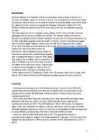
Estonia is a democratic parliamentary republic and is divided into fifteen counties. The capital and largest city is Tallinn. With a population of only 1.4 million, it is one of the least-populous members of the European Union. Estonia was a member of the League of Nations from 22 September 1921, has been a member of the United Nations since 17 September 1991, of the European Union since 1 May 2004 and of NATO since 29 March 2004 Estonia has also signed the Kyoto protocol. Economy Estonian economy was one of the fastest growing in the world until 2006 with growth rates even exceeding 10% annually. Despite some concerns both in and outside of the country, the Estonian economy and its currency remained highly resilient and solvent. Until recent years the Estonian economy continued to grow with admirable rates. Estonian GDP grew by 6.4% in the year 2000 and with double speeds after accession to the EU in 2004. The GDP grew by 7.9% in 2007 alone. Increases in
seasons towards the equator. In this region the temperature can climb up to 35 degrees Celsius in the summer and descend to a chilly -25 degrees Celsius during winter. Canada's climate and environment are one of the main reasons that Canada is such a succesful country. The blend of natural resources and climate sustains us. The seasons dictate the look of the land: according to whether the natural environment is in a state of dormancy or growth. Canada's climate is characterized by its diversity, as temperature and precipitation differ depending on where you are and what time of year it is. Other than the North where it's above freezing for only a few months a year, most Canadian cities are within 300 km of the southern border, where mild springs, hot summers and pleasantly crisp autumns are common during the majority of the year. Climate sculpts the landscape through heat, cold, humidity, light and wind. In Canada, the
Pärnu, Põltsamaa and Pedja rivers. Forests Forest covers around one half of Estonia. The most common types of tree are pine, spruce and birch. The forests are rich in game. The forests contain elk, roe deer, wild boar, beavers, lynxes, bears and wolves. Estonia, along with Finland and Sweden are the countries with the greatest percentage of forest. Forest management and wood production are particularly important for the Estonian economy. Meadows Meadows in Estonia are much richer in different species than western Europe, and in summer foreign tourists travelling around the countryside can discover for themselves the variety and colour of the roadside meadows. The type of meadow richest in species is the wooded meadow. Marshes and bogs About one fifth of Estonia is covered with marshes and bogs, and most of these are to be found in the central and eastern parts of the country. The best place to see marshes is in the
TALLINNA ÜLIKOOL POLITICAL SCIENCE AND GOVERNMENT INSTITUTE ANNELI PALM CRITISIM ABOUT IMF AND WORLD BANK INTERNATIONAL POLITICAL ECONOMY (RIR6032/RIR6004) ESSAY 2014 Contents TALLINNA ÜLIKOOL.............................................................................................. 1 Introduction............................................................................................................ 3 Basic of liberalism.................................................................................................. 4 International Monetary Fund and World Bank............
- 751 liiget, 750 max + president Party groups - Group of the European People’s Party (Christian Democrats) - Group of the Progressive Alliance of Socialists and Democrats in the European Parliament - Group of the Alliance of Liberals and Democrats for Europe - Group of the greens/european free Alliance - European conservatives and reformists group - Confederal group of the european united left – nordic green left - Eruope of freedm and direct democracy group - Europe of nations and freedom European Comission - EL täitevorgan (rakendab seadusi ja viib ellu poliitikat), sai täidesaatva võimu Lissaboni lepinguga 2007 - executive - Teeb parlamendile ja EL nõukogule õigusaktide ettepanekuid ja teostab järelvalvet koos kohtuga - Haldab EL eelarvet ja eraldab rahalisi vahendeid - Esindab EL rahvusvaheliselt - Komiteed, sekretariaat
the Celtic Sea and St George's Channel to the South and South-East. The legal name of the state is simply "Ireland", but its legal description the Republic of Ireland is sometimes used to differentiate the state from the island. On 29 December 1937 Ireland became the successor-state to the Irish Free State, itself established on 6 December 1922. Ireland was one of the poorest countries in Western Europe and had high emigration. The protectionist economy was opened in the late 1950s and Ireland joined the European Communities (now the European Union) in 1973. An economic crisis led Ireland to start large-scale economic reforms in the late 1980s. Ireland reduced taxation and regulation dramatically compared to other EU countries. Despite a forecast for reduced economic growth in 2008, Ireland today has the fifth highest gross domestic product per capita and the seventh gross domestic product per
corporations, dealers in securities and derivatives (when dealing for their own account), venture capital corporations and development capital companies (http://www.ecb.int/home/glossary/html/glosso.en.html#94). 5.1.1.Overview of the Chapter 5.1.2.Intermediation and Institutions Financial intermediation refers to the process of allocation and transformation of financial resources in economies according to the needs of economic agents 3. The objective is fulfilled by banks, non-bank financial institutions, and capital markets. Traditionally, the most important part of the intermediation has been considered channelling the funds form from ultimate creditors (surplus saving units) to the ultimate borrowers (deficit saving units) with the banks playing major role in the process. The simple intermediation description is given on the figure below.
They approach innovation in its broadest sense, including both new technologies and new ways of doing things” – (Porter 1990) ● “An innovative business is one which lives and breathes “outside the box”. It is not just good ideas, it is a combination of good ideas, motivated staff and an instinctive understanding of what your customer wants” – (Branson 1998) ● “...novel implementation of an invention, discovery, new or existing knowledge in economic process” (Joseph A. Schumpeter) ● An innovation is the implementation of a new or significantly improved product (good or service), or process, a new marketing method, or a new organisational method in business practices, workplace organisation or external relations” (Oslo Manual). Innovation and entrepreneurship Schumpeter on innovation: the role of inventions and entrepreneurs ● Innovation as “new combinations” of existing
inhabitants which is 7.3% of the world population, there are 23 different languages and for now 17 countries are using EUs common currency Euro. EU was founded after World War II, when Europe was struggeling in social and political devastations. In 1948 a congress in Hague was held to discuss ideas about the development of European political co-operation. There were many important political figures such as Konrad Adenauer and Winston Churchill. On 9th May in 1950 French Minister of Foreign Affairs proposed that France and the Federal Republic of Germany should combine their coal and steel resources and let other European countries join also. From that on, the 9th of May has been considered as the birth of European Union and is now celebrated as Europe Day. In 1951 the founding members (Belgium, the Federal Republic of Germany, France, Italy, Luxembourg and Netherlands sign a treaty of European Coal and Steel Community for a period of 50 years
development. The local foods such as sauerkraut stew, curd cake and ,,kama" (a meal made with sour milk and a mixture of ground grains) are popular even nowadays. There is even a song that says: "It is good to live in Mulgimaa / The nature is beautiful and the land is fructuous/ There are glorious groves and large wealthy Estonian farms". As for now, the large-scale industry has become more and more dominating in agriculture. After thorough reforms in Estonian economy the people living in villages and small towns are searching for new possibilities for self-realisation and one of the outputs is tourism. This can also be seen in Southern Viljandimaa as there are continuously more establishments providing accommodation, caterers and organisers of active holidays. Many tourism maps have been put beside the road as well as many hiking trails have been built and marked. History of Estonia
European Union Exam 1949 France, UK and the Benelux countries decide to set in place a Council of Europe. 1951 Treaty of Paris signed by the Six (Belgium, France, Germany, Italy, Luxembourg, Netherlands), establishing the European Coal and Steel Community (ECSC). 1957 Treaties of Rome establish the European Economic Community (EEC) and the European Atomic Energy Community (Euratom). 1959 July, seven countries of the Organisation for European Economic Co- operation (OEEC) – Austria, Denmark, Norway, Portugal, Sweden, Switzerland and the UK – decide to establish a European Free Trade Association (EFTA). 1960 Creation of European Free Trade Association 1961 UK applies to join the Community. 1962 The Parliamentary Assembly changes its name to the European Parliament. 1965 The Treaty merging the executives of the three Communities (ECSC, EEC, Euratom) is signed in Brussels; enters into force on July 1, 1967. Empty chair crisis 1966
the island between 4000 and 1000 BC. When Christopher Columbus arrived in 1494 there were over 200 villages ruled by caciques. The south coast of Jamaica was the most populated, especially around the area now known as Old Harbour. Christopher Columbus claimed Jamaica for Spain after landing there in 1494. Columbus' probable landing point was Dry Harbour, now called Discovery Bay. The capital was moved to Spanish Town, now located in the parish of St. Catherine, as early as 1534. It was then called ,,Villa de la Vega". Spanish Town has the oldest Cathedral in the British colonies. The English Admiral William Penn and General Robert Venables seized the island in 1655. In 1660 the population of Jamaica was about 4 500 whites and some 1 500 blacks. As early as the 1670s, blacks formed a majority of the population. During its first 200 years of British rule, Jamaica became one of the world's leading sugar-
BARRIERS TO DISTRICT HEATING DEVELOPMENT IN SOME EUROPEAN COUNTRIES Abstract District heating (DH) offers low primary energy demand, high security of supply and small CO 2 emissions. Barriers to DH in the UK, Ireland, France, Romania and the Czech Republic have been compiled through publications and interviews. DH systems require large investments, have negative initial cash flow and long payback time, which obstructs financing. One actor should control DH from source to consumption. If the value chain is fragmented, contracts are required between the links. It increases risks and financing costs, like in the UK and Ireland, where DH is not established. There are few multi- family houses with central heating and it is expensive to build DH networks in built areas.
1710-1850 and 1850-1918 Contents Contents.................................................................................................................................. 2 17101850.............................................................................................................................. 3 Population and social structure........................................................................................ 4 Serfdom and the intensifying manorial economy ............................................................. 4 Influences of Pietism and the Moravian Brethren............................................................. 5 Enlightenment and enlightened absolutism...................................................................... 6 18501918.............................................................................................................................. 8 The national awakening.............................
Denmark and Northern Germany. Estonians were reduced to the status of peasantry until the 19th century. From 1558 onwards, Estonia became the battleground for the Livonian War involving Denmark, Sweden, Russia and Poland. Sweden emerged as the winner and Estonia remained under its influence until the beginning of the 18th century. During Swedish rule, the first university in Estonia was founded at Tartu in 1632. Tartu University is still widely considered the most important university in Estonia. The period is still often remembered by Estonians as "the Good old Swedish time". In the early 18th century, the Great Northern War left Estonia under Russian rule. A high point of the Estonian national movement was the first nation-wide Song Festival in Tartu in June 1869. In 1918 on the 24th of February, the Estonian Republic was proclaimed. It is a highly important holiday in Estonia. At first it was merely a decision on paper. True
 annaabi.ee