Leidsid 33 sarnast õppematerjali, mis on seotud failiga "Independence day of Estonia". Need materjalid aitavad sul teemat sügavamalt mõista.
republic, february, president, formal, freedom, square, church, concert, known, holiday, founded, committee, päästekomitee, revolution, russia, opportunity, gain, celebration, anniversary, graves, figures, sunday, hermann, memory, those, fell, base, monument, service, dome, forces, science, cultural, awards, prime, ansip, reception, hosted, theatreFebruary 24: Independence Day The Republic of Estonia was founded on February 24, 1918 when the Salvation Committee, Päästekomitee, declared the independence of the Republic of Estonia. This date was celebrated as the Day of Independence until the Soviet occupation of Estonia in 1940. During the Soviet occupation, the Independence Day was festively celebrated in Estonian communities around the world. Every year, the US Secretary of State sent greetings on the occasion to the Ambassador of the Republic of Estonia to the United States, Ernst Jaakson. On February 24, 1989, the red flag of Soviet Estonia was replaced by the blue-black-white
*Estonians conquered by the crusaders 1208 *Reformation 16th century establishments of new school, Estonians first book appeared in 1525 *Tartu University 1632 founded by King Gustavus II Adolphus, classical university, member of the Coimbra group *Abolition of serfdom 1816 *Song festival 1869 in Tartu, an organiser was J.V.Jannsen, 822 singers, men only *Declaration of independence 24th February 1918 *War of independence 1918-1920 during the Russian Civil War, resulted in a victory for Estonia *Deportation 1949 *Estonia becomes independent 20th August 1991 *Joining EU 1st May 2004 Language: Estonian language, belongs to the Balti-Finnic group of the Finno-Ugric languages, closely realted to Finnish and rather remotely to Hungarian; Latin alphabet with 32 letters , 5 of which occur only in foreign words, the phenomes include 9 vowels and 18 consonants; words are
It is the story of a poor girl who falls in love with the son of the village elder, and disguises herself as a choirboy in order to sneak into the castle. But, alas, the lord of the manor's son discovers the deception. He is overcome by jealous rage and orders his men to seal the girl inside the thick stone walls while still alive. Turned into an incarnation of undying love, the White Lady now appears every August, on the night of the full moon, in the Dome Church chapel window. Haapsalu is seven-and-a- quarter centuries old this year, and the townsfolk intend to make it a celebration to remember. The annual dance and light show dedicated to the Lady alone involves over 100 performers - and you'll have several chances to catch it over the four days of the event. Musical shows, dances and contests of strength and skill will be held all over town.
Tallinn English College Topic Estonia Tallinn 2008 1. Introduction Estonia is a small country about the size of Switzerland, or New Hampshire and Massachussetts combined. Estonia is named after the people called "Ests" who lived in the region in the 1 st century AD. The Republic of Estonia is one of the three countries commonly known as the "Baltic States". The other Baltic States are Latvia and Lithuania. 2. Geographical position Estonia is situated in northeastern Europe. Estonia is bounded on the north by the Gulf of Finland, on the east by Russia, on the south by Latvia and on the west by the Baltic Sea. In the north it borders on Finland. The coastline of the Baltic Sea in Estonia is characterized by numerous gulfs and bays, the biggest of them being the Gulf of Finland, the Gulf of Riga and the Gulf of Pärnu
Estonian War of Independence During World War I the greatest colonial power in Europe the Russian Empire seized to exist. On its ruins the formerly enchained nations founded their own states. Among them was the Estonian Republic, officially declared on February 24, 1918. When Germany surrendered to the Western Allies on November 11, 1918 a strategic vacuum arose in Eastern Europe. The new rulers of Russia the Bolsheviks decided to use it as a proper moment to re-conquer their lost territories. The ultimate goal was international communist revolution and Germany was the first standing on their way. Thus on November 13, 1918 the Government of Soviet Russia denounced peace with Germany
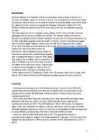
Estonia Topic Tallinn 2007 2 List of Contents page Facts and figures 3 Geography 3 Climate 3 Nature 4 History 5 Economy 6 Culture 6 Biggest towns 7 Language 8 3 Facts and figures The Republic of Estonia is a small country. Covering only 45, 228 sq km it is slightly bigger than Denmark, Belgium or Switzerland. Estonia's population is under 1.4 million. The official language is Estonian but since very many Russians live here Russian is also wide spread. The capital of Estonia is Tallinn. The currency used in Estonia is Eesti kroon. The Estonian national flag is blue-black-white. It was originally the flag of the Estonian Students' Society
Estonian national holidays Christmas Christmas , also referred to as Christmas Day, is an annual holiday celebrated on December 25 or January 7 that commemorates the birth of Jesus of Nazareth. Modern customs of the holiday include gift-giving, Church celebrations, and the display of various decorations--including the Christmas tree, lights, mistletoe, nativity scenes, and holly. In many countries there are many different types of decorations used depending on the traditions and available resources. However , in Estonia people bring Christmas tree in and decorate it with straw ,glass balls and candles. Estonians eat sauerkraut and black pudding.
This was the time of the crystallization and the culmination of serfdom, when various socio- political and cultural undercurrents were also active, preparing the ground for the industrial society and the national-democratic movement in the second half of the 19th century. The 1710 of the corporations of knights and towns, until Alexander II (18551881), established the relationships between Estonia, Livonia and the Russian Empire. The Baltic Landesstaat reached its full development. The freedom of action in the new provinces was naturally granted to one of the most firm ideological pillars of the tsarist empire -- the Russian orthodox church; though as the Landeskirche in the Estonian and Livonian territories, the Lutheran church long maintained a de facto predominance. The most important organ of Baltic German local government was the Diet, consisting of all the noble families who had been `selected' in a list of the eligible. Although jealously
During Swedish rule, the first university in Estonia was founded at Tartu in 1632. Tartu University is still widely considered the most important university in Estonia. The period is still often remembered by Estonians as "the Good old Swedish time". In the early 18th century, the Great Northern War left Estonia under Russian rule. A high point of the Estonian national movement was the first nation-wide Song Festival in Tartu in June 1869. In 1918 on the 24th of February, the Estonian Republic was proclaimed. It is a highly important holiday in Estonia. At first it was merely a decision on paper. True independence was fought for in the following years, in the War of Liberation. Independence lasted until 1939 when a pact between Nazi Germany and the Soviet Union was signed. Following the Soviet occupation in 1940, Estonia was occupied by Nazi Germany from 1942 to 1944. The Soviet Union incorporated Estonia in the autumn of 1944. A large proportion of the population fled abroad
In the "Singing Revolution" of the 1980s, Estonians showed their desire for independence in peaceful mass meetings. In 1989, 2 million people from the three Baltic countries linked hands in a human chain stretching from Tallinn to Vilnius in Lithuania. Independence was proclaimed(declared) on Aug. 20, 1991.Within weeks Estonia was recognized as a free and independent country On June 20, 1992, the kroon replaced the rouble. In September 1992 Estonians elected their first president and parliament in more than 50 years. On 14 September 200 In May 1993, the Council of Europe voted Estonia a full member. On May, 1, 2004 Estonia joined the European Union. Wordlist 1. vallutama Eestit 2. pärinema 12 sajandist 3. ühinema millegagi 4. nõudma iseseisvust 5. rahareform 6. välja saatma Siberisse 7. ,,metsavennad" 8. ulatuma Tallinnast vilniusesse 9. välja kuulutama iseseisvust 10. tunnustama 11. Kroon asendas rubla 12. valima presidenti ja parlamenti
Tallinna Inglise Kolledz Estonia Topic Alice Tärk, 9b Tallinn 2007 FACTFILE Area: 45 228 sq km Poplulation: under 1.4 million Capital: Tallinn Language: Estonian Currency: Eesti kroon (EEK) Main religion: Lutheran National holiday: 24 February (anniversary of the republic) National flower: Cornflower National bird: Barn Swallow National stone: Limestone LOCATION The Republic of Estonia is the northernmost and smallest of the three Baltic States. It is located on the eastern shores of the Baltic Sea in the north east of Europe. To the east the country borders Russia. Latvia is the countries neighbour to the south. From the west the coast of Estonia is washed by the Baltic Sea and from the north by the Gulf of Finland. The length of the coastline is approximately 3 800 km. The longest distance from east to west is
The modern name of Estonia is thought to originate from the Roman historian Tacitus, who in his book Germania (ca. AD 98) described a people called the Aestii. Similarly, ancient Scandinavian sagas refer to a land called Eistland, close to the German term Estland for the country. Early Latin and other ancient versions of the name are Estia and Hestia. Until the late 1930s, the name was often written as Esthonia in most English speaking countries. Estonia is a democratic parliamentary republic and is divided into fifteen counties. The capital and largest city is Tallinn. With a population of only 1.4 million, it is one of the least-populous members of the European Union. Estonia was a member of the League of Nations from 22 September 1921, has been a member of the United Nations since 17 September 1991, of the European Union since 1 May 2004 and of NATO since 29 March 2004 Estonia has also signed the Kyoto protocol. Economy
townapothecary's shop was opened. In Kopli was established ship factories( ,,Vene-Balti's", ,,Noblenesser's" and ,,Bekker's factory"). Tramway was opened in Kopli in 1915 by factories ( ,,Vene-Balti's", ,,Noblenesser's" and ,,Bekker's factory") to they'r workers transport. 4 Independent Estonia (1918-1940) On February 24, 1918 Estonia took advantage of the weakening Bolsheviks and proclaimed independence; already the next day German troops occupied Estonia. Local town government was restored after Germany capitulated in the WW I. The first city council elected during the Republic of Estonia assembled on June 16, 1919. On 2 February 1920, the Tartu Peace Treaty was signed with Soviet Russia, wherein Russia acknowledged the independence of the Estonian Republic
Estonia. Estonia, officially the Republic of Estonia is a country in Northern Europe. It is the smallest of the three Baltic countries. Estonia has land borders with Latvia (339 km) to the south and Russia (229 km) to the east. It is separated from Finland in the north by the narrow Gulf of Finland and from Sweden in the west by the Baltic Sea. Estonia has been a member of the European Union since May 1, 2004 and of the NATO since March 29, 2004. The area of Estonia is about 45000 square kilometres and the population is
hunger and wars. Sweden finally managed to take control of the whole of Estonia in 1629. Their rule ended after the Northern War in 1710 when Estonia was joined to the Russian Empire. Life changed for the better thanks to the opening of a railway line from St. Petersburg to Tallinn in 1870. Tallinn grew into a major port and an industrial centre, with huge shipyards. Interest in culture grew and Estonians became conscious of their national identity, dreams of independence gained ground. On 24 February 1918 Estonia was declared an independent country and Tallinn became the capital of the Republic of Estonia. During World War II Estonia was occupied by both German and Russian invaders and Tallinn suffered heavily. The bombing of the city by the Soviet air force on 9 March 1944 left over 20,000 people homeless. During the Russian occupation which followed attempts were made to Russify the local people. Estonia re-established its independence on 20 August 1991. Toompea
Võnnu Keskkool ESTONIA Referaat Autor: Klass : 9 Juhendaja: Võnnu 2013 Estonia officially the Republic of Estonia, is a state in the Baltic region of Northern Europe It is bordered to the north by the Gulf of Finland, to the west by the Baltic Sea, to the south by Latvia and to the east by Lake Peipus and Russia.Across the Baltic Sealies Sweden in the west and Finland in the north. The territory of Estonia covers 45,227km2 The Estonian climate resembles that of other countries on the Baltic littoral. On account of the
Gümnaasium Prague referaat Autor: Klass: Juhendaja: 2010 CONTENTS 1. Contents 2. Introduction 3. Compendium about Prague 4. Important about Czech Republic and Prague 5.-7. History 8. Independence 9. Main sights 10. the Czech Republic 11. List of famous people from Prague 12. Geography 13. Weather and climate 14. Population 15. Culture 2 INTRODUCTION The Czech Republic lies at the heart of Central Europe and at its center is the beautiful and historic city of Prague. With a population of some 1.3 million residents, the city lies on either side of the Vltava River in the middle of Bohemia that is one of the three
The Great Famine (1845-52) killed roughly a million and prompted another million to emigrate. In 1890, 40 % of Irish people were living abroad "Exodus in reverse" has been used to describe Irish people returning to Ireland, especially from the US. Immigration from many countries, but mostly from Poland, the UK, Lithuania, Latvia, Nigeria and Romania. Is Ireland still an emigration country? No 7. What is the difference between the Irish Free State and the Republic of Ireland? All three names refer to the same country (Northern Ireland was part of the Irish Free State for one day, if you want to be really pedantic). The Irish Free State was established in 1922. It was part of the British Commonwealth, and a dominion of the UK, with which it shared a monarchy. Before this, all of Ireland was a part of the UK. In 1937, Irish voters backed a plebiscite which voided the Anglo-Irish Agreement (which created
A wall was built to separate the Upper Town and the Lower Town. In 1285 Tallinn joined the Hanseatic league and became a junction of trade between East and West. Tallinn is said to be built on salt, as it was an important trading commodity. In the 16th century Tallinn had a population of about 7,000 8,000 making it one of the biggest cities in northern Europe. In 1629 Sweden took control of the whole of Estonia. Though hard times continued, the period that followed is known as the "good old Swedish era": foundations were laid for the Estonian school system, the privileges of the nobility were curtailed, local peasants were granted the right to own property, and so on. Peter the Great wanted to open a window onto Europe for Russia so he started the Northern War in 1700. Estonia remained under Russian rule and the Baltic-German nobility vowed allegiance to the Tsar; the barons were restored their former privileges. In 1870 a railway line was opened from St
mainstream of western European culture. Unlike the German invasions, the Norman invasion was small-scale. On 14 October 1066, an invading army from Normandy defeated the English at the Battle of Hastings. The battle was close and extremely bloody. At the end of it, most of the best warriors in England were dead, including their leader, King Harold. On Christmas Day that year, the Norman leader, Duke William of Normandy, was crowned king of England. He is known in popular history as “William the Conqueror” and the date is remembered as the last time that England was successfully invaded. There was no such thing as a Norman area of settlement. Instead, the Norman soldiers who had invaded were given the ownership of land and of the people living on it. A strict feudal system was imposed. 12. Magna Carta. In 1215 King John was forced to sign the document, drawn up by the noblemen of England
I. Portugal ABOUT Photo Location of Portugal (dark green) Portugal (Portuguese: Portugal, IPA: [putua]; officially the Portuguese Republic, Portuguese: República Portuguesa) is a country located in Southwestern Europe, on the Iberian Peninsula. It is the westernmost country of mainland Europe, and is bordered by the Atlantic Ocean to the west and south and by Spain to the north and east. The Atlantic
Tobacco plantations African slaves, working in tobacco harvest 1620 by Dutch boat. Also Englishmen (convicts and poor people) Mayflower and Pilgrim Fathers Mayflower- cargo ship In 1620 one hundred Puritans boarded the Mayflower From Plymouth, England, to today's Plymouth, Massachusetts, United States Claim they are the forefathers of USA aristocracy- FALSE They saw little chance of England becoming a proper country Wished to live free of English laws and oppressing church religious freedom In may (had time before winter!!!) · Mayflower Compact First governing document of Plymouth Colony Agreement composed by a consensus among new Settlers Composed for the sake of their own survival Fair and equal laws, for the general good Signed by 41 adult male members on the Mayflower Free of English law foundation of the USA constitution · Puritan Colony in Plymouth, New England America's first permanent puritan settlement Along with Jamestown, the most successful colony
ESTONIA AND THE ESTONIANS FOREWORD IN THE FOLD OF TSARIST RUSSIA. EMERGENCE AND FIRST STEPS ON THE CLASSICAL-ROMANTIC PATH. HISTORICAL INTRODUCTION I. MUSICAL LIFE IN TARTU AT THE TURN OF THE CENTURY. TRAILBLAZERS: ALEKSANDER LÄTE, RUDOLF TOBIAS, ARTUR KAPP. II. THE FIRST DECADE OF THE 20TH CENTURY. ARTUR LEMBA: THE BEGINNING OF ESTONIAN SYMPHONY AND OPERA. III. NEW DEVELOPMENTS IN CULTURAL AND MUSICAL LIFE: THE END OF THE TSARIST PERIOD. THE INDEPENDENT REPUBLIC OF ESTONIA: THE INTRODUCTION OF INNOVATIONS FROM WESTERN ART AND THE EVOLUTION OF NATIONALLY ORIENTED MUSICAL TRENDS. IV. THE TWENTIES. ARTUR KAPP: ROMANTICIST AND DRAMATIST. V. THE INFLUENCE OF NEW WESTERN MUSICAL TRENDS. HEINO ELLER: A PROGRAMME PAINTER. VI. THE THIRTIES. THE WIDENING OF NATIONAL SYMPHONISM. THE RISE OF ATTENTION TO HISTORY AND FOLKLORE: JUHAN AAVIK, EDUARD TUBIN, EUGEN KAPP. VII. FURTHER MATURING OF SYMPHONIC MUSIC: HEINO ELLER, EVALD AAV,
*The Picts, Caledonia The Romans called Scotland 'Caledonia' because the dominant tribe of Picts they encountered was the Calidonii. Romans thought they were barbarian savages, but actually they had an advanced, cultured society. There was no slavery amongst them and women for instance had a higher standing than in Roman society. The Picts fought the Romans. The Picts- ,,The Painted Ones"- spoke Pict-Celtic. *The Scots, Hibernia In early medieval times Ireland was known by the name "Hibernia". In Hadrian's time the ancient race called the Scots inhabited Hibernia (now called Ireland). Irish and Scottish missionaries were spreading Christianity in Anglo-Saxon England during the 6th centurie. The Latin term Scotti refers to the Gaelic-speaking people of Ireland and the Irish who settled in western Scotland. *The Venerable Bede Bede was a Christian monk, he was the most learned man in Europe at that time
Tallinn English College Topic The United States of America Tallinn 2007 1. Introduction The United States of America's territory is over 3.7 million square miles (over 9.6 million km²) and population more than 300 million people. The capital city is Washington D.C. Although the United States has no official language at the federal level, English is the de facto national language. English is the most common language for daily interaction among both native and non-native speakers. Spanish is the second language. The largest city is the New York City. The Government is Federal constitutional republic and the president is George W. Bush. 2
herself to avoid capture Hadrian´s wall A defensive barrier builtin 122 AD by Roman emperor Hadrian to guard the northern part of Britain against barbarian invaders Most imposing frontier of Roman Empire, controlling peoples mobements Building took several years, builders kept changing minds about the size 119 km lenght, 5m high, 3m deep The Picts, Caledonia The painted ones, northern tribes, part of the Scots Inhabited an area known as eastern and th western Scotland, until 10 c Mysteriously disappeared Constantly fought with Romans Teir country- Caledonia- Pictland The Scots, Hibernia Raiders, Celts living in Ireland/Hibernia Migrated to Scotland Raided Roman Britain After Kenneth McAlpin united Scotland all inhabitants became Scots The Venerable Bede A monk in the Northumbrian monastery of Jarrow
Introduction Name: The United States of America Area: ~10 mln km2 Population: ~300 mln people Symbols: The American Flag- consists of 13 equal horizontal stripes of red alternating with white and represent the Thirteen Colonies. The 50 small, white stars represent the 50 U.S. states. The U.S. flag is commonly called ,,the Stars and Stripes". The Statue of Liberty, that is locatd in New York,is a gift from the France. The Libety Bell, that is a bronze bell that symbolizes freedom in the United States of America. It is located in Pennsylvania,U.S. Capital: Washington D.C Biggest city: New York National language: English Location U.S is located in North America, bordering both the North Atlantic Ocean and the North Pacific Ocean. United States neighbour countries are Canada and Mexico. The USA has the 8th longest coastline in the world at ~20 000 km. 62% of the perimeter of the USA is coastline
Only men compete in boxing and modern pentathlon. The host country must provide a large stadium for the opening and closing ceremonies, the athletic events and football. Many host cities build special facilities for various Olympic events. More than 1,000 athletes now take part in the Summer Games and they represent more than 160 countries. The Summer Games of the year will take place in 2008 Beijing, China. Winter Games The Winter Games are held in January or February. They last for 16 days. A sport must be popular in at least 25 countries on 3 continents to be considered for the Winter Games. About 3,000 athletes take part in the Winter Games. The host city of the Winter Games must provide an outdoor stadium. The opening and closing down ceremonies may be held there, the host city must also have at least 2 outdoor stadiums for figure skating, speed skating and ice-hockey. Skilled workers establish ski-runs for the cross-country, downhill,
it got its first permanent building the Kadriorg Palace, built in the 18th century. In 1929 the palace was expropriated from the Art Museum in order to rebuild it as the residence of the President of Estonia. The Art Museum of Estonia was housed in several different temporary spaces, until it moved back to the palace in 1946. In September, 1991 the Kadriorg Palace was closed, because it had totally deteriorated by then. At the end of the year the Supreme Council of the Republic of Estonia decided to guarantee the construction of a new building for the Art Museum of Estonia in Kadriorg. Untill then the Knighthood House at Toompea Hill served as the temporary main building of the Art Museum of Estonia. The exhibition there was opened on April 1, 1993. Art Museum of Estonia premanently closed down the exhibitions in that building in October 2005. At the end of the 1970s, in the 1980s the first branches of the Art Museum of Estonia were founded
Girls needed a dowry and had to marry before they were twenty-five years old. They usually had a "coming out" during an evening at the Theatre d'Orleans, which marked the beginning of their search for a husband. The whole family attended the performance and sat in a box. Young men who were interested in the girl stopped by the box to pay their respects. They had intermediaries talk to the father and ask if they would be permitted to call on the girl at home. The first formal visit was brief, with the girl's mother and perhaps other relatives in attendance who would find out the young man's intentions. After four home visits the father asked the young man if he was serious about his daughter. If the young man wanted to marry the girl the two fathers negotiated the dowry. A notary came to write a list of the couple's possessions and drew up the marriage contract. Once the contract was signed, the families announced the engagement.
Reval - comes from the German words “REH” and “FALL”, meaning the falling of the deer; could be deers trying to escape from the Danes, running down the Toompea hill Tallinn - the word origins from estonian language, could mean “taani-linn”, “tali-linn” or “talu- linn”; Reval was replaced when Estonia became independent Symbols Flag - blue black white tricolor; blue represents sky, black the soil, and white our freedom. Danneborg - red flag with a white cross fell from the sky during the battle in 1219. It is also set into the small coat of arms of Tallinn. Great coat of arms - three lions, a knight, and Danish queen; leaves around Old Thomas - quardian of Tallinn, put on top of the spire of Tallinn Town Hall in 1530; boy that excelled springtime contests thrown by Baltic German elite, because of his low-born status was unable to receive a prize, therefore was granted the position of town guard
5C was recorded in the valley. The place got its name because of gold seekers. Hoping to find a shorter way to gold fields, many of them died crossing the valley during the 1849 Gold Rush. 6 Economy, Agriculture The United States is a country of highly developed economy. Most American industry is located in the eastern and Midwestern parts, around the Great Lakes and also on the Pacific coast. The U. S. engineering products are known all over the world the country produces planes, rockets, spaceships, cars, agricultural machinery, ships etc. Electronics has become a major industry. The role of service and leisure industries has also grown. Canned fish and timber are the chief products of the state of Alaska, while Hawaii's are sugar, nuts and canned pineapple. Textile industry is also well-developed, especially in the South near the large cotton plantations in the Mississippi Valley.
Pending case "käibel" olev kohutasi. Citizenship you live in this country and you have obligations to the country and you have rights from. KODAKONDUS Nationality ppl with the same nationality often share common origin, language, cultural background. RAHVUS NB! In some countries "nationality" means "citizenship" (ex USA) To remove sb from office töölt lahti laskma Term of office aeg, milleks inimene tööle määratakse (nt president 4 aastat) To appoint sb to office tööle määrama? Misuse usually no malicious attempt. Abuse more like when you do it with you malicious attempt kuri tahe Property law / law of property asjaõigus Moveables Immoveables Common sense rational, reasonable thinking. Separation lahku kolimine nt Divorce lahutus Hate crime vihkamiskuriteod CIS commonwealth of independent states SRÜ rigid NIS new independent states uued iseseisvunud rigid
 annaabi.ee