Leidsid 33 sarnast õppematerjali, mis on seotud failiga "Hemingway A Farewell to Arms (themes, motifs, symbols)". Need materjalid aitavad sul teemat sügavamalt mõista.
henry, catherine, them, novel, engineer, than, other, while, however, loyal, real, symbol, hair, come, though, reality, character, hemingway, relationship, game, couple, even, takes, count, happiness, tent, themes, characters, begin, cannot, death, nature, away, partr, stand, wise, mean, illusion, here, symbols, work, farewell, remain, offersAnalysis of Major Characters Frederic Henry - In the sections of the novel in which he describes his experience in the war, Henry portrays himself as a man of duty. He attaches to this understanding of himself no sense of honor, nor does he expect any praise for his service. Even after he has been severely wounded, he discourages Rinaldi from pursuing medals of distinction for him. Time and again, through conversations with men like the priest, Ettore Moretti, and Gino, Henry distances himself from such abstract notions as faith, honor, and patriotism. Concepts such as these mean nothing to him beside such concrete facts of war as the names of the cities in which he has fought and the numbers of decimated streets. Against this bleak backdrop, Henry's reaction to Catherine Barkley is rather astonishing. The reader understands why Henry responds to the game that Catherine proposes--why he pledges his love to a woman he barely knows: like Rinaldi, he hopes
Plot Overview Lieutenant Frederic Henry is a young American ambulance driver serving in the Italian army during World War I. At the beginning of the novel, the war is winding down with the onset of winter, and Henry arranges to tour Italy. The following spring, upon his return to the front, Henry meets Catherine Barkley, an English nurse's aide at the nearby British hospital and the love interest of his friend Rinaldi. Rinaldi, however, quickly fades from the picture as Catherine and Henry become involved in an elaborate game of seduction. Grieving the recent death of her fiancé, Catherine longs for love so deeply that she will settle for the illusion of it. Her passion, even though pretended, wakens a desire for emotional interaction in Henry, whom the war has left coolly detached and numb. When Henry is wounded on the battlefield, he is brought to a hospital in Milan to recover. Several
embarrassing situation that happened to me when I thought that General Tilney killed his wife. I was very ashamed of myself. To sum up, I lack of experience and am too keen on reading novels. This is what makes me so naïve and sometimes causes trouble. Even when I think I should read less I just cannot help it! I love fiction too much. So, I think that this is it, I do not have much to say anymore. Now you know what to expect from me. Henry Tilney My name is Henry Tilney. I am actually not sure what to tell you about myself, because I am just an ordinary man and I think of myself as a rather boring person. I definitely do not want to sound self-centered, but I must say that I am always rather gentle and caring. I pay attention to others' feelings and never want to hurt anybody. I often display a humorous arrogance and ironic humour towards women. I especially like to do that to Catherine because she is just so naïve. Do not get me wrong, I love
The making of a new nation. The Enlightenment in America. The emergence of the notion of the American Dream. The great Enlighteners: Crèvecoeur, Jefferson, Paine, Franklin. The American Enlightenment is the intellectual thriving period in the United States in the midtolate 18th century (17151789), especially as it relates to American Revolution on the one hand and the European Enlightenment on the other. Influenced by the scientific revolution of the 17th century and the humanist period during the Renaissance, the Enlightenment took scientific reasoning and applied it to human nature, society, and religion. American Enlightenment a gradual but powerful awakening that established the ideals of democracy, liberty, and religious tolerance in the people of America.
Ameerika Kirjandus 30.01.13 Naturalism · France, Emile Zola · Put down his theory in 1879: Le Roman Experimental, attempt to explain the development of human society throuch biological laws · Outlook is deterministic, pessimistic, fatalistic (fate or biology) · Man as an animal-clever than other beasts, still explainable within the framework · Man is not a free agent, is govern by something · Unable to determine his own faith · Hereditary · Naturalists tried to apply in fiction the processes of natural sciences · Writers task is to record facts, systems of behaviour, living conditions, never revealing any natural unbiased (completely natural) · Point of view: amoral-outside the category of morality, neither good or bad
Many aspects of Stonehenge remain subject to debate. There is little or no direct evidence for the construction techniques used by the Stonehenge builders. *The Celts in Britain and their legacy The Cets lived in Britain in The Iron Age. They were warring tribes who were battleful amongst themselves as well as inter-tribal war. They were not centrally governed. The Celts brought iron working, iron ploughs and metal swords, horses, wheels and chariots - all these things gave them an instant superiority over the native tribes. The Celts built a number of hill forts throughout the region. The society was divided into warrior aristocracy, agricultural commons and the priests, the druids. *Caesar in Britain - Britain was very rich in minerals but that wasn't the main reason Caesar wanted to defeat it. He could clearly see that Britain was a threat to his latest and greatest conquest - France. He invaded Britain twice, in 55 and 54 BC. The first invasion was
All Quiet on the Western Front Erich Maria Remarque Character List Paul Bäumer - A young German soldier fighting in the trenches during World War I. Paul is the protagonist and narrator of the novel. He is, at heart, a kind, compas-sionate, and sensitive young man, but the brutal expe-rience of warfare teaches him to detach himself from his feelings. His account of the war is a bitter invective against sentimental, romantic ideals of warfare. Read an in-depth analysis of Paul Bäumer. Stanislaus Katczinsky - A soldier belonging to Paul's company and Paul's best friend in the army. Kat, as he is known, is forty years old at the beginning of the novel and has a family at home
Of Plymouth Plantation Of Plymouth Plantation is the single most complete authority for the story of the Pilgrims and the early years of the Colony they founded. Written between 1620 and 1647, the journal describes the story of the Pilgrims from 1608, when they settled in the Netherlands, through the 1620 Mayflower voyage, until the year 1647. The book ends with a list, written in 1650, of Mayflower passengers and what happened to them. The Age of Reason The Age of Reason: Being an Investigation of True and Fabulous Theology , a deistic treatise written by eighteenth-century British radical and American revolutionary Thomas Paine, critiques institutionalized religion and challenges the inerrancy of the Bible. Published in three parts in 1794, 1795, and 1807, it was a bestseller in America, where it caused a short- lived deistic revival
seem tragically absurd. As a Jew and a nonveteran, Cohn is a convenient target for the cruel and petty antagonism of Jake and his friends. Read an in-depth analysis of Robert Cohn. Bill Gorton - Like Jake, a heavy-drinking war veteran, though not an expatriate. Bill uses humor to deal with the emotional and psychological fallout of World War I. He and Jake, as American veterans, share a strong bond, and their friendship is one of the few genuine emotional connections in the novel. However, Bill is not immune to the petty cruelty that characterizes Jake and Jake's circle of friends. Mike Campbell - A constantly drunk, bankrupt Scottish war veteran. Mike has a terrible temper, which most often manifests itself during his extremely frequent bouts of drunkenness. He has a great deal of trouble coping with Brett's sexual promiscuity, which provokes outbreaks of self-pity and anger in him, and seems insecure about her infidelity as well as his lack of money.
Levin is upset at the poor deal he makes with the buyer and his lack of understanding of the rural lifestyle. Levin pays Dolly a visit, and she attempts understand what happened between him and Kitty and to explain Kitty's behaviour to him. Levin is very agitated by Dolly's talk about Kitty, and he begins to feel distant from her as he perceives her behaviour towards her children as false. Levin resolves to forget Kitty and contemplates the possibility of marriage to a peasant woman. However, a chance sighting of Kitty in her carriage as she travels to Dolly's house makes Levin realise he still loves her. In St. Petersburg, Karenin exasperates Anna by refusing to separate from her. He insists that their relationship remain as it was and threatens to take away their son Seryozha if she continues to pursue her affair with Vronsky. Part 4 Anna continues to pursue her affair with Vronsky. Karenin begins to find the situation intolerable. He talks with a lawyer about obtaining a divorce
Chapter 17 Chapter 38 Chapter 58 Chapter 18 Chapter 39 Chapter 59 Chapter 19 Chapter 40 Chapter 60 Chapter 20 Chapter 41 Chapter 61 Chapter 21 Chapter 42 Chapter 1 It is a truth universally acknowledged, that a single man in possession of a good fortune, must be in want of a wife. However little known the feelings or views of such a man may be on his first entering a neighbourhood, this truth is so well fixed in the minds of the surrounding families, that he is considered the rightful property of some one or other of their daughters. "My dear Mr. Bennet," said his lady to him one day, "have you heard that Netherfield Park is let at last?" Mr. Bennet replied that he had not. "But it is," returned she; "for Mrs. Long has just been here, and she told me all about it." Mr
education more people went to universities. profound change in morals: · No universal value and perspective on things · Multiple truths, multiple perspectives · Nothing has inherent (kaasasündinud, sisemist) importance · Life lacks purpose Science: Albert Einstein-general theory of relativity had a huge impact on culture as well. Everything is relative. Philosophy: Henri Bergson (French) came to challenge the immediate experience ad intuition are more significant than rationalism and science for understanding reality. Opposition to materialism and positivism. Opposition to abstract, untested theories &ideologies. Friedrich Nietzsche ,,God is dead"-through explaining and putting forward theories had killed Christian god. The essence of Freudian theory: the process in the human psyche Superego-society, conscience, morals, traditions, religion, a moral censor Ego-rational behavior, motivation, self-identification, conscious decisions
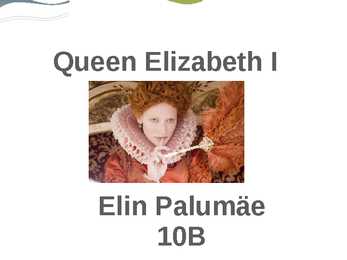
Queen Elizabeth I Elin Palumäe 10B Elizabeth I Reign - 17 Nov. 1558 24 March 1603 (44 years) Coronation - 15 January 1559(25 years) Predecessor - Mary I Successor - James I House - House of Tudor Father - Henry VIII Mother - Anne Boleyn Born - 7 September 1533 Greenwich, England Died - 24 March 1603 (aged 69) Burial - Westminster Abbey Anne Boleyn Queen consort of England Mother of Elizabeth I Tenure - 28 May 1533 17 May 1536 Coronation 1 June 1533 Anne Boleyn was Queen of England from 1533 to 1536 as the second wife of Henry VIII of England and the 1st Marquess of Pembroke in her own right for herself and her descendants. House - House of Tudor Father - Thomas Boleyn, 1st Earl of Wiltshire
likely not yet favorable for a widespread flowering to occur. One day, however, a critical threshold was reached, and suddenly there would have been an explosion of color and scent all over the planet – if a perceiving consciousness had been there to witness it. Much later, those delicate and fragrant beings we call flowers would come to play an essential part in the evolution of consciousness of another species. Humans would increasingly be drawn to and fascinated by them. As the consciousness of human beings developed, flowers were most likely the first thing they came to value that had no utilitarian purpose for them, that is to say, was not linked in some way to survival. They provided inspiration to countless artists, poets, and mystics. Jesus tells us to contemplate the flowers and learn from then how to live. The Buddha is said to have given a “silent sermon” once during which he held up a flower and gazed at it. After a
To her, the ideal marriage is based on rational love, mutual understanding and respect. The Bronte sisters, Ann, Emily and Charlotte, wrote a few decades later. Although often viewed collectively, their literary output differs greatly from each other. Wrote under male pen names – difficult to get published as a woman. At the time they wrote, their works were considered blasphemous (dealt with sexuality and death). Emily Bronte – Wuthering Heights, critics presumed was written by a woman. Not understood by her contemporaries
During this period a new class called bourgeoeisie came into being. This is the period when monarchies based on nationality were estabilished. The Renaessance started in Italy In the 14th century. Then it spread all over Europe, reached England in 16th century. The struggle for power culminated in a war called The War of Roses. It was a civil war between two dynasties, families. They had different emblems on one side the Yorks (white rose) other Lancasters (red). They couldn't decide who gets the throne. War ended 1485. A new dynasty came to throne, Tudor, the first king in this dynasty was Henry Vll. When he came to throne a period of stability followed because he built a nation based state. He was good at diplomacy.He could avoid quarrels and wars with neigbouring countries. France, Spain - greatest enemies.So he could save much money and thus laid a good economic basis for his state. Besides that he built a
Old Mr. Dashwood is the owner of a large estate in Sussex called Norland Park. Following the death of his sister, Mr. Dashwood invites his nephew Mr. Henry Dashwood to come live with him at Norland. The younger Mr. Dashwood brings John Dashwood, his son from a previous marriage, as well as the three daughters born to his present wife. John Dashwood is grown and married, and has a four-year-old son, Harry. When Old Mr. Dashwood dies, he leaves his estate to John and little Harry, who had much endeared himself to the old man. But now John's father, Henry Dashwood, is left with no way of
vivacious woman about whom a future Viceroy of India would say, "Dullness and Mrs. Kipling cannot exist in the same room."[3] Father - John Lockwood Kipling. Lockwood Kipling, a sculptor, an illustrator, museum curator and pottery designer, was the principal and professor of architectural sculpture at the newly- founded Sir Jamsetjee Jeejeebhoy School of Art and Industry in Bombay. Later in life Kipling illustrated many of Rudyard Kipling's books, and other works. Kipling also remained editor of the Journal of Indian Art and Industry, which carried drawing works from the students of the Mayo School. COUPLE named their son after the place they had first met Rudyard Lake. Alice Kipling Fleming - Sister of British author Rudyard Kipling who became a well-known psychic, producing automatic writing under the name "Mrs. Holland." Born June 11, 1868, Alice Kipling was privately educated
Nelly remembers her childhood. As a young girl, she works as a servant at Wuthering Heights for the owner of the manor, Mr. Earnshaw, and his family. One day, Mr. Earnshaw goes to Liverpool and returns home with an orphan boy whom he will raise with his own children. At first, the Earnshaw children--a boy named Hindley and his younger sister Catherine--detest the dark- skinned Heathcliff. But Catherine quickly comes to love him, and the two soon grow inseparable, spending their days playing on the moors. After his wife's death, Mr. Earnshaw grows to prefer Heathcliff to his own son, and when Hindley continues his cruelty to Heathcliff, Mr. Earnshaw sends Hindley away to college, keeping Heathcliff nearby. Three years later, Mr. Earnshaw dies, and Hindley inherits Wuthering Heights. He returns with a wife, Frances, and immediately seeks revenge on Heathcliff
replaced King Harold on the throne The invasion was completed by 1071 - The Norman invasion is depicted on the Bayeux Tapestry a long embroidered cloth The death of King Harold embroidered on the Bayeux Tapestry The Norman England William I ensured his power by dividing the land into parts and making 1/7 of it a royal domain He made his nobles swear an oath of allegiance and become his vassals Died in 1087 while fighting in France, was succeeded by his third son, William II Rufus William II was very unpopular: - Problems with the church - Increased taxes and claimed the money of many positions of the church William the Conqueror began building the Tower of London one of the most notorious prisons in the world After William II died in 1100 due to an incident while hunting, the throne was claimed by his brother, Henry I
At first, each pilgrim was to tell two stories on the way to Canterbury and two on the way back; the innkeeper would give a good meal and a night at the inn to the best storyteller. Altogether 144 stories, GC only managed to write 24 before his death. It is studied as a faithful reflection of 14th century life in England. GC was amused by his own characters and rarely criticises them sharply; shows a very deep understanding of human motivation. His comments reveal his profound understanding of the social problem of his day. o The Prologue paints the setting of the story. Introduces each character (30). GC himself functions as the narrator. He tries to be objective and tries to keep a distance from the characters. The descriptions are very vivid and economic.
Following their clearance of wrongdoing, Othello is immediately sent to defend against the Turks in Cyrpus. Taking Desdemona with him, Othello sets out for the island with Iago and his wife Emilia in tow. Again displaying his deceitful nature, Iago manages to convince Roderigo to follow along for when Desdemona tires of her new husband. When the Venetians arrive in Cyprus, Iago immediately goes about planting doubt in Othello’s mind as to how loyal his wife is. A carefully planned fight between Roderigo and Cassio, the man who was promoted above Iago, results in Cassio’s demotion. Taking advantage of his saddened state, Iago advises Cassio to seek out Desdemona’s favor to speak on his behalf. Iago carefully maneuvers Othello and himself to arrive as Cassio is leaving Desdemona’s audience. Iago points out how Cassio seems to be avoiding Othello. Desdemona for her part immediately begs
................................................. Orson Scott Card He was born on the 24th of August, 1951 in Richland, Washington. Card's writing career began primarily as a poet, studying at Brigham Young University. During his studies as a theatre major, he began "doctoring" scripts, adapting fiction for theatre production, and finally writing his own one-act and full-length plays. Later he has worked both as a freelancer and a contracted writer. He first wrote the short story "Ender's Game" while working at the BYU press. Ender's Game and its sequel Speaker for the Dead were both awarded the Hugo Award and the Nebula Award, making Card the only author (as of 2008) to win both of science fiction's top prizes in consecutive years. Card continued the series with seven books, which divide into "Shadow" and "Speaker" series. He has also announced his plan to write two more novels: Shadows in Flight, a book that connects the "Shadow" series and "Speaker" series together, and Ender in
century. The Celts introduced their tribal organization and an early form of agriculture before they were forced westward by the Roman invasion. Forms of Celtic language are still spoken in Britain. Romans (with Julius Caesar in the head of them) first tried to occupy Britain in 55 B.C., but there was a rebellion in Gaul so they had to leave to fight against it. Next time they came in 43 A.D. and their leader was Emperor Claudius. Romans brought a lot with them. Their brought paved roads, the sites of important cities, the seeds of Christianity, the Roman law, Roman baths, language and advanced civilization. They also built Hadrian's Wall in 122 A.D. Romans occupied Britain for four centuries. The Roman way of life all vanished after the invasions from Northern Europe by the Angles, Saxons and Jutes from the 5th century onwards. They ruined Londinium, but they were easily turned into Christianity and religion became more and more important
sent her to school in Paris. In 1834, Dickens became a political journalist, reporting on parliamentary debate and traveling across Britain by stagecoach to cover election campaigns for the Morning Chronice. His journalism, in the form of sketches which appeared in periodicals from 1833, formed his first collection of pieces Sketches by Boz which were published in 1836 and led to the serialization of his first novel, The Pickwick Papers, in March 1836. On 2 April 1836, he married Catherine Thompson Hogarth (1816 1879), the daughter of George Hogarth, editor of the Evening Chronice. After a brief honeymoon in Chalk, Kent, they set up home in Bloomsbury, where they had ten children. On 9 June 1865, while returning from France with Ternan, Dickens was involved in the Staplehurst rail crash in which the first seven carriages of the train plunged off a cast iron bridge that was being repaired.Because of that he died.( 9 June1870)
1. Beowulf. The dating of Beowulf is still controversial. The poem is one of the earliest and greatest monuments of the Germanic literatures. The main stories of the poem (the fights of B.) are versions of common folk-tales, but the poet also introduces many incidental stories, some of which belong to the world of ancient Germanic legend. He writes his folk-tales and legends in a web of other events, mainly set in the Baltic Kingdoms. He shows a very rich and leisurely portrayal of this Baltic world, providing many customs like the close relationship between lord and man in the war-band and others. All this encouraged the supposition that the unknown author of the poem was himself a bard of the ancient type portrayed within the poem (a lord's scoop). However, many people propose that the author could be
in creating credible and identifiably Am characters. His works sold widely in Am, Britain and Europe. Edgar Allan Poe was a southerner who moved north to find work as an author and editor in Baltimore, Philadelphia and New York City. His gothic tales of horror included the Romantic elements of fantasy and terror. His masterpieces The Fall of The House of Usher (1839) and The Masque of the Red Death (1842) show a deeply analytical mind which Poe also applied to literary criticism. His novel The Murders in the Rue Morgue is widely considered to have given rise to the genre of detective stories. The characteristic mixture and haunting imagery can also be found in his poetry, of which The Raven (1845) and Annabel Lee (1849) are good examples (Also The Bells). Somewhat overlooked by his contemporary fellow countrymen, Poe's work was particularly influential in France, where it was (discovered and) translated by Charles Baudelaire.
Part IV: Of the kingdom of darkness Churches are misinterpreting the bible to make profit of it. Church condemned Galileo for no good reason and is not a institution what helps to create an ideal society. Locke second treatise on government I Locke defines political power as the right to make laws for the protection and regulation of property. In his view, these laws only work because the people accept them and because they are for the public good. Monarchy is not derived from god or a direct decender of leaders described in the Old testament. Sovereign protects people and their property. Sovereginity not analouges to a father's relation to his children husband, wife etc II People have an obligation to punish those who go against God's will and attempt to harm another by compromising his life, liberty, or possessions. In the state of nature man is equal to his fellows
theme to story and m a k i n g a script come alive." — Lynda Obst, Producer, How to Lose a Guy in 10 Days, Sleepless in Seattle, One Fine Day, Contact; Author, Hello, He Lied "The Writers Journey is an insightful and even inspirational guide to the craft of story telling. An approach to structure that is fresh and contemporary, while respecting our roots in mythology." — Charles Russell, Writer, Director, Producer, Dreamscape, The Mask, Eraser "The Writer's Journey should be on anyone's bookshelf who cares about the art o f storytelling at the movies. N o t just some theoretical tome filled with development clichés of the day, this book offers sound and practical advice on how to construct a story that works."
Years 1154-1485 Henry I was the first unquestioned ruler. One of the most important kings in the Middle Ages. He had lands in Britain & France. Then the government was the monarch, a person, not a place. He had more land than any pervious king. After his marriage to Eleanor of Aquitaine, he also ruled the lands south of Anjou. His empire stretched from the Scottish border to the Pyrenees. England provided most of its wealth, but the heart was Anjou. Henry II began to regain royal control. During the war some barons had become very powerful. He pulled down some of their castles. He tried to restore law & order. He wanted the same kind of justice to be used everywhere. He appointed his own judges to travel around
Prof. A. V. Isacenko was replaced first by Assoc. Prof. . urovic (1955-1959) and then by Assoc. Prof. J. Kopanicák (1959-1970). The political turnaround in 1989, of course, also had impact on the evolution of Russian studies as an academic discipline. The department found itself in a peculiar situation. On the one hand, it represented one of the most developed philological disciplines with a large personnel and material base; on the other hand, the factors that had made Russian studies one of the favoured philological disciplines in the past ceased to be significant. What followed was a perceptible drop in the number of applicants for the Russian teaching programme as Russian gradually lost its dominant position at primary and secondary schools. In terms of research, literary studies, which had appeared to be less productive for decades, prevailed over Russian linguistics. Part 1. Linguistics
head, won the battle of Midway, led to cruel Allied defeats in North Africa, and broke up a vast Nazi spy ring. • How one American became the world's most famous codebreaker, and another became the world's greatest. • How codes and codebreakers operate today within the secret agencies of the U.S. and Russia. • And incredibly much more. "For many evenings of gripping reading, no better choice can be made than this book." —Christian Science Monitor THE Codebreakers The Story of Secret Writing By DAVID KAHN (abridged by the author) A SIGNET BOOK from
Music, dance, poetry, lavish illusionistic scenic display to express the doctrines of divine kingship. Great impact. Like gods come down to earth. 2. The Caroline masque Charles decided on subject matter, and acted and danced in masques. Now the regal divinity even more obvious. Ben Jonson. Divine minds of this incomparable pair. Arts role – to set a noble ideals, to strengthen practice of virtue. He and queen living incarnations of ideals. Visual style of his reign more classical than James’s. Thomas Carew „Coelum Britannicum”. King’s policy of peace (peace in every courtly celebration). Benefits to the isle by the union of divine couple. Henrietta Maria Love and Beauty and Charles – Heroic Virtue, together a great force. Masques centre of court life. Stuart divinity + now queen as a Platonic love goddess. Maria – from French court amnners and highly artificial language of adoration – fashion. Idealised love wiped away all stains
 annaabi.ee