Leidsid 33 sarnast õppematerjali, mis on seotud failiga "EXAM 2022 Estonian in multilingual Baltic". Need materjalid aitavad sul teemat sügavamalt mõista.
language, linguistic, russia, russian, keeleoskus, languages, baltic, other, töötaja, speak, work, ethnic, german, latvia, than, east, soviet, social, status, share, cultural, policy, identity, sole, europe, estonians, finn, between, foreign, choice, lithuania, stand, exam, contact, network, able, examples, land, describe, shift, change, individualTallinna Mustamäe Humanitargümnaasium Valeria Jefremenkova ENGLISH AS A GLOBAL LANGUAGE INGLISE KEEL KUI ÜLEMAAILMNE KEEL Research work Supervisor: Jevgenija Kozlova Tallinn 2016 1 Table of Contents СONTENT…………………………………………………………………………………...2 INTRODUCTION…………………………………………………………………………...3 CHAPTER I……………………………………………………………………………….....5
This was the time of the crystallization and the culmination of serfdom, when various socio- political and cultural undercurrents were also active, preparing the ground for the industrial society and the national-democratic movement in the second half of the 19th century. The 1710 of the corporations of knights and towns, until Alexander II (18551881), established the relationships between Estonia, Livonia and the Russian Empire. The Baltic Landesstaat reached its full development. The freedom of action in the new provinces was naturally granted to one of the most firm ideological pillars of the tsarist empire -- the Russian orthodox church; though as the Landeskirche in the Estonian and Livonian territories, the Lutheran church long maintained a de facto predominance. The most important organ of Baltic German local government was the Diet, consisting of all the noble families who had been `selected' in a list of the eligible
Estonian history has been written from multiple perspectives. Often, religion, politics, and personal motives have fashioned history into what its authors wanted it to be. People have written from a multiplicity of perspectives. It should be one Estonian historical research's greatest priorities to distance itself from this, to seek after holistic, balanced accounts of the past. Early chronicles of Estonian history illustrate this diversity of perspective. Johann Renner, a Baltic German, held his own people in high esteem, deeming them the people of God. He implied this when he wrote that God would save His people from the hand of Gog. He seems to indicate that Gog was the Muscovite people. Perhaps the Muscovite people truly were vicious towards Baltic peoples, but perhaps not. Whatever the case, his biases colored his writing, likely distorting the truth as to how things actually were and how events actually happened.1 The same can be said of chronicles
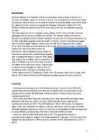
Facts and figures 3 Geography 3 Climate 3 Nature 4 History 5 Economy 6 Culture 6 Biggest towns 7 Language 8 3 Facts and figures The Republic of Estonia is a small country. Covering only 45, 228 sq km it is slightly bigger than Denmark, Belgium or Switzerland. Estonia's population is under 1.4 million. The official language is Estonian but since very many Russians live here Russian is also wide spread. The capital of Estonia is Tallinn. The currency used in Estonia is Eesti kroon. The Estonian national flag is blue-black-white. It was originally the flag of the Estonian Students' Society. The flag was first consecrated in Otepää Church in 1884. For a while, during the Soviet occupation, the flag was banned but it was again seen in public in Tartu in May 1988. The national flower is cornflower, the national bird is barn swallow and the national stone is limestone.
Essey How does the United States influence Estonia? The United States of America with it's global economic and political superpower is one of the most influential countries in the world and therefore it’s influence can also be felt in Estonia. Fluctuations in Estonia’s status as an independent country have had significant impact on the amount of influence from other countries, whether it is the language, eating habits or lifestyle. But how has United States influenced Estonia after we gained our independence? Estonia is not economically dependent on the United States as they are not one of our most important trading partners, but as the economics of the United States has a great influence on the world economy, they can still indirectly have an influence on Estonian economy. In Estonian politics the influence of the United States can be seen the most in relations with NATO
Summary • Early history of translation studies – Cicero and St. Jerome (what did they do/how/why are they relevant to translation studies?) St. Jerome – Greek scholar, did some translation work. Lived during the 4th century. Jerome is best known as the translator of the Bible into Latin. A previous version (now called the Old Latin) existed, but Jerome's version far surpassed it in scholarship and in literary quality. Jerome was well versed in classical Latin (as well as Greek and Hebrew), but deliberately translated the Bible into the style of Latin that was actually spoken and written by the majority of persons in his own time. This kind
Tallinn English College Topic Estonia Tallinn 2008 1. Introduction Estonia is a small country about the size of Switzerland, or New Hampshire and Massachussetts combined. Estonia is named after the people called "Ests" who lived in the region in the 1 st century AD. The Republic of Estonia is one of the three countries commonly known as the "Baltic States". The other Baltic States are Latvia and Lithuania. 2. Geographical position Estonia is situated in northeastern Europe. Estonia is bounded on the north by the Gulf of Finland, on the east by Russia, on the south by Latvia and on the west by the Baltic Sea. In the north it borders on Finland. The coastline of the Baltic Sea in Estonia is characterized by numerous gulfs and bays, the biggest of them being the Gulf of Finland, the Gulf of Riga and the Gulf of Pärnu. Bays include the
Russian philology The meaning of the word "philology" is "love for word". This is love that unites teachers and researchers of modern and Classical languages and literature, interpreters and diplomats, journalists and publishers, writers and poets. Russian philologis are highly demanded in various spheres of scholarly research and education, in the mass media, in civil service at the Ministry of Foreign Affairs, in archives, libraries, museums, in travel agencies, as well as Russian and international companies. Curriculum within in philological faculty includes courses of Russian and European languages and literature, courses of Linguistics and Theory of Literature for students to familiarize themselves with various schools and trends of Russian and foreign philology. The core curriculum also includes a number of Liberal Arts courses (Philosophy, History, Psychology, Pedagogy), as well as courses of basic mathematics and computer studies, and
technological factors, economic factors and the trends in Estonian economy compared to Germany and to briefly discuss Estonian business environment. Estonian population The total population of Estonia is 1 313 271 according to Statistics Estonia, of which 69.1% are Estonians, 25.1% Russians, 4.9% of which are of different nationalities for example Ukrainians, Belarusians and Finns. Rest are of unknown nationality. 68.5% of population speaks Estonian as a mother language, 29.6% speaks Russian as a mother language and 0.6% Ukrainian. Estonia has only one official language which is Estonian. According to information by the Institute of the Estonian Language there are about 75% of Estonian people who speak Estonian. The most common foreign languages learned by Estonian students are English, Russian, German and French. Other popular languages include Finnish, Spanish and Swedish. Tallinn is the capital and largest city of Estonia. In Estonia there are 47 cities/towns. More
Indians in everyday conversation. They are still legally categorized by the Canadian Government under the Indian Act as Status Indians. Those who have lost their legal status are called Non-Status Indians. Prime Minister Pierre Trudeau tried to get rid of the Indian Act, but First Nations political groups insisted on keeping it, because it defines their special status. The Inuit are the people who originally lived in the Arctic. Their language is Inuktitut, but it has several dialects the differ considerably from place to place. The Métis, are the group of people who resulted from the mixing of European and Native men and women. The Métis developed a unique culture that included elements of both European and Native ways and artifacts (clothes, tools, means of travel, etc.). They pride themselves on their distinctiveness from both the cultures from which they are descended. 3
........................................................................................... 9 Conclusions........................................................................................................................10 References..........................................................................................................................11 3 Introduction English is considered to be one of most important languages in the world. It is one of the official languages of the United Nations. According to research by the British Council, around 375 million people in the world speak English as their native language and English has official or special status in at least seventy-five countries. The British Council has also noted that English is the main language of newspapers, airports and air-traffic control, international business and academic conferences, science, technology, diplomacy and sport. Perhaps even
Introduction Estonia, officially the Republic of Estonia (Estonian: Eesti or Eesti Vabariik) is a country in the Baltic region of Northern Europe. It is bordered to the north by Finland across the Gulf of Finland, to the west by Sweden across the Baltic Sea, to the south by Latvia (343 km), and to the east by the Russian Federation (338,6 km). The territory of Estonia covers 45,227 km² and is influenced by a temperate seasonal climate. The Estonians are a Finnic people closely related to the Finns, with the Estonian language sharing many similarities to Finnish. The modern name of Estonia is thought to originate from the Roman historian Tacitus, who in his book Germania (ca. AD 98) described a people called the Aestii. Similarly, ancient Scandinavian sagas
German ecclesiastical states of the Holy Roman Empire. From 1418–1562 the whole of Estonia was part of the Livonian Confederation. After the Livonian War, Estonia became part of the Swedish Empire from the 16th century to 1710/1721, when it was ceded to the Russian Empire as the result of the Great Northern War. Throughout this period the Baltic German nobility enjoyed autonomy, where the language of administration and education was German. • The Estophile Enlightenment Period 1750–1840 led to the Estonian national awakening in the middle of the 19th century. In the aftermath of World War I and the Russian revolutions, the Estonian Declaration of Independence was issued in February 1918. The Estonian War of Independence ensued on two fronts between the newly proclaimed state and Bolshevist Russia to
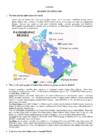
Society and culture of english-sspeaking countries Introduction 1. The countries of the world where the English language is spoken. 2. Approximate number of mother tongue speakers of English approximately 350-400 million native speakers. Which place does English occupy in the world by its number of speakers?After which language? English occupies second place by its number of speakers after Mandarin Chinese. 3. What is the difference between English as a Second Language, English as a Foreign Language and English for Specific Purposes? Give examples of situations where they are used. English as a Second Language (ESL or TESL) is a traditional term for the use or study of the English language by non-native speakers in an English-speaking environment. That environment may be a country in which English is the mother tongue (e.g., Australia, the U.S.) or one in which English has an established role (e.g., India, Nigeria)
Bad worse worst Much more most Little less least Estonian: hea parem (cf "paras" fitting, in Finnish "the best" - metonymical link), palju - rohkem Finnish: mennä (to go), lähteä (to leave) Estonian: minema, mine, lähen, läksin French: aller, je vais/nous allons, ira (future) Russian: chelovek ljudi, French: personne- gens, English: person persons/people byt' est' hodit' idti shol, shla. horoshij luchij Essentially the same words suppletive in various languages, including non-related ones. The most common words (`good', `to be', `to go', `much', "people", etc). General principle: the more frequently used a word, the more one can "afford" it to be irregular/non-iconic. Suppletion perhaps the most drastic form of irregularity/iconicity), covers mainly the most frequent words Metathesis-Two sounds, at least one of which is a consonant, change places inside a word. When one of the sounds is a vowel,the other is usually /r/
Tallinn 2007 FACTFILE Area: 45 228 sq km Poplulation: under 1.4 million Capital: Tallinn Language: Estonian Currency: Eesti kroon (EEK) Main religion: Lutheran National holiday: 24 February (anniversary of the republic) National flower: Cornflower National bird: Barn Swallow National stone: Limestone LOCATION The Republic of Estonia is the northernmost and smallest of the three Baltic States. It is located on the eastern shores of the Baltic Sea in the north east of Europe. To the east the country borders Russia. Latvia is the countries neighbour to the south. From the west the coast of Estonia is washed by the Baltic Sea and from the north by the Gulf of Finland. The length of the coastline is approximately 3 800 km. The longest distance from east to west is 350 km, while north to south Estonia stretches 240 km. THE NAME The name EESTI was apparently derived from the word AISTI, the
LEL 2E Notes on Vocabulary One of the key facts about the lexicon of any language is that it reflects in various ways the physical and cultural environment in which the language is spoken. A people unfamiliar with, say, horses is unlikely to have a word for `horse'; similarly with ploughs, printing presses, and internet porn sites. For the most part this is trivial it's hard to imagine how it could be otherwise, given the general nature of human language. People tend to make a great deal of the alleged fact (see Pullum 1989) that "the Eskimos have lots of words for snow", but it doesn't take much thought to realise that any language spoken in a given physical and cultural environment is likely to have efficient ways of referring to distinctions that are important in that environment. That doesn't mean that you can read very much into individual words and individual facts about the lexicon of a given language (this topic has
the home of prosperous Estonian farms..." Tourism and handicraft in Lõuna-Viljandimaa Lõuna- Viljandimaa captivates senses with its beautiful landscapes. Lõuna- Viljandimaa as we know it today stays in the heart of the historic Mulgimaa. Mulgimaa is the home of mountains, deep valleys and lakes, its natural axis is the beautiful old valley of Halliste. Southern Viljandimaa has been the homeplace of mulgi inhabitants who spoke their own dialect called mulgi language. The speakers of mulgi language can still be found in Southern Viljandimaa and in the past years people have started to pay more attention to learning and developing the dialect. The mulgi inhabitants have always been characterised by strong connection to their old-established traditions and customs. At the same time, the way of life of the local people is characterised by strong families, marriage, children and respect and love for fellow men. The local cultural heritage offers
Milestones in Estonian History The Estonians are a Finno-Ugric people who came from the area near the Urals and the Volga and Oka rivers. They migrated westward to the Baltic shores some 5, 000 years ago. In the ninth century A.D. Viking ships invaded Estonia and the country became a vital link in the sea-trade between East and West. By the 12th century, the Arabian geographer al-Idrisi had placed the city on his maps. In the 13th century, Tallinn joined the Hanseatic League, the union of European commercial towns that stretched from London to Novgorod. Pärnu, Viljandi and Tartu were also members. Estonia became a vital link in the sea-trade between East and West
1627 no trace of the "Estonians and Livonians" who left their homeland to settle at the mouth of the Delaware River (a Swedish colony) · 1654 at least one Estonian in the settlement of New Sweden on the Delaware River Johan Schalbrick, a drummer from Tallinn (Reval) · New Sweden Swedish colony on the Delaware River from 16381655 · 1657 Martinus Hoffman, born in Tallinn (Reval), came to New York (New Amsterdam), started to work as a saddlemaker. · His great-granddaughter Cornelia Hoffmann (b. 1734) married Isaac Roosevelt, which makes her the great-great-grandmother of Franklin Delano Roosevelt, president of the US from 193345. · Hans Rebane = 1897 founded the first Estonian-language newspaper in the US Eesti Ameerika Postimees (published in NY until 1911) · 1898 founded an Estonian Lutheran congregation in NY (still exists today) 2
people. It means that the population of Estonia is decreasing. As young Estonians often like to go study or live abroad, the population is aging as well – young people move away, while older stay there. Many different nationalities live there: besides Estonians there are Russians, Ukrainians, Belarussians, Finnish, Tatars, Latvians, Poles, Lithuanians, Jews, Germans and others. Due to this fact, the most popular languages spoken as a mother language are Estonian, Russian and Ukrainian. Nevertheless, there is still just one official language of Estonia, which is Estonian. Most of the people, approximately 900,000 live in the cities, such as Tallinn, Tartu, Narva. The most common sector that people work in is the service sector. People in Estonia are also involved in other sectors of industry, such as wood, construction, electronic and energy. Estonia is a democratic parliamentary republic. It has a single-chamber parliament
My languages I love different languages. I mean, I really, really love different languages. I also believe and have been told that I pick them up rather easily. That might be true, although I did not pick any Greek up in Greece but that might have been because they spoke so damn fast that I could not tell if it was a word or an entire sentence. The first foreign language I learned was Russian. Considering I was ten when Estonia became a Republic, it makes sense. We began studying Russian in first grade, though it was simplified – "koška" instead of "kot", "medvešonok" instead of "medved", "saichik" etc. Did not make much sense and we mostly played some games in Russian (Tare-tareke etc). Learned as much playing outside, since we had Estonian-Russian kids around as well. Not that we played with them. It's sad to say but it was not a nice time to be a Russian kid
English structure revision for the exam 1. Terms Language → A systematic, conventional (tavakohane) use of sounds, signs or written symbols in a human society for communication and self-expression. Human language at all levels is rule- or principle- governed (valitsema) meaning that language corresponds to the grammar. Natural language is usually spoken, while language can also be encoded into symbols (such as letters, morse etc) For example: Estonian, English. Linguistics → The scientific study of human natural language. Broadly, there are three aspects to the study which are Pragmatics (studies the use of language → interested in the gap between the sentence’s meaning and the speaker’s meaning). Semantics (concerned with the meaning of the language aspects and the way they
..........................................................9 12. References....................................................................................................10 Introduction I chose finland because there are friendly people and beautiful nature. Finland is bigger than Estonia. There lives over 5 milj. people. Finland capital is Helsingi and there lives about 2 milj. people. Highest top is 1328m. Finland is bordersed with Sweden to the west, Russia to the east and Norway to the north. It is the eight largest city in Europe. Most Finns speak Finnish. The second language is Swedish. Finland is rated the sixth most peaceful country in the World. In Finland there are more than 60000 lakes. Capital: Helsinki Area: 338145km2 Population: 5200000 Language: Finnish, Swedish Currency: Euro (EUR)
My Town I live in Tallinn. It's the capital and main seaport of Estonia. Tallinn is a very beautiful city that lies on the Baltic Sea. It covers 158 square kilometres. The Mayor of Tallinn is Jüri Ratas. The population of our capital is about 400000 people. About 55% of them are Estonian, 37% Russians and the other 8% are from different nations. The people here are mostly engaged in industry- mainly the food industry (23%), trade (16%) and transport and communication (14%). History. Tallinn has a great history. It was first marked on a map of the world by the Arab geographer al-Idrisi in 1154, its name then being Kolyvan. In the 13 th- century chronicle of Henricus de Lettis the town was called Lyndanise. Then it was
Estonia Estonia, officially the Republic of Estonia, is a state in the Baltic region of Northern Europe. It is bordered to the north by the Gulf of Finland, to the west by the Baltic Sea, to the south by Latvia, and to the east by Lake Peipus and Russia. Across the Baltic Sea lies Sweden in the west and Finland in the north. The territory of Estonia covers 45,227 km 2, and is influenced by a humid continental climate. The Estonians are a Finnic people, and the official language, Estonian, is a Finno-Ugric language closely related to Finnish, and distantly to Hungarian and to the Sami languages. The population of Estonia is 1.5 million. Of this number 62 per cent are Estonians. The geography of the land is surprisingly varied
European Union since 1995, Finland was the only Nordic state to join the euro system at its initiation in January 1999. In the 21st century, the key features of Finland's modern welfare state are a high standard of education, equality promotion, and national social security system currently challenged by an aging population and the fluctuations of an exportdriven economy (Central Intelligence Agency, 2012, ISSN 15538133). 2.1.2 Geography Location: Northern Europe, bordering the Baltic Sea, Gulf of Bothnia, and Gulf of Finland, between Sweden and Russia Area: total: 338,145 km2 land: 303,815 km2 and water: 34,330 km2 Coastline: 1250 km Climate: cold temperate; potentially subarctic but comparatively mild because of moderating inf luence of the North Atlantic Current, Baltic Sea, and more than 60,000 lakes Terrain: mostly low, f lat to rolling plains interspersed with lakes and low hills
UNO SOOMERE ESTONIAN SYMPHONIC MUSIC. THE FIRST CENTURY 1896-1996. AN OVERVIEW With a Historical and Cultural Summary IN MEMORY OF THE GREAT ESTONIAN COMPOSERS CONTENTS ESTONIA AND THE ESTONIANS FOREWORD IN THE FOLD OF TSARIST RUSSIA. EMERGENCE AND FIRST STEPS ON THE CLASSICAL-ROMANTIC PATH. HISTORICAL INTRODUCTION I. MUSICAL LIFE IN TARTU AT THE TURN OF THE CENTURY. TRAILBLAZERS: ALEKSANDER LÄTE, RUDOLF TOBIAS, ARTUR KAPP. II. THE FIRST DECADE OF THE 20TH CENTURY. ARTUR LEMBA: THE BEGINNING OF ESTONIAN SYMPHONY AND OPERA. III. NEW DEVELOPMENTS IN CULTURAL AND MUSICAL LIFE: THE END OF THE TSARIST PERIOD. THE INDEPENDENT REPUBLIC OF ESTONIA: THE INTRODUCTION OF
People • Estonians are Maarahvas • Estonians are seen as calm, withdrawn and shy. Of course this isn’t true for every Estonian and once you get to know them they’re very open. • Estonians are patriotic due to the hardships during it’s history and their own shared love of their home country. • Historically Estonia is one of the "least religious" countries in the world in terms attitudes, though many Estonians do look for alternative beliefs. Language • The Estonian language is finno ugric, it’s closest relatives are the Finno-Ugrian languages of the Vedic and Livonian languages. • There are many dialects, the main groups can be separated into North and South Estonian dialects. • Besides the typical spoken Estonian language the second most notewordy dialect is the Võru dialect. • Estonian is one of the languages with a larger number of noun cases than typical. • According to comparative grammar studies, Estonian
*Estonians conquered by the crusaders 1208 *Reformation 16th century establishments of new school, Estonians first book appeared in 1525 *Tartu University 1632 founded by King Gustavus II Adolphus, classical university, member of the Coimbra group *Abolition of serfdom 1816 *Song festival 1869 in Tartu, an organiser was J.V.Jannsen, 822 singers, men only *Declaration of independence 24th February 1918 *War of independence 1918-1920 during the Russian Civil War, resulted in a victory for Estonia *Deportation 1949 *Estonia becomes independent 20th August 1991 *Joining EU 1st May 2004 Language: Estonian language, belongs to the Balti-Finnic group of the Finno-Ugric languages, closely realted to Finnish and rather remotely to Hungarian; Latin alphabet with 32 letters , 5 of which occur only in foreign words, the phenomes include 9 vowels and 18 consonants; words are borrowed from Latin, Greek, English etc
Me and languages. To begin with, language is a congrecation of thoughts and feelings through a system of signals, such as voice sounds, gestures, or written symbols. Communication or language is a process every child learns from birth and during our life we will usually learn many different languages. Due to the fact that both of my parents are Estonians , my mother tongue is Estonian, therefore I can speak and write in it very fluently. I also prefer read the books in Estonian. I know that some people like to do it in some other languages, in English for instance. I am really amused by the Estonian literature. I like to read books and stories from Andrus Kivirähk and F.R. Kreutzwald. English is one of the world most spoken language. You can hear it everywhere, no matter which part of the world are you in. In the third grade of elementary scool I started to
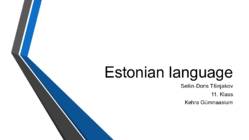
Estonian language Seliin-Doris Tsinjakov 11. Klass Kehra Gümnaasium · Estonian is the official language of Estonia. · Spoken natively by about 1.1 million people. · It belongs to the Finnic branch of the Uralic language family. Classification · Belongs to the Finnic branch of the Uralic languages, along with Finnish, Karelian, and other nearby languages. · Estonian has been influenced by Swedish, German and Russian, though it is not related to them genetically. History · The two different historical Estonian languages, the North and South Estonian languages, are based on the ancestors of modern Estonians migration into the territory of Estonia in at least two different waves, both groups speaking considerably different Finnic vernaculars. · Modern standard Estonian has evolved on the basis of the dialects of Northern Estonia.
Estonia. Estonia, officially the Republic of Estonia is a country in Northern Europe. It is the smallest of the three Baltic countries. Estonia has land borders with Latvia (339 km) to the south and Russia (229 km) to the east. It is separated from Finland in the north by the narrow Gulf of Finland and from Sweden in the west by the Baltic Sea. Estonia has been a member of the European Union since May 1, 2004 and of the NATO since March 29, 2004. The area of Estonia is about 45000 square kilometres and the population is about 1.4 million people. The capital of Estonia is Tallinn and the official language is Estonian. The currency is Eesti kroon. The main religion is Lutheran. Anniversary of the republic is celebrated on February 20. The national flower is cornflower, national
 annaabi.ee