Leidsid 33 sarnast õppematerjali, mis on seotud failiga "Egypt". Need materjalid aitavad sul teemat sügavamalt mõista.
egypt, summer, museum, museums, ticket, price, usually, temples, weather, winter, there, temperatures, average, between, expensive, money, currency, comparison, euros, simbel, nature, beauty, famous, giza, known, chephreni, sfinks, miracle, king, tutankhamunThere are 3 things that chiefly determine the climate of the United Kingdom: the position of the islands in the temperate belt; the fact that the prevailing winds blow from the west and south-west and the warm current -- the Gulf Stream that flows from the Gulf of Mexico along the western shores of England. All these features make the climate more moderate, without striking difference between seasons. It is not very cold in winter and never very hot in summer. So, the British ports are ice-free and its rivers are not frozen throughout the year. The weather on the British Isles has a bad reputation. It is very changeable and fickle. The British say that there is a climate in other countries, but we have just weather. If you don't like the weather in England, just wait a few minutes. It rains very often in all seasons in Great Britain. Autumn and winter are the wettest. The sky is usually grey and cold winds blow
1. Key features for all studied biomes. Tundra The main seasons are winter and summer. The tundra is the world's coldest and driest biomes. The average annual temperature is -28° C. Nights can last for weeks when the sun barely rises during some months in the winter, and the temperature can drop to -70° C. During the summer the sun shines almost 24 hours a day. Summer are usually warm. Average summer temperatures range from 3° to 16°C. TaigaTaiga is the Russian word for forest and is the largest biome in the world. It stretches over Eurasia and North America. The taiga is located near the top of the world, just below the tundra biome. The winters in the taiga are very cold with only snowfall. The summers are warm, rainy, and humid. Some of the animals in the taiga hibernate in the winter, some fly south if they can, while some just cooperate with the environment.
is likely looking for contact and play Age Things for cats Spa Hair Park Hotels s salons s Cafes Jewellery Clothes Names Bombay Bombay gets along well with children and other pets Like a black leopard gold to copper eyes and short, flat, gleaming coat that accentuates a solid, muscular body often good at playing fetch, and some have learned to walk on leash usually wants to dominate other cats LIFE SPAN - 12 to 16 years Price 262 - 1,747 Japanese Bobtail One of the oldest cat breeds Full of energy, always playful, loving, endearing, and happy best describe the Japanese Bobtail's personality will watch TV with you, help you read the newspaper or a book, and they love to help you send emails on the computer LIFE SPAN - 9 to 15 years Price: 436 - 524 Tonkinese Shorthaired breed Hybrid of the Burmese and Siamese breeds
is likely looking for contact and play Age Things for cats Spa Hair Park Hotels s salons s Cafes Jewellery Clothes Names Bombay Bombay gets along well with children and other pets Like a black leopard gold to copper eyes and short, flat, gleaming coat that accentuates a solid, muscular body often good at playing fetch, and some have learned to walk on leash usually wants to dominate other cats LIFE SPAN - 12 to 16 years Price 262 - 1,747 Japanese Bobtail One of the oldest cat breeds Full of energy, always playful, loving, endearing, and happy best describe the Japanese Bobtail's personality will watch TV with you, help you read the newspaper or a book, and they love to help you send emails on the computer LIFE SPAN - 9 to 15 years Price: 436 - 524 Tonkinese Shorthaired breed Hybrid of the Burmese and Siamese breeds
Weather in Sidney Sydney's climate is pleasantly temperate all year round with more than 340 sunny days a year. In summer (December to February), average maximum temperatures in Sydney are around 26°C. It can also be humid at this time with an average humidity of 65 per cent. Average maximum temperatures in the winter (June-August) are around 16°C. Sydney's rainfall is highest between March and June. Appealling climate - Australian seasons are the opposite to the Northern Hemisphere, summer starts in December, autumn in March, winter in June and spring in September. Australian seasons Spring: September November Summer: December February Autumn: March May Winter: June August The best seasons to travel to Australia (nicest weather) are in either Spring or Autumn. Driving in Australia The most important thing to remember in Australia when driving is that Australian people drive on the left-hand side of the road. For people coming
Gümnaasium Prague referaat Autor: Klass: Juhendaja: 2010 CONTENTS 1. Contents 2. Introduction 3. Compendium about Prague 4. Important about Czech Republic and Prague 5.-7. History 8. Independence 9. Main sights 10. the Czech Republic 11. List of famous people from Prague 12. Geography 13. Weather and climate 14. Population 15. Culture 2 INTRODUCTION The Czech Republic lies at the heart of Central Europe and at its center is the beautiful and historic city of Prague. With a population of some 1.3 million residents, the city lies on either side of the Vltava River in the middle of Bohemia that is one of the three
Neotropical realm. A good example is the Atacama of Chile. Cold deserts occur in the Antarctic, Greenland and the Nearctic realm. Climate In hot and dry deserts temperatures exhibit daily extremes because the atmosphere contains little humidity to block the Sun's rays. Many mean annual temperatures range from 20-25° C. The extreme maximum ranges from 43.5-49° C. Minimum temperatures sometimes drop to -18° C. Rainfall is usually very low and/or concentrated in short bursts between long rainless periods. In semiarid deserts summer temperatures usually average between 21-27° C. It normally does not go above 38° C and evening temperatures are cool, at around 10° C. The average rainfall ranges from 2-4 cm annually. In coastal deserts the average summer temperature ranges from 13-24° C; winter temperatures are 5° C or below. The maximum annual temperature is about 35° C and the minimum is about -4° C
_ 5 I _________________________________ (start) work at 8.30 every morning. _ 6 He is a good cook but she _________________________________ (prefer) to eat out. _ 7 English tests _________________________________ (get) more and more interesting. _ 8 They _________________________________ (have) a party because it's her birthday. _ 9 I sometimes _________________________________ (ride) my bicycle to school. 10_ She usually _________________________________ (go) to the gym on Friday evenings. Marks: /10 2 Choose the correct tense (present simple or present continuous) in these sentences. 1 How do you usually start/are you usually starting your day? _____________________________________ 2 What time do you go/are you going to bed at weekends? _____________________________________
1. Don't use an with own. Sue needs her own room. (NOT Sue needs an own room.) I'd like a phone line of my own. (NOT ... an own phone line.) 2. Use or rather to correct yourself. She's German or rather, Austrian. (NOT She's German or better, Austrian.) I'll see you on Friday or rather, Saturday. 3. Use the simple present play(s), rain(s) etc to talk about habits and repeated actions. I play tennis every Saturday. (NOT I am playing tennis every Saturday.) It usually rains a lot in November. 4. Use will ..., not the present, for offers and promises. I'll cook you supper this evening. (NOT I cook you supper this evening.) I promise I'll phone you tomorrow. (NOT I promise I phone you tomorrow.) 5. Don't drop prepositions with passive verbs. I don't like to be shouted at. (NOT I don't like to be shouted.) This needs to be thought about some more. (NOT This needs to be thought some more.) 6. Don't use a present tense after It's time.
centre. In culture centre there are café, library, parish government etc. There take places acting lessons, theatres, parties and other activities. There is music school also. This is for children's, but older people can learn there too. Karksi Nuia has many interesting places to visit and look. One of them is Maies farm, few kilometers from city centre. There you can visit the birth place of A. Kitzberg, famous Estonian writer. There is skiing mountain too, it is opened in winter when there is a lot of snow. Near Karksi Nuia are many lakes, capes, nice parks and mansions, Near the Karksi is beautiful ruins of castle, what was built in 13 century and destroyed by wars and attacks many years later. There is and church too. It is Karksis Peters Church. If you want to relax and enjoy summer, then you should go camping to lake Mäeküla, what is about 10km from Karksi Nuia. There you can fish, have sauna, and etc. There are many other lakes and rivers too.
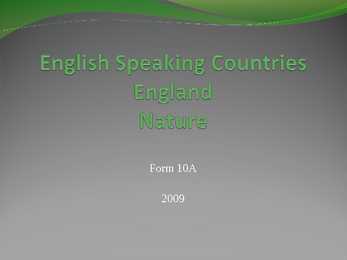
Form 10A 2009 Introduction The climate is cyclical England is in the middle latitude The English weather changes frequently 52% of the year is overcast England is washed by the warm Gulf Stream Spring March, April, May Wild areas may still be cold and muddy Animals start emerging from their hibernation Plants start blooming Sun and showers Summer Plants and animals start breeding Warm weathers The landscapes are covered with flowers Warm rain The average temperature ranges from 10 0C 150C Britain's highest temperature recorded is 38.5°C in August 2003 Autumn
place once, never or several every ..., N: He does not speak. normally, often, Q: Does he speak? times seldom, · facts sometimes, · action set by a timetable or usually schedule Present A: He is speaking. · action taking place in the at the moment, Continuous N: He is not speaking. moment of speaking just now, Q: Is he speaking? Listen!, Look!, · action taking place only for a now, right now
It is a land of great natural beauty with a long and varied history and rich culture. That's their nature especially concerning national symbols such as their music or their language. Even if Estonia is tiny, it still offers a breathtaking amount of nature. It is safe or safer than most places. It offers beautiful cities and beautiful people. It lacks pollution and traffic jams. There is water everywhere. It has four seasons. Dark days in the winter and white nights in the summer and it is wonderful. Many countries have gradually climate , when all time sun is shining and it rains one time in 1 month. In my opinion, all seasons have own benefits. For example, Even winter is coming, snow is falling, temperature is very high, weather is cold, Estonian forests are so fantastic and enchantress. Also, Estonia is slightly bigger than Denmark, the Netherlands, Belgium and Switzerland. On the other hand, this country have own drawbacks
Canada and the U.S. state of New York. Lake Champlain and the Ottawa, Richelieu and Saguenay rivers drain into the St. Lawrence. 5. Climate Northern Canadian vegetation tapers from coniferous forests to tundra and finally to Arctic barrens in the far north. The northern Canadian mainland is ringed with a vast archipelago containing some of the world's largest islands. Average winter and summer high temperatures across the country vary depending on the location. Winters can be harsh in many regions of the country, particularly in the Prairie provinces, where daily average temperatures are near -15°C (5°F), but can drop below 40°C (40°F) with severe wind chills. Coastal British Columbia is an exception and enjoys a temperate climate with a mild and rainy winter. On the east and west coast average high temperatures are generally in the
2. Where is prairie, pampas, steppe, and veldt situated? EurasiaSteppe, North America-Prairie, South AmericaPampa, South AfricaVeldt 3. Using the climate diagram describe the climate of the region. Temperate deciduous forest -Well-defined seasons with a distinct winter characterize this forest biome. Moderate climate and a growing season of 140-200 days during 4-6 frost-free months distinguish temperate forests. Temperature varies from -15° C to 25° C. Precipitation (750-1500 mm) is distributed evenly throughout the year. Temperate grassland- Semiarid, continental climates of the middle latitudes typically have between 25 cm and 50 cm of precipitation a year. Much of this falls as snow, serving as reservoir of moisture for the beginning of the growing season
Maturita Solutions Advanced Workbook Key stand bananas and coffee! It's a bit 3 1 to 8 of Unit 1 uncanny really. Is it something she's 2 about 9 century passed on to me genetically, or is it 3 like 10 assumed / 1A Memories page 3 learned behaviour? Who knows? 4 of thought / 1 See exercise 2 2 5 6 any fought
ASTLANDA). To the ancient Scandinavians the land was known as EISTLAND; to modern Scandinavians it is known as ESTLAND. Most contemporary languages use the Latin name ESTONIA. FLAG The Estonian blueblackandwhite national flag was originally the flag of the Estonian Student's Society, consecrated in Otepää Church in 1884. today there is a memorial plaque on the church wall commemorating the event. The Flag Museum attracts tourists who take an interest in the history of the flag. After about half a century, during which it was prohibited by the Soviet authorities, the flag was sen again in public for the first time in Tartu. Many elderly people were carrying the flags they had kept in secret hiding places durin the Soviet years; tears were rolling down their cheeks. On 24 February 1989, Estonia, still part of the Soviet Union, hoisted its tricolour on the tower of Pikk Hermann in Tallinn
This all lead to Estonia's independence on 24 February 1918. In June 1940 Estonia became a part of the Soviet Union. On 20 August 1991 the Republic of Estonia was restored without any bloodshed. CULTURE? National emblems. The Estonian blue-black-and-white national flag was originally the flag of the Estonian Students' Society, consecrated in Otepää Church in 1884. Today there is a memorial plaque on the church wall commemorating the event. The Flag Museum was opened in 1996. During the Soviet time the flag was prohibited. But many people hided their flags somewhere and the flag was seen again in 1988 in public. A meeting was held in Tartu and elderly people were carrying the flags, nationalistic speeches were told and patriotic songs were sung. Tears were rolling down people's cheeks. The Estonian flag is hoisted every morning at sunrise and lowered at sunset.
Estonia has many rivers but only nine of them are longer than 100km. The most important ones are Pärnu River and Emajõgi River Climate Estonia lies in the northern part of the temperate climate zone and in the transition zone between maritime and continental climate. Because Estonia is continuously warmed by the Gulf Stream it has a milder climate despite its northern latitude. Northern latitude means long summer daylight hours (the longest summer day stretches to 19 hours), and dark winters when daylight lasts sometimes only six hours. Being on the Baltic Sea the country is subjected to sea breezes and humidity. Estonia has a temperate climate, with four seasons of near-equal length. Summer is warm, while spring and autumn can be mild. Winter, which lasts from November to middel March, 4 can be very cold. The cold winter does not necessarily mean constant snow; in fact snowfalls
Meadow / 'med / aas, heinamaa England features mostly low hills and plains. The Pennine Chain runs from the north to south, splitting northern England into western and eastern parts. The Lake District in situated in the north-west of England and there are the most beautiful landscapes and the highest peak in England is Scafell Pike (978 m). The warmest part in England is the Peninsula of Cornwall in summer. Scotland Densely / 'densl / tihedasti Scotland features very wild landscapes, large areas of untouched land, mountains and lochs. Scotland can be divided into two parts: the Lowlands and the Northern Highlands. The highest peak in Scotland is Ben Nevis (1343 m) Wales Earthwork / :w:k / mullavall Beacon / 'bi:kn / tuletorn, majakas Peninsula / p'nnsjl / poolsaar
invaders from the Mediterranean lands. These men were the first farmers. In about 500 BC came the people whose homeland was near the Rhine River. These were the Celts. The Roman invasion began in 43AD. The Romans were highly organized conquerors. They built good roads, baths and bridges. The Romans stayed in the British Isles up to the 5th century. The remarkable thing about the Romans is that, despite their long occupation of Britain, they left very little behind. Most of the villas and temples the impressive network of roads and the cities they founded, including Londinium, 4 were soon destroyed. The next invaders were the Anglo-Saxons. They came from nowadays Germany, Holland and Denmark. In 1066 the last successful invasion was made by French-speaking Normans. French became the language of the ruling class, Latin was the written language. By the 14th
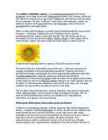
The sunflower (Helianthus annuus) is an annual(iga aastane) plant in the family Asteraceae, with a large flower head (inflorescence(õiekobar, õisik, õitseaeg, õidumine)). The stem(tüvi) of the flower can grow up to 3 metres tall, with the flower head reaching 30 cm in diameter. The term "sunflower" is also used to refer(nimetama, viitama, üle andma) to all plants of the genus(perekond, sugu) Helianthus, many of which are perennial(alaline, aastaringne) plants. What is usually called the flower is actually a head (formally(ametlikult) composite(liit-, komposiit- ; korvõieline, komposiit) flower) of numerous flowers (florets) crowded(täistuubitud, tunglev, rahvarohke) together. The outer flowers are the ray florets(pähik (õisiku osa) and can be yellow, maroon, orange, or other colors, and are sterile(steriilne, viljatu). The florets inside the circular head are called disc florets. Sunflower head displaying florets in spirals of 34 and 55 around the outside
Today Australia is a modern developed country with a diversified economy. Australia is an island continent of 7.7 million square kilometres, which makes it a little smaller than the USA. Located in south of Asia, between The Pacific and Indian Oceans, Australia is the World's driest continent. Although large areas of the centre are desert, Australia has a wide range of climate from tropical in the north to temperate in the south east, where it frequently snows in winter. Geographical position The coasts of Australia are surrounded by the Pacific Ocean, the Indian Ocean and the Southern Ocean. Four seas are surrounding Australia, which are the Timor Sea and Arafura Sea in the north of Australia, the Coral Sea in the north-east of Australia and the Tasman Sea, near the island of Tasmania, in the south-east of Australia. Government The full name of the county is the Commonwealth of Australia. Its territory is 7.7 million
7. When do you last go to a concert? What concert was it? 8. Have you ever been to an openair concert? What was it like? 9. Do you sing at family parties? Where else Estonians like to sing? 10. Have you got a collection of cassettes, CD´s or LP´s at home? 11. Have you watched a ballet on TV? 12. Which do you prefer ballet, drama or musical? 13. How often do you go to the theatre? 14. Do you prefer going to the theatre or watching TV? Why? 15. Do you prefer buying a cheap ticket and getting a seat at the back or spending more money and sitting in the front? Why? 16. Do you prefer going to the theatre with your family or friends? Why? 17. How old were you when you first went to see a puppet show? Do you remember what it was? 18. Who is your favourite actor/actress? 19. What performance or concert would you like to see if it were possible? Why? 20. Have you got a drama club at your school? Are you a member of it? 21. Have you ever worn a costume? When? Why? 22
Changing the Guard · Perhaps the epitome of London's surviving pageantry can be found in the ceremonial Changing of the Guard. · A hugely popular spectacle, the Changing of the Guard takes place at a range of royal locations in and around · London daily during the summer and on alternate days for the rest of the year. · There is no ticketing, so make sure you get there early. · Ever since 1660 Household Troops have guarded the Sovereign Palaces. · The Palace of Whitehall was the main residence until 1689 and was guarded by the Household Cavalry. · The court moved to St James's Palace in 1689 and when Queen Victoria moved into Buckingham Palace the Queen's Guard remained at St James's Palace and a
vowel sound). It comes from the Old English word ãn, which meant one. The Definite Article is the. It comes from the Old English word ţis, which meant this. Thus, in most general terms, a and an cannot be used with countable nouns in the plural and with uncountable nouns. Countable nouns are names of the things you can count (one elephant, two elephants, three elephants, etc). Uncountable nouns are names of the things you cannot normally count (love, air, philosophy, etc). The can usually be used when we mean this. The Indefinite Article – a/an (= one!) can only be used with singular countable nouns. a child, a book, an elephant, an apple On the other hand, singular countable nouns cannot be used without any determiner. Determiners are both articles (a/an and the) and different pronouns (e.g., one, another, each, every, this, that; personal pronouns: my, your, his, her, its, our, their). Only one determiner can be used at a time: My house was deserted
writers. Bands such as the Rolling stones, the Beatles, The Sex Pistols and Pink Floyd are one of the most famous bands in the world. In 2006 UK was selected to be the most toleranr country in the world. It is one of the few countries where gay marriges are allowed. There are 8 public holidays in Great britain. They are Christmas, Boxing Day, New Year's Day, Good Friday, Easter Monday, May day, Spring bank holiday and late Summer bank holiday. The economy is traditionally based on coal-mining, iron and steel manufacturing etc. England has a large supply if coal and the oil have gas reserves in the North Sea. Buckingham Palace is teh offical London residence of the Queen and the Royal Family. When the Queen is at home the Royal Flag flies on the top. Houses of Parliament stands on the north bank of the river Thames. St James's Park is the most ancient of London's parks. Hyde Park is the people's park.
requires several days (if not years) boasting diverse cultural enclaves. to get to know. That said, your Neighborhoods like Nob Hill, inaugural visit (as you will certainly the Castro and the Mission be coming back for more) should District offer unique experiences include trips to the Tower of for every traveler. Yet, there are London, the National Gallery, and several monuments that you can't the British Museum. But if you miss, such as the cable have more time, hit up Portobello cars, Fisherman's Road and Borough Market to Wharf andAlcatraz. And, of appreciate the local culture. course, the city's crowning architectural achievement, the Golden Gate Bridge, is unmistakable. New York City and Maui
N O P Q R S T U V W X Y Z When do you use a capital letter? 4Use a capital letter for the first letter in a sentence: The dog is barking. Come here! 4Always use a capital letter for the word I : I am eight years old. Tom and I are good friends. 4Use a capital letter for the names of people: Alice, Tom, James, Kim, Snow White 4Use a capital letter for the names of places: National Museum, Bronx Zoo, London, Sacramento 4Use a capital letter for festivals, holidays, days of the week, months of the year: New Year's Day, Christmas, Labor Day, Mother's Day, Sunday, Monday, Friday, January, May, July, October Exercise 1 Circle the letters that should be CAPITALS. Then write the correct letter in the space above them. 1 peter and i are good friends. we are going to chicago during our summer 2 vacation.
Taigas are the largest biomes on Earth and they are a major source of oxygen. The climate is cold and harsh with low precipitation and a short growing season. The soil is acidic and only deciduous trees can grow there like hemlocks, pines, larches, spruces and firs. Some typical animals are brown bears, foxes, geese, lynxes and moose. Prairies are temperate grasslands which consist of grass plains that are hot in summer and cold in winter. Prairies are made by fires. The soil is rich and precipitation is medium and because of that prairies are used for agriculture. Common agriculture plants are oats, rye, barley and wheat. The area has very few trees or shrubs so it's very windy. Some typical animals that live there are: bobcats, antelopes, snakes, rodents, rabbits, badgers and bisons. Prairies are also called the "Bread-basket of Canada". The Deciduous Forests are cool and rainy areas. There are four distinct seasons
The tributaries of Mississippi-the Ohio and the Tennessee are also very long. Climate Every type of climate can be found in the United States due to the tremendous size of the North American landmass. Most of the country has a humid continental climate with hot summers and cold winters. Because of the lack of the natural barriers in south and north, dry air flows south from Canada, and warm, humid air north from the Gulf of Mexico. The Great Plains and Midwest have spectacular weather, with hot and humid summers. The rainfall decreases to the west due to rain shadow caused by Sierra Nevada. The southwest part of the Great Plains is the hottest and driest region of the U.S. The Pacific coast is almost rainless in the summer, but having often fog. IN the winter there is frequent drizzle, but the climate is still, warm. The eastern part of the county is moderately rainy and the summers are extremely humid. History
elements is set to play a role in reducing global warming. Apart form the many benefits obtained from using clay bricks in construction, such as their durability, insulation properties and aesthetic qualities, recent findings show that they also produce less carbon emissions than any other masonry material. History (slide 3) In more detail the earliest bricks were dried bricks, meaning they were formed from clay- bearing earth or mud and dried usually in the sun until they were strong enough for use. The oldest discovered bricks, originally made from shaped mud and dating before 10000 BC, were found in Mesopotamia related to the first known cities. Ceramic or fired bricks were first introduced by the Romans. These were mainly flat, broad thin sections, not unlike a tile, which is probably why they `burnt' so well, causing them to last for centuries. In Estonia the fired clay bricks came in to use in 13 century
plain. It is noted for its frost-moulded landscapes, extremely low temperatures, little precipitation, poor nutrients, and short growing seasons. Dead organic material functions as a nutrient pool. The two major nutrients are nitrogen and phosphorus. Nitrogen is created by biological fixation, and phosphorus is created by precipitation. The most distinctive characteristic of tundra soil is its permafrost, a permanently frozen layer of ground. The average winter temperature is -28°C, but the average summer temperature is 3-16°C. During the brief summers, the top section of the soil may thaw out allowing plants and microorganisms to grow and reproduce. However, these plants and microorganisms become dormant during the cold winter months. Soil is formed slowly. The constant freezing and thawing in the tundra helps to break the rocks into smaller pieces. Permafrost consists mostly of gravel and finer material. The arctic tundra is also a windy place and
 annaabi.ee