Leidsid 33 sarnast õppematerjali, mis on seotud failiga "Education in Russia". Need materjalid aitavad sul teemat sügavamalt mõista.
russia, year, years, pisa, compulsory, literacy, rate, student, stages, results, country, interesting, rules, secondary, kicked, highest, higher, pass, place, eleven, drop, approval, parent, local, students, elementary, middle, senior, institutions, five, scale, lowest, good, poor, subjects, score, science, reading, mathematics, below, average, percentUSA school system Most children enter the public education system around ages five or six. They may begin in preschoolpreschool, kindergartenkindergarten or first gradefirst grade. They normally attend 12 grades of study over 12 calendar years of primary and secondary education before graduating, earning a diploma that makes them eligible for admission to higher educationhigher education. Education is only mandatory until age 16, however. There are generally five years of primary (elementary) school, during which students customarily advance together from one grade to the next as a single cohort or "class", three years of middle school, which may have cohorts, and four years of high school. There is some variability in the arrangement of grades. In the U.S., ordinal numbersordinal numbers (e.g., first gradefirst grade) are used for identifying grades. Typical ages and grade groupings in contemporary, public and private schools may be found through the U.S
TRADERUN MOODUL TRADERUN MODULE BUSINESS PECULIARITIES IN THE EU, RUSSIA AND EASTERN PARTNERSHIP COUNTRIES ÄRI ERIPÄRAD EUROOPA LIIDUS, VENEMAAL JA IDAPARTNERLUSRIIKIDES Lecturers: Ryhor Nizhnikau (responsible) Giorgi Gaganidze, Sergei Proskura, Andres Assor P2EC.00.202 (UT code), RIE 7044 (TLU code) Reading materials: Business peculiarities in Ukraine and Belarus Lugemismatejal: Äri eripärad Ukrainas ja Valgenenes Created by Andres Assor
Author Group Girli Vasiljev RB1X Title of report Number of pages Economic Country Review: Finland, Estonia 20 and Hungary Teacher Kalevi Torunen The goal of this paper is to compare the economic performance of Finland, Estonia and Hungary. First, a general overview on the countries will be given. After, economic indicators (real GDP growth rate, inflation, unemployment, household consumption, investment, current account, government budget and deficit) of the three countries will be compared to draw a conclusion. Keywords GDP, inflation, unemployment, household consumption, investment, current account, government budget, deficit, surplus Table of contents 1 Introduction .......................................................................................1 2 Country Specs ......................................
Kingdom of Great Britain and Ireland. After the Irish War of Independence most of Ireland seceded from the Union, which then became the United Kingdom of Great Britain and Northern Ireland. The relatively limited variety of fauna and flora on the island is due to its size and the fact that wildlife has had little time to develop since the last glacial period. The high level of urbanisation on the island has contributed to a species extinction rate that is about 100 times greater than the background species extinction rate. 2 The History of the Great Britain The island was first inhabited by people who crossed over the land bridge from the European mainland. Traces of early humans have been found (at Boxgrove Quarry, Sussex) from some 500,000 years ago and modern humans from about 30,000 years ago. Until about 10,000 years
TRADERUN MOODUL TRADERUN MODULE BUSINESS PECULIARITIES IN THE EU, RUSSIA AND EASTERN PARTNERSHIP COUNTRIES ÄRI ERIPÄRAD EUROOPA LIIDUS, VENEMAAL JA IDAPARTNERLUSRIIKIDES Lecturers: Ryhor Nizhnikau (responsible) Giorgi Gaganidze, Sergei Proskura, Andres Assor P2EC.00.202 (UT code), RIE 7044 (TLU code) Reading materials: Business peculiarities in Russia Lugemismatejal: Äri eripärad Venemaal Created by Sergei Proskura Tartu 2013 TABLE OF CONTENTS INTRODUCTION ....................................................................................................................................... 3 1. LEGALIZATION OF A COMPANY WITH A FOREIGN OWNER IN RUSSIA ....................................... 4 1.1. Laws ................................
assessment statistics for each school. These league tables, together with the provision to parents of some degree of choice in assignment of the school for their child (also legislated in the same act) were intended to encourage a 'free market' by allowing parents to choose schools based on their measured ability to teach the National Curriculum. Whilst only certain subjects were included at first, in subsequent years the curriculum grew to fill the entire teaching time of most state schools. The requirement for state schools to teach Religious Education predates the National Curriculum as this was introduced in the Education Act (1944). Key stages 1.)Pre-school education – Starting at the age of 3 or 4 at a nursery school or in the nursery class at a primary school 2.)Primary education – England and Wales: from age 5 to age 11 – Scotland: from age 5 to age
pressAnti-War Children: Representation of youth protests against the Second Iraq War in the British national press`, Childhood, Vol 12 (2005 a) 301- 326 (pp.301-303.) 7 UNICEF, Steps to the Award (2014), http://www.unicef.org.uk/Education/Rights- Respecting-Schools-Award/Steps-to-the-Award/ [accessed 2 May 2014] 5 rights was almost extraordinary. Over the last twenty years, the children`s rights have attracted scholarly work from various disciplines ranging from law, philosophy to education and politics. However, due to the time and space constructs, a total of 60 academic articles, books, primary and secondary material was chosen. Moreover, in order to gain the greater knowledge around the challenges of children`s active participation within the Cadle Primary School, the interview was conducted with head teacher of Jamie Richards. In relation to
How can a rich person help a poor one? By giving some money? Well, can smart, or educated people give education to those needing it? Sometimes just taking the time to discuss things with troubled people is a great favor and aid. I don't have much surplus money to give to worthy causes, yet donate my time freely. I don't pretend to be able to educate in general -- but do know enough about plant life in Seattle to be valuable teaching that. I suppose I could share my plant knowledge with a single student, or several, and it wouldn't make much difference to me. The whole role of apprenticeship and master-apprentice needs to be expanded beyond its present confines of carpentry, masonry, electricity, and the like. It is true all of us are genetically capable of only so much; that our upbringing and education can be the same yet we turn out differently because of our genes. Well, how should you or I raise kids? Or if we don't want to be parents, how do we help educate children in general?
By 2006, the state had over 130 km2 of vineyards, a harvest of 109,000t of grapes and exports going to over 40 countries around the world from the 600 wineries located in the state. While there are some viticultural activities in the cooler, wetter western half of the state, the majority (99%) of wine grape production takes place in the desert-like eastern half. Education Elementary and secondary As of the 2008–2009 school year, 1,040,750 students were enrolled in elementary and secondary schools in Washington, with 59,562 teachers employed to educate them.[106] As of August 2009, there were 295 school districts in the state, serviced by nine Educational Service Districts.[107] Washington School Information Processing Cooperative provides information management systems for fiscal & human resources and student data. Higher education There are more than 40 institutions of higher education in Washington
century, and the Department of Russian Folklore. The core curriculum includes courses in the history of Russian literature (from Kievan Rus times to the present) and folklore, modern Russian , Old Slavonic, the history of the Russian language and Russian dialectology, etc. The Department of Russian Literature of XX century in Russian literature explore (from 1890s to the present), including works of Russian emigrants abroad and nonRussian writers in Russia proper. Curriculum at the Division of Russian as a Foreign Language is similar to the one of the Division of the Russian Language and Literature, with additional stress laid on foreign languages, the theory and methods of teaching Russian as a foreign language, and area studies. Division of Theoretical and Applied Linguistics aims at giving students profound knowledge in the field of linguistic theory. The core courses include mathematics (mathematical
..........................................................9 12. References....................................................................................................10 Introduction I chose finland because there are friendly people and beautiful nature. Finland is bigger than Estonia. There lives over 5 milj. people. Finland capital is Helsingi and there lives about 2 milj. people. Highest top is 1328m. Finland is bordersed with Sweden to the west, Russia to the east and Norway to the north. It is the eight largest city in Europe. Most Finns speak Finnish. The second language is Swedish. Finland is rated the sixth most peaceful country in the World. In Finland there are more than 60000 lakes. Capital: Helsinki Area: 338145km2 Population: 5200000 Language: Finnish, Swedish Currency: Euro (EUR)
Age 15 is legally a "young person" not a "child". Age 16 is a school leaving age. They can leave home, drive a moped, marry with "parents' consent" buy beer. Age 17 can drive a car. Age 18 can vote, get married, drink in pubs. Education is a very important part in the life of British youth. One can't become an independent person without it. When time comes to enter a college a young Englishman chooses one far away from home. It is a necessary part of becoming adult. During the last 30 years there were a lot of different trends in youth movements. All of them were characterized by their own philosophy, way of life, style of dressing. Each tendency was born by the influence of economic and political changes in the society. Those trends are known as the "hippies" the "punks" the "rockers". But certainly there are different traditional youth organizations in Great Britain. Among them -- the Scout Association, the Girl Guides Association, the National Union of
Thematic Apperception Test Cattell Rogers Rotter Big Five Mischel · Objective tests (limited success) Behavioural (amount of laughter, rapid/inaccurate responses) Physiological (heart rate, skin conductance, brain imaging) Personality traits Developing a satisfactory personality trait theory · A characteristic or distinguishing feature · Consistent ways of thinking, behaving, or feeling · Trait `theories' are classifications of people's characteristics · Can't be accepted at face value
Estonia is a small country about the size of Switzerland, or New Hampshire and Massachussetts combined. Estonia is named after the people called "Ests" who lived in the region in the 1 st century AD. The Republic of Estonia is one of the three countries commonly known as the "Baltic States". The other Baltic States are Latvia and Lithuania. 2. Geographical position Estonia is situated in northeastern Europe. Estonia is bounded on the north by the Gulf of Finland, on the east by Russia, on the south by Latvia and on the west by the Baltic Sea. In the north it borders on Finland. The coastline of the Baltic Sea in Estonia is characterized by numerous gulfs and bays, the biggest of them being the Gulf of Finland, the Gulf of Riga and the Gulf of Pärnu. Bays include the Narva Bay, Matsalu Bay, Kolga Bay, Kunda Bay, Tallinn Bay etc. Estonia has over 1500 islands, the largest being Saaremaa and Hiiumaa, Muhu and Vormsi.
Lõuna- Viljandimaa captivates senses with its beautiful landscapes. Lõuna- Viljandimaa as we know it today stays in the heart of the historic Mulgimaa. Mulgimaa is the home of mountains, deep valleys and lakes, its natural axis is the beautiful old valley of Halliste. Southern Viljandimaa has been the homeplace of mulgi inhabitants who spoke their own dialect called mulgi language. The speakers of mulgi language can still be found in Southern Viljandimaa and in the past years people have started to pay more attention to learning and developing the dialect. The mulgi inhabitants have always been characterised by strong connection to their old-established traditions and customs. At the same time, the way of life of the local people is characterised by strong families, marriage, children and respect and love for fellow men. The local cultural heritage offers as much variety as the nature. Many rare work and mythological motives are retained in folk songs
a means of both assessment and instruction. The first section discusses what AES is, how it works, and who the major purveyors of the technology are. The second section describes outgrowths of the technology as it applies to on-going projects in measurement and education. In 1973, the late Ellis Page and colleagues at the University of Connecticut programmed the first successful automated essay scoring engine, "Project Essay Grade (PEG)" (1973). The technology was foretold some six years earlier in a landmark Phi Delta Kappan article entitled, "The Imminence of Grading Essays by Computer" (Page, 1966). At the time the article was provocative and a bit outrageous, though in hindsight, it can only be deemed prophetic. As a former high school English teacher , Page was convinced that students would benefit greatly by having access to technology that would provide quick feedback on their writing. He also realized that the greatest hindrance to
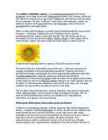
are most commonly found in valleys with wet meadows or swamps. The Giant sunflower grows between July and October. To grow well, sunflowers need full sun. They grow best in fertile, moist, well-drained soil with a lot of mulch. In commercial planting, seeds are planted 45 cm (1.5') apart and 2.5 cm (1") deep. Sunflower "whole seed" (fruit) is sold as snacks and can be processed into a peanut butter alternative, Sunbutter, especially in China, the United States, the Middle East and Europe. In Russia it is probably the most wide spread snack.[citation needed] It is also sold as food for birds and can be used directly in cooking and salads. Sunflower oil, extracted from the seeds, is used for cooking (but is less cardiohealthy than olive oil), as a carrier oil and to produce biodiesel, for which it is less expensive than the olive product. During the 18th Century, the use of sunflower oil became very popular in Europe,
1. UN as a world organization The United Nations officially came into existence on 24 October 1945, when the UN Charter had been ratified by a majority of the original 51 Member States. The day is now celebrated each year around the world as United Nations Day. The purpose of the United Nations is to bring all nations of the world together to work for peace and development, based on the principles of justice, human dignity and the well-being of all people. It affords the opportunity for countries to balance global interdependence and national interests when addressing international problems. There are currently 192 Members of the United Nations. The Aims of the United Nations:
Such a process of individuals revising their ethnic adherence, which had begun in the Middle Ages and continued until the early 20th century. Serfdom and the intensifying manorial economy The impact of the Swedish social order in Estonia continued under the Russian Empire. Although the Northern War meant a severe setback to the development of schools, the Swedish church and school systems remained practically unchanged. Most peasants learned to read at home, though the level of literacy in North Estonia was 40%, in South Estonia 55% and in Saaremaa Island 62%. The 1739 declaration of Otto Fabian von Rosen, a Livonian district magistrate, postulated the landlords' limitless right of ownership over the entire property and person of a peasant. It can be regarded as the ideal legislative model expressing the supremacy of the nobility. But everyday life during the serfdom period, which in Estonia has been researched even less than
· Brought a strong Socialist contingent to the United States; led to the formation of many Estonian American Socialist and Communist organizations. * The 1920s30s: · Establishment of independent Estonia · Tightening of American immigration laws · Estonian immigration to the United States slowed down dramatically 1924 The Estonian quota fixed at 116; even this small annual quota was not used up *After World War II = In the post World War II years, all three Baltic nations maintained consulates in the United States · About 15,000 Estonians came to the United States · This group was strongly anti-Communist and nationalistic 3. Russian colonization of America. What has preserved from this period to the present? The Russian colonization of the Americas covers the period, from 1732 to 1867, when the Tsarist Imperial Russian Empire laid claim to northern Pacific Coast territories in the Americas
jugglers?) 28. Are you good at juggling? What makes you think so? 29. Do you like aerobics? Are you good at it? Do you know anybody who is? 30. Would you like to perform in a circus? 31. Do you know anybody who might become a good clown? What must a clown be good at? 32. Have you ever played sport regularly? What training classes do you go to and how often? What sport would you like to play and why? 33. Have you ever taken part in sport competitions? When, where and what were the results? 34. Are sports days held at your school? 35. What sports events do you watch on TV? 36. Do you read the sports page in a paper? Do you watch/listen to sports news? Could you tell us the latest sports news? 37. Who is the best athlete in your class? 38. Who is your favourite athlete? What do you know about him? 39. What sports events are popular in Estonia? How many Estonian Olympic gold medalists can you name? 40. Do you think it is necessary for children to play sport? Why?
Jonathan Dekel-Chen lectures, Jews in the USSR, 1917-2000 1937 census didn't get published. 1939, pretty accurate for Js. 3.1 mill Js in pre- Molotov-Ribbentrop area. 1939, 2.2 mill. Js not shy about declaring Jewishness. Inherits 1.3 mill in Poland. Similar # annexed by Germ. 250,000 in Lithuania. 330,000 Bessarabia. Back to pre-1917 #s of Sov Jewry. 5 ½ mill of pre-war levels. Pre-mature deaths during famine of '21-'22, '31-'33, 7 years of war, emigration up to 1924 (vast majority to West, 3rd and 4th aliyahs). J pop growth still significant, high birth rates, but pop static. Grows more in SU than anywhere else few leaving, pop growth significant. Vast majority in W borderlands. Very few emigrate during year and a half from annexed areas. Germans occupied Leningrad-Moscow-Stalingrad, all and more of former Pale. 1939, started evacuating. Stalin thought 43-44, war. Purges, Winter War, military needed
The army established Roman rule in the south and SW of the country. The Romans started to introduce their laws to a new province of the Roman Empire and started to build good roads. Officials were appointed (governors, procurators to collect taxes, look after the estates and mines and se that the gold, silver, iron and lead were exported back to Rome). Introduced schools,a new language Latin, large farms (villas), baths. In AD 410 they had to leave . roman occupation lasted nearly 400 years. They left behind very little. Roman province of Britannia covered most of present-day England and Wales. 4. Latin influence on English *The influence of Latin is noticeable also in the names of European cities: the Latin noun colonia (settlement, colony) may be found in numerous place-names: Lincoln, Colchester, Cologne ; from Latin word castrum (military camp) were derived English affixes -chester and -castle:
versa for the reverse process, nuclear fission. In the simplest case of hydrogen fusion, two protons have to be brought close enough for their mutual electric repulsion to be overcome by the nuclear force and the subsequent release of energy. Nuclear fusion occurs naturally in stars. Artificial fusion in human enterprises has also been achieved, although not yet completely controlled. Building upon the nuclear transmutation experiments of Ernest Rutherford done a few years earlier, fusion of light nuclei (hydrogen isotopes) was first observed by Mark Oliphant in 1932, and the steps of the main cycle of nuclear fusion in stars were subsequently worked out by Hans Bethe throughout the remainder of that decade. Research into fusion for military purposes began in the early 1940s, as part of the Manhattan Project, but was not successful until 1952. Research into controlled fusion for civilian purposes began in the 1950s, and continues to this day.
it got its first permanent building the Kadriorg Palace, built in the 18th century. In 1929 the palace was expropriated from the Art Museum in order to rebuild it as the residence of the President of Estonia. The Art Museum of Estonia was housed in several different temporary spaces, until it moved back to the palace in 1946. In September, 1991 the Kadriorg Palace was closed, because it had totally deteriorated by then. At the end of the year the Supreme Council of the Republic of Estonia decided to guarantee the construction of a new building for the Art Museum of Estonia in Kadriorg. Untill then the Knighthood House at Toompea Hill served as the temporary main building of the Art Museum of Estonia. The exhibition there was opened on April 1, 1993. Art Museum of Estonia premanently closed down the exhibitions in that building in October 2005.
Obviously, the spreading of misinformation is self-governed within the community, and it's the responsibility of people adding ed material to ensure that the material doesn't contain misinformation. Last but not least argument that speaks for the use of blogs in education concerns the fact that blogs might serve as a link between formal and non-formal education, where students learn to learn by themselves (Lissina, 2010). Moreover, the results of Anna Lindh Euro-Mediterranean forum show that such social media tools as blogs may provide major access to educational materials and establish the environment for dialogue between the countries across the North and South of Europe (Lissina, 2010). It should also be noted that in this virtual classroom teachers will switch their roles to trainer's positions and the majority of learning process will be done by learners
and its hinterland. In addition, there were increasing numbers of Africans entering the south, as a result of the slave trade, and this dramatically increased in the eighteenth century: a population of little more than 2,500 black slaves in 1700 had become about 100,000 by 1775, far out-numbering the southern whites. [3, p.35] The nineteenth century saw a massive increase in American immigration, as people fled the results of revolution, poverty, and famine in Europe. Large numbers of Irish came following the potato famine in Ireland in the 1840s. Germans and Italians came, escaping the consequences of the failed 1848 revolutions. And, as the century wore on, there were increasing numbers of Central European Jews, especially fleeing from the pogroms of the 1880s. In the first two decades of the twentieth century, immigrants were entering the USA at an average of three-quarters of a million a year
under or unemployment 15%to 70% and the public debt grew from 240 million to 16 billion (Perkins, 2004, lk 239). This essay is going to explore how this kind of thing could have happened? The idea is not to blame well-known organizations. The idea is to observe and explain what happened to Ecuador and discuss if the criticism about this matter is grounded. In this essay author is going to use a book “ Confessions of an Economic Hitman“ by John Perkins that spent a year on New York Times bestseller list in 2004 and caused lot of discussion all over the world. Author also uses other sources what you can find from literature. In the first part author is going to write about the basics of liberalism. In the second part writer is going to give a brief overview of IMF and World Bank and the criticism about these organizations. In the third part essay explores the Ecuador case and looks it through the realism
were considered subject of international law, this was created before the collapse of the colonialized system, UN charter is a very old and stupid document, that's why there's still such a definition) Strong point of int. Conventions - it's easier to apply, no proof is needed, the rules exist in the text. However, int. Treaties and conventions are only legally binding for member states, some conventions are not applicable to everybody. Customs are compulsory for everybody, for all countries of the world. However, it's harder to apply these, because there should be a consensus that a custom is customary norm for it to be legally binding. To create a legally binding norm, two criteria: 1) should have general practice of the states (practice should be established, wide-spread and consistent; it should be a settled practice), 2) should be accepted as law, opinio juris is necessary (positive legal opinion). How such
topic of school. Both photos show page 4 6 He dropped a leaf into the water students in class. In the first photo I imagine that 1 1 ate and watched it drift under the they're about 13 years old. 2 have/'ve met bridge. It looks like a science lesson 3 have/'ve caught 7 As she got older, her health and judging by the students' 4 lived deteriorated
THE CAPITALIST NIGER Chika Onyeani ………………………Every African must internalise this book - period….DAA INTRODUCTION In October 1960, Nigeria received its independence from Britain. By then, Ghana the former Gold Coast had been independent for three years under the great Osagyefo Kwame Nkumah. It was a time for celebrating Africa’s coming of age, as more and more African countries received their independence either from Britain or France. It was especially a poignant time for Africa, as then British Prime Minister Harold McMillan articulated his now famous “winds of change” sweeping Africa. We had high hopes for Africa, for the Black race, that the insidious imposition of foreign rule on us, the looting of Africa’s
order to sneak into the castle. But, alas, the lord of the manor's son discovers the deception. He is overcome by jealous rage and orders his men to seal the girl inside the thick stone walls while still alive. Turned into an incarnation of undying love, the White Lady now appears every August, on the night of the full moon, in the Dome Church chapel window. Haapsalu is seven-and-a- quarter centuries old this year, and the townsfolk intend to make it a celebration to remember. The annual dance and light show dedicated to the Lady alone involves over 100 performers - and you'll have several chances to catch it over the four days of the event. Musical shows, dances and contests of strength and skill will be held all over town. This festival is held in August and it is said that Haapsalu, Estonia's most famous ghost, appears during this festival Black nights film festival http://www.tourism.tallinn
across the country, Canadians experience many different landscapes from rolling plains and mountains to the cold tundra of the north. Despite Canada's great size, it is one of the world's most sparsely populated countries. This fact, coupled with the grandeur of the landscape, has been central to the sense of Canadian national identity. 2. Geographical position Canada is the second largest country in the world after Russia. In the Arctic, Canada reaches almost as far north as Greenland. To the south it extends to the same latitude as southern France. The distance from Canada's west coast, the Pacific Ocean, to its east coast, the Atlantic Ocean, is farther than from North America to Europe. Canada's total land area includes thousands of adjacent islands, notably Newfoundland in the east and those of the Arctic Archipelago in the north. In
 annaabi.ee