of Rome 200 years of peace followed by 100 years of warfare in 284 AD Diocletian divided the Roman empire into two halves: East and West in 306 Constantine I declared Christianity in 401 the Visigoths invaded Italy the last emperor in Rome was deposed in 476 Ancient Egypt one of the oldest in the world and began more than 5000 years ago lasted for over 3000 years was divided into two kingdoms - Upper and Lower Egypt King Menes had conquered Lower Egypt - 'King of Upper and Lower Egypt` the age of the 1st Dynasty had begun new capital city at Memphis the 3rd Dynasty the Old Kingdom was a time of prosperity and peace by the 6th Dynasty the pharaohs had lost their influence Mentuhotep seized power and reunited the land: new capital city was built at Faiyum the power of the royal families declined once again invasion by the Hyksos followed: ruled for over 100 years Kamose led a revolt the new capital Thebes
the time of the First Republic of Estonia and is hidden behind the walls of the castle. Beginning Old legend - the hill of Toompea was heaped up, stone by stone, by Linda The earliest buildings confirmed by historical data originate from the 9th century A settlement of tradesmen and artisans began to develop at the foot of Toompea hill Farmers from the neighbouring counties, were the masters In 1219 King Valdemar II of Denmark conquered the stronghold From that time on the stronghold of Toompea belonged to foreign rulers After the subjugation, the Danes immediately set out to fortify it In the following years, the Danish stronghold was repeatedly besieged All attempts ended in failure Timeline Occupied in 1227 by the Order of the Brethren of the Sword In 1238 the rights of the Danes in North Estonia were restored and Toompea was once again ruled by Danes
Christianity in Roman Britain - Christianity became the state religion of Roman Empire in 4.century. Boadicea(Boudicca) was the queen of the British Iceni tribe who led an uprising against the occupying forces of the Roman Empire. Boudica's husband Prasutagus, ruler of the Iceni tribe, who had ruled as a nominally independent ally of Rome, left his kingdom jointly to his daughters and the Roman Emperorin his will. However, when he died, his will was ignored --the kingdom was annexed as if conquered, Boudica was flogged, her daughters were raped, and Roman financiers called in their loans. Obviously Boudicca was not happy about it and start an uprising. Boudicca's revolt was in 60-62 AD. Druids A druid was a member of a priestly class in Britain, Ireland, Gaul and possibly other parts of Celtic Europe and Galatia during the Iron Age and possibly earlier. Very little is known about the ancient druids because they left no written accounts about themselves. They were healers, teachers etc
History The history of England began with the arrival of humans thousands of years ago In AD 43 the Roman conquest of Britain began; the Romans maintained control of their province of Britannia through to the 5th century. The Roman departure opened the door for the Anglo-Saxon invasion Raids by the Vikings were frequent after about AD 800, and the Norsemen took control of large parts of what is now England In 1066, the Normans invaded and conquered England. 1348 was the Blach Death, which killed half on England population During the Renaissance, England was ruled by the Tudors England had conquered Wales in the 12th century and was then united with Scotland in the early 18th century to form the Kingdom of Great Britain Following the Industrial Revolution, Great Britain ruled a worldwide Empire, the largest in the world in the 20th century the vast majority of the empire became independent
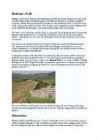
Solway Firth. The A69 and B6318 roads follow the course of the wall as it starts in Newcastle upon Tyne to Carlisle, then on round the northern coast of Cumbria. The Wall is entirely in England and south of the border with Scotland by 15 kilometres (9 mi) in the west and 110 kilometres (68 mi) in the east. Hadrian Hadrian's Wall was built following a visit by Roman emperor Hadrian (AD 76138) in AD 122. Hadrian was experiencing military difficulties in Britain, and from the peoples of various conquered lands across the Empire, including Egypt, Judea, Libya, Mauretania, and many of the peoples were conquered by his predecessor Trajan, so he was keen to impose order. However the construction of such an impressive wall was probably also a symbol of Roman power, both in occupied Britain and in Rome. Frontiers in the early empire were based more on natural features or fortified zones with a heavy military presence. Military roads or limes often marked the border, with forts and signal
For over three centuries Western Europe was raided by the Vikings. The Vikings who had settled down in England had mixed with the Anglo-Saxons. They lived under the rule of the English kings. In the 9th century a territory in northern France was conquered by another branch of the Vikings. That territory was called Normandy. They took over the French coustoms,traditions and language. The Normans lived under the rule of their own duke. By the 11th century the dukes of Normandy had become very powerful. Altought the kinf of France was their lord, they were very independent. William was the Duke of Normandy when the English king Edwar died. William had promised him that he'll be the next king. But there
third time 58 BC consul Pison's daughter Calpurnia. Children Own his daughter Julia Cleopatra, Caesar. he gave wife to Pompeius. He put Cleopatra on the throne oh Egypt, with who he had son Caesar, who was born in 47 BC Power Julius Caesar was the Julius Caesar most famous Roman speachman. He conquered Gallia and was the firsti Roman commender who tired conquer the Britain. Conclusion Now I know much more about Julius Caesar and his children and power. References http://et.wikipedia.org/wiki/Julius_Caesar http://www.vroma.org/~bmcmanus/caesar.html http://www.bbc.co.uk/history/historic_figures/caesar_julius
Robert inherited Normandy, while William became king of England. Died from injuries EDWARD V He and his brother Richard were murdered in the Tower of London Alfred the Great - King of Wessex (part of England). All British modern British monarchs trace from the Wessex line. William I, the Conqueror. Founder of the modern British state. Henry II - added Ireland the British possessions John I - signed Magna Carta, the beginigs of the British constitution Edward I - conquered Wales Edward III - started 100 years war Henry V - Last great warrior king Henry VIII - Broke England away from Catholic church. Elizabeth I - laid the seeds of the British Empire, and tons of other stuff James I - Was King James VI of Scotland, inherited throne from Elizabeth I, united England and Scotland Charles I - Overthrown by Parliament and executed. Replaced by a republic Charles II - son of above, put on throne after republic turned out to be a really bad idea.
The truth pushes our world forward 1. Truth has helped us to study and learn more about our world, not like religion and bible have done. Religion did not let science to evolve, but thanks to the sciences like Galileo Galilei science evolved because he was brave enough to say that earth is not the centre of the world. 2. Truth always comes out, Crusade wars began because of Turks conquered the holy lands and mistreated the Christians not because Christians wanted to increase their religion that happened later after the Crusade wars. 3. The Bible put humans to believe that we all are Childs of Adam and Eve but in fact humans evolved from apes and the truth helped the science to find the real origin of people. 4. Many people say that they have seen UFO-s but most of us do not believe them and the truth of alien
Towns in Roman Britain Ingrit Roosileht 7.Klass 2013 Roman roads The Romans built Britain's first towns. They built towns all over Britain as centers to administer the people they had conquered. Within 17 years of the invasion, they had several major towns connected by the famous Roman roads. Towns soon became important places for meetings and trade. What were Roman towns like? v The Roman towns were full of fine buildings and temples. v Streets were laid out in neat, straight lines, like on a chess- board. In the middle there was a large square, called the forum v Many towns had running water and sewers. Aqueducts were
into a series of holes on a golf course using the fewest number of strokes. While the modern game of golf originated in 15th century Scotland, the game's ancient origins are unclear and much debated. Some historians trace the sport back to the Roman game of paganica, in which participants used a bent stick to hit a stuffed leather ball. One theory asserts that paganica spread throughout Europe as the Romans conquered most of the continent, during the first century BC, and eventually evolved into the modern game. A golf course consists of a series of holes, each with a teeing ground that is set off by two markers showing the bounds of the legal tee area, fairway, rough and other hazards, and the putting green surrounded by the fringe with the pin (normally a flagstick) and cup. A typical golf course consists of 18 holes, but nine-hole courses are common and can be
governed by the King. That ensured more settlers to come to New France. Still, by 1700, New France was not a great farming colony like the King had wanted and France didn't also have money or the time to spend on that colony. France and Britain didn't have good relations; they fought over colonies, fur trade and religion. In 1756 Seven Years' War started between them. The British colonists wanted new farmland and French fur traders had forts, which they refused to move. By 1758, the British had conquered the French fortress of Louisbourg at the entrance of the St. Lawrence River. This was the beginning of the end for French rule in North America. In September 1759, the British attacked the French on the Plains of Abraham and won. The following spring they also conquered Montreal. The British renamed the new French-speaking region Quebec. They allowed the French to keep their Roman Catholic religion, civil law system and language, so that they would not try to break away from Britain.
5th century. Old English · 450-1100 AD · The Germanic tribes spoke similar languages which developed into Old English · Did not sound or look like English today · About half of the most commonly used English words have Old English roots · Be, strong, water Part of Beowulf, a poem written in Old English. Middle English · 1100-1500 · In 1066 William the Conqueror, the Duke of Normandy (part of modern France), invaded and conquered England · The new conquerors (called the Normans) brought with them a kind of French, which became the language of the Royal Court, and the ruling and business classes · The lower classes spoke English and the upper classes spoke French · In the 14th century English became dominant in Britain again, but with many French words added An example of Middle English by Chaucer Early Modern English · 1500-1800 · The Great Vowel Shift · Many new words and phrases entered the language
SCOTLAND 1. What is the capital of Scotland? The capital of Scotland is Edinburgh. 2. What is the population of Scotland? 2008 estimate is 5, 168, 500. 3. Why isn't S an independent country? Because it's part of the United Kingdom. 4. Did the Romans conquer Scotland? No, the Romans never conquered Scotland. 5. Why did they build Hadrian's wall? They built it to protect thei Empire south of the Scottish border. 6. When were S and England united? Why? Because there were many wars between them and in 1603 the Scottish kind James VI, became King of England and a century later they were united because of that. 7. Who's Robert Burns?' He's the national poet of Scotland. 8. When and how do Scottish celebrate Burns Night? (What do they do on that day?)
Estonia was settled near the end of the last glacial era, beginning from around 8500 BC. Before the Germans invaded in the 13th century proto-Estonians of the Ancient Estonia worshipped the spirits of nature. Since the Northern Crusades Estonia became a battleground for centuries where Denmark, Germany, Russia, Sweden and Poland fought their many wars over controlling the important geographical position of the country as a gateway between East and West. Being conquered by Danes and Germans in 1227, Estonia was ruled initially by Denmark in the north, by the Livonian Order, an autonomous part of the Monastic state of the Teutonic Knights and Baltic German ecclesiastical states of the Holy Roman Empire. From 1418–1562 the whole of Estonia was part of the Livonian Confederation. After the Livonian War, Estonia became part of the Sweden from the 16th century to 1710/1721, when it was ceded to the Russian Empire as the
Swansea(1969 to mark the investiture of the Prince of Wales.) Bangor Newport(the latest,marking the Queen`s Golden Jubilee in 2002,today a centreof high technology industry) NAME The name Wales comes from the Cymraeg word Gwalia, meaning in English "Homeland". It later became Latinized as Walia, then by the Normans to something like Wal~es....then Wales. Wales has not been politically independent since 1282,when it was conquered by King Edward I of England. Until 1999,Wales was ruled directly from London;that year saw the first elections to the National Assembly of Wales,which has limited domestic powers and cannot make law. Wales doesn`t issue its own currency and isn`t in control of any armed forces.These are the powers of the national government of the UK. SPORT Cricket Rugby Boat race Boxing day hunts Horse racing Polo Bowls Darts
the 9th century when ancient Estonians took advantage of the steep escarpment of Toompea and erected here their ancient stronghold of Lindanisa, one of the best-protected strongholds in Estonia. A settlement of tradesmen and artisans began to develop at the foot of Toompea hill. Farmers from the neighbouring counties, mainly from Rävala County, were the masters of Toompea stronghold and used it only in the event of danger. This also explains how in 1219 King Valdemar II of Denmark conquered the stronghold with ease. From that time on the stronghold of Toompea, and about ten years later the whole of Estonia, belonged to foreign rulers until the Republic of Estonia established its centre of power on Toompea in 1918.
HAAPSALU By Marika Form 7 HAAPSALU Seaside resort town located on the west coast of Estonia Administrative centre of Lääne County Population - 11,618 Tallinn 100 km away White Lady Western Region Administrative Centre Area - 10,59 km2 HISTORY The German Knights of the Sword conquered this region in 1224, and Haapsalu became the bishop's residence, with a fortress and cathedral built soon afterwards. The Danes took control during the Livonian War then the Swedish had their turn in the 17th century, but they lost it to the Russians during SYMBOLS Flag-blue and white, the flag is confirmed on 27 September 1994 Coat of arms- of the 27th confirmed September 1994 NATURE A few rivers and lakes A lot of deciduous trees and coniferous trees Lakes- Vaikeviik lake
executioner in his earlier life.They failed, perhaps because the monk's ghost must have spoken Latin. As Tallinn has two "legs" of different length, it is sometimes humorously called "a limping town". Right from the Danish Conquest Toompea started to develop into the centre of provincial authority, clergy and nobility in Northern Estonia. Most of the vassals chose Toompea for their residence – living in their estates in the conquered countryside was deemed too dangerous; by the end of the 13th century the Great Castle was densely populated. Toompea has a radial net of streets – all streets start at the Dome Church Square and stretch to the walls of the fortifications. In 1684 Toompea suffered the most devastating fire of its history. Toompea had been affected by fires in earlier years, but the fire of 1684 was much larger in scale, destroying most of the buildings in the Great Castle, including the cathedral
Such as church organ, piano and expanded drum kit. Discography Muutke teksti laade Teine tase Released in September 2003. Kolmas tase Neljas tase This was their first debut album which Viies tase conquered UK charts and placed on the first place and they had 4 songs in TOP20.Band started touring around the world and played their first big gig, Glastonbury 2004. After that concert Dominic´s father, who attended festival, died from a heart attack.
The Great Wall UNESCO World Heritage Sites The Statue of Liberty Names: Kaspar- Eerik Maarand Ingmar Tamsalu Origin and history of The Great Wall Several walls were being built as early as the 7th century bc, the most famous wall was built during 220-206 bc King Zheng conquered the last of his opponents and unified China as the First Emperor of the Qin dynasty. He ordered the building of new walls to connect the remaining fortifications along the empire's northern frontier. ● The great wall was built when seven powerful states appeared at the same time, to defend themselves. At that time the wall was 3107 miles and each part of wall belonged to different part of the states. In 221B.C the Emperor Qin Shi Huangdi ordered to connect
At that time the region was divided into small pagan states. Beginning in 1202, an order of German crusading knights from Livonia (Latvia) joined with the Danes to conquer and 2 Christianize the Estonians. By 1227 the Danes controlled northern Estonia; the Livonian Knights, southern Estonia. The Teutonic Knights, another German crusading order, gained control of southern Estonia in 1237 and later conquered all of Estonia. The Teutonic Knights withdrew from Estonia in 1560. Sweden and Poland then fought for control of Estonia; in 1629, Sweden won and annexed the region. Peter I of Russia conquered Estonia in 1710, and in 1721 Sweden formally recognized Russian possession of the region. Russia remained in control of Estonia until shortly after the Bolshevik revolution of 1917. At the treaty of Brest-Litovsk the following year, which brought an end to
In Old Gutnish it was Dagai (day isthmus), from which the local North Germanic name "Daë" is derived. History Archaeological evidence of the first human settlement in Hiiumaa dates to as early as the 4th century BC. The first documented record of the island of Dageida was made by contemporary chroniclers in 1228, at the time when Hiiumaa, along with the rest of Estonia, had been conquered by Germanic Crusaders. In 1254, Hiiumaa was divided between the Bishoprick of Ösel-Wiek and the Livonian branch of the Teutonic order who were also partly acting on behalf of the Hanseatic league The island was part of Swedish Estonia from 15631720, after which it passed to the Russian as part of the Governorate of Estonia, although Dagö's Swedish population kept most of their privileges. Most of the island's
read and write A wise ruler Encouraged the formation of fortified towns Established schools Translated books from Latin The story of the burning of the cakes Danish raids The name "England" first used in 973 (Edgar becomes king of nearly all of present-day England) A new wave of raids in the 980's In 991 a decision to buy off the raiders Danegeld A dangerous precedent Good money for just showing up Conquered England at the beginning of the millennium Canute The greatest ruler United England, Denmark and Norway After his death, the son of the overthrown Anglo-Saxon king returned The Danes and the Anglo-Saxons The cultural differences relatively small Similar way of life Different varieties of the same Germanic language The Danes soon converted to Christianity By the end of the 10th c, England was a united kingdom with a Germanic
an overdose of wedlock. In the Olympic Games, Greeks ran races, jumped, hurled the biscuits, and threw the java. The reward to the victor was a coral wreath. The government of Athen was democratic because the people took the law into their own hands. There were no wars in Greece, as the mountains were so high that they couldn't climb over to see what their neighbors were doing. When they fought the Parisians, the Greeks were outnumbered because the Persians had more men. Eventually, the Ramons conquered the Geeks. History call people Romans because they never stayed in one place for very long. At Roman banquets, the guests wore garlic in their hair. Julius Caesar extinguished himself on the battlefields of Gaul. The Ides of March killed him because they thought he was going to be made king. Nero was a cruel tyrany who would torture his poor subjects by playing the fiddle to them. Then came the Middle Ages. King Alfred conquered the Dames, King Arthur lived in the Age of Shivery, King
Likewise, the three Baltic countries are situated in the area which has been frequented by hostile conquerors in several hundreds of years. During the past centuries the indigenous nations of the Baltic States have developed deep distrust against their neighbours no matter how well-intentioned they try to appear. As we know, quite a few empires have used Messianism as a weapon to serve their own interests. As a rule, the powerful states make an effort to convince the conquered states of the fact that they actually provide support to the little ones who would not be able to survive without them. In case one of these small countries succeeds in gaining independence, the fear of possible occupation in future still remains. As for the problems of integration of the Russian community in the Republic of Estonia, it is very likely that the xenophobia of the local population has brought about the development of the closed Russian community.
From the late 19th century the Second Industrial Revolution in the United States and the German Empire presented an increasing challenge to Britain's role as leader of the global economy. The flag of the United Kingdom is the Union Flag (also referred to as the Union Jack). It was first created in 1606 by the superimposition of the Flag of England on the Flag of Scotland and updated in 1801 with the addition of Saint Patrick's Flag. Wales is not represented in the Union Flag as Wales had been conquered and annexed to England prior to the formation of the United Kingdom; the possibility of redesigning the Union Flag to include representation of Wales has not been completely ruled out.[436] The national anthem of the United Kingdom is "God Save the King", with "King" replaced with "Queen" in the lyrics whenever the monarch is a woman. Britannia is a national personification of the United Kingdom, originating from Roman Britain.
Lembitu was killed. · Ancient Estonian fight for independence. http://wapedia.mobi/thumb/4176501/en/fixed/470/376 /Danmarks_flag_1219_Lorentzen.jpg?format=jpg Click icon to add picture Danish Estonia · Conquered by Danish king Click icon to add picture Waldermat II · The Danish Army defeated the Estonians at the Battle of Lyndanisse. · The Estonians of Harria started a rebellion in 1343- St. George's Night Uprising. http://ts1.mm.bing.net/images/thumbnail.aspx? q=819230880636&id=9318fc57fdc860ec1be51 52b3d56ff20
the Parliament that the enemy had successfully been driven out of Estonian territory. Though the Red Army was continuously supplemented it could not stop the Estonian armed forces. On counterattack the Estonian army took 6,000 prisoners of war and more than 40 cannons. The successful offensive also greatly helped Estonia's neighbors Latvia and Lithuania. On May 12, 1919 the Estonian army went on a decisive offensive and conquered Pskov on May 25. The ostentatious attack of the Red Army towards the West had failed and Soviet Russia was forced into defensive warfare. Estonia was not alone in the War of Independence. Great Britain was the first to answer Estonia's call for help and sent her naval squadron to Tallinn on December 12, 1918. This provided coastal defence until Estonia could build her own navy. The British fleet also brought armament and other military equipment for Estonia. The United States of America
• Estonia was settled near the end of the last glacial era, beginning from around 8500 BC. Before the German invasions in the 13th century proto-Estonians of the Ancient Estonia worshipped the spirits of nature. Since the Northern Crusades Estonia became a battleground for centuries where Denmark, Germany, Russia, Sweden and Poland fought their many wars over controlling the important geographical position of the country as a gateway between East and West. Being conquered by Danes and Germans in 1227, Estonia was ruled initially by Denmark in the north, by the Livonian Order, an autonomous part of the Monastic state of the Teutonic Knights and Baltic German ecclesiastical states of the Holy Roman Empire. From 1418–1562 the whole of Estonia was part of the Livonian Confederation. After the Livonian War, Estonia became part of the Swedish Empire from the 16th century to 1710/1721, when it was ceded to the Russian Empire as the result
wall, it could take hundreds of years at the time of the various emperors. Machu Picchu Machu Picchu ("Old Mountain" in Quechua language, often called "the lost Inca City") is a location of pre-Columbian Inca ruins located in the mountains at an altitude of about 2350 m. above sea level. Is above the Urubamba Valley in Peru, about 70 km northwest of Cusco. It is a symbol of the most famous Incan Empire. Built in about 1450, but abandoned a hundred years later, when the Spaniards had conquered the Incan Empire. Petra It is an archaeological site in Jordan, located in the lowlands between the mountains which form the eastern wing of Wadi Araba, the large valley originated from the Dead Sea to the Gulf of Aqaba. Petra is a city founded by carving the stone walls in Jordan. Symbols and protection techniques. The town was founded by multiplying and carve the rock at 40 meters. Petra was the capital of Nabatean kingdom. Founded in 9SM-40M by King Aretas IV as we that are difficult to
diaper from d'Apres). The shirt, nightdress, bed tick, pocket handkerchief, tablecloth and napkin were invented in Holland, along with starch. (7) 6 Chapter 2 The history of the Netherlands 2.1 1st dated historical facts Historical accounts of the Netherlands date from the 1st century BC, when Roman forces led by Julius Caesar conquered most of the present area of the country. At the time the region was inhabited by Frisians, a Germanic tribe that lived in the north, and by other Germanic and minor Celtic tribes. (3) 2.2 The Roman Era Before the conquest, the Romans had annexed lands to the southeast extending beyond the Rhine River. They penetrated the Netherlands region mainly to control the several mouths of the Rhine, which were then farther to the north than they are now. Under Roman rule, general
a ragged resistance movement forms. Random acts of sabotage occur against soldiers and the coal mine. The invaders, under orders from above, impose repressive measures to keep the production going. Their commander follows his order knowing that, in fact, there is little hope of stopping the sabotage for more than a few days at a time. The conquerors say of themselves and their futile efforts to defeat the undefeated motivation of the townspeople, "The flies have conquered the flypaper!" Soon, all semblance of harmony is ended. The occupiers feel isolated and surrounded by hate. Coal production grinds to a halt due mostly to the fact that "Allied" planes have been dropping sticks of dynamite for the people to use to sabotage railroads, food supplies, power sources, and the mine itself. And as several of the invaders are murdered, they begin to realize that their hopes to be accepted as good men bringing a glorious New Order are coming to naught. The townspeople
In 1215 King John was forced by the Barons to sign the Magna Carta, which was a collection of 37 English laws. The purpose of the Magna Carta was to curb the King and make him govern by the old English laws that had prevailed before the Normans came. King John's reign lasted until 1216. Then the power was taken over by his son King Henry III. He leaded England for a very long time, until 1272. He was succeeded by his son Edward I. Edward I conquered Wales in 1284. He also tried to conquer Scotland and it even went right for him but only temporarily. Under the direction of Robert Bruce Scotland managed to restore its independence. In 1307 he was succeeded by Edward II, his son. In 1311-1315 there was the Great Famine. There was a series of cold and wet springs and early winters that reduced harvests throughout western Europe, and by the Spring of 1315, about ten percent of the population had died of
*Estonians conquered by the crusaders 1208 *Reformation 16th century establishments of new school, Estonians first book appeared in 1525 *Tartu University 1632 founded by King Gustavus II Adolphus, classical university, member of the Coimbra group *Abolition of serfdom 1816 *Song festival 1869 in Tartu, an organiser was J.V.Jannsen, 822 singers, men only *Declaration of independence 24th February 1918 *War of independence 1918-1920 during the Russian Civil War, resulted in a victory for Estonia *Deportation 1949 *Estonia becomes independent 20th August 1991 *Joining EU 1st May 2004 Language: Estonian language, belongs to the Balti-Finnic group of the Finno-Ugric languages, closely realted to Finnish and rather remotely to Hungarian; Latin alphabet with 32 letters , 5 of which occur only in foreign words, the phenomes include 9 vowels and 18 consonants; words are borrowed from Latin, Greek, English etc.; sinc...
The early middle ages The Norman Conquest Since William was crowned king, there were many rebellions against the Normans. A small Norman army marched from village to village and destroyed the ones it couldn't control. The Normans took away the Saxon lords' land. Only a few Saxons who supported William could keep their land. Feudalism William gave parts of his conquered land to his captains around the country to avoid rebellions and uprisings. He also kept some land to himself to make sure his was much stronger than his nobles. Of all the farmland half went to his nobles, quarter to church and fifth he kept to himself. William organised the English kingdom according to feudal system. The main purpose of using that system was economic. King gave the land to "vassals" in return of army services and goods. When a noble dies, his son took over the estate
Kas teil on seda M suurusele? This top is too tight for me. Do you have it in size M? 4 Minu toas ei ole palju mööblit. There isn't much furniture in my room. 5 Kas sa sageli loed interneti kommentaare? Do you often read online comments? 6 Kas sa tead, kuidas internetis käituda? Do you know how to behave on the Internet? 7 Paljud inglisekeelsed sõnad on ladina päritolu. A lots of English words is of Latin origin. 8 Sakslased vallutasid Eesti 13. sajandil. The Germans conquered Estonia in 13th century. 9 Ei ole hea mõte tema eeskuju järgida. It is not a good idea to follow his example. 10 Turvamees peatas mind, sest ma olin unustanud kauba eest tasuda. The security guard stopped me because I had forgotten to pay for the goods. _______________________________________________________________
8th century = raids by the Vikings and the Danes 1016 1042 : Under Danish rule ( York was the capital ) 1042 : local AngloSaxons regain their rule 1066 : Normans arrive ( the Norman conquest ) Medieval Britain (106615th c.) the Battle of Hastings William the Conqueror a new AngloNorman state the feudal system introduced the rule of the king and church strengthened centralised country, military rule Scotland, Wales and Ireland conquered Norman castles built spoke Norman French 1170 the murder of Archbischop Thomas a Becket in Canterbury Cathedral ( the religious centre of England & the Anglican church of the whole world ) late 12th century : Robin Hood 1215 the Magna Carta ( personal and political liberty, signed by the king & the barons ) The first legal document! 1337 : the Hundred Year's War 1348 the Black Death
groupings. At the top of the social pyramid were the peninsulares: European born Spaniards. Next were the criollos: Spaniards who had been born in New Spain. Next were the mestizos: people who had mixed Spanish and native parentage. At the bottom were the indigenous peoples. From Madrid's point of view, New Spain was important as a source of valuable resources, primarily silver, from which the crown took its "royal fifth." The individual soldiers that conquered New Spain sought personal gain initially in the form of plunder and later in the form of encomiendas. An encomiendero was a person who was granted authority over a tract of land and all of the people living on it. The encomiendero was responsible for the welfare of the people under his charge and, in return, the people in the encomienda were required to provide him with tribute and free labor. The encomienderos, akin to feudal lords, quickly became an important
The history of England from Caesar's invasion until 731. · Aelfric a monk who lived in the 11th century. · Alfred, King of Wessex (at one point there were 7 kingdoms Sussex, Essex, Wessex, Northumbria, Mercia, East Anglia, Kent). Wrote in his native A-S dialect, his greatest work is called ,,The Anglo-Saxon Chronicle". History of England, even more detailed than Bede's. The Norman period / the late Medieval period The Kingdom was more or less unified and was conquered by William who came from Normandy. Originally he was the Duke of Normandy. The Normands were Vikings who had settled in the north of France. William became William the Conqueror, William I. The Normands brought with them a centralised political system which was much more stable than the A-S tribes. Gradually the old A-S elements fused with the new Normand elements. Under the Normands the feudal system flourished. The new aristocracy was mostly Normand, many of them of French origin
· Overtaxing England for war against France · Lost the war · Result: a revolt of the English barons · Forced John to sign the Magna Charta in 1215 · Not even the King was above the law · No free man could be arrested without due process of law and a trial Edward I · Reigned 1272-1307 · Known as Edward Longshanks and the Hammer of the Scots · A strong king · Re-established royal authority over the nobles · Conquered Scotland and Wales · Remembered for his governmental reforms · The evolution of Parliament · Originally, parliament was any meeting of the king and his vassals to talk (parley), usually over taxes · Negotiating taxes with each town and shire was difficult · Called the Model Parliament in 1295 · Representatives from all three estates Parliament · Parliament became important for a couple of reasons:
Tallinn was first mentioned in the historical books of the Arabic geographer. If the primeval city walls could talk, they would tell us stories better than any adventure book. The walls have seen it all: the black pestilence, the great fire of Tallinn and brave warriors. Many big and powerful countries have conquer Estonia, but Estonia has always fought for their freedom. Many legends are related to those countries who have conquered Estonia. For example, Danish, Russia and Germany. There are many legends of tallinn. For example Linda's rock, Old Thomas, Old Man of Ülemiste Lake , St. Olav's Church and Reval. 2 Legend of St. Olav's Church In old times, when Estonia was small country, people often thought of how to raise the importance of the city. City residents wanted that their city became big and famous. Citizens come to idea to build big church
woodland, pasture, weapons, iron objects, langugae, culture Caesar in Britain The great Roman Emperor Firts came 55 BC to gather information, celts were doing agriculturally well,so romans wanted to get some food too In 54BC Caesar defeated Cassivelaunus Actual reasons why he made expeditions are unknown or wheteher he wanted to intend conquest The Roman Occupation 43-410 43 AD Emperor Claudius conquered Britain, it was easy, romans were more skilled and betetr equipped. Romans faced assaults of Picts, Scots, barbarians. 406-7 barbarians begin invasion Legacy- new types of animals, plants; miles, feet, inches-roman measurements;christianity; Roman basilica in curches; reading, writing; buildings, roads Christianity in Roman Britain Until 4th C christians were persecuted 313 AD Emperor Constantine legalised christianity
originally decorated the Parthenon and other buildings on the Acropolis of Athens. · Pyramids, obelisks eclecticism (was trendy, those things were built again) · Philhellenism - Hellas (Greece) Philia (Love) a love for Greece; lords gave money to the people of Greece to fight against the Ottoman empire · New awareness of Greek Heritage the Ottoman (Turkish) empire had subdued (conquered) Greece 1821 revolt against them (Supporter Lord Byron) · Nationalistic pride takes over by 1830s Gothic as the national style 5. The Grand Tour as the main source of inspiration and part of education The Grand Tour was a pilgrimage. Young men (later women also) got to know the history, especially the Renaissance. During that trip, they also learned different skills that prepared them for a leadership position at home. Only the wealthy could afford that
They fought over colonies and areas in that war. By 1758 the British had captured the French fortress of Louisbourg. It was an important position for the British to acquire because it guarded the entrance of the St. Lawrence river. This marked the beginning of the end for French rule in North America. In 1759 a famous battle on the Plains of Abraham just outside of Quebec City was fought. Yhe British were victorious and on the following spring they conquered the last French stronghold Montreal. At the present day more than five million French-speaking peole live in the Quebec province. Even today there are tensions bettween the British people and the French people and it threatens the unity of Canada. When the British took over they didn't change much in French traditions. They allowed the French peole to keep their religion, civil law system and language. The British didn't want any French people to try to break away from Britain.
Medieval England 1066-1485 Eva Asper Anna Pohlak 11.c The Norman Dynasty The Norman Conquest In the 11th century, Normans conquered England - The Battle of Hastings 14.10.1066 The Anglo-Saxon forces had more soldiers but the Normans had better military tactics and won in the end thanks to a clever strategy William I, also known as William the Conqueror, replaced King Harold on the throne The invasion was completed by 1071 - The Norman invasion is depicted on the Bayeux Tapestry a long embroidered cloth The death of King Harold embroidered on the Bayeux Tapestry
´the City` which is the business and financial heart of the United Kingdom, and the City of Westminister, where the Parlament and most of the government offices are located. Also the Buckingham Palace, the official London residence of Queen and the Royal family are located there too. London was founded by the Romans in AD 43 and was called Londinium. In AD 61 the town was burnt down and when it was rebuilt by the Romans it was surrounded by a wall. When William the Conqueror conquered England in 1066 he made London his base. He built the Tower of London and was crowned in Westminster Abbey. During the Tudor period London became an important economic and financial centre. 1666 was the Great Fire of London, which destroyed most of the city, after the fire many buildings were built in a much safer way. During the Victorian period London was one of the most important centres of the Industrial Revolution and the centre of the British Empire
critisizes the society and politics with the use of sarcasm Dickens symphatizes with the poor and implies that their woes result from society's unfairness not their own failings Wealthy people are mostly pictured harsh, selfish, cruel and heartless ,,Subdue your appetites, my dears, and you've conquered human nature." ,,Dignity, and even holiness too, sometimes, are more questions of coat and waistcoat than some people imagine."
when it became an official Roman municipality. For this reason, Ibiza today offers excellent examples of late Carthaginian-Punic civilization. During the Roman Empire, the island became a quiet imperial outpost, removed from the important trading routes of the time. After the fall of the Roman empire and a brief period of first Vandal and then Byzantine rule, the island was conquered by the Moors, as well as much of the Iberian peninsula. Under Islamic rule, Ibiza came in close contact with the city of Dénia (the closest port in the nearby Iberian peninsula, located in the Valencian Community) as the two areas were administered jointly by the same taifa. Moreover, the tribes who lived in Ibiza and Denia during the period 10601085 were Moorish tribes named Bno-Alaglab & Bano- Mujahed. Geography
the Empire days, when it became an official Roman municipality. For this reason, Ibiza today offers excellent examples of late CarthaginianPunic civilization. During the Roman Empire, the island became a quiet imperial outpost, removed from the important trading routes of the time. After the fall of the Roman empire and a brief period of first Vandal and then Byzantine rule, the island was conquered by the Moors, as well as much of the Iberian peninsula. Under Islamic rule, Ibiza came in close contact with the city of Dénia (the closest port in the nearby Iberian peninsula, located in the Valencian Community) as the two areas were administered jointly by the same taifa. Moreover, the tribes who lived in Ibiza and Denia during the period 10601085 were Moorish tribes named Bno Alaglab & BanoMujahed. The island was reclaimed for Christendom by Aragonese King James I of Aragon in 1235
 annaabi.ee