Leidsid 33 sarnast õppematerjali, mis on seotud failiga "Anthropology and Tourism". Need materjalid aitavad sul teemat sügavamalt mõista.
tour, travel, tourism, male, female, tourist, adventure, women, cultural, anthropology, madli, these, activities, experience, there, local, country, egypt, bhutan, different, place, other, east, between, likely, seek, holiday, instance, travelling, traveler, arab, paragraph, similar, leisure, solo, difference, western, impact, arrivals, studiesAdventure Tourism Project Management Madli Tuvike There is no such thing as a totally sustainable tourism (Swarbrooke, 1999). Tourism as one of the leading industries in the world is contributing to sustainable development (Mintel, 2005). Tourism needs to cope with changing world and world order, also trends that are occurring. Sustainable tourism is one rising industry in tourism market. Swarbroke (1999) and David (2011) are suggesting that sustainable tourism and sustainability is taking wider part in tourism industry. Moreover, Mintel (2005) states that tourism contribution to sustainable development is being recognised increasingly by governments and international organisations. In addition, United Nations World Tourism Organization (UNWTO, a.i.) states that tourism nowadays takes full responsibility of impacts that it is making, such as current and future economic, social and environmental
This is a post-refereeing final draft. When citing, please refer to the published version: Cohen, S.A. (2011). Lifestyle travellers: Backpacking as a way of life. Annals of Tourism Research, 38(4), 1535-1555. DOI: 10.1016/j.annals.2011.02.002 LIFESTYLE TRAVELLERS: Backpacking as a way of life Scott A. Cohena Bournemouth University, United Kingdom a corresponding author: School of Tourism, Dorset House, Talbot Campus, Poole, Dorset, BH12 5BB, United Kingdom. Tel: +44 1202 961261 Fax: +44 1202 515707 Email: [email protected] ABSTRACT Scholarship on backpackers speculates some individuals may extend backpacking to a way of life. This article empirically explores this proposition using lifestyle consumption as its framing concept and conceptualises individuals who style their lives around the enduring practice of backpacking as ‘lifestyle travellers’
direction of a purchase decision and of using and evaluating products and services (Moutinho, Ballantyne & Rate, 2011, p. 83) The nature of consumer behavior is focusing on when, why, how and where people do or do not buy products. It blends elements from psychology, sociology, social anthropology, and economics. It attempts to understand the buyer decision making process, both individually and in groups. It also tries to assess influences on the consumer from groups such as family, friends, reference groups and society in general (Sandhusen, 2000, p. 218, 219) The study of individuals, groups, or organizations and the processes they use to
office: Mortimer House, 37-41 Mortimer Street, London W1T 3JH, UK Perspectives: Studies in Translatology Publication details, including instructions for authors and subscription information: http://www.tandfonline.com/loi/rmps20 When `we' are `the other'. Travel books on Romania as exercises in intercultural communication a Rodica Dimitriu a Department of English , Alexandru Ioan Cuza University of Iaþi , Romania Published online: 06 Aug 2012.
Traveling Description Traveling is the movement of people or objects (conveyances) between relatively distant geographical locations. Travel may occur by human-powered transport such as walking or bycycling, or with vehicles, such as public transport, automobiles, trains and airplanes. Etymology The term "travel" originates from the Old French word travail. The term also covers all the activites performed during a travel (movement). A person who travels is spelled "traveler" in the United states, and "traveller" in the United Kingdom. Purpose and motivation Reason for traveling include recreation, tourism or vacationing, research travel for gathering information, for holiday to visit people, volunteer travel for charity, migration to begin life somewhere else, religious pilgrimages and mission trips, business travel, trade, commuting,
Traveling There are many ways how to travel in the world. For example some people like to travel in their own country, other people like to travel trough the world and visit different exotic places. There are also different reasons for travelling. Some travel to learn more about other cultures, learn about other countrys history.Others might travel just to have some fun and meet new people, visit friends and family or just for business.The most common ways to travel are by plane,by car,by train or by bus. Travelling has many positive sides. When people have traveled to a completely different country, then they can compare the life in their own country and the country they are visiting. It makes people see how they can enjoy their life more. Visiting other places also is very good for practicing
The traveler sees what he sees, the tourist sees what he has come to see To most people, the words tourist and traveler have the same meaning - a person visiting a foreign country to see what it has to offer. However, for people in the travel community these titles may have vastly different meanings. For many, when hearing the word tourist, a stereotypical picture comes to mind: a person with cargo shorts, a hawaiian shirt, a huge hat and sunglasses with a camera around their neck and map in hand. That is rather common amongst tourists, wearing what’s comfortable and they’d wear at home and not putting much effort into blending in. Their trips are usually planned to the T, leaving no room for any spontaneous adventures that might come up along the way. They
BEDOUINS REFERAAT Õppeaines: INGLISE KEEL Arhitektuuri- ja keskkonnatehnika teaduskond Õpperühm: TÖ 21A Juhendaja: M.Kala Tallinn 2009 1. Who are bedouins? Bedouins are Arabic speaking nomadic tribes that originate from the Arabian Peninsula (mainly Saudi Arabia) and would travel the desert to locations where they would find drink and food. Sometimes traveling for days before they arrived at their final destinations. Each tribe would have an area of land under their responsibility from which they would make income by allowing travelers and traders to pass through. As knowledgeable guides of the desert they controlled the desert trade routes, and escorted caravans. Table 1. Bedouin
A royal commission investigating the 1938 riots recommended an increase of economic development funds and a faster restoration of representative government for Jamaica. In 1944 universal adult suffrage was introduced, and a new constitution provided for a popularly elected house of representatives. Economy Jamaica is a mixed, free-market economy with state enterprises as well as private sector businesses. Major sectors of the Jamaican economy include agriculture, mining, manufacturing, tourism and financial and insurance services. Tourism and mining are the leading foreign exchange earners. Supported by multilateral financial institutions, Jamaica has, since the early 1980s, sought to implement structural reforms aimed at fostering private sector activity and increasing the role of market forces in resource allocation. Since 1991, the Government has followed a programme of economic liberalization and stabilization by removing exchange controls,
Fair Trade Tourism Local people have often been the last to benefit financially from international tourism. But this is slowly changing. It's happening in Vietnam. The first tourists can see many famous war sites, towns and vibrant green paddy fields. But if they go up into the hills they find a region inhabited by hill tribe people, who live basic, subsistence life. Local people are looking at tourists with fear and disdain. In the villages children are playing and mothers with elaborate headdresses are getting on their daily lives, but if tourists come, they run indoors and villages become silent
Mass tourism - a threat or blessing for local communities? Nowadays, it is not a problem to travel from one location to another. Hundreds of tourists visits the most famous and beautiful places all over the world every single day but mass tourism has many disadvantages and fortunately some advantages too. The most important advantages of mass tourism are the financial profits. Thanks to tourism local people are employed in various kind of companies which are connected with tourists and their attractions. Local people also get more options how to be more successful in making money because in popular tourist areas they can start their own business, such as, shops, cafes, pubs, hotels, tent camps and so on. In addition, thanks to the money spent by tourists, local authorities have funds to maintain different buildings and places like, for example, libraries or parks and to
Travelling in the world There are many ways how to travel in the world. For example some people like to travel in their own country, other people like to travel trough the world and visit different exotic places. There are also different reasons for travelling. Some travel to learn more about other cultures, learn about other countrys history, others might travel just to have some fun and meet new people. Travelling has many positive sides. When people have traveled to a completely different country, then they can compare the life in their own country and the country they are visiting. It makes people see how they can enjoy their life more. Visiting other places also is very good for practicing other languages and communicating with people. Some people only travel to learn history of other regions.
Estonia is one of the worlds wealthiest countries when it comes to forests. Almost half of the country is covered with the divercity of trees.Also we have many big rivers. Nowadays there are many possibilities to hike in the forests or to go for a ride on the river.Many company`s have started to give out this kind of service and it is very popular not only among the inhabitants of Estonia but also among tourists. Economical tourism shows that people still have a sence of responsibility towards nature.This kind of travelling gives support to preserving natural and cultural heritage as well as the well-being of local inhabitants. The purpose of economical tourism is to increase the knowledges of the tourists and their cultural understanding.The most important resurss in Estonia is the untouched nature. Nowadays you can see that on the isles. There are a lot of islands and islets all around Estonia
Formal characteristics(11) · Open Form · Free verse · Discontinuous narrative · Juxtaposition (kõrvutamine) · Intertextuality · Classical allusions(vihje) · Borrowings from other cultures and languages · Unconventional(ebaharilik) use of metaphor · Metanarrative · Fragmentation · Multiple narrative points of view (parallax) Thematic characteristics(8) · Breakdown of social norms and cultural sureties(veendumus) · Dislocation(nihestus) of meaning and sense from its normal context · Valorization of the despairing individual in the face of an unmanageable future · Disillusionment (silmade avamine, illusioone purustama) · Rejection of history and the substitution of a mythical past, borrowed without chronology · Product of the metropolis, of cities and urbanscapes · Stream of consciousness
Introduction Children have `somewhat tenuous relationship to citizenship` as a number of authors interested in children`s citizenship have noted.1 Historically, they have not been considered as subjects of rights, but rather as objects of social concern or citizens-in-making. Children have been perceived as objects of investments in the future, and thereupon recognised as `productive economic subjects` who will be carrying out vital tasks for the society and their families`.2 Similarly to how women were once viewed, children have been seen as irrational, emotional and incompetent and therefore are often excluded from the citizenship status. However, the adoption of the U.N Convention of the Rights of the Child (UNCRC) in 1989 was the initial legally binding law that for the first time, granted children the recognition as worthy individuals with rights of their own. 3 The UNCRC has been considered as one of the most innovative international treaties ever ratified
Tourism For ages people have had a constant urge to travel different and new places. Today tourism is a global multi-billion industry and essential as an income for many countries. What are the pros and cons of it? Should we limit the flow of tourists or let them come and sometimes stay forever? As I mentioned before, one of the most positive thing about tourism is money. Basicly tourists creat jobs and give people a chance to do something with their lives. The money and taxes, that all the hotels and companys pay, help to develop the local community. Tourism is also a reason to keep the crime down and the streets clean of rubbish. As a tourist it is also a way to learn about other cultures. It is possible to go almost averywhere and to do almost everything. As the tsunami few months ago proved can total destruction of tourism-industry be quite
3 pitch 7 bone room. I've been in trouble a couple of married where both men and 4 boiling 8 brand times recently over issues such as not getting paperwork done on time and women celebrate together. `Hag' is a Challenge! each time Gill has stepped in to defend mixture of `stag' and `hen'. 1 gets on my nerves me. I can always rely on her to be on 3 1 to 2 get out of hand my side in those situations. Life can 2 of
key role in behavior. 2) Animals may be studied as a means of understanding human behavior. 3) There are biological correlates of behavior. Cognitions, emotions and behaviors are products of the anatomy and physiology of our nervous and endocrine system. Explain how principles of the biological level of analysis may be demonstrated in research. 1) Correlational studies: Study by Buss, who hypothesized that across cultures, men will prefer to marry younger women because of greater reproductive capacity and women will place greater value on a potential mate's earning potential to provide survival advantages. This evolutionary hypothesis was tested in 37 cultures by sending out questioners. 2) Twin studies (type of correlational studies) compare trait similarities in identical and fraternal twins (Minnesota twin study by Tellegen, Buchard). 3) Experiment: Split-brain experiments by Gazzaniga & Sperry, brain plasticity
annually between 1820 and 1824. The population in 1834 was 371 070 of whom 15 000 were white, 5 000 free black, 40 000 coloured or mixed race, and 311 070 slaves. Strong economic growth, averaging approximately 6% per annum, marked the first ten years of independence under conservative goverments which were led successively by Prime Ministers Alexander Bustamante, Donald Sangster and Hugh Shearer. The growth was fueled by strong investments in bauxite/alumina, tourism, manufacturing industry and, to a lesser extent, the agricultural sector. Economix deterioration continued into the mid-1980s; The first and third largest alumina producers, Alpart and Alcoa, Henry Morgan was a famous closed and there was a significant Caribbean pirate and privateer reduction in production by the second who had arrived in the West
Socio-cultural Socio-cultural factors Socio-cultural factors take into account the views and trends of society. It is essential for companies to take into account socio-cultural factors, because they need to know what their customers are looking for. In the UK where the streets are narrow and everybody is parking on the roadside; it is much comfortable to own a small car then a big one. Vehicles generally have been considered to be more a men's subject. Although over the years more women have started to use a car, but the change between male and female car users have still persisted. Females have started to make working-career by themselves and the need for transportation has increased; one of the comfortable ways to get to a work would definitely be a car. Housewives can also use car to do the grocery shopping or to take children to school. (http://academic.mintel.com A) Since 1998 more and more households are owing 2 cars. The percentage has been raised 6,4
industry as many of the enterprises were oriented to the Soviet military industry and their products became unnecessary after Estonia regained its independence. The principal part of it is constituted by the export of petroleum products from Russia. Other Russian goods that have been transported through Estonia are grain and fertilizers. Another important area is passenger shipping which is directly linked to tourism. The Estonian national air company Estonian Air has also proven successful as it has managed to increase both cargo volumes and the number of passengers. A large part of freight transport is still done by road. Passenger transport is organised with buses for the most part, there are international lines to St Petersburg, Latvia, Lithuania, Poland, Germany and Scandinavia. During the recent years a lot of roads have been repaired and new ones have been constructed,
Around 870 singers took part, along with 76 musicians. Things have changed a lot, and today, the average festival gathering involves 25,000 participants, including large, joint choirs from all over Estonia. Festivals often close with choirs of around 25,000 taking part in an electrifying finale, in front of an openair audience of about 100,000. The festival takes place at the beginning of July, and it's common for many Estonians to take the week off work and travel to Tallinn to join in the celebrations. Visitors from other countries converge in Tallinn to experience the powerful singing, lively dances and intricate, colourful folk costumes at first hand. If you're interested in seeing this spectacular live performance, or maybe even taking part in a festival, the next event happens in 2004, 2009 and 2013. The song festivals began in 1869, part of the romantic and nationalist movement in Europe. They developed a network of
English literature is one of the oldest literatures in Europe; dates back to the 6th century AD. Oral literature, i.e. not written down, spread from person to person. In 449 AD Anglo-‐Saxon tribes invaded England – beginning of the Anglo-‐Saxon period in English literature. The first form of literature was folklore, carried by scops and gleemen, who sang in alliterative verse (a kind of simple poetry). Prose developed much later. The first form of recorded English literature was the epic Beowulf, which was produced sometime near the end of the 7th and beginning �
and a steady growth rate despite growing uncertainty of land tenure in the sugar industry. The expiration of leases for sugar cane farmers (along with reduced farm and factory efficiency) has led to a decline in sugar production despite a subsidized price. Subsidies for sugar have been provided by the EU and Fiji has been the second largest beneficiary after Mauritius. Urbanization and expansion in the service sector have contributed to recent GDP growth. Sugar exports and a rapidly growing tourist industry -- with 430,800 tourists in 2003[24] and increasing in the subsequent years -- are the major sources of foreign exchange. Fiji is highly dependent on tourism for revenue. Sugar processing makes up one-third of industrial activity. Long-term problems include low investment and uncertain property rights. The political turmoil in Fiji has had a severe impact on the economy, which shrank by 2.8% in 2000 and grew by only 1% in 2001.
1. The Jacobean masque Elizabethan one nation culture, now cultural polarisation between the new courtly culture and the rest of the country. Court in cultural isolation. Ben Jonson. King and courtiers were close to universally recognised ideal types (conflict with the reality). Mysticism. Emergence of perspective view, stage machinery, artificial light, revolution. The stage cast the monarch in the focal point (the lines of perspective of the stage met there. Inigo Jones. Masque an educative vehicle, towards classical antiquity and architecture. Tide towards absolute monarchy. Masque – linked poetry and moral philosophy into art.
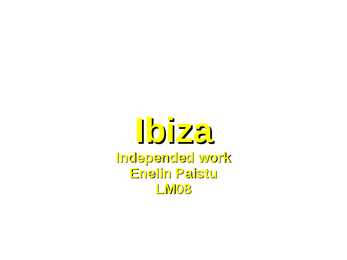
Eivissa is the official Catalan name (Catalan pronunciation:, locally. The name in Spanish is Ibiza . In British English, the name is usually pronounced in an approximation of the Spanish while in American English the pronunciation is more anglicized The island is well-known for its summer club parties which attract large numbers of tourists, but the island and the Spanish Tourist Office have been working to shed the prevailing "sex-and-alcohol" image in order to promote more family- oriented tourism. Noted clubs include Space, Pacha, Privilege (ex Ku), Amnesia, DC10, Eden, El Divino, Es Paradis, and Café del Mar.It is also home to the 'West End' party district of Sant Antoni, a popular stop for many tourists. History In 654 BC Phoenician settlers founded a port in the Balearic
ESTONIA MAP OF ESTONIA Southern Viljandimaa The southern part of Viljandi county catches the eye with its sublime scenery. The area today lies in the very heart of the historical Mulgimaa the home of hills, deep valleys and lakes brought together by a beauty spot Halliste primeval valley. According to several folk tales, it is also in these valleys, woods and bogs that Old Nick found refuge.The great variety displayed in the nature is also reflected in the local cultural heritage. At the beginning of the 19th century growing linen spread and became the basis of the legendary wealth of Mulgi farms. The ancient barn-dwellings and decaying manor houses are the mute witnesses of those times. The riches and cultural heritage of Mulgimaa owe to the diligence and tenacity of the local people. Village handicraftsmen and masters have always been honoured. Mulgikapsad (stewed sauerkraut with barley
1. Society- people who interact in such a way as to share a common culture. The cultural bond may be ethnic or racial or geographical, based on gender, or due to shared beliefs, values, and activities. 2. Culture- beliefs, behaviors, objects, and other characteristics common to the members of a particular group or society. 3. A unitary state- a state governed as one single power in which the central government is ultimately supreme and any administrative divisions (subnational units) exercise only powers that their central government chooses to delegate
Tourism-good or bad ? Nowadays in many countries, tourism is one of the fastest growing industries and it can bring enormous advantages to countries, especially poor ones. It may seem that tourism bring only benefits, but further consideration shows that it also has disadvantages. To start with, tourism offers many benefits. Tourists spend money on local goods and services ,so the area can get much money to develop the other essential public services, for example education and health. Also tourism services such as roads, bars, hotels, restaurants and other leisure facilities are built. Thanks to it, local people can get more jobs. Finally, tourism allows both the tourist and the local community a chance to experience other cultures.
Tuvalu, Uganda, UK Islands (Channel Is, Man), US Virgin Islands, Vanuatu, Zambia, Zimbabwe. [3, p. 61- 65 ] 1.7 Perspectives of English There are a lot of speculations on the possible future of English, however lingingistic history shows us that such speculations have to be made with precautions, remembering about the fate of French and Latin. Several possibilities can be envisaged. A significant change in the balance of power – whether political, economic, technological or cultural – could affect the standing of other languages so that they become increasingly attractive, and begin to take over functions currently assumed by English. Pressures arising out of the need to express community identity might disrupt the ability of English to function as a global language. There are also economic arguments which might persuade a country to reduce its investment in the English language. A country might see its economic future as operating
Australia. Cook landed in Botany Bay on the eastern coast. He charted the region and named it New South Wales. Britain decided to use its new outpost as a penal colony; the first fleet of 11 ships carried about 1500 people half of them convicts. The fleet arrived at Port Jackson, the cite of modern Sydney, on 26 th January, 1788, and on this day every year Australia day is celebrated. In all, about 160 000 en and women were brouth to Australia as convicts. The transportation was ended in 1868. by this time many settlements were established. In 1901 all the separate parts of Australia were united into one country. In 1851 gold was discovered in eastern Australia. This brought along the great gold rush. Thousands of people went to the new land to find fortune. Forty years later the gold was found in the west. The miners of the east had a very hard time, the water was scarce and the roads were bad
desire of many U.S. citizens who sought to move to Ireland for work. Sport Gaelic football, hurling and football are the most popular sports in Ireland.[19] Along with Camogie, Ladies' Gaelic football, handball and rounders, they make up the national sports of Ireland, collectively known as Gaelic Games. All GAA players, even at the highest level, are amateurs and receive no wages. Golf is a popular sport in Ireland and golf tourism is a major industry. Culture Literature and the arts For an island of relatively small population, Ireland has made a disproportionately large contribution to world literature in all its branches, mainly in English. Poetry in Irish represents the oldest vernacular poetry in Europe with the earliest examples dating from the 6th century; Jonathan Swift, still often called the foremost satirist in the English language, was wildly popular in his day and remains so in modern times
Largest Cities Economy in New Zealand is very modern and developed. It's GDP is about 101,688 billion dollars (data from 2005). Country's GDP is ~$26,400 per one resident (for example in Australia it's $31,900 and in USA $41,800). New Zealand is a country which mostly bases on its bargaining, agricultural production. 20% of agricultural produce is exported. Most important export partners are Australia, USA, Japan, China, Germany. The country's biggest incomes comes from tourism. Every year about 2 million tourists visit New Zealand - it's marketed as a green and clean adventurous place. Typical tourist attractions there are bungee jumping and whale watching. The capital city of New Zealand is Wellington, but it isn't the largest one. The largest city is Auckland and after that comes Christchurch. Wellington is the third- largest city in New Zealand. In Auckland the population is 1,333,300 million. It's obviously the most populous city in New Zealand
 annaabi.ee