 10 punkti
Autor soovib selle materjali allalaadimise eest saada 10 punkti.
10 punkti
Autor soovib selle materjali allalaadimise eest saada 10 punkti.
 ~ 10 lehte
Lehekülgede arv dokumendis
~ 10 lehte
Lehekülgede arv dokumendis
 2013-06-02
Kuupäev, millal dokument üles laeti
2013-06-02
Kuupäev, millal dokument üles laeti
 3 laadimist
Kokku alla laetud
3 laadimist
Kokku alla laetud
 0 arvamust
Teiste kasutajate poolt lisatud kommentaarid
0 arvamust
Teiste kasutajate poolt lisatud kommentaarid
 tuuli010
Õppematerjali autor
tuuli010
Õppematerjali autor
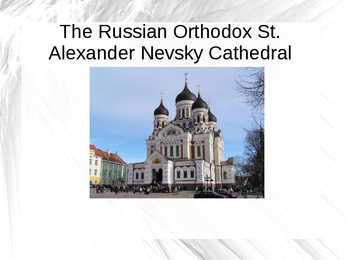
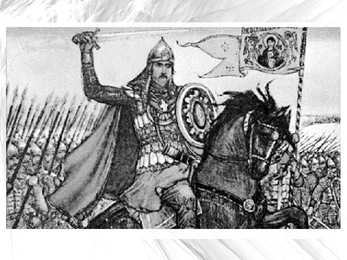
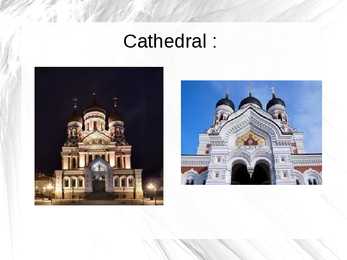
Kunda Ühisgümnaasium Tallin Old Town Report Student: Kristin Karu Teacher: Kristi Aron Kunda 2012 The Alexander Nevsky Cathedral The Alexander Nevsky Cathedral is an orthodox cathedral in the Tallinn Old Town,Estonia. It was built to a design by Mikhail Preobrazhensky in a typical Russian Revivalstyle between 1894 and 1900, during the period when the country was part of theRussian Empire. The Alexander Nevsky Cathedral is Tallinn's largest and grandest orthodox cupola cathedral. It is dedicated to Saint Alexander Nevsky who in 1242 won the Battle of the Ice on Lake Peipus, in the territorial waters of present-day Estonia
Alexander Nevsky Cathedral was built on orders from St. Petersburg during the times of Russian Imperial rule. Supposedly built on the grave of a legendary Estonian hero, Kalevipoeg, on the city's mighty Toompea Hill, the Orthodox cathedral was something of a Russian propaganda exercise at the time and still remains a subject of controversy amongst hardline patriots. Most locals though are content to admire the Alexander Nevsky as the fine piece of architecture. http://www.tallinn-life.com/culture/culture_details/103-Alexander_Nevsky_Cathedral The Song Festival Grounds The tradition of the song festival was born along with Estonian national awakening. The first national song festival was held in Tartu in the summer of 1869.One of the organisers of the first song festival was Johann Voldemar Jannsen. In the first three festivals only men's choirs and brass orchestras participated
at all. It’s commonly recognised that whoever’s flag flies on top of this tower is the ruler of Estonia. Toompea as a tourist attraction Alexander Nevsky Cathedral - largest and grandest orthodox cathedral crowning the hill of Toompea. It was finished in 1900, when the country was a part of the Russian empire. Time of russification, many estonians against it. Dedicated to the prince of novgorod, alexander nevsky who won the battle of ice. Due to the lack of funds and the building’s massive construction, it was never demolished. Kohtuotsa viewing platform - gives great view to the both parts of the city. blabla Estonian Knighthood House - The German nobles in Estonia were united in the Estonian Knighthood. The Estonian Knighthood House was the building where the Knights met and held their festivities and where their peerage register was kept. Town Hall Square
walls on three occasions. The unusually tall building was struck by lighting in 1625. The fire destroyed the tower and the spire, the bells and the entire interior. Although only the walls remained standing, the church was re-opened in three years. The church burned completely down again in 1820 within only four hourd. Only the St. Olaf's library was miraculously spared. The restoration took 20 years this time and received personal support of the Russian Emperors Alexander I and later Nicholas I. The presend altar by F.L. Von Maydell and J.G.Exner (1835) ad the altar painting by W. Von Kügelgen (1834) both date back to the period after that fire. The present height of the church spire, after the reconstruction, which followed the numerous fires, is seemingly insignificant 123 metres, compared to the previous figures, yet even so it is the second tallest building in Tallinn after the TV tower. It is noteworthy
Uusikaupunki, was a relatively static period in Estonian history with few momentous events. This was the time of the crystallization and the culmination of serfdom, when various socio- political and cultural undercurrents were also active, preparing the ground for the industrial society and the national-democratic movement in the second half of the 19th century. The 1710 of the corporations of knights and towns, until Alexander II (18551881), established the relationships between Estonia, Livonia and the Russian Empire. The Baltic Landesstaat reached its full development. The freedom of action in the new provinces was naturally granted to one of the most firm ideological pillars of the tsarist empire -- the Russian orthodox church; though as the Landeskirche in the Estonian and Livonian territories, the Lutheran church long maintained a de facto predominance.
Tallinn English College English Sergo Vainumäe 9A TALLINN Report Supervisor: Inge Välja Tallinn 2006 Order of contents: 1.Introduction 2.Toompea 3.Lower Town 4.Kadriorg and Pirita 5.Museums 1. Introduction Tallinn, the capital of Estonia, lies on the Baltic Sea. It is on almost the same latitude east St. Petersburg in Russia, Stockholm in Sweden and Stavanger in Norway, and covers 158 sq km. Tallinn was first marked on a map of the world by the Arab geographer al-Idrisi in 1154, its name then being Kolyvan (probably derived from the name Kalev). In the 13th-century Chronicle of Henricus de Lettis the town was called Lyndanise. Later came Reval (presumably after the old county of Rävala), the name used by the Germans who ruled the country for seven centuries. Russians then modified Reval to Revel. For Estonians, the town came to be c
the very beginning of the faculty's existence there were courses in Russian studies on offer for students of Slavic studies. In the 1922/1923 academic year, an independent Section of Russian Language and Literature was founded within the School of Slavic Studies. The section was, from its foundation until 1945, headed by Valerij Alexandrovic Pogorielov. In 1945 another member of the post-revolutionary wave of Russian emigrants, Prof. Alexander Vasilievic Isacenko, was appointed Professor in Russian Philology. In 1946 Prof. A. V. Isacenko became the director of the newly established School of Russian, which transformed itself into the Department of Russian Literature and Modern Language Studies in 1948. Prof. Isacenko was still holding the leading post in 1950 when the Department of Russian Language and Literature came into being. In 1955, when Prof. A. V. Isacenko left Bratislava for Olomouc, the department already had
1814-1816 and replaced an earlier temporary bridge. The bridge was thoroughly renovated in 1913, at which time a bust-portrait of the university's first rector, G. Fr. Parrot, and a dedication text, was placed on the bridge's Toome Hill face (sculptor C. v. Wetter- Rosenthal). The Devil's Bridge The Devil's Bridge was built in 1913 in honour of the 300th jubilee of tsarist Russia's Romanov Dynasty, which is memorialized on the bridge by the dates 1613-1913. The bridge is dedicated to Emperor Alexander I, who signed the founding treaty for the tsarist university - the second official opening of Tartu University, and whose embossed relief decorates the bridge side facing Vallikraavi Street. Toome Hill Toome Hill was a gift of Tsar Paul I to the University till then the clearing was used mainly as a grazing area for townspeople's cows and goats. Toome Hill has been a centre of settlement activity throughout the centuries. The oldest trees in the park are now 200 years old
 annaabi.ee








Kõik kommentaarid