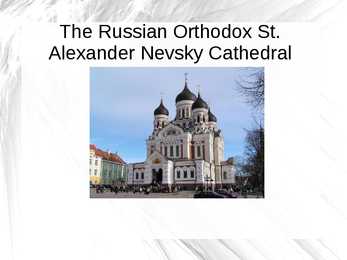
The Russian Orthodox St. Alexander Nevsky Cathedral The Russian Orthodox St. Alexander Nevsky Cathedral is designed by Mikhail Preobrazhensky ( a professor at St. Petersburg Academy of Arts) And built on the order of Alexander III between 1894 and 1900,during the period when the country was part of the Russian Empire The Alexander Nevsky Cathedral is Tallinn's largest and oldest orthodox cathedral It is dedicated to Saint Alexander Nevsky who in 1242 won the Battel of the Ice on Lake Peipus The church's towers' hold Tallinn's most powerful church bell ensemble,consisting of 11 bells (one of them weighing 15 tonnes) Orthodoxy in Estonia is practiced by 12.8 % of the population,making it the second most identifield religion after Lutheran Christianity with 13.6 % Orthodoxy is mostly practiced within Estonia's Russian ethnic minority The first mention of an Orthodox...
Tallinn sightseeing Cristofer Krik 8.klass Lagedi Kool Tallinn's Old Town Included in the UNESCO World Heritage List Best protected and intact medieval town Cobblestone lanes, gothic spires and iron street lamps Cappuccino and Wifi The Town Hall On Raekoja square Intact gothic town hall Operates as a museum and concert hall ,,Old Thomas" Town Hall Aphothecary The Aleksander Nevsky Cathedral Orthodox cathedral Design by Mikhail Preobrazhensky Spectacular and onion- domed structure Dedicated to Alexander Yaroslavich Nevsky Kasutatud materjal http://www.visitestonia.com/en/ http://www.tourism.tallinn.ee/eng/explore/attractions/old_town http://images.google.ee/ http://en.wikipedia.org/wiki/Tallinn
Kunda Ühisgümnaasium Tallin Old Town Report Student: Kristin Karu Teacher: Kristi Aron Kunda 2012 The Alexander Nevsky Cathedral The Alexander Nevsky Cathedral is an orthodox cathedral in the Tallinn Old Town,Estonia. It was built to a design by Mikhail Preobrazhensky in a typical Russian Revivalstyle between 1894 and 1900, during the period when the country was part of theRussian Empire. The Alexander Nevsky Cathedral is Tallinn's largest and grandest orthodox cupola cathedral. It is dedicated to Saint Alexander Nevsky who in 1242 won the Battle of the Ice on Lake Peipus, in the territorial waters of present-day Estonia. The late Russian patriarch, Alexis II, started his priestly ministry in the church. Interior of the Cathedral. The Alexander Nevsky Cathedral crowns the hill of Toompea where the Estonian folk hero Kalevipoeg...
Kunda Gymnasium Rait Türkel Old Tallinn Report Instructor:Teacher Kristi Aron Kunda 2012 Introduction Like most cities with an eight-hundred-year-old past, Tallinn is a patchwork of historic areas. The city's pride and joy is without a doubt its Medieval Old Town, but equally enchanting is the Kadriorg district, a throwback to the time when Estonia was ruled by the Russian Tsars. Tallinn is the capital and largest city of Estonia. It occupies an area of 159.2 km2 with a population of 416,470. It is situated on the northern coast of the country, on the shore of the Gulf of Finland, 80 km south of Helsinki, east of Stockholm and west of Saint Petersburg. Tallinn's Old Town is in the list of UNESCO World Heritage Sites. It is ranked as a global city and has been listed among the top 10 digital cities in the world.The city was a European Capital of Culture for 2011, along with urku, Finland.T...
The Old Town (The Dome Hill) Kelly Pärkman 10a Tallinn Lillekyla Gymnasium Table of Contents Tallinn Toompea Castle Tall Hermann's Tower Cathedral of Saint Mary the Virgin Danish King's Garden The House of the Estonian Knighthood Maiden Tower References Tallinn The centre of Tallinn Dome Hill The lower town Toompea Castle Location Built in the 13th to the 14th centuries Wooden fortress The building of the Riigikogu Several parts Tall Hermann's Tower Location 14th century The name of the tower The Estonian flag Cathedral of Saint Mary the Virgin Location Lutheran church 1219 1233 ...
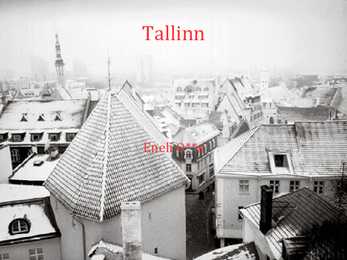
Tallinn Eneli O**a History City rights were given to Tallinn on May 15, 1248 Independent since 1991 Covers the area of 159.2 km2 Old Town of Tallinn Tallinn's Old Town is one of the most well- preserved old towns in northern Europe The golden era in lies in the period between the early 15th and mid 16th centuries It has three parts: Lower Town, Upper Town + Town Wall, Towers and the Gates Lower Town/Upper Town Town Hall Square Toompea Castle & Tall Tallinn Town Hall Hermann's Tower Town Hall Pharmacy Cathedral of Saint Mary the Virgin Great Guild Hall Danish King's Garden House of the Brotherhood of Black Heads Other Attractions Ka...
Toompea - obere Stadt Dieser Bereich war einmal eine unterschiedliche Stadt (Dom zu Reval), der Wohnsitz des Chivalry von Estland, römisch-katholische Bishops von Tallinn (bis 1561) und die lutherischen Betriebsleiter von Estland und besetzte einen leicht verteidigungsfähigen Aufstellungsort, der die umgebenden Bezirke übersieht. Die Hauptanziehungskräfte sind die Wände und verschiedene Bastionen von Castrum Danorum, die russische orthodoxe Kathedrale Alexander-Nevsky (errichtet während des Zeitraums des russischen Reiches, wurde die Kirche auf einem Aufstellungsort errichtet, der früher eine Statue von Martin Luther unterbrachte) und die lutherische Kathedrale (Domkirche) und von alten estnischen Royal Palace jetzt das Parlamentsgebäude. Altstadt - Bereich ist eine der besten konservierten alten Städte in Europa und die Behörden setzen seine Rehabilitation fort. Die Sehenswürdigkeiten da sind: " Fettes Margaret" , " Kiek in de Kök" , Kirchturm Str
Tapa Gümnaaasium Aleksandr Borodin Referaat Sisukord 1. Üldandmed 3 2. Üldiseloomustus 4 3. Lisad 5 Üldandmed Tuntud kui Aleksandr Porfiryevich Borodin Sündinud: 31-Oct-1833 Sünnikoht: St. Petersburg, Venemaa Suri: 15-Feb-1887 Surmakoht: St. Petersburg, Venemaa Surma põhjus: südameatakk Jäänused: Maetud, Alexander Nevsky Kirik, St. Petersburg, Venemaa Sugu: Mees Rass: Valge Seksuaalne orientatsioon: hetero Okupatsioon: Helilooja Rahvus: Venelane Isa:Luka Gedevanishvili Naine: Ekaterina Sergeyevna Protopopova (abiellus 29-Apr-1863, kuni surmani, üks laps) Tütar: Liza Balaneva (lapsendatud) Üldiseloomustus Andekas keemik ja väga suur muusik. Lapsepõlvest peale armastas loodusteadusi, kuid tegeles ka kirjandusega, armastas joonistada, õppis lapsepõlves mitut keelt (pr, it keel ja kultuur). Õppis kooli hoidjatädi käest vene keelt ja laule. Kodus ...
Old Tallinn Old Town, a medieval walled city filled with old buildings and fortifications. The sheltered bay and the easily defended Toompea Hill made it a natural place to settle. Sometime about 1050 A.D. a fortress was built atop the hill, the first of many. In 1219 the Danes showed up as part of the Northern Crusade to subjugate the Baltics and convert the local pagans to Christianity whether they wanted to or not. The Danes improved the fortifications and expanded the town, which became part of the Hanseatic League, a trading organization of a hundred northern cities. The Danes sold Tallinn to the Livonan Order, a branch of the Teutonic Knights, in 1346. The Swedes came next in 1561. Tallinn weathered plague and the Great Northern War and became part of Russia in 1710. In 1918, Estonia declared independence from Russia and fought a bitter war against Bolshevik Russia. Independence didn’t last long, ...
2 Towns (Upper & Lower Town) Tallinn used to be divided into 2 parts - Upper Town where lived the aristocracy, gentry and the clergy; and Lower Town with traders, craftsmen and merchants. Legend says the Toompea Hill is actually the tumulus mound of the great Kalev. Linda carried rocks to his grave. It is a naturally- formed limestone hill. Lower Town was a merchantile centre, Tallinn also belonged to the Hansaetic League (1285). It is often referred to as the town of citizens. Any grown-up, married and economically independent person, born in a legal marriage between two free people and having lived in the town for at least 3 months, could apply to the Magistracy for citizenship. Serfs could escape from serdom after having successfully hidden in town for a year and a day. Two parts remained separated until the end of the 19th century. Four Names Lyndanise - mentioned by Henricus de Lettis in his Chronicle; derives from the name Lind...
Toompea - obere Stadt Dieser Bereich war einmal eine unterschiedliche Stadt (Dom zu Reval), der Wohnsitz des Chivalry von Estland, römisch-katholische Bishops von Tallinn (bis 1561) und die lutherischen Betriebsleiter von Estland und besetzte einen leicht verteidigungsfähigen Aufstellungsort, der die umgebenden Bezirke übersieht. Die Hauptanziehungskräfte sind die Wände und verschiedene Bastionen von Castrum Danorum, die russische orthodoxe Kathedrale Alexander-Nevsky (errichtet während des Zeitraums des russischen Reiches, wurde die Kirche auf einem Aufstellungsort errichtet, der früher eine Statue von Martin Luther unterbrachte) und die lutherische Kathedrale (Domkirche) und von alten estnischen Royal Palace jetzt das Parlamentsgebäude. Altstadt - Bereich ist eine der besten konservierten alten Städte in Europa und die Behörden setzen seine Rehabilitation fort. Die Sehenswürdigkeiten da sind: " Fettes Margaret" , " Kiek in de Kök" , Kirchturm Str
Russian philology The meaning of the word "philology" is "love for word". This is love that unites teachers and researchers of modern and Classical languages and literature, interpreters and diplomats, journalists and publishers, writers and poets. Russian philologis are highly demanded in various spheres of scholarly research and education, in the mass media, in civil service at the Ministry of Foreign Affairs, in archives, libraries, museums, in travel agencies, as well as Russian and international companies. Curriculum within in philological faculty includes courses of Russian and European languages and literature, courses of Linguistics and Theory of Literature for students to familiarize themselves with various schools and trends of Russian and foreign philology. The core curriculum also includes a number of Liberal Arts courses (Philosophy, History, Psychology, Pedagogy), as well as courses of basic mathematics and compute...
Filmikunsti ajalugu 31.01.12 The age of pioneers: the early history of film How the horses helped to ivent the cinema. Cinema was invented by accident. 1872, west coast: leland standford, party, rich people, end of the 19 century, bored. Stanfrod talks friends about horses: problem: question is, what happens with the hooves while its moving, running. Bet, with eyes, can't settle this. Cannot ever see if the hooves touch the ground. Stanford has enough money, hires most famous photographer. Eadwerd muybridge, comes to usa. Tells him to settle this with photography. That time with photography you cannot get any informatio either. Started to install boxes, in each box, there was a camera. Does the hooves touch the ground or not? Fast shutter, can freeze the moment. Makes fast shutters, to record this. Finds solution, hooves are touching. The prerequisites for cinema: camera(edison and dickson), film stock that is flexible and stable to ru...
 annaabi.ee