The West End Trafalgar Square is called the heart of London because it connects the political area of Westminster to the rest of West London. Lord Nelson's column stands in the center of the beautiful square. Horatio Nelson was a great British commander who defeated Napoleon in the Battle of Trafalgar but unfortunately he himself was killed. To the north and west from the Trafalgar Square is the West End, which is London's main shopping and entertainment area. Most of London's best residential and commercial areas are in the West End. You can find there expensive shops, restaurants, hotels, museums and many art galleries. Great Britain's biggest department store is in Knightsbridge. It was founded in 1834 by Charles Henry Harrod. Harrods is also the world's first building with an escalator. Today Harrods is an amazing place with over 330 shops, which includes twenty-six fine eating places, where you can go eat...
Squares of London Trafalgar Square Trafalgar Square is a public space and tourist attraction in central London, England, United Kingdom. At its centre is Nelson's Column, which is guarded by four lion statues at its base. There are a number of statues and sculptures in the square, with one plinth displaying changing pieces of contemporary art. The square is also used for political demonstrations and community gatherings, such as the celebration of New Year's Eve. The name commemorates the Battle of Trafalgar (1805), a British naval victory of the Napoleonic Wars over France. The original name was to have been "King William the Fourth's Square", but George Ledwell Taylor suggested the name "Trafalgar Square" Leicester Square Leicester Square is a pedestrianised square in the West End of London, England. The Square lies within an area bound by Lisle Street, to the north; Charing Cros...
LONDON LONDON Largest city in western Europe Dominates Britain Headquarters of all goverment departments the country´s parliament major legal institutions the monarch Bussiness and banking centres, the national television networks and newspapers Seven times larger Fifth of the total population TWO AREAS Walled City (the square mile) Small Did not contain Parliament or the royal court Traders and merchants Westminster Outside London´s walls National institutions meeting place WEST END AND EAST END West End Theatres, cinemas, expensive shops East End Poorer residental area Home to successive waves of immigrant groups LONDON “Londoners“ live in its suburbs Travel to work each day Cultural and racial variety greatest 300 languages spoken Nearly third of the people were born outside The most popular City in the world (2007) Signs of its richness a...
England is a country that is part of the United Kingdom.It shares land borders with Scotland to the north and Wales to the west; the Irish sea is to the north west, theCeltic sea to the south west and the North Sea to the east, with the English Channel to the south separating it from continental Europe. The mainland of England consists of the central and southern part of the island of Great Britain in the North Atlantic but England also includes over 100 small isl such as the Isles of Scilly and the Isles of weight.The area now called England has been settled by people of various cultures for about 35,000 years, but it takes its name from the Angles, one of the Germanic tribes who settled during the 5th and 6th centuries. England became a unified state in AD 927, and since the Age of Discovery, which began during the 15th century, has had a significant cultural and legal impact on the wider world. The Kingdom of Englan which after 1284 ...
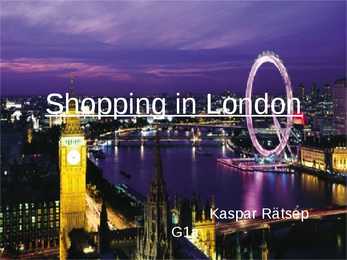
Shopping in London Kaspar Rätsep G1a General overview London is without doubt the centre for shopping in the United Kingdom and the numerous districts provide a shopper's paradise. Whether you are looking for London fashion, antiques, furniture or home accessories, rest assured that London will provide you with a huge choice. London has a lot to offer the shopper from large department stores to exclusive boutiques. There are many areas to go on shopping trips, such as Oxford Street, Covent Garden, and Knightsbridge. And, of course, London has many street markets to browse around. Oxford street two miles of wall to wall shops. the UK's busiest and most famous shopping area. There are over 300 shops to choose from. Apart perhaps from Selfridges the street consists of tourist orientated small shops interspersed with the UK flagship stores of all the main chain stores in...
St. James Park History St James’s Park is the oldest Royal Park in London. On James I's accession to the throne in 1603, he ordered that the park be drained and landscaped, and kept exotic animals in the park, includingcamels, crocodiles, and an elephant, as well as aviaries of exotic birds along the south. Charles II opened the park to the public, as well as using the area to entertain guests. On his desire had the park redesigned in a more formal style, probably by the French landscaper André Mollet. At the end of the 17th century and early 18th century were the cows in the park and could to buy fresh milk in "Lactarian". Location: The park is located in central London. This is 23 hectare large. St. James's Park is surrounded by Buckingham Palace to the west, The Mall and St. James's Palace to the North, Horse Guards to the east, and Birdcage Walk to the south. The park has a small lake, St. Jam...
Topic London Tallinn English College Tallinn 2007 1. Introduction London is the capital city of the United Kingdom and the largest urban area in England. The ancient City of London, to which the name originally belonged, still maintains its medieval boundaries, but the name "London" has long applied more to the whole metropolis that has grown up around it. London has been an important settlement for over two millenniums. It is also one of the world's leading business, financial and cultural centres and its influence in politics, education, entertainment and even fashion contribute to its status as a major global city. London is a major tourist attraction with four world heritage sites, several royal parks and numerous iconic landmarks such as the Houses of Parliament, Towe Bridge, the Tower of London, Westminster Abbey and the London Eye. 2. History Although there is some evidence of a permanent settle...
London is the capital of both England and the United Kingdom, and the largest metropolitan area in the European Union. An important settlement for two millennia, London's history goes back to its founding by the Romans. Since its foundation, London has been part of many movements and phenomena throughout history, including the English Renaissance, the Industrial Revolution, and the Gothic Revival.The city's core, the ancient City of London, still retains its limited medieval boundaries; but since at least the 19th century, the name "London" has also referred to the whole metropolis that has developed around it. Today the bulk of this conurbation forms the London region of England and the Greater London administrative area, with its own elected mayor and assembly. London is one of the world's most important business, financial and cultural centres and its influence in politics, education, entertainment, media, fashion and the arts contri...
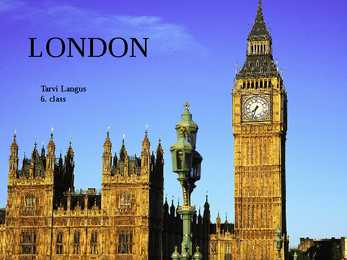
LONDON Tarvi Langus 6. class Contains The Big Ben The Tower of London Hyde Park The London Eye The Tower Bridge More pictures The Big Ben Big Ben is the nickname for the great bell of the clock of the Palace of Westminister in London The Palace of Westminster was destroyed by fire in 1834. The tower has appeared in many films. Muutke teksti laade Teine tase Kolmas tase Neljas tase Viies tase The Tower of London The Tower of London is historic castle on the north bank of the River Thames in central London. The Tower of London has played a prominent role in English history. The Tower has used: Zoo; Prison and now it is a museum. Muutke teksti laade Teine tase Kolmas tase Neljas tase Viies ta...
Põltsamaa Ühisgümnaasium LONDON REFERAAT Bruno Pähkel 7c klass 2010 CONTENT Introduction...............................................................................................lk3 London history...........................................................................................lk4 Today london.............................................................................................lk5 Big Ben.............................................
London March 28th Parliament of the United Kingdom The Parliament of the United Kingdom, commonly known as the UK Parliament or British Parliament, is the supreme legislative body in the United Kingdom, British Crown dependencies and British overseas territories. It alone possesses legislative supremacy and thereby ultimate power over all other political bodies in the UK and its territories. Its head is the Sovereign of the United Kingdom (currently Queen Elizabeth II) and its seat is the Palace of Westminster in the City of Westminster, one of the Boroughs of the British capital - London. Tower of London The Tower of London, officially Her Majesty's Royal Palace and Fortress of the Tower of London, is a historic castle located on the north bank of the River Thames in central London. It lies within the London Borough of Tower Hamlets, separated from the eastern edge of the square mile of the City of L...
The history of London There were some people living on the banks of the Thames when the Romans came to England in 43 AD. The Romans built houses, a port and a bridge over the river and named the place Londinium. The bridge which was built by the Romans was later known as London Bridge and it was built in stone in 1176. It was London's only bridge until 1729. Now there are about twenty bridges crossing the river within London. London soon became the largest city in England and by the time of the Norman Conquest in 1066 it had become the most important city in Britain. It grew in area and population until September 1666, when the Great Fire destroyed four fifths of the wooden buildings in the City including ST Paul's Cathedral. The fire lasted for five days. By now London has swallowed up many of the small towns and villages that surrounded it. It is a city of seven million pepole covering 1,606 square mile...
Artikkel Artikkel puudub Määrav artikkel Isikunimed: Perekonnanimed mitmuses: Veiko the Tamms Tom Smith the Talvistes Riiginimed, kontinendid: Riigi või piirkonna nimed, mis on mitmuses Estonia või kus on täiendina pärisnimi, kingdom, France state või republic: Asia the United Kingdom = the UK Europe the United States of America = the USA = the US the Republic of Estonia the Estonian Republic the United Arab Emirates ...
THE U.K Different Parts The United Kingdom is a short way of saying the United Kingdom of Great Britain and Northern Ireland. The UK is the political name for those countries which share a parliament in London. All of them were at one time independent kingdoms with their own monarch. Now they are all part of the same kingdom and share the same monarch. The UK consists of Northern Ireland, Scotland, England and Wales. The peoples of these countries are British subjects; they hold British passports and therefore their nationality is British. The british Isles is the geographical name for all the islands off the west coast of Europe. These islands also include The Republic of Ireland, which is politically independent of the Britsh government. Many people refer to the inhabitants of the British isles as 'the English', but England is only one of the countries. The other countries are Scotla...
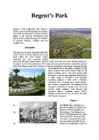
Regent's Park Regent's Park (officially The Regent's Park) is one of the Royal Parks of London. It is in the northern part of central London partly in the City of Westminster and partly in the London Borough of Camden. It contains Regent's College and the London Zoo. Description The park has an outer ring road called the Outer Circle (4.3 km) and an inner ring road called the Inner Circle, which surrounds the most carefully tended section of the park, Queen Mary's Gardens. Apart from two link roads between these two, the park is reserved for pedestrians. The south, east and most of the west side of the park are lined with elegant white stucco terraces of houses designed by John Nash. Running through the northern end of the park is Regent's Canal which connects the Grand Union Canal to the ...
London History The Romans AD 43- AD 410 The Romans finally invaded Britain in AD 43 from Kent. The Romans lead by Julius Caesar attempted to invade Britain twice before that in 55 and 54 BC but the invasions were unsuccessful. They made their way to the river Thames and sailed up it. The Romans knew it was important to control a crossing point at the river Thames, so they decided to build a settlement on the north bank. Although small settlements had been built on the banks of the Thames, the Romans were the ones who built the first city. They called their city Londinium. The Roman engineers noticed that the point where the swampy river narrowed would make an ideal crossing point, they built London Bridge. Less than 20 years later the native Iceni tribe, led by Queen Boudicca, rose up against the Romans in revenge for mistreatment and burnt Londinium to the ground. The well disciplined Roman army defeated her forces and Londinium was r...
Landmarks of London Uku Gross ja Hans Richard Antsmäe Royal Opera House, London The royal opera house is major performing house in UK. It was opened in 1732. In 1734, the first ballet was presented. The next year, Handel's first season of operas began. It has have 2 disauster fires. The main auditorium seats 2,256. http://www.roh.org.uk/publications/la-boheme-2017-digital-programme http://www.roh.org.uk/visit Elizabeth tower It's also known as Big Ben. It was the largest clock for 23 years in UK. It's 96 metres tall. The tower is designed by Augustus Pugin in a neo-gothic style. Built in 1859, by the time the constructor said that it's the most accurate clock in the world. https://londonist.com/2016/08/secrets-of-big-ben Oxford street Major road in the City of Westminster in the West End of London. Europe's busiest shopping street. Million daily visitors. At least 300 shops. It has the lenght of 1,9 km. http...
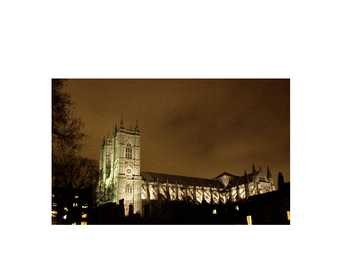
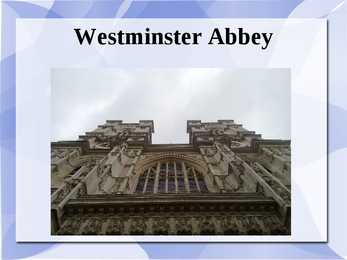
Westminster Abbey The Collegiate Church of St Peter Location In London, just to the west of the Palace of Westminster History · Benedictine monks tenth century · Coronation church since 1066 · The present church 1245 - 1745 Traditional burial and coronation site · 17 monarchs : o Henry III o Mary II o Edward the confessor · Famous people o Sir Isaac Newton o Charles Dickens o Charles Darwin o Rudyard Kipling THE END
London London is the capital of Great Britain. It is situated on the river Thames. The Thames is a river flowing through southern England and connecting London with the sea. The Thames has a length of 346 kilometres (215 miles). The first bridge was the tower bridge, built in the 12th century. The second bridge was built in the year 1750. .The river Thames divides London into the northern and the southern part. The port of London is one of the greatest trade centres in the world. The river Thames is certainly the most famous water body in London. London is also the seat of the government of Great Britain. It is one of the largest cities in the world with its population of about seven million. Before the great fire in 1666 there were many wooden houses and narrow crooked streets in the town but after the fire it became a well-planned city with wide streets, beautiful squares and parks. It star...
England The United Kingdom is very small compared with many other countries in the world. However there are only nine other countries with more people, and London is the world's seventh biggest city. When you travel about the country you can see how the scenery changes right in front of your eyes. Highlands turn into lowlands; forests and hills turn into meadows and plains very quickly. It's hard to believe, but in Great Britain one you can find practically any type of scenery. Britain is unusually beautiful country! England can be divided for four parts: the Southeast, the Southwest, East Anglia, the Midlands and the North of England. The Southeast is a highly populated region of England. London, the capital of the UK, and such historical cities as Windsor, Dover and Brighton are situated here. When people travel to Britain by sea or by air they...
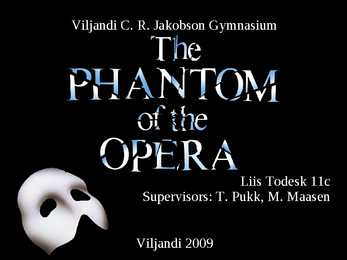
Viljandi C. R. Jakobson Gymnasium Liis Todesk 11c Supervisors: T. Pukk, M. Maasen Viljandi 2009 INTRODUCTION The composer Background The story Paris Opera House Characters Facts & figures Reviews Awards On Broadway THE COMPOSER Andrew Lloyd Webber Born 22 March, 1948 Attended Oxford University The Really Useful Group Knighted in 1992 Owns 7 theatres in London THE COMPOSER Years active: 1965-present 13 musicals Joseph and the Amazing Technicolor Dreamcoat Individual pop songs Collaboration with Tim Rice Eurovision Song Contest Many different awards BACKGROUND Based on Le Fantome de l'Opera by Gaston Leroux Music by Andrew Lloyd Webber Lyrics by Charles Hart and Richard Stilgoe Choreographed by Gillian Lynne Directed...
Trafalgar Square is a square in central London, England. With its position in the heart of London, it is a tourist attraction, and one of the most famous squares in the United Kingdom and the world. At its centre is Nelson's Column, which is guarded by four lion statues at its base. Statues and sculptures are on display in the square, including a fourth plinth displaying changing pieces of contemporary art, and it is a site of political demonstrations. The name commemorates the Battle of Trafalgar (1805), a British naval victory of the Napoleonic Wars. The original name was to have been "King William the Fourth's Square", but George Ledwell Taylor suggested the name "Trafalgar Square". The northern area of the square had been the site of the King's Mews since the time of Edward I, while the southern end was the original Charing Cross, where the Strand from the City met Whitehall, coming north from Westminster. As the midpoint between th...
Main Sights England is known for its many world-famous sightseeings and people all around the world come to see them. Some of them are even like symbols of England. The most famous ones are: Stonehenge is one of the greatest national icons of Britain. That prehistoric monument is located in the plain of Salisbury, in the county of Wiltshire in the south-west of England. It is built of 150 enormous stones which are set in a purposive circular pattern. Stonehenge was probably built to mark the longest and shortest day of the year because it lies on the line of the midsummer sunrise and the midsummer sunset. That would have enabled people to keep a record of changing of seasons. Although it is still unclear who built it. Hadrian’s Wall is an ancient wall which was built in 2nd century by Hadrian, the emperor of Rome from AD 117 to 138, and it marked the northern border of the Roman Empire in Britain. The wall was 80 Roman miles (117 kilom...
London Topic Tallinn 2008 2 General information London is the capital of the United Kingdom. It covers the area of about 1000 square kilometres and its population is about 7 million. London is located on the river Thames. It is divided into 32 boroughs and the City. Currency used in London is British Pound. London is one of the most popular tourist destination in the world. It is also world's leading business, financial and cultural centre. Subway is commonly used to move around in London. Climate London has a temperate marine climate. It has daily high temperatures during summer. The warmest month is July. The coolest month is January. Winders are seldom below freezing. Rainfall is regular, but most often in the form of drizzle occurring throughout the year. Snow occurs sometimes in winter but rarely settles more than a few millimetres deep. History The origin of London may be dated around the beginning of the...
How well do you know London? Form 10, Welcome to the tour of London! You will spend two days (lessons) exploring the famous landmarks of the city. While on the way, follow the map so that you would not get lost and so that you could eventually get streetwise in London. Take the following questions with you, find answers to them and put them down for yourself in this MSWord document. Don’t forget to “take” photos - you are supposed to recognise the landmarks later on! At the end of the tour send the worksheet to yourself so that you could use it again. Good luck with exploring the city! DAY 1. The route: The Buckingham Palace – Trafalgar Square – National Gallery – Piccadilly Circus – The British Museum – Madame Tussauds – Oxford Street – Hyde Park – Harrods Destination 1: The Buckingham Palace What is its function? - Buckingham Palace has served as the official London re...
English began as a west Germanic language which was brought to England by Saxons around 400AD. The spoken and written language between 400 and 1100AD is referred to as Old English. Many words used today come from Old English. English from 1300 to 1500 is known as Middle English. It was influenced by French and Ltin. Modern Englis was greatly influenced by English used in London and changed a great deal until the end of the 18th century. The standart English today in known as BBC English. Spelling and pronaunciation seem to be the most difficult aspects of the English language for foreign students. English is very rich in synonyms. The huge vocabulary of the language is due to the free admission of words from other language. Old English had several inflections to show singular and plural, tense and person, but over the centuries words have been simpified. The loss of inflections had made English a very flexible lnguage. At p...
Westminster Abbey Westminster Abbey is a large, mainly Gothic church, in Westminster, London, England (UK). It's located just to the west of the Palace of Westminster. Westminster Abbey was built by Edward the Confessor and opened in 1065. It is one of the most important Gothic buildings in the country and in the world. In 1066, it saw its first coronation, that of William the Conqueror. Since then, nearly every king and queen has been coronated there. On 17 September 2010, Pope Benedict XVI became the first pope to set foot in Westminster Abbey. The Abbey has also been the church since 1066. Many of England's most illustrious statesmen, generals, politicians and artists have been buried there. It is also the final resting place of seventeen monarchs. Westminster School and Westminster Abbey Choir School are also in the precincts of the Abbey. The Westmins...
Andrew Lloyd Webber, Baron Lloyd-Webber (born 22 March 1948) is a British composer of musical theatre, the elder son of William Lloyd Webber and also the brother of renowned cellist Julian Lloyd Webber. Lloyd Webber started composing at the age of six and published his first piece at the age of nine. Lord Lloyd-Webber has achieved great popular success, with several musicals that have run for more than a decade both in the West End and on Broadway. He has composed 13 musicals, a song cycle, a set of variations, two film scores, and a Latin Requiem Mass. He has also gained a number of honors, including a knighthood in 1992, followed by a peerage, seven Tony Awards, three Grammy Awards, an Academy Award, an Emmy Award, seven Olivier Awards, a Golden Globe, and the Kennedy Center Honors in 2006. Several of his songs, notably "I Don't Know How to Love Him" from Jesus Christ Superstar, "Don't Cry for Me, Argentina" from Evita, "Memory" from ...
Kristi . 8a. klass LONDON History .... There were some people living on the banks of the Thames when the Romans came to England in 43 AD . The Romans built houses , a port and a bridge over the river and named the place Londinium. In September 1666 , when the Great Fire destroyed four fifts of the wooden buildings . The fire began in the kitchen of the King ´s baker in Pudding Lane and lasted for five days . London . London is an exiting city . The population of London is about seven million people and it is made up of the people of very many nationalities . There are nine piers where you can get a boat and enjoy numerous sights like .... The Tower of London Click to edit Master text styles Second level Third level Fourth level Fi...
HENRY MOORE Henry Moore was born on the 30th of July in 1898. He was an English sculptor and artist. He was best known for his abstract bronze sculptures which are located around the world. He was also the most celebrated sculptor of his time, and the second part of his career, in particular, demonstrated that Modernist sculpture was surprisingly adaptable to official needs. In this sense, Moore was the contemporary equivalent of the great Neo Classical sculptors such as Canova and Thorwaldsen. Moore was born in Castleford as the son of a mining engineer. He became well-known through his large-scale abstract cast bronze and carved marble sculptures, and was instrumental in introducing a particular form of modernism to the United Kingdom. His ability in later life to fulfill large-scale commissions made him exceptionally wealthy. Yet he lived frugally and most of the money he earned went towards s...
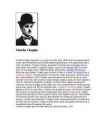
Charlie Chaplin Charlie Chaplin was born in London on 16th April, 1889. Both his parents were music hall entertainers and Charlie started appearing on the stage while still a child. His father, Charles Chaplin, deserted the family and eventually died of alcoholism. His mother, Hannah Chaplin, found it increasingly difficult to find work on the stage and in 1895 the family entered the Lambeth Workhouse. When he was sixteen Chaplin won the part of Billy in a West End production of Sherlock Holmes. He later joined Fred Karno's music hall revue. While touring the United States in 1913 Chaplin was discovered by the film producer Mack Sennett. Over the next couple of years Chaplin made a series of short slapstick films for Sennett's Keystone Company. In these films Chaplin developed a character that wore baggy pants, tight frock coat, large shoes on the wrong feet and a black derby hat. By his thirteenth film, Caught in the Rain (1914), Cha...
London important sights guide Roman period 20th century · Big Ben is the nickname for the great bell of the clock at the north end of the Palace of Westminster in London and is often extended to refer to the clock or the clock tower as well. It is the largest four-faced chiming clock and the third-tallest free-standing clock tower in the world. The clock first ticked on 31 May 1859. The pendulum is installed within an enclosed windproof box sunk beneath the clockroom. It is 3.9m long, weighs 300 kg and beats every 2 seconds. The clockwork mechanism in a room below weighs 5 tons. · Buckingham Palace is the official London residence of the British monarch. Originally known as, the building which forms the core of today's palace was a large townhouse built for the Duke of ...
Names with and without the Names fot the streets/roads/squares/parks etc are without the: Union street Fifth avenue Piccadilly Circus Hyde Park Blackrock road Broadway Times Square Waterloo Bridge Many names (especially names of important buildings and institutions) are two words: Kennedy Airport Cambridge University The first word is usually the name of a person (Kennedy) or a place (Cambridge). We do not usually use ,,the" with names like these. Some more examples: Victoria Station Edinburgh Castle London Zoo Westminister Abbey Buckhingham Palace Canterbury Cathedral But we say 'the White House' and 'the Royal Palace' because 'white' and 'royal' are not names like 'Kennedy' and 'Cambridge' Most other names (of laces, buildings etc) have names with the: The + adjective or + noun ...
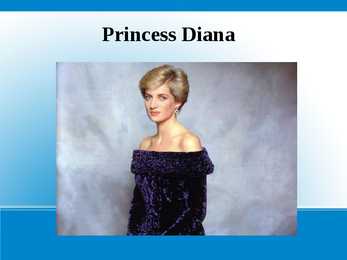
Princess Diana Diana Frances Spencer was born on July 1, 1961 at Park House, Sandringham, Norfolk, England, UK. She was a member of the British royal family and the first wife of Charles, Prince of Wales. Diana was first educated at Silfield School, then at Riddlesworth Hall in Norfolk, and at West Heath Girls' School . Diana reportedly excelled in swimming and diving, and wanted to be a professional ballerina. From the mid-1980s, the Princess of Wales became increasingly connected with charities. (As Princess of Wales she was expected to visit hospitals, schools, etc.) In addition, the Princess was the patroness of charities and organisations working with the homeless, youth, drug addicts and the elderly. From 1989, she was announced as a President of Great Ormond Street Hospital for Children. ...
The United Kingdom The United Kingdom consists of England, Scotland, Wales and North Ireland and it is situated in the Atlantic Ocean near the mainland of Europe. The population of the UK is 58.6 million and area is 244,110 sq km. Britain has a temperate humid climate. Its characteristic features are mild winters, warm summer, no temperature extremes, abundant rain all year round and frequent changes of weather. The mild climate is partly due to the warm Gulf Stream and partly to the south westerly winds. Occasional winds from the east in winter may bring cold and dry weather. The distribution of rainfall is influenced by the Atlantic Stream. The mountainous areas of the north and west have more rain than the lowlands of the south and east. Wales is located on a peninsula in central-west Britain. The entire area of Wales is about 20,779 km². Wales borders by England to the e...
khTallinn English College The United Kingdom Topic Mari-Liis Pakats Tallinn 2008 2 Table of Contents Introduction..................................................................................................................4 Geographical Position .................................................................................................4 History .........................................................................................................................4 Government..................................................................................................................5 Queen Victoria.............................................................................................................5 Relief...............................................................................................................................
ENGLISH LITERATURE Ancient Britain Lived on the British Isles in the 1st millenium. They most probably came from Eastern Europe and belonged to the Celtic race and also spoke Celtic. They were primitive hunters- gatherers, farmers. Some Celtic words are still used in modern English, however they are used mostly in place names. For example: · avon river · cumb valley · ford shallow place in the river Ancient Britons had their own religion and priests or druids and temples. In the year 55 BC Britain became a Roman province. Romans were highly developed and had their own language latin, which has also greatly influenced English. The military occupation of the Isles ended in 410 AD. The Romans eventually brought Christianity to Britain. Hadrian's wall on the border of Scotland and England. It began constru...
Ireland and the UK AnneMai Runtal Ireland and UK UK (United Kingdom) Ireland • Capital: Dublin • Capital: London • Area: 70,282 square kilometres • Area: 243,610 square kilometres • Population: 3.8 million • Population: 63,181,775 • Offical lagunges: Irish, English • Offical lagunges: English • National symbol: the shamrock • National symbol: The Eagle Ireland and UK Ireland And UK Differents • Ireland is a big island to the west of great Britain.England is a country on Great Britain. • Irelandeuro, UKdollar • There is a greater proportion of Catholics in Ireland than in England. • England is ruled by a Monarch, Ireland is a Republic. Common • Travel area • Lagunge • Time Ireland intresting facts • Ireland has wo...
The Presentations Triinu: "The Notorious Prisoners of the Tower" Built in 1078, has been used as a fortress, Royal Palace, a prison, the home for Crown Jewels. The first prisoner was Ranulf Flambard in 1100. The only woman tortured in the Tower was Anne Askew. Guy Fawkes was prisoned 5 th November 1605, hung in 1607. Walter Raleigh was knighted, married without queen´s permission. Last prisoners were in the Tower in 1952. Rita: "Alexander Fleming" Was a pharmacologist, has graduated 6 schools, studied anti-bacterial agents, found Lysozyme accidentally in 1922 and penicillin, which changed the world, in 1928. Won Nobel Prize in 1945. Has been married twice, first wife was a trained nurse. He died in 1955 at home because of a heart attack. He had 1 child. Liis: "The Phantom of the Opera" A.L. Webber is knighted, started writing musicals in 1965, owns 7 theatres and has written 13 musical...
PREPOSITIONS (eessõnad) Prepositions of place: KUS? WHERE? AT ON IN at 10 High Street on Fifth Avenue in the world at 224 Fifth Avenue on the street(AmE) in High Street at the corner of the street on the plane in the east of Europe at a hotel on a bus in London at a store on a boat/ship in Trafalgar Square at the concert on the floor in America at the cinema on the wall in a village at the theatre on the shelf in the country at the station on the table in (the) town at the airport ...
English began as a west Germanic language which was brought to England bt the Saxons around 400 AD. The spoken and written laguage berween 400 and 1100 AD is referred to as Old English. Many words used today come from Old English. In the 9th and 10th centuries, when Vikings invaded England, Old Norse words entered the language English from about 1300 to 1500 is known as Middle English. It was influenced by French and Latin. French brouht many words connected with goverment. Modern English eas greatly influenced by the English used in London and changed a great deal until the end of the 18th century. Many words were introduced from Greek and Latin to express new ideas, especially in science, medicine and philosophy. Nowadays 80 percent of the word-stock is foreign-born. So we can say that most world languages have contributed some words to English at some time, and the process is now being reversed. Purists of the languages are res...
Kontserdiarvustus Pärnu Kontserdimajas esines 13. jaanuari õhtul The London Quartet- Cantabile, mis on Inglismaalt pärit ansambel. Kvartett koosneb neljast mehest, kes esitavad humoorikalt a capella laule erinevatest ajastutest. Liikmeteks on Michael Steffan (bariton), Steven Brooks (tenor), Mark Fleming (tenor), Richard Bryan (kontratenor). Olles tegevuses alates 1982. aastast, on ansambel väljastanud 13 sooloalbumit, andnud üle 2000 kontserdi ja teinud enam kui 200 telesalvestust üle maailma . Nad on osalenud muusikalides Londoni West Endis, ooperiprojektides Covent Gardeni festivalil, esinenud New Yorgis Carnegie Hallis, kuninganna Elizabeth II galakontsertidel, andnud kontserte BBC Big Bandiga ja esitanud klassikalisi paroodiaid 40 000 inimesele BBC Promsil. Kontserdi pealkiri oli ,,Madrigalist McCartneyni", mis tähendas seda, et esitusele tulevad laulud olid järjestatud ajaliselt, alustati...
Fay Weldon an English author, essayist and playwright Early life § Fay Weldon was supposed to be born in New Zealand, but instead was born in England in 1931. At 5 weeks old she and her mother returned to New Zealand. § Her father was a doctor and her mother was a writer of commercial fiction under the pen name "Pearl Bellairs", among others. Her parents divorced when she was five. She lived with her mother, sister and grandmother until she started college and, as a result, grew up believing "the world was peopled by females". This problably influenced her works too. § She returned to England with her mother and studied economics and psychology at the University of St Andrews in Scotland. § Her actual christened name was "Franklin Birkinshaw". which she feels contributed to her being accepted at St Andrews and permitted to study economics: the school assumed she was a male student applica...
BRITISH HISTORY 17TH-19TH CENTURY SEVENTEENTH-CENTURY ☄ When James I became the first English king of the Stuart dynasty, he was already king of Scotland, so the crowns of these two countries were united. ☄ The kind of Middle English spoken in lowland Scotland had developed into a written language known as Scots ☄ The Scottish Protestant church adopted English rather than Scots bibles ☄ Religion and politics are inextricably linked ☄ Some people tried to kill the king because he wasn't Catholic enough and another king had been killed, partly because he seemed too Catholic ☄ Anger grew in the country at the way that the Stuart monarchs raised money ☄ Puritanism- ideological Protestantism ☄ Some of them thought the luxurious lifestyle of the king and his followers was immoral. They were also fiercely anti-Catholic and suspicious of the apparent sympathy t...
Medieval literature Religious literature- mostly written in church languages(Latin, Greek, Old Slavic) Secular literature- written in vernacular languages as well 6th -15th century Anonymity Religious writing Liturgical writing-hymns, psalms Theological writing-aquinas, abelard etc Religious poetry Mystery plays-reenactment of bible stories Secular writing Troubadour writing:"courtly love", romance Epic poem(song of roland) Travel writing History writing-chronicles Allegory The use of symbols and analogy to convey a certain meaning /message Literary output of medieval English Anglo-saxon or Old English literature(7th century-1066) Middle english literature(12th century-15th century) End of the period:1470s chancery standard(regulating english) and onset of renaissance Middle English literature Written in many dialects in early period 14th century Middle english was used for majority literary works...
The Renaissance * From the end of 15 century to the beginning of 17th century * The Renaissance is a cultural movement thata started in Italy and spread through Europe * The Renaissance in England covers the period of apporoximately 150 years (1492- 1623 ) * As Queen Elisabeth l was the ruler at that time, it is also called Elisabeth Age * It was the time of the spread of printing ( books) and the exploration of the New World * The Reformation and the establishment of national churches * Humanism. Value on individual human worth and dignity * Art. Reallistic portrayals of human beings * Science * It was also the time that brought federal domains under one man power and established absolute monarchy that only strengthened the influence of national cultures and languages. * The bourgeoisie- as a new class became as influencial as the... * The term ´´renaissance´´ comes from an Italian word and it means in English ´´rebirth´´ * First marke...
United Kingdom AT115 Martin Pillai Early history • In 1066, the Normans invaded England from France • In 1603, the kingdoms of England, Scotland and Ireland were united in a personal union when James VI, King of Scots, inherited the crowns of England and Ireland and moved his court from Edinburgh to London • In the mid-17th century, all three kingdoms were involved in a series of connected wars, which led to the temporary overthrow of the monarchy and the establishment of the short-lived unitary republic of the Commonwealth of England, Scotland and Ireland. Acts of Union • On 1 May 1707, the united Kingdom of Great Britain came into being, the result of Acts of Union being passed by the parliaments of England and Scotland to ratify the 1706 Treaty of Union and so unite the two kingdoms • The term "United Kingdom" became officia...
Tallinn English College Topic Great Britain 2007 1. Introduction The official name of Great Britain is `the United Kingdom of Great Britain and Northern Ireland (or short United Kingdom)' The population is about 60.4 million. The capital is London. Other biggest cities include Birmingham, Bristol, Portsmouth, Glasgow and Swansea. English is the main language of Great Britain, but Welsh is officially recognized in Wales and Gaelic in Scotland. 2. Geographical position The British Isles is the geographical term for a group of about 5000 islands off the coast of mainland Europe. The largest island is Great Britain, which is also the largest island in Europe. It consists of England, Wales and Scotland. The next largest island is Ireland, which is made up of Northern Ireland and the Irish Republic. Britain and Northern Island together form the United Kingdom. When referring to Britain ...
Scotland ! Scotland (Gaelic: Alba) is a country in northwest Europe that occupies the northern third of the island of Great Britain. It is part of the United Kingdom, and shares a land border to the south with England. It is bounded by the North Sea to the east, the Atlantic Ocean to the north and west, and the North Channel and Irish Sea to the southwest. In addition to the mainland, Scotland consists of over 790 islands including the Northern Isles and the Hebrides. Edinburgh, the country's capital and second largest city, is one of Europe's largest financial centres. It was the hub of the Scottish Enlightenment of the 18th century, which saw Scotland become one of the commercial, intellectual and industrial powerhouses of Europe. Scotland's largest city is Glasgow, which was once one of the world's leading industrial metropolises, and now lies at the centre of the Greater Glasgow conurbation which dominates the Scottish Low...
Jüri Gümnaasium THE GREAT PLAGUE IN LONDON Research paper Ervin Sagor 10.h Supervisor: Kristel Kriisa Jüri 2011 TABLE OF CONTENTS INTRODUCTION The history of England has always been fascinating for me and plague was one the most horrifying diseases in human history with millions of deaths across the world. That is why I chose the Great Plague as the topic of my research. The purpose of my study is to educate myself and gain more knowledge on the history and find out how people lived in England in the seventeenth century. For a start, I will give a short review what the bubonic plague is. Then I tell about Black Death in England before the Great Plague, city life before and during the plague. Secondly, I will examine how the plague reached Great Britain. ...
 annaabi.ee