 50 punkti
Autor soovib selle materjali allalaadimise eest saada 50 punkti.
50 punkti
Autor soovib selle materjali allalaadimise eest saada 50 punkti.
 ~ 2 lehte
Lehekülgede arv dokumendis
~ 2 lehte
Lehekülgede arv dokumendis
 2012-10-03
Kuupäev, millal dokument üles laeti
2012-10-03
Kuupäev, millal dokument üles laeti
 3 laadimist
Kokku alla laetud
3 laadimist
Kokku alla laetud
 0 arvamust
Teiste kasutajate poolt lisatud kommentaarid
0 arvamust
Teiste kasutajate poolt lisatud kommentaarid
 ave999
Õppematerjali autor
ave999
Õppematerjali autor
London is the capital of both England and the United Kingdom, and the largest metropolitan area in the European Union. An important settlement for two millennia, London's history goes back to its founding by the Romans. Since its foundation, London has been part of many movements and phenomena throughout history, including the English Renaissance, the Industrial Revolution, and the Gothic Revival. The city's core, the ancient City of London, still retains its limited medieval boundaries; but since at least the 19th century, the name "London" has also referred to the whole metropolis that has developed around it. Today the bulk of this conurbation forms the London region of England and the Greater London administrative area, with its own elected mayor and assembly. London is one of the world's most important business, financial and cultural centres and its influence in politics, education, entertainment, media, fashion and the arts contributes to its status as a major global city. Cent
It is a military ceremony. It is held on the 2nd Saturday in June. Queen is greeting the parade. Notting Hill Carnival It started in 1964. It is held in August. It comes from Trinidad and Tobago. It is the 2nd largest festival held in London. The City of London Festival It started in 1962. It is similar to our Old Town Days. Regent Street Festival It started in 2009 to celebrate the 180 years of shopping history. It is held close to the Regent Street. All shops have discounts. The Ceremony of the Keys It is held every night since1340 in the Tower of London. The guard lock the gates. It was once interrupted during the World War II but it was still successfully finished. The State Opening of Parliament It started in the Medieval London. It is held since the Gunpowder Plot. Before the queen arrives it is checked that no one wants to blow up the parliament again.
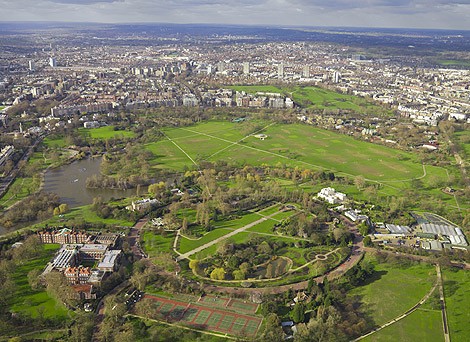
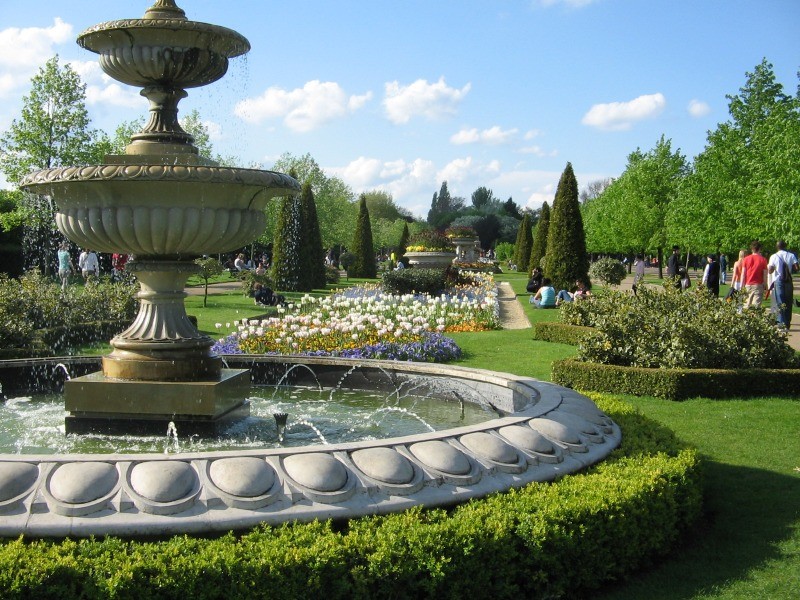
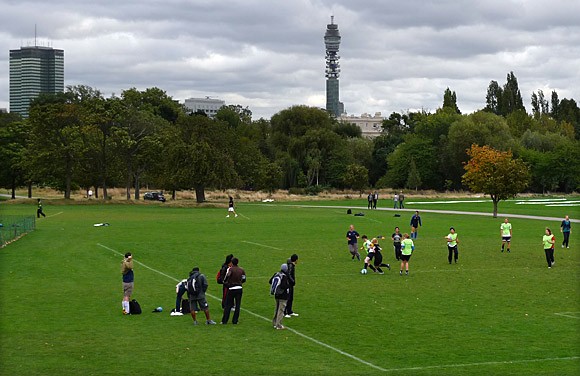
London. St. James's Park is the most ancient of London's royal parks. The area was bought by Henry VIII in 1530 and in 1660 Charles II had it landscaped by a French architect. Hyde Park is the ´people's park`: it is used for every kind of public event. The famous Speakers Corner, where you can let your soul out and scream at the whole world or have normal debate with strangers about topics that interest you, is a part of the park. In Regent Park you can feed the duck and watch the pelicans. You can also visit the Zoological Gardens, the largest zoo in the country. If you like shopping, London is the place to go! Oxford S treet and Regents S treet both streets are London's busiest shopping areas.They have lots of departments stores, clothes shops, big music shops and bookshops.
but George Ledwell Taylor suggested the name "Trafalgar Square". The northern area of the square had been the site of the King's Mews since the time of Edward I, while the southern end was the original Charing Cross, where the Strand from the City met Whitehall, coming north from Westminster. As the midpoint between these twin cities, Charing Cross is to this day considered the heart of London, from which all distances are measured. In the 1820s the Prince Regent engaged the landscape architect John Nash to redevelop the area. Nash cleared the square as part of his Charing Cross Improvement Scheme. The present architecture of the square is due to Sir Charles Barry and was completed in 1845. Trafalgar Square is owned by the Queen in Right of the Crown, and managed by the Greater London Authority.[1] Trafalgar Square ranks as the fourth most popular tourist attraction on Earth with more than 15 million visitors a year. Overview
Alberta The capital of Alberta is Edmonton. The population is 3.7 million people and there are many nationalities. Besides English and French there are also immigrants from Scotland, Ireland, Wales, Germany, Ukraine and Scandinavia. In Edmonton and Calgary there are also historic Chinatowns, and Calgary has Canada's third largest Chinese community. Geographical features Alberta covers an area of 661,848 square kilometres, an area about 5% smaller than Texas or 20% larger than France. This makes it the fourth largest province after Quebec, Ontario, and British Columbia. To the south, the province borders on the 49th parallel north, separating it from the U.S. state of Montana, while on the north the 60th parallel north divides it from the Northwest Territories. To the east the 110th meridian west separates it from the province of Saskatchewan, while on the west its boundary with British Columbia follows the 120th meridian west south from the Northwest Territories at 60°N until it reac
1. Ancient Britain: the Celtic tribes. 2000 years ago there was an Iron Age Celtic culture throughout the Br Isles. It seems that the Celts, who had been arriving from Europe from the 8th cent BC onward, intermingled with the peoples who were already there. The Celts were extremely talented people, creative and artistic. More than 1 Celtic tribe invaded Br. The descendants of ancient Celts live in Wales, Scotland, Cornwall and Ireland. They lived in primitive society. Druids priests, more powerful than chiefs. Acted like prophets. 2. Stonehenge From prehistoric period. Was built on Salisbury plain between 2500 and 1500 bc. One of the most famous and mysterious archaeological sites in the world. One of the mysteries is how it was built at all with the technology of the time. Another is its purpose. It appears to function as a kind on astronomical clock and we know it was used by the Druids for ceremonies marking the passing of the seasons. It appears in number of novels. T
Topic Australia Tallinn English College 2006 Australia 1 . Introduction The name Australia is derived from the Latin Australis, meaning of the south. In land area, Australia is the sixth largest nation, its territory is 7,686,850 sq km and its population reaches today over 20,5 million people. It is the only nation to govern an entire continent and its outlying islands. Australia's capital is Canberra, the only city with its own territory. It was built in the early 1900s just to be the capital. The official language is English and the official name of Australia is the Commonwealth of Australia. Australia is located on the Southern Hemisphere (because of that Australia is also called "A land down under"). 2 . Geographical position Australia is an island continent and it is located between the Indian and South Pacifi
Australia Australia is the smallest continent in the world. It is 7.6 million square kilometres big. It is often called the island continent because it is rather small for a continent and very big for an island. There are only five countries bigger than Australia in the World. There are five states in the mainland. Tasmania is also considered as a state so there are six states. The Northern Territory and Canberra are also independent but they are not states. Canberra is the capital of Australia and it is situated between Sydney and Melbourne because both of these cities wanted to be the capital. The population is about 19 million people and growing. New South Wales is the most populated state and Victoria is the most densely populated state. The national language is English. It is English because British settlers came to live in Australia in the past and they brought convicts with them who were also British. S
 annaabi.ee







Kõik kommentaarid