Leidsid 33 sarnast õppematerjali, mis on seotud failiga "The English Patient". Need materjalid aitavad sul teemat sügavamalt mõista.
hana, english, patient, geoffrey, caravaggio, plane, canadian, part, german, arrived, bomb, hold, started, found, though, italy, character, year, novel, there, books, room, hands, them, helped, university, poems, writer, poet, during, days, british, nurse, hospital, leave, friend, father, thief, camera, find, could, steal, lost, nerve, lovers, throughThe Moving Finger Agatha Christie The Moving Finger Agatha Christie Plot summary: Brother and sister Jerry and Joanna Burton bought a country house in an idyllic English town called Lymstock so that Jerry could recover from injuries received in a wartime plane crash. They had been living in London their whole life and thus were excited but intimidated to go. Lymstock was much like any other English village, no more than 300 people. Those that live there enjoy the peace of rural life and form a union to where it can be difficult for strangers to blend in. Fortunately, it wasn't much of a problem for Jerry and Joanna.
Chapter2: The State gave Oliver to Mrs. Mann who housed a number of orphaned children. Mrs. Mann took a large portion of the money given to her by the authorities for each child's food so Oliver grew up small and malnourished. On his ninth birthday, the town beadle, Mr. Bumble, came to collect Oliver and take him to the board for an interview. They told him he was to live with other wards of the state to become educated and learn a trade. Oliver did not mind this, but soon after he arrived, the state decided to implement a plan that would save money by feeding the people very little. After a time on this diet, the boys at the table chose Oliver to go ask the head cook for more gruel. Oliver did this, and was taken away. A flyer was then posted that said the state would give five pounds for someone to take young Oliver off their hands. Chapter3: The board locked up Oliver in what he called the `dark room' all day until someone would take him as an apprentice
Brother jumped off horse into a river, died in bed. Elder brother was already married. Henry Vlll married with his brothers widow.Catherine of Aragon, she came from Spain, she was arden(innukas) Catholic. At first they had good relations. Soon there were big problems. Had daughter Mary, couldn't get a son. Needed a new king. Henry decided to get a divorce. Henry wrote a long letter to Pope for a divorce. Pope said no. Then Henry decleared himself the head of English church to get divorce. Catherine was sent to live in countryside and brought up Mary, who was also a Catholic. Next wife was Anne Bolyn, daughter of a knight. They had daughter called Elizabeth l. Time went by and Henry had to get rid of Anne, she was sent to tower accused of treason (riigi reetmine) and executed. Henry was free, needed another wife. Had six wives together. 1 died, 1 survived, 2 divorced, 2 killed. Henry had a son, was a king Edward Vl, died very young
In Deism, there is no interference by a deity, and man controls his own destiny. These ideas stirred the masses into action, as the people dreamed of carving their own futures. Adopted by the Founding Fathers, Enlightenment ideals became the vision for modernday America, where these ideologies are deeply rooted in the nation. The Enlightenment was important America because it provided the philosophical basis of the American Revolution. The Revolution was more than just a protest against English authority; as it turned out, the American Revolution provided a blueprint for the organization of a democratic society. And while imperfectly done, for it did not address the terrible problem of slavery, the American Revolution was an enlightened concept of government whose most profound documents may have been the American Declaration of Independence and United States Constitution. To feel the full impact of the Enlightenment
american-spanish war-to 1927, the execution of Sacco and Vanzetti. He shows history as a great operative force, wants to recreate history, wants to show that the causes of what is happening now has to be found somewhere in the history. Unlike other modernists Dos Passos is interested in the average man, more than other modernist authors. Geography of the novel extends from east coast to west coast. It is also international because part of it takes place in france. Organization of LEIVA??, industrial interest, war and ??, art, expluatation, standardisation, dehumanistaion, degradation of ethical and cultural values. He is fascinated with outcasts, the alienated, the outsiders, people who have been beated with life, the descenters-those who don't agree with the majority are the descenters, they are interested in those people. The book follows the lives of nine characters. All aspects of the lives are
Book Report on "Ender's Game" By Taavo Allik March 23, 2009 Book Report on "Ender's Game".................................................................................................. Orson Scott Card....................................................................................................................... The Setting................................................................................................................................ Main Characters........................................................................................................................ Ender..................................................................................................................................... Valentine............................................................................................................................... Peter..........................................................................
In the 15 th century Johann Gutenberg invented a mechanical process of duplicating texts, which we today call book printing. The first book was printed between 1444 and 1446, so these years can be considered as the beginning years of book printing. His most important preserved printings are the 40 copies of the Bible. By the end of the 15 th century there were about 1000 print-shops in Europe already. The oldest Estonian book dates back to 1535. Libraries form a vital part of education. They make available-through books, films, recordings and other media- knowledge that has been accumulated through the ages. People in all walks of life use libraries to get information for their work. Libraries also play an important role in preserving people's cultural heritage. For example, some libraries have rare books, authors' and composers' manuscripts or works by artists. Today's libraries differ very much from the ones from the past - not only in
Tests Superstar 1 Luke Prodromou Test 1 Name____________________ Class_______ Use your English 1 Complete these sentences using the correct form (present simple or present continuous) of the verb in brackets. _ 1 She is in a band and she _________________________________ (record) a CD at the moment. _ 2 She is an actress and often _________________________________ (appear) on television. _ 3 At the moment she _________________________________ (have) a rest because she is tired. _ 4 Mike is a doctor and he _________________________________ (live) in Manchester.
All Quiet on the Western Front Erich Maria Remarque Character List Paul Bäumer - A young German soldier fighting in the trenches during World War I. Paul is the protagonist and narrator of the novel. He is, at heart, a kind, compas-sionate, and sensitive young man, but the brutal expe-rience of warfare teaches him to detach himself from his feelings. His account of the war is a bitter invective against sentimental, romantic ideals of warfare. Read an in-depth analysis of Paul Bäumer. Stanislaus Katczinsky - A soldier belonging to Paul's company and Paul's best friend in the army
Outstanding figures in British literature Eva Martina Põder 11.b British literature Refers to all literature produced by British authors from the United Kingdom, which includes England, Scotland, Northern Ireland, Wales, the Channel Islands, and Isle of Man Includes early works written in Gaelic, Welsh, and Latin, works in Old, Middle, and Modern English, each of which represents a different period Full of great works British works in Latin Venerable Bede He lived between 673 and 735 AD The greatest of all the AngloSaxon scholars He's the earliest English historian, whose work has shed light on a period of English history that would have otherwise been unknown ,,The Father of English History" Wrote / translated about 40 books on almost every area of knowledge, i.e. nature, astronomy, and poetry
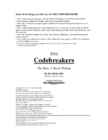
Some of the things you will learn in THE CODEBREAKERS • How secret Japanese messages were decoded in Washington hours before Pearl Harbor. • How German codebreakers helped usher in the Russian Revolution. • How John F. Kennedy escaped capture in the Pacific because the Japanese failed to solve a simple cipher. • How codebreaking determined a presidential election, convicted an underworld syndicate head, won the battle of Midway, led to cruel Allied defeats in North Africa, and broke up a vast Nazi spy ring. • How one American became the world's most famous codebreaker, and another became the world's greatest.
lending library in America and first fire department in Pennsylvania. He was an early proponent of colonial unity, and as a political writer and activist he supported the idea of an American nation.As a diplomat during the American Revolution he secured the French alliance that helped to make independence of the United States possible. A year after Benjamin Franklin's death, his autobiography, entitled "Memoires De La Vie Privee," was published in Paris in March of 1791. The first English translation, "The Private Life of the Late Benjamin Franklin, LL.D. Originally Written By Himself, And Now Translated From The French," was published in London in 1793. Known today as "The Autobiography of Benjamin Franklin," this classic piece of Americana was originally written for Franklin's son William, then the Governor of New Jersey. Noah Webster Noah Webster (October 16, 1758 May 28, 1843) was an American lexicographer, textbook
a line from Shakespeare's Julius Caesar in a speech by Brutus in Act IV: "There is a tide in the affairs of men, which taken at the flood leads on to fortune...". The quotation is given in full as the epigraph to the novel. 4 Literary significance and reception No review of this book appeared in the Times Literary Supplement. For once, Maurice Richardson, in his review of the 21 November 1948 issue of The Observer was slightly unimpressed: "Agatha Christie has, if not a whole day off, at least part of the afternoon. The killing of the blackmailing Enoch Arden, who puts up at the local to harry the already embarrassed Cloade family, the murder that follows, and Poirot's doubly twisted solution are ingenious enough, but the characterisation is a little below par. The quintessential zest, the sense of well-being which goes to make up that Christie feeling, is missing."[3] An unnamed reviewer in the Toronto Daily Star of 10 April 1948 said, "Hercule Poirot, whose eggshaped cranium
AGATHA CHRISTIE Agatha Christie was born Agatha May Clarissa Miller in Devon, in England in 1890, the youngest of three children. Her father died, when she was a child. At sixteen she was sent to school in Paris where she studied singing and piano. Christie was an accomplished pianist but her stage fright and shyness prevented her from pursuing a career in music. She never attended school. Dame Agatha Christie was an English crime writer of novels, short stories and plays. She also wrote romances under the name Mary Westmacott, but is best remembered for her 80 detective novels and her successful West End theatre plays. On the Christmas Eve in 1914, Agatha married an aviator, Archibald Christie. their daughter, Rosalind, was born in 1919. On discovering extramarital affair, she divorced him in 1928. In the same year Christie's beloved mother died.
been painted over, spoilt with knives, even used for target practice. The American Rock Art Research Association protects rock-art sites. 2) THE FAVOURITE SPORT IN BRITAIN The most popular sport is probably football. Two kinds of football is played in Great Britain. One of them, which is called association football, is played all over Europe. The other kind: rugby football is also very popular in New Zealand, France, and some other European countries. English boys play it at school, and in public parks. When they grow up, they play as members of important amateur teams or as a professional in teams competing in football ,,leagues". Professional football is as much a business as a sport. Rugby football was first played in 1823. In rugby every player is allowed to carry the ball. The ball is oval, not round. Each team contains 15 players. The oldest game of football in England is probably the football match which takes place at
Vronsky, Betsy's cousin. Vronsky continues to pursue Anna. Although Anna initially tries to reject him, she eventually succumbs to his attentions. Karenin warns Anna of the impropriety of paying too much attention to Vronsky in public, which is becoming a subject of society gossip. He is concerned about his and his wife's public image, although he believes that Anna is above suspicion. Vronsky, a keen horseman, takes part in a steeplechase event, during which he rides his mare Frou-Frou too hard and she falls and breaks her back. Vronsky escapes with minimal injuries but is devastated that his mare must be shot. Anna tells him that she is pregnant with his child, and is unable to hide her distress when Vronsky falls from the racehorse. Karenin is also present at the races and remarks to her that her behaviour is improper. Anna, in a state of extreme distress and emotion, confesses her affair to her husband
school, it was decided that he lacked the academic ability to get into Oxford University on a scholarship[22] and his parents lacked the wherewithal to finance him; [16] consequently, Lockwood Kipling obtained a job for his son in Lahore (now in Pakistan), where Lockwood was now Principal of the Mayo College of Art and Curator of the Lahore Museum. Kipling was to be assistant editor of a small local newspaper, the Civil & Military Gazette. He sailed for India on 20 September 1882 and arrived in Bombay on 18 October 1882. This arrival changed Kipling, as he explains, "There were yet three or four days' rail to Lahore, where my people lived. After these, my English years fell away, nor ever, I think, came back in full strength". Travels & First writings During the summer of 1883, Kipling visited Simla (now Shimla), well-known hill station and summer capital of British India. By then it was established practice for the Viceroy of India and the government to
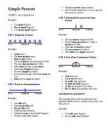
Simple Present · · New York is a small city. It is not important that this fact is untrue. [VERB] + s/es in third person USE 3 Scheduled Events in the Near Examples: Future · You speak English. · Do you speak English? · You do not speak English. USE 1 Repeated Actions Examples: · The train leaves tonight at 6 PM. · The bus does not arrive at 11 AM, it arrives at 11 PM. · When do we board the plane?
"koška" instead of "kot", "medvešonok" instead of "medved", "saichik" etc. Did not make much sense and we mostly played some games in Russian (Tare-tareke etc). Learned as much playing outside, since we had Estonian-Russian kids around as well. Not that we played with them. It's sad to say but it was not a nice time to be a Russian kid. We were mean to them, and we did not even know why. I think that's the only time I've ever been part of bullying someone, but there was this kid everybody called Vene-Russ and we spent a lot of time playing mean tricks on him. Well, there's that. And I also learned a lot of Russian from my mother's lover who was a Russian military officer and pretty much my father figure at the time. I tried to teach him Estonian and learned some Russian instead. My Russian studies in school have always been very hectic and making very little sense
Charles Dickens Charles John Huffam Dickens was the foremost English novelist of the Victorian era, as well as a vigorous social campaigner. Considered one of the English language's greatest writers, he was acclaimed for his rich storytelling and memorable characters, and achieved massive worldwide popularity in his lifetime. Charles Dickens was born in Landport, Portsmouth in Hampshire, the second of eight children to John Dickens n 7 February 1812. The 12-year-old Dickens began working ten hour days in a Warren's boot-blacking factory. In May 1827, Dickens began work in the office of Ellis and Blackmore as a law clerk. At the age
spend a month every summer until I was fourteen. That was the year I finally put my foot down; these past three summers, my dad, Charlie, vacationed with me in California for two weeks instead. It was to Forks that I now exiled myself-- an action that I took with great horror. I detested Forks. I loved Phoenix. I loved the sun and the blistering heat. I loved the vigorous, sprawling city. "Bella," my mom said to me -- the last of a thousand times -- before I got on the plane. "You don't have to do this." My mom looks like me, except with short hair and laugh lines. I felt a spasm of panic as I stared at her wide, childlike eyes. How could I leave my loving, erratic, harebrained mother to fend for herself? Of course she had Phil now, so the bills would probably get paid, there would be food in the refrigerator, gas in her car, and someone to call when she got lost, but still... "I want to go," I lied
noticed when I was born! 3 1 Laura was offered a place at much. Personality-wise, I've got a lot of my Manchester University but she dad's traits in me. We're both quite bubbly and friendly (or so people 1C The origins of English turned it down. page 5 2 Whilst some people are in favour say), and we share quite a laid-back of the monarchy, others think we approach to life. When it comes to 1 1 Anglo-Saxon 8 Conquest
Th e story ends with their tryst in Moscow and a wrenching discussion of the impossibility of their situation -- he cannot leave his wife because of the loss of status and wealth that a divorce would entail, and she cannot leave her husband and family for much the same reason -- yet they pledge to one another to carry on with their aff air because they are now clearly in love with one another. Just after sex TY What is missing from this passage in English is the asymmetrical use o the second-person pronouns in the Russian original. Gurov addresses Anna throughout as ty while she addresses him throughout as vy. Because of his unhappy marriage and the ease with which he had always been able to enter into brief aff airs, Gurov had long considered women "a lower breed." So now, aft er he and Anna have had sex, he addresses Anna as he would anyone who had proven herself to be of the "lower breed," with a slight degree of contempt.
and Julius Caesar never returned to Britain after that. The island was left undisturbed for nearly a century. *The Roman occupation of Britain 43-410 and its legacy Britain was conquered by Emperor Claudius, the Roman rule in England lasted up to 410. The Romans left behind a huge legacy: many types of animals and plants were brought to Britain in Roman times. Roman introduced theire measurements, Christianity, reading and writing. Also, many words in English and Welsh have been borrowed from the Latin language. An important legacy of the Romans was its roads, agriculture and cities. In the Roman times the land was dominated by rules and reguations. *Christianity in Roman Britain The Roman authorities were suspicious of Christianity because followers of Jesus Christ refused to take an oath of loyalty to the Roman emperor. For this reason the early Christians were regarded as dangerous enemies of the Empire. That
biographies, accounts of voyages, diaries, sermons, pamphlets. Much of the material addressed the problems of Church and State. There were few examples of fiction, poetry or drama. Anne Bradstreet of Massachusetts published some lyrical poems of high literary quality (1650) and Edward Taylor, who was born in England but lived in Boston, wrote some poetry in the style of John Donne and the metaphysical poets. All 17 th cent Am writings were, both in content and form, similar to English lit of the same period. The great literary figures of the 18th cent were Benjamin Franklin (1706-1790), Thomas Paine (1737-1809) and Thomas Jefferson (1743-1826). The common sense and witty aphorisms of Franklin's popular Poor Richard's Almanac series appealed to colonial readers. Franklin also wrote effectively on the question of allegiance to the British crown but it was his protégé, Thomas Paine, who
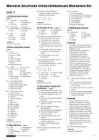
5 seen 12 walked school. It's hard to say. 6 were waiting 13 didn't admit 3 stewardess 7 retirement 7 was looking 4 wonderful 2 1 I reckon they are about 17 years old. 3 1 was getting, arrived Challenge! 2 It's a mixed class of girls and boys. 2 was preparing, cut Students' own answers 3 It's difficult to tell what kind of 3 discovered, were building 1E Past perfect simple and lesson their in.
• Sydney – where he came from • Shika Maru – last stop before Thursday Island • New Caledonia – prison, where Joe was. • Melbourne – where he fleed the boat • New Guinea – where he went to live after Melbourne STORY: Thursday Island is the last place God ever made. People in Sydney told me not to go, because there was nothing to see and I should get my throat cut. He had come up from Sydney in a Japanese tramp. He arrived in he middle of the night and one of the sailors told him that if he turned left he should presently come to a two-storey building, which was a hotel. The boat pushed off. He didn't like the idea of sleeping on hard stones on a jetty. So he started walking towards the hotel. He seemed to walk much more than a few hundred yards which it should be, but a little bit later he saw a building. No light showed, but his eyes were used to the darkness, so he found a door. There was no door
come true. You deserve it. And to Alistair and Jessica, from Seven Years to Sin , who inspired me to write Gideon and Eva's story. I'm so glad the inspiration struck twice! 1 "We should head to a bar and celebrate." I wasn't surprised by my roommate's emphatic pronouncement. Cary Taylor found excuses to celebrate, no matter how small and inconsequential. I'd always considered it part of his charm. "I'm sure drinking the night before starting a new job is a bad idea." "Come on, Eva." Cary sat on our new living room floor amid a half-dozen moving boxes and flashed his winning smile. We'd been unpacking for days, yet he still looked amazing. Leanly built, dark-haired, and green-eyed, Cary was a man who rarely looked anything less than absolutely gorgeous on any day of his life. I might have resented that if he hadn't been the dearest person on earth to me.
The Project Gutenberg EBook of Pride and Prejudice, by Jane Austen This eBook is for the use of anyone anywhere at no cost and with almost no restrictions whatsoever. You may copy it, give it away or re-use it under the terms of the Project Gutenberg License included with this eBook or online at www.gutenberg.org Title: Pride and Prejudice Author: Jane Austen Release Date: August 26, 2008 [EBook #1342] [Last updated: August 11, 2011] Language: English Character set encoding: ASCII *** START OF THIS PROJECT GUTENBERG EBOOK PRIDE AND PREJUDICE *** Produced by Anonymous Volunteers, and David Widger PRIDE AND PREJUDICE By Jane Austen Contents Chapter 1 Chapter 22 Chapter 2 Chapter 23 Chapter 43 Chapter 3 Chapter 24 Chapter 44
open to a `heavenly home'. 3. The Gen. Charst. Of OE poetry and prose. The distinction between verse and prose is by no mean always clear in that period of time. Anglo-Saxon verse is the product of a tradition which reached far back into pre-literate times and which was challenged and eventually replaced after the Conquest by a quite different tradition, so to say Eng poetry began with an end. But by contrast, the earliest monuments of English prose represent the true beginning of a tradition of written prose. But indeed the only work of prose which can claim a foothold of English literature is `Mandeville's Travels' and it's translated from the French. With the religious works bulk much larger and important writers are Thomas More, Jeremy Taylor, etc. The main tradition of vernacular prose began in England in late 800s with the Anglo-Saxon chronicle and with the group of translations made or inspired by the king himself
Test 14 1 Translate. 1 arstiabi puudumine lack of medical care 2 haiguste käes kannatama suffer from illnesses 3 saksa päritolu of german descent 4 Ameerikat avastama discover America 5 ametlik keel official language 6 orjusele lõppu tegema put an end to slavery 7 oma traditsioone ja kultuuri säilitama keep your traditions and culture 8 immigrantide arv the number of immigrants 2 Complete the sentences with the names of countries, nationalities, and languages. 1 The capital of Norway is Oslo. 2 Kevin lives in Chicago. He is American. 3 Michail comes from Moscow. He speaks Russian. 4 What nationality are you
Prasutagus(ruler) was first allowed to rule when romans conquered England, after his death, romans decided to rule Iceni and flogged Boudicca and raped her daughters 60-62 AD Iceni rebelled, Boudicca´s warriors defeated Roman Ninth Legion, destroied capital-Colchester Finally Boudicca was defetated, she poisoned herself to avoid capture Hadrian´s wall A defensive barrier builtin 122 AD by Roman emperor Hadrian to guard the northern part of Britain against barbarian invaders Most imposing frontier of Roman Empire, controlling peoples mobements Building took several years, builders kept changing minds about the size 119 km lenght, 5m high, 3m deep The Picts, Caledonia The painted ones, northern tribes, part of the Scots Inhabited an area known as eastern and th western Scotland, until 10 c Mysteriously disappeared Constantly fought with Romans
Book 1 BASIC ENGLISH BASIC ENGLISH GRAMMAR GRAMMAR BASIC ENGLISH GRAMMAR Book 1 Book 1 Younger students at beginning to intermediate levels will greatly benefit from this step-by-step approach to English grammar basics. This is the ideal supplement to your language arts program whether your students are native
 annaabi.ee