Leidsid 33 sarnast õppematerjali, mis on seotud failiga "The Eiffel Tower (esitlus Eiffeli tornist inglise keeles)". Need materjalid aitavad sul teemat sügavamalt mõista.
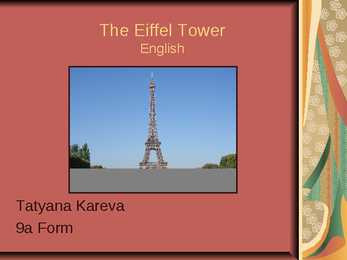
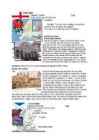
tall, lifts, build, building, introduction, france, metres, structure, iron, paris, engineer, built, monument, addition, than, legs, tons, first, floor, named, gustave, whose, designed, fair, leading, artists, global, cultural, icon, structures, paid, storey, base, square, during, held, years, until, york, finished, broadcasting, aerial, upper, platformThe Eiffel Tower English Tatyana Kareva 9a Form The Eiffel Tower The Eiffel Tower is an iron tower built on the Champ de Mars beside the Seine River in Paris. The tower has become a global icon of France and is one of the most recognizable structures in the world. Most visited monument Named after its designer, engineer Gustave Eiffel, the Eiffel Tower is the tallest building in Paris. More than 200,000,000 have visited the tower since its construction in 1889, making it the most visited paid monument in the world High Including the 24 m antenna, the structure is 325 m high (since 2000), which is equivalent to about 81 levels in a conventional building. Structure
Eiffel tower The Eiffel Tower is an iron tower built beside the Seine River in Paris. The tower has become a global icon of France and is one of the most recognizable structures in the world. The structure was built between 1887 and 1889 for universal Exhibition of the French Revolution. The construction was only meant to last for the duration of the Exposition. The man behind the Eiffel Tower was Gustave Eiffel, known from his revolutionary bridge building techniques. The structure took more than two years to complete. Each one of the about 12,000 iron pieces were designed separately to give them exactly the shape needed
Described in the Collins Encyclopaedia of Scotland as "the one immediately and internationally recognised Scottish landmark", it may be nominated by the British government to be added to the UNESCO World Heritage Sites in Scotland. The bridge and its associated railway infrastructure is owned by Network Rail Infrastructure Limited. Until 1917, when the Quebec Bridge was completed, it was the longest cantilever bridge in the world. The Forth Bridge remains the second longest. First steel structure The bridge was built in steel alone, the first bridge in Britain to use that material. It was the first major structure in Britain to be constructed of steel; Its contemporary, the Eiffel Tower was built of wrought iron. Construction The bridge is, even today, regarded as an engineering marvel. It is 2.5 km (1.5 miles) in length, and the double track is elevated 46 m (approx. 150 ft) above high tide. It consists of two main spans of 521.3 m (1,710 ft), two side spans of 207
the Great Fire of London. London Bridge The home of the London Bridge is the Thames River, and a bridge has existed on the spot for at least the last 2000 years. The first bridge on record was constructed by the Romans, and since then many bridges have risen at the hands of various empires. London Bridge today remains one of the most popular tourist attractions in Britain as well as an icon for the City of London. London Bridge history records the building of a wooden bridge by the Romans about 2000 years ago. Historians suspect that the location was chosen for its relatively convenient access to the deeper ocean waters, as well as the excellent land conditions available for bridge building. The home of the London Bridge as it appeared in Roman times was in virtually the same spot as the home of the London Bridge today, suspended over the Thames River. The Romans were not the only people in London Bridge history to construct a wooden bridge
the Soviet Union in 1991. http://en.wikipedia.org/wiki/Alexander_Nevsky_Cathedral,_Tallinn The church's towers hold Tallinn's most powerful church bell ensemble, consisting of 11 bells, including the largest in Tallinn, weighing 15 tonnes. You can hear the entire ensemble playing before each service. http://www.tourism.tallinn.ee/eng/fpage/explore/churches#!p_307 Old Town Twisting cobblestone lanes and iron street lamps. Gothic spires and medieval markets. Cappuccino and Wi-Fi. This is the city's famous Old Town. If you're looking for that mix of historic ambience and cutting-edge culture that defines Tallinn, you'll find it here. Built up from the 13th to 16th centuries, when Tallinn or Reval as it was known then was a thriving member of the Hanseatic trade league, this enclosed neighbourhood of colourful,
Burj al-Arab Hotel - The tourist magnet of Dubai The Burj Al Arab : literally, Tower of the Arabs is a luxury hotel located in Dubai, United Arab Emirates. Construction Construction of Burj Al Arab began in 1994. In 1999 the tower that resembles the sail of a dhow, became the world's tallest hotel with the height of 321 m. The architect Tom Wright has said that the client wanted a building that would become an iconic or symbolic statement for Dubai. This is very similar to Sydney with its Opera House, or Paris with the Eiffel Tower. It had to be a building that would become synonymous with the name of the country. The world's tallest hotel is also popularly described as the world's only 7-Star hotel - although its formal rating is 5 Star Deluxe, the highest the international rating system offers.
Foreword Bridging rivers, gorges, narrows, straits, and valleys always has played an important role in the history of human settlement. Since ancient times, bridges have been the most visible testimony of the noble craft of engineers. A bridge can be defined in many ways, but Andrea Palladio, the great 16th century Italian architect and engineer, hit on the essence of bridge building when he said "...bridges should befit the spirit of the community by exhibiting commodiousness, firmness, and delight." In more practical terms, he went on to explain that the way to avoid having the bridge carried away by the violence of water was to make the bridge without fixing any posts in the water. Since the beginning of time, the goal of bridge builders has been to create as wide a span as possible which is commodious, firm, and occasionally delightful
and the third-tallest free-standing clock tower in the world. The clock first ticked on 31 May 1859. The pendulum is installed within an enclosed windproof box sunk beneath the clockroom. It is 3.9m long, weighs 300 kg and beats every 2 seconds. The clockwork mechanism in a room below weighs 5 tons. · Buckingham Palace is the official London residence of the British monarch. Originally known as, the building which forms the core of today's palace was a large townhouse built for the Duke of Buckingham in 1703 on a site which had been in private ownership for at least 150 years. During the 19th century it was enlarged, principally by architects John Nash and Edward Blore, forming three wings around a central courtyard. Buckingham Palace finally became the official royal palace of the British monarch on the accession of Queen Victoria in 1837.
It is instead wholly owned by the U.S. government; thus admission to the gallery is free. The gallery's west wing features the nation's collection of American and European art through the 19th century. The east wing, designed by architect I. M. Pei, features works of modern art. The Smithsonian American Art Museum and the National Portrait Gallery are often confused with the National Gallery of Art when they are in fact entirely separate institutions. The National Building Museum, located near Judiciary Square, was chartered by Congress and hosts temporary and traveling exhibits. 4.There are many private art museums in the District of Columbia, which house major collections and exhibits open to the public such as: the National Museum of Women in the Arts; the Corcoran Gallery of Art, the largest private museum in Washington; and The Phillips Collection in Dupont Circle, the first museum of modern art in the United States
Roman armies were recalled from Britain to defend Rome itself. Once they had left Anglo-Saxons invaded and settled in Britain. They were farming people who preffered to live outside towns. For a while London probably lay in ruins, but it eventually developed again, partly because of its position on the river was good for trading. The Tower of London There is more of London's history in the Tower than anywhere else in London. It is the oldest surviving building in the capital. The Tower of London was begun by William the Conqueror in 1078 as a castle and a palace but even before the site had been used by the Romans and Anglo-Saxons. The tower comprises not one, but 20 towers, the oldest, the White Tower, dates back to the 11 th Century. The Roman stone wall, parts of which can still be seen on the territory of the Tower, may have been a small Roman fort near the river. The White Tower, called so on account of the white Caen stone Brought from
Sightseeing in Estonia Tallinn TV Tower The Tallinn TV Tower (Tallinna teletorn) is a free-standing structure with an observation deck, built to provide better telecommunication services for the 1980 Moscow Summer Olympics regatta event (see Sailing at the 1980 Summer Olympics). It is located near Pirita, six km north-east of the Tallinn city center. The tower has a specified height of 314 m (1030.2 ft), though some sources put it at 312.6 m (1026.6 ft). The building is administered by the public company Levira (formerly Estonian Broadcasting Transmission Center Ltd) and is a member of the World Federation of Great Towers. The tower was designed by architects David Baziladze and Juri Sinis. The cornerstone was laid on September 30, 1975, and the building was inaugurated July 11, 1980 (although the first transmission took place in 1979). The tower body was constructed of reinforced concrete
Wonders of the modern world Channel Tunnel Date started: December 1, 1987 Date finished: May 6, 1994 Location: Strait of Dover, between the United Kingdom and France The Channel Tunnel is a 50.5-kilometre undersea rail tunnel .At its lowest point, it is 75 metres deep. At 37.9 kilometres the Channel Tunnel possesses the longest undersea portion of any tunnel in the world, although the Seikan Tunnel in Japan is both longer overall at 53.85 kilometres and deeper at 240 metres below sea level. The tunnel carries high-speed Eurostar passenger trains, Eurotunne Shuttle roll-on/roll-off vehicle transport--the largest in the world--and international rail freight trains. The tunnel connects end-to-end with the
............lk5 Big Ben......................................................................................................lk6 Pictures......................................................................................................lk7 Summary....................................................................................................lk8 Used in the literature...................................................................................lk9 Introduction I chose this topic because it is interesting to know about London.London is one of the impotrtant cities in Europe .I also think that everyone would like to travel in London. 3 London history During the 19th century, London was transformed into the world's largest city and capital of the British Empire. Its population expanded from 1 million in 1800 to 6.7
Tallinn Mustamäe College G2K Jaana-Kristiina Jõgevest The Four oldest churches of Tallinn Report Supervisor: Ingrid Teigar Tallinn 2009 The Dome Church The Danes began fortification of Toompea after the conquest of Tallinn in 1219 and probably also built the first church there. It was presumably a wooden building located at the site of the present cathedral. However, a serious conflict with the Order of the Brothers of the Sword broke out soon as the latter wanted to gain control of the entire Estonia. The order succeeded in subordinating Tallinn and the whole of North Estonia to its rule in 1227. The monks of the Dominican Order began the construction of a stone church in Toompea in 1229. The first written data on the cathedral date back to 1233, the date of a
The New York 1. The Empire State Building. The Empire State Building is a 102-story landmark Art Deco skyscraper in New York City at the intersection of Fifth Avenue and West 34th Street. Its name is derived from the nickname for the state of New York, The Empire State. It stood as the world's tallest building for more than forty years, from its completion in 1931 until construction of the World Trad Center's North Tower was completed in 1972. 2. Central Park. Central Park is an urban park that occupies about 1.2 square miles (341 hectares, or 843 acres) in the heart of Manhattan in New York City. It is host to approximately twenty-five million visitors each year. Central Park was opened in 1859, completed in 1873 and designated a National Historic Landmark in 1963. 3. The statue of Liberty.
Right now there’s third Old Thomas, first one can be seen at Tallinn City Museum. Toompea as a symbol of power Toompea palace - wooden fortification was originally built in the 9th century, Danes made the castle the centre of secular power; Toompea palace hosts the parliament of the Republic of Estonia, designed by Eugen Habermann and Herbert Johanson. The parliament has 101 members and is chosen for 4 years. Stenbock House - the official seat of the Estonian Government since 2000; the building started in 1787, originally meant to be a courthouse. After russians ran out of fund, house went into Jakob Pontus Stenbock’s possession. Renovation was carried out in 1996-2000. Tall Hermann - tower in the south-west corner of the castle; 49 m built in 1371; ten floors and a viewing platform. Estonian flag is raised there every morning at sunrise but not before 7am and lowered at sunset but not later than 10pm; except at midsummer June 23, when it’s not lowered at all
The coolest month is January. Winders are seldom below freezing. Rainfall is regular, but most often in the form of drizzle occurring throughout the year. Snow occurs sometimes in winter but rarely settles more than a few millimetres deep. History The origin of London may be dated around the beginning of the 1st century AD, when a Celtic tribe settled near a fordable point of the Thames. L achieved real importance following the Roman conquest under Claudius (43AD). The Romans build a bridge, somewhat east of the present city. This bridge soon was part of a trade road and attracted more and more traders. Soon the flourishing city Londinium came into existence. The Romans rebuilt the town into a centre of great importance. After the Romans withdrew from Britain in the Picts, Scots, Jutes, Angles and Saxons invaded London. It started to expand again under the Saxon kings. London was described as a
restaurants, sport and cultural centres. Every five years national song and folk dance festivals take place in Tallinn. The yachting regatta of the 1980 Moscow Olympic Games was held at Pirita. History Tallinn means in English "Danish town". The place is believed to have been settled by Finno-Ugric people about 2500 BC. It was first marked on a map of the world by the Arab geographer al-Idrisi in 1154. The Estonians were the first to build a stronghold on the spot of the Toompea Hill, but the real Tallinn was built by the Danes who conquered the north of Estonia in 1219. Legend has it that one day, when the Danes were about to lose a bloody battle, the sky suddenly opened and a red flag with a white cross on it dropped down upon them from the heaven. This is how the Danes obtained their national flag. In 1346 the Danish king sold his Estonian lands to the Teutonic Order, who a year later resold them to the Livonian Order
The oak is the national tree of England. Interesting plases: Royal Opera House The Royal Opera House is the third theatre on the Covent Garden site, the previous two being destroyed by fire. The new building opened in May 1858 becoming known as the Royal Opera House in 1892. Restoration work began again in 1996 and was completed in December 1999. Thousands of visitors each year are welcomed through the doors not only for performances but to marvel at the views from the
Edinburgh Castle is an ancient stronghold which dominates the sky-line of the city of Edinburgh from its position atop Castle Rock. It is Scotland's second most visited tourist attraction. Human habitation of the site is dated back as far as the 9th century BC. As it stands today though, few of the castle's structures pre-date the Lang Siege of the 16th century, with the notable exception of St Margaret's Chapel, the oldest surviving building in Edinburgh, which dates from the early 12th century.As with all castles, Edinburgh's fortress has been a centre of military activity. As an ancient fortress Edinburgh Castle is one of the few that still has a military garrison, albeit for largely ceremonial and administrative purposes. The New Barrack Block is now home to the official headquarters of the Royal Regiment of Scotland and 52 Infantry Brigade, as well as home to the regimental museum of the Royal
Kristiina Stõkova 105281, EAEI-33 Structural loads As everyone might know that great architecture is the successful marriage of art and technology and a structure is an artifact expressing one of the many aspects of human creativity, however it is an artifact that cannot be created without a deep respect for the laws of nature. And that is the main problem brought out by the author of the book ,,Why buildings stand up", Mario Salvadori. So why should an engineer consider different loads? the answer is simple - if the earth did not pull, the wind did not blow, the earth's surface did not shake or sink and the air temperature did not change, then
tower considerably. 4. Suur Munamägi ("Big Egg Hill") Mountain Suur Munamägi, or Big Egg Hill, is the highest point in Estonia and other two Baltic countries. It is 318 meters high. The mountain is located in the middle part of Haanja uplands. It is in Haanja national park in Võrumaa. On the top of the mountain there is an observation tower the view from 346,7 meters is 50 km in radius. 5. The Town Hall building 3 The building history of the Town Hall goes back to the 13th century. In its present form it was completed in 1404. The management of the city worked in the Town Hall until 1970. Since 1975 the
Tallinn English College English Sergo Vainumäe 9A TALLINN Report Supervisor: Inge Välja Tallinn 2006 Order of contents: 1.Introduction 2.Toompea 3.Lower Town 4.Kadriorg and Pirita 5.Museums 1. Introduction Tallinn, the capital of Estonia, lies on the Baltic Sea. It is on almost the same latitude east St. Petersburg in Russia, Stockholm in Sweden and Stavanger in Norway, and covers 158 sq km. Tallinn was first marked on a map of the world by the Arab geographer al-Idrisi in 1154, its name then being Kolyvan (probably derived from the name Kalev). In the 13th-century Chronicle of Henricus de Lettis the town was called Lyndanise. Later came Reval (presumably after the old county
London History The Romans AD 43- AD 410 The Romans finally invaded Britain in AD 43 from Kent. The Romans lead by Julius Caesar attempted to invade Britain twice before that in 55 and 54 BC but the invasions were unsuccessful. They made their way to the river Thames and sailed up it. The Romans knew it was important to control a crossing point at the river Thames, so they decided to build a settlement on the north bank. Although small settlements had been built on the banks of the Thames, the Romans were the ones who built the first city. They called their city Londinium. The Roman engineers noticed that the point where the swampy river narrowed would make an ideal crossing point, they built London Bridge. Less than 20 years later the native Iceni tribe, led by Queen Boudicca, rose up against the Romans in revenge for mistreatment and burnt Londinium to the ground
as “ward off the enemy”) was built, on the north-east corner was a round cannon tower Landskrone (“crown of the land”), and on the north-west corner, which offered relatively good natural protection owing to the hill bank, a small corbelled tower, Pilsticker (“arrow-sharpener”). Three of these towers have been preserved. Stür den Kerl was demolished in the 18th century when the government administration building was being erected. The core of the fortress was taken up by the Convent House, built to a specific plan and the layout evolved in the course of the Order´s construction activities.In the 1920s the house, which had fallen into disrepair, was replaced with the building of the parliament of the Republic of Estonia that follows in general the layout of the medieval construction. The building was designed by Eugen Habermann and Herbert Johanson, who later proved to be Estonia’s most
It is written in the chronicles that Kiek in de Kök was once the most powerful tower along the Baltic shores. The round cannon tower, built in the 15th century, has a diameter of 17 meters. Its height is 38 meters and its walls are 4 meters thick. The tower was just high enough that its guards had a view into the kitchens of neighbouring buildings. The tower s name, "peek in the kitchen", comes from its height. The tower was partially destroyed during the Livonian War (1558-1583), but the building itself did not fall. The tower has been rebuilt several times, but up until the 20th century, it was still being used as a gunpowder storage and storehouse. Today the tower tells the story of the birth and development of Tallinn and the most important military events from the 13th to the 18th centuries. The external wall still holds stone and iron cannonballs from Russian tsar Ivan IV. The Great Coastal Gate, built along with the city wall, is situated on the northern side of the Old
Tallinna Lillekyla Gymnaasium Report Song Festival Ground Student:Laura Kivistu Supervisor:Meeri Sild Tallinn 2008 Table of Contents 2 Introduction The topic of my report is ,,Song Festival Ground". I chose this topic, because everything what is related with music and singing is very interesting to me. Music is part of our lives. We all know that Estonians made singsong revolution. In this report I want to find out more information with Song Festival ground, it history and what's going on here today. 3
spectacular (although I did enjoy the vistas from the Tour Montparnasse in Paris more). The London Eye, also known as the Millennium Wheel, is an observation wheel that completed construction in 1999 and opened to the public in March, 2000. As of June 2007, it is the largest observation wheel in the world, although there are larger ferris wheels, such as The Star of Nanchang, and a contender for the title in the Singapore Flyer due for completion in 2007. The London Eye has become the most popular paid for UK visitor attraction, visited by over 3
1. Fat Margareta - 16. Cent. Tallinn's most impressive defensive structures, the Great Coastal Gate (Suur Rannavärav) and Fat Margaret's Tower. They were built not only to defend the city from the seaward side of town, but also to impress any visitors arriving via the harbour. Fat Margareta used to be a prison. It is a town wall's building. Now it's home to the Estonian Maritime Museum, which provides a detailed look at the nation's seafaring past. 2. The Great Coastal Gate - with the Viru Gates, are the last of six gates that controlled access to the town in Medieval times. 3. Kolm Õde - a hotel. In 2003, three of Tallinn's splendid merchant houses, built in 1362, were renovated and united to create The Three Sisters, which now offers modern amenities with great design and a
It has the second biggest airport in the UK after London. No tickets on certain buses. Mainly nightlife economy, over 10 000 visitors per night. 2 universities, 2 football clubs, 2 big stadiums, largest is Manchester United Football stadium. Granada television, BBC, Hollywood films, The Guardian, red brick houses, second greatest after London. Mihkel: "Liverpool" Founded in 1207, city in 1880. Has been bombed 80 times. Albert Dock, Royal Liver Building (1911), Cunard Building (1917), Port of Liverpool (1907)is being restored in 2009.the Liverpool Blue Coat School is the top school in UK, has produced 8 Nobel Prize winners. The Beatles in 1960, record company was Parlophone records, Paul and Ringo still active. 1892 FC Liverpool,most successful in UK. Robert: "Traditional British Foods" Breakfast 1:eggs, bacon, sausages, bread, beans, mushrooms,coffee Breakfast 2: cereals, slice of toast, orange juice, coffee Lunch: sandwiches, crisps, fruits, juices
is known, because there is the London zoo. The London zoo, opened in 1828 as a scientific zoo, is the oldest one in the whole world. In 1848, it was opened for people. The London zoo covers 36 acres and there are about 5000 animals in the zoo. The zoo is open every day except Christmas Day. The ticket costs 14 pounds for and adult and 10.75 pounds for a child. St. James's park is famous for its water birds, for example ducks and pelicans. Buckingham palace is near St James's park. The building of the Buckingham palace started in 1703. It was built for the Duke of Buckingham. The house was later bought by King George III for himself and Queen Charlotte. In 1820, King George IV commissioned John Nash to build a State Palace, much of the structure and decoration of which is seen today. Queen Victoria was the first monarch to live in the Palace, from 1837, and it has been the London home of the Royal Family ever since. The Royal Standard flies above the Palace when The Queen is in
01.2010 Juhendaja: Roode Liias ……………………….. Ülesande vastu võtnud: Tanel Friedenthal ………………………. Abstract How are 3D and BIM Changing the Design, Fabrication and Construction of Complex Steel Structures? The adoption of three-dimensional (3D) design and construction tools have created a remarkable shift in the building industry. Intelligent 3D technology in the form of Building Information Modeling (BIM) not only promises to improve the notoriously inefficient construction process, but also opens the door for designing new geometric shapes, which until recently have been considered unbuildable. Steel has been extensively used to build some of the most challenging architectural icons of the 21st century, due to its low weight and high strength in both compression and tension. Therefore, the steel
may be marginal, it is convenient to use. Local walking tours offer short-cuts to understanding the city. The main attractions are in the two old towns (Lower Town and Toompea) which are both easily explored on foot. Eastern districts around Pirita and Kadriorg are also worth visiting and the Estonian Open Air Museum (Eesti Vabaõhumuuseum) near Rocca al Mare, west of the city, preserves aspects of Estonian rural culture and architecture. My 5 favourite places in the Old Town are Tall Hermann, the viewing points in Toompea, St. Olaf's Church, Town Hall Square and Bun Passage. For centuries Toompea was always inhabited by the ruling classes. In the Middle Ages, it was the place where the bishops and the nobility resided. Here the landed gentry built their beautiful town houses. Most of the remaining buildings were erected after the big fire on Toompea in 1684. Historically, the fortress on Toompea consisted of two parts: the small fortress
 annaabi.ee