Leidsid 33 sarnast õppematerjali, mis on seotud failiga "The 4 oldest Churches in Tallinn". Need materjalid aitavad sul teemat sügavamalt mõista.
church, tall, cent, century, build, building, olaf, date, fire, grave, ghost, back, built, altar, spire, toompea, chapel, wall, present, cathedral, construction, medieval, even, complete, year, order, late, other, work, king, record, christ, reformation, monument, metres, oldest, gain, stone, mary, years, period, once, grete, eelk, eight, destroy, earlythen being Kolyvan (probably derived from the name Kalev). In the 13th-century Chronicle of Henricus de Lettis the town was called Lyndanise. Later came Reval (presumably after the old county of Rävala), the name used by the Germans who ruled the country for seven centuries. Russians then modified Reval to Revel. For Estonians, the town came to be called Tallinn from Taanilinn (Danish town) after Danish conquest in the 13th century. Over the course of time, Taanilinn was shortened to Tallinn The place is believed to have been settled by Finno-Ugric peoples about 2500 BC. The Danes, led by King Valdemar II, conquered northern Estonia in 1219. Legend has it that one day, when the Danes were about to lose a bloody battle, the sky suddenly opened and a red flag with a white cross on it dropped down upon them from the heavens. This is allegedly how the Danes obtained
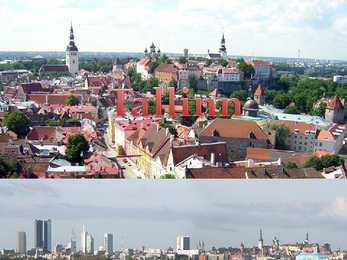
restaurants, sport and cultural centres. Every five years national song and folk dance festivals take place in Tallinn. The yachting regatta of the 1980 Moscow Olympic Games was held at Pirita. History Tallinn means in English "Danish town". The place is believed to have been settled by Finno-Ugric people about 2500 BC. It was first marked on a map of the world by the Arab geographer al-Idrisi in 1154. The Estonians were the first to build a stronghold on the spot of the Toompea Hill, but the real Tallinn was built by the Danes who conquered the north of Estonia in 1219. Legend has it that one day, when the Danes were about to lose a bloody battle, the sky suddenly opened and a red flag with a white cross on it dropped down upon them from the heaven. This is how the Danes obtained their national flag. In 1346 the Danish king sold his Estonian lands to the Teutonic Order, who a year later resold them to the Livonian Order
Estonian sculptors, has been standing for several decades. Lai Street stretches from Nunne Street to Pikk Street. Parallel with Pikk Street, Lai Street, too, ends at the Great Coast Gate (first mentioned 1359). Lai Street is very wide considering that it was laid out in the Middle Ages. This is because it sprang up on both sides of former city wall. Lai is quite a peaceful street with few shops. However, it has three museums and two theatres. The main entrance into St Olaf´s Church also faces the street. Several Lai Street houses have kept their Gothic appearance and even interiors, although we can also notice moderate Nordic Baroque, Neoclassicicm, Historicism and even Art Nouveau. The origin of the name "Lai" Lai Street belongs among the oldest streets of Tallinn. Despite its length and width its share in the city's inner traffic is fairly modest. The extraordinary width of the street is likely due to
2 Towns (Upper & Lower Town) Tallinn used to be divided into 2 parts - Upper Town where lived the aristocracy, gentry and the clergy; and Lower Town with traders, craftsmen and merchants. Legend says the Toompea Hill is actually the tumulus mound of the great Kalev. Linda carried rocks to his grave. It is a naturally- formed limestone hill. Lower Town was a merchantile centre, Tallinn also belonged to the Hansaetic League (1285). It is often referred to as the town of citizens. Any grown-up, married and economically independent person, born in a legal marriage between two free people and having lived in the town for at least 3 months, could apply to the Magistracy for citizenship. Serfs could escape from serdom after having successfully hidden in town for a year and a day.
into the enemy’s kitchen. The walls are 4 m thick, can see the cannons stuck in there. Tallinn City Museum. ● Town Wall (Unesco) - one of the greatest towers of Tallinn’s Town Wall, Old Town declared the UNESCO World Heritage Site in 1997 Toompea ● Toompea is a limestone hill in the central of Tallinn. It towers about 30-40 metres above the surrounding areas. According to the legend, its the tumulus moundn over the grave of the national hero Kalev, erected stone by stone by his grieving wife Linda. While we don’t want to question this wonderful theory, there is an alternative version which says that Toompea is just a naturally formed limestone hill. ● It’s the birthplace of Tallinn - in 1229, the Knights of the Sword built a fortress - Toompea castle. It’s the most potent symbols of the reigning power. Today it’s the seat of the Government of Estonia as well as the Riigikogu.
TOOMPEA Toompea (from German Domberg – Cathedral Hill ) is a limestone hill with an area of about 7 hectares in the central part of Tallinn. It towers about 30-40 m above the surrounding areas. According to the legend it´s the tumulus mound over the grave of the national hero Kalev, erected stone by stone in his memory by his grieving wife Linda. It is the birthplace of Tallinn - a place where in 1229 the Knights of the Sword built a fortress instead of the wooden Estonian stronghold. Toompea Castle is also one of the most potent symbols of the reigning power. Today Toompea is the seat of the Government of Estonia as well as the Riigikogu, both of which are often simply colloquially referred to as Toompea.
Art Museum of Estonia Art Museum of Estonia was founded on November 17th, 1919, but it was not until 1921 that it got its first permanent building the Kadriorg Palace, built in the 18th century. In 1929 the palace was expropriated from the Art Museum in order to rebuild it as the residence of the President of Estonia. The Art Museum of Estonia was housed in several different temporary spaces, until it moved back to the palace in 1946. In September, 1991 the Kadriorg Palace was closed, because it had totally deteriorated by then. At the end of the year the Supreme Council of the Republic of Estonia decided to guarantee the construction of a new building for the Art
Turu Kael sidestreet. The market location perfectly suited for trade: five trade routes started there. The square is connected to Town Hall Square by a short sidestreet. Town Hall Square Was used as marketing place, for festivities as well as for executions. In summer it is filled with outdoors cafes In winter it becames a magical christmas market The L-shaped sigh There has been a town hall in Tallinn since at least 1322. Town Hall Built in 13th century The management of the city worked in the Town Hall until the year 1970 The only gothic town hall on Northern Europe Weathervane Old Thomas The height of the towe is 64 metres Town Hall pharmacy Is one of the oldest working pharmacies in Europe and the oldest company in Tallinn Was first mentioned in 1422 There were also sold other goods like: ground bats, dried frog feet etc You can try spiced wine claret which was known and valued during the middle
trade (16%) and transport and communication (14%). History. Tallinn has a great history. It was first marked on a map of the world by the Arab geographer al-Idrisi in 1154, its name then being Kolyvan. In the 13 th- century chronicle of Henricus de Lettis the town was called Lyndanise. Then it was called Reval for some time and finally Estonians started to call the town Tallinn from Taanilinn (Danish town) after the Danish conquest in the 13th century. The Knights of the Sword took Tallinn from the Danes in 1227 and made Toompea their fortress. In the middle of the 14th century Denmark sold its possessions in Estonia to the German Teutonic Order; Toompea became the seat of German-born gentry. A fortified wall was built between the Toompea (the Upper Town) and the Lower Town (inhabited by people of a lower social standing), as there were conflicts between the two. The doors and the gates of the wall were locked at night, a
1. Fat Margareta - 16. Cent. Tallinn's most impressive defensive structures, the Great Coastal Gate (Suur Rannavärav) and Fat Margaret's Tower. They were built not only to defend the city from the seaward side of town, but also to impress any visitors arriving via the harbour. Fat Margareta used to be a prison. It is a town wall's building. Now it's home to the Estonian Maritime Museum, which provides a detailed look at the nation's seafaring past. 2. The Great Coastal Gate - with the Viru Gates, are the last of six gates that controlled access to the town in Medieval times. 3. Kolm Õde - a hotel. In 2003, three of Tallinn's splendid merchant houses, built in 1362, were renovated and united to create The Three Sisters, which now offers modern amenities with great design and a
Sculptures and monuments St. John's Lutheran Church St John's Church was probably built in the first third of the 14th century. There is no other brick church decorated with so much terracotta plastic in Europe Eduard Tubin Monument The Eduard Tubin monument, marking the 100th birthday of the composer, was dedicated in 2005. The authors of the statue are sculptor Aili Vahtrapuu, architect Veronika Valk, with sound installations by Louis Dandrel.Eduard Tubin (1905-1982) was a versatile composer and conductor, one of the most recognized symphonists throughout history. He served as concert master and conductor at the Vanemuise Theatre
It was built to a design by Mikhail Preobrazhensky in a typical Russian Revivalstyle between 1894 and 1900, during the period when the country was part of theRussian Empire. The Alexander Nevsky Cathedral is Tallinn's largest and grandest orthodox cupola cathedral. It is dedicated to Saint Alexander Nevsky who in 1242 won the Battle of the Ice on Lake Peipus, in the territorial waters of present-day Estonia. The late Russian patriarch, Alexis II, started his priestly ministry in the church. Interior of the Cathedral. The Alexander Nevsky Cathedral crowns the hill of Toompea where the Estonian folk hero Kalevipoeg is said to have been buried according to a legend. (There are many such legendary burial places of him in Estonia.) The cathedral was built during the period of late 19th century Russification and was so disliked by many Estonians as a symbol of oppression that the Estonian authorities scheduled the cathedral for demolition in 1924, but the decision was
What kind of city is Tallinn? What is it famous for? Old own The old City, city of Hanseatic sellers, was not an administrative part of a city (the Cathedral Hill) till the end of a XIX-th century. It was the centre of medieval marketing that has provided him well- being. Now it is the most popular place among tourists with shops and big variety of restaurants. It was opened 22 july 1718 year.Kadriorg it is the largest park in Tallinn.Kadriorg`s founder was the Peter I. He named the park in honour of his wife Ekaterine I. Y ou can walk around this beautiful park and enjoy delightful sights of nature. Tallinn Hall square is the area, popular in summer months and is
died. The fall of a dear is called Reh-fall in German, so that's where the name Reval probably derives from. How the Toompea hill came into being Kalev, the father of the hero Kalevipoeg, was killed by his greatest enemy. His widow, Linda, mourned for seven days and eventually dug his grave and started to gather up large boulders to make him tumulus mound. So the tomb of the great King Kalev is what we call Toompea hill today. How the Lake Ülemiste was formed It is believed that once Linda was carrying boulders to make his husband a tomb, she got tired and one of the boulders fell from her apron. She sat on it and wept, thus
London History The Romans AD 43- AD 410 The Romans finally invaded Britain in AD 43 from Kent. The Romans lead by Julius Caesar attempted to invade Britain twice before that in 55 and 54 BC but the invasions were unsuccessful. They made their way to the river Thames and sailed up it. The Romans knew it was important to control a crossing point at the river Thames, so they decided to build a settlement on the north bank. Although small settlements had been built on the banks of the Thames, the Romans were the ones who built the first city. They called their city Londinium. The Roman engineers noticed that the point where the swampy river narrowed would make an ideal crossing point, they built London Bridge. Less than 20 years later the native Iceni tribe, led by Queen Boudicca, rose up against the Romans in revenge for mistreatment and burnt Londinium to the ground
koolinimi Report Legends of Tallinn Student: nimi Supervisor: nimi Tallinn 2010 Table Of Contents Table of Contents..................................................................................................................................2 Introduction......................................................................................................................................3 Legend of St. Olav's Church.......................................................................................................4 True story of St. Olav's Church..............................................................................................5 Legend of Old Thomas.....................................................................................................6 True story of Old Thomas......................................................................................
Tallinn is a beautiful city in NorthEstonia. It is washed and influenced by the Gulf of Finland in the north. Tallinn has a lot on sights and I'm going to introduce some of them. Town Hall Square the square in front of Tallinn's Town Hall functioned as a marketplace for centuries, dating back to times even before the Town Hall itself was built. Through the years this served as a place of celebrations as well as executions. St. Olav's Church was the tallest church in Medieval Europe. The earliest data on St. Olav's Church come from 1267. Little is known about the building of this Gothic style church and its early years. Church of the Holy Ghost is the only sacred building from the 14th century in Tallinn that has preserved its original form. The simple, humble Church of Holy Ghost was completed in the 1360's, but for the exception of the baroque spire, it has retained its original medieval exterior.
Thereof, shortly before his death, Edward named Harold as his successor even though he may already have promised the crown to a distant cousin, William Duke of Normandy. Edward's greatest achievement was the construction of a new cathedral, where virtually all English monarchs from William the Conqueror onward would be crowned. It was determined that the minster should not be built in London, and so a place was found to the west of the city (hence "Westminster"). The new church was consecrated at Christmas, 1065, but Edward could not attend due to illness. Some say, probably correctly, that Edward was a weak, but violent man and that his reputation for saintliness was overstated, possibly a sham perpetrated by the monks of Westminster in the twelfth century. Others seem to think that he was deeply religious man and a patient and peaceable ruler. Having warded off political threats, England during the last 15 years of Edward's reign was peaceful
defeated Boudicca. The city was rebuilt and was gradually surrounded with a wall of stone and brick which lasted for many centuries. During the archeological excavations in 1954 the Roman Temple of Mithras was revealed. It was a pagan temple dedicated to the Persian Sun-god. The Temple was later reconstructed only a short way from its original site and the relics are displayed in the Museum of London in the Barbican. At the end of the fourth century AD the Roman Empire began to crumble and the Roman armies were recalled from Britain to defend Rome itself. Once they had left Anglo-Saxons invaded and settled in Britain. They were farming people who preffered to live outside towns. For a while London probably lay in ruins, but it eventually developed again, partly because of its position on the river was good for trading. The Tower of London There is more of London's history in the Tower than anywhere else in London. It
town of London, surrounded by the wall first built by Romans. The Romans also built a bridge over the Thames and there has been one in the same area ever since. The Roman Londinium grew up on the northern side of the bridge. In AD 61 the native Celtic tribe, led by Queen Boudicca, rose up against the Romans. They burnt down Londinium to the ground and killed most of its inhabitants. Roman armies eventually defeated Boudicca and Londinium was rebuilt. At the end of the fourth century AD the Roman Empire began to crumble and the Roman armies were recalled from Britain to defend Rome itself. Once they had left, tribes such as Angles, Saxons and Jutes invaded and settled in from Holland, Germany and Denmark. Together they are known as Anglo-Saxons. They were farming people who preferred living outside towns. For a while London probably lay in ruins, but it eventually developed again, partly because its position on the river was good for trading
than true. A unique color is added by old-fashioned style and language. Tallinn has a long and complicated history. Tallinn has had more than twenty different names. Tallinn was for the first time mentioned in written sources in the Arab geographer al-Idrisi's in 1154. Tallinn has survived many historical events. Over the centuries, has Tallinn been reflected in ethnical stories - in numerous legends. In some areas the number of stories may reach tens. For example, a legend of St. Olaf's church, which is known around the legend of eighty, tells how the Estonians wanted that their city would be famous. The habitants of Tallinn let the chuch built by a mighty man. Unknown man said that he will build the church free if they guess his name. What in fackt happend. The church was named as its builder. And the sculpture of the snake and frog, which came out from Olaf'f mouth, are there nowadays. According to legend, there were some difficulties to find a right place where to build
wanted to defeat it. He could clearly see that Britain was a threat to his latest and greatest conquest - France. He invaded Britain twice, in 55 and 54 BC. The first invasion was unsuccessful - it gained a beachhead on the coast of Kent but achieved little else. The second was more successful, the Celts asked for truce. However it wasn't a victory he had imagined and Julius Caesar never returned to Britain after that. The island was left undisturbed for nearly a century. *The Roman occupation of Britain 43-410 and its legacy Britain was conquered by Emperor Claudius, the Roman rule in England lasted up to 410. The Romans left behind a huge legacy: many types of animals and plants were brought to Britain in Roman times. Roman introduced theire measurements, Christianity, reading and writing. Also, many words in English and Welsh have been borrowed from the Latin language. An important legacy of the Romans was its roads, agriculture and cities
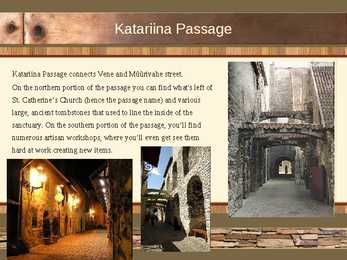
Katariina Passage Katariina Passage connects Vene and Müürivahe street. On the northern portion of the passage you can find what's left of St. Catherine's Church (hence the passage name) and various large, ancient tombstones that used to line the inside of the sanctuary. On the southern portion of the passage, you'll find numerous artisan workshops, where you'll even get see them hard at work creating new items. City wall Tallinn's medieval city wall is a sub-facility that was built to protect the lower Tallinn and upper Tallinn (Toompea). The building of the city wall began in 1310th years, and
Soon you will see The Devils Bridge. From what stone do you think it is made of? To go to the next object, you need to turn around and walk back along the Lossi street. Then you should see the famous Angels Bridge. What is written on the bridge? When do you think it was built? After that, go along the Lossi street, until you reach Jaani street. Then turn left on Jaani street, walk approximately 100 meters along the Jaani street. On your left you should see the Main Building of Tartu University. How many pillars has The University Building? What has been written on the under them? Whose statue is behind this building? If you are done with the tasks, walk again approximately 100 meters forwards along the Jaani street. You should soon notice a church, this is Tartu Jaani (St. John's) Church. About how high is this churches tower? Now walk back to the Munga street, on the corner turn left to the Munga street and walk to the Rüütle street.
His intellectual stature is indicative of the quality of the monastery's leadership. The offerings made on the occasion of such family festivals made a significant contribution to the monastery's finances. The various guilds gave gifts when their feast days were celebrated. The Merchant Guild, for example, each year in December gave the friars a tun of meat, a tun of codfish, and a tun of peas. Rich burgers left legacies to the monastery for the privilege of having a family tomb in the church, But these did not suffice to sustain all those whom the monastery housed. The friars, in consequence, becaipe farmers and fish-mongers. In addition they ran a brewery, which produced four different kinds of beer. In northern Europe beer occupied the place enjoyed by wine in the south, and was a staple element of both the monastic and secular diet. The monastery also drew profit from the veneration of relics. Many documents mention twelve silver reliquaries containing the heads of saints.
Charles Church By Annabel Peterson Charles Chruch is a Lutheran church in the centre of Tallinn, on Tõnismägi hill. It is architecturally the most magnificent out of all Estonian sacred buildings in the 19th century, also Charles congregation is currently the largest in Estonia by the number of members. It was originally built in the 17th century, during the time of Swedish rule, when king Charles XI commissioned the construction of a church for the Estonian and Finnish population in 1670. At first it was wooden and not very large, built in a Greek cross style. Traditionally, the church was named after the king that built it. In 1710, right before the invasion of the Russian troops and during the Great Northern War, the church was burnt down along with many buildings surrounding the city fortification wall
The Kadriorg Art Museum displays hundreds of 16th- to 20th-century paintings by Western and Russian artists, as well as prints, sculptures and other works. 3. Estonian Open Air Museum This museum lets you travel back in time to the rural Estonia of old. The vast, forested park is filled with thatched, 18-20th- century farm buildings, windmills, a wooden chapel and a village school, with staff demonstrating how people lived and worked in times past. 4.Oleviste Church (St. Olav's Church) and Tower 124-metre steeple still dwarfs most of Tallinn's buildings and remains an important symbol of the town. From April to October, visitors can make the vigorous climb to the top of the stone portion of the tower for magnificent and dizzying views of Old Town, Toompea hill and the port. 5.Kumu Art Museum A must-see for culture creatures, Kumu, the main building of Art Museum of Estonia, serves both as Estonia's national gallery and
The shights of Estonia Brigita Maria Raave St. Olaf’s Church St. Olaf’s Church in Tallinn, in Estonia is believed to have been build in the 12th century. St. Olaf’s Church is located in Lai Street. St. Olaf’s Church is the city’s biggest medieval structure, took its name from the sainted Norwegian king Olaf Haraldsson. St Olaf Church was part of the united western tradition of Christianity, whose polity continues in the Roman Catholic church today. However, from the Reformation the church has been part of the Lutheran tradition. In 1950 St. Olaf’s Church became a Baptist church.The Baptist congregation continues to meet at St Olaf’s today. Pictures of St. Olaf’s Church cc St Olaf’s Church Tower According to some sources St Olaf’s Church was the tallest building in world from 1549 to 1625, till the Eiffel Tower was built. In 1590 the total height of the tower was 115 meters. After several rebuildings,
1. Ancient Britain: the Celtic tribes. 2000 years ago there was an Iron Age Celtic culture throughout the Br Isles. It seems that the Celts, who had been arriving from Europe from the 8th cent BC onward, intermingled with the peoples who were already there. The Celts were extremely talented people, creative and artistic. More than 1 Celtic tribe invaded Br. The descendants of ancient Celts live in Wales, Scotland, Cornwall and Ireland. They lived in primitive society. Druids priests, more powerful than chiefs. Acted like prophets. 2. Stonehenge From prehistoric period. Was built on Salisbury plain between 2500 and 1500 bc. One of the most
Tower of London, is a historic castle located on the north bank of the River Thames in central London. It lies within the London Borough of Tower Hamlets, separated from the eastern edge of the square mile of the City of London by the open space known as Tower Hill. It was founded towards the end of 1066 as part of the Norman Conquest of England. St. Paul`s Cathedral St Paul's Cathedral, London, is an Anglican cathedral, the seat of the Bishop of London and the mother church of the Diocese of London. It sits on Ludgate Hill at the highest point of the City of London and is a Grade 1 listed building. Its dedication to Paul the Apostle dates back to the original church on this site, founded in AD 604. The present church, dating from the late 17th century, was designed in the English Baroque style by Sir Christopher Wren . Its construction, completed in Wren's lifetime, was part of a major rebuilding programme in the
formed many kingdoms that were hostile to one another. London fell into ruins. King Egbert united all the small kingdoms and formed one kingdom named Englad. Later king Alfred the Great chose London to be the capital of the country. During the reign of Edward the Confessor Westminster Abbey and the royal palace were built. In 1066 The Normans invaded an William the Conqueror took the British throne as William I. He built a mighty fortess, now known as the white tower. The 14th century was a messy period. In 1337 the Hundred years war against France began. The black death in 1348 took many many lives. Almost half of the city's population. In 1381 the grievances [griivensis] of the lower class exploded into the ,,Peasant's [pesents] revolt". The Hundred Years War was almost immediately followed by the war of roses. It was between two branches of the Royal house York and Lancaster. It was ended by Henry Tudor in 1485. (lancaster)
London important sights guide Roman period 20th century · Big Ben is the nickname for the great bell of the clock at the north end of the Palace of Westminster in London and is often extended to refer to the clock or the clock tower as well. It is the largest four-faced chiming clock and the third-tallest free-standing clock tower in the world. The clock first ticked on 31 May 1859. The pendulum is installed within an
German style with a robust contrapuntal technique, an unrivalled control of harmonic and motivic organisation, and the adaptation of rhythms, forms and textures from abroad, particularly from Italy and France. Bach's abilities as an organist were highly respected throughout Europe during his lifetime, although he was not widely recognised as a great composer until a revival of interest and performances of his music in the first half of the 19th century. He is now regarded as the supreme composer of the Baroque, and as one of the greatest of all time. Johann Sebastian Bach was born in Eisenach, Saxe-Eisenach. He was the youngest child of Johann Ambrosius Bach, the director of the Stadtpfeifer or town musicians, and Maria Elisabeth Lämmerhirt. His father taught him to play violin and harpsichord. His uncles were all professional musicians, whose posts ranged from church organists and court chamber musicians to composers.
 annaabi.ee