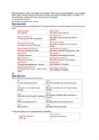
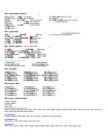
Leidsid 33 sarnast õppematerjali, mis on seotud failiga "Test - Future". Need materjalid aitavad sul teemat sügavamalt mõista.
shall, there, wait, diana, come, remember, arrive, year, tomorrow, find, found, shan, wars, tired, late, answer, know, address, doesn, afraid, party, paris, evening, remembers, perhaps, bought, fourteen, sure, hotel, tickets, advance, rained, everybody, thinks, married, aren, gives, drugs, disease, years, theatre, beforeJ: - Take this form and fill it in. May I see your passport? H: - Yes. Please. So...Should I write my full name, my passport number and the sum of money that has been sent to me, right? J: - Certainly. How would you like the money? H: - I prefer one hundred rouble notes, if you don't mind. J: - Here is your money. H: - Thank you Getting a post-restante. H: - Hi, Julia! What are you doing here? J: - I'm getting post restante letter from Boris... H: -Ah, yeah, remember him. What is he saying? J: - Oh, well...He is asking to come to him, and, besides, here is the money-order... H: - Oh! Would you like to cash money-order? Have you got your passport with you? J: - Yeah, certainly. H: - Then, they'll cash your money order without fail. J: - Ok, I'll go to that counter and speak to clerk. Wait for me, please! Can you go and by tickets with me after this? H: - Certainly! Discuss the functions of post office H: - There are a lot of functions of post office
/ Can't complain, thanks. · So so, thanks. / So and so, thanks. · Not so good, actually 1 The English alphabet Spelling Work with your partner and spell out first your name and then some names of places. Write down each letter as you hear it, and then say the word. The English alphabet on the phone: You might find the following alphabet (used by international airlines) useful when trying to spell a word on the telephone. A Alpha O Oscar Ä Alpha-Echo Ö Oscar-Echo B Bravo P Papa C Charlie Q Quebec D Delta R Romeo E Echo S Sierra F Foxtrot Sch Sierra Charlie Hotel
Am, Is and Are 83 Comma 151 The Present Progressive Tense 89 Exclamation Point 152 Have and Has 93 Question Mark 152 The Present Perfect Tense 96 Apostrophe 153 1 What is Grammar? Here's an old children's rhyme about the eight parts of speech of English grammar. It gives you an idea of what grammar is about. Read and remember it. Every name is called a noun, Pronoun As field and fountain, street and town. Noun In place of noun the pronoun stands, As he and she can clap their hands. The adjective describes a thing, As magic wand or bridal ring. Adjective Most verbs mean action, something done,
I don't know what the word means. Look it up in a dictionary. 10 ____________________________________________________________________________________________ No, I don't like the Spice Girls. Marks: /10 Words, words, words 4 Complete these sentences using the correct form of the words below. There is one extra word which you do not need to use. aggressive nervous dull funny easy-going ambitious expensive usual experienced successful practical 1 She told a very ________________________ joke and everyone laughed. 2 She's a very ________________________ person. She will do anything to become famous. 3 They didn't give him the job because he was ________________________. He had never done anything like that before.
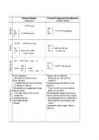
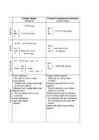
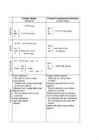
...... 4 Future Perfect....................................................................... 6 Other ways of referring to the future ..................................... 7 Other future references......................................................... 8 Future Simple In Future Simple we use the modal verb will + the verb. It is the same in all persons. I will work I’ll work you will study you’ll study he will come he’ll come Negative I/you/he/we/they will not write I/you/he/we/they won’t write Question Will you/he/she/we/they come? 1. We often use will as a neutral way of expressing the future. We use will to say what we know or think about the future. It is known as the predictive future, and describes known facts, or what we suppose is true. I’ll be late home this evening. The company will make a profit next year.
CHARACTERS MADAME PERNELLE, mother of Orgon ORGON, husband of Elmire ELMIRE, wife of Orgon DAMIS, son of Orgon MARIANE, daughter of Orgon, in love with Valere CLEANTE, brother-in-law of Orgon TARTUFFE, a hypocrite DORINE, Mariane's maid M. LOYAL, a bailiff A Police Officer FLIPOTTE, Madame Pernelle's servant The Scene is at Paris ACT I SCENE I MADAME PERNELLE and FLIPOTTE, her servant; ELMIRE, MARIANE, CLEANTE, DAMIS, DORINE MADAME PERNELLE Come, come, Flipotte, and let me get away. ELMIRE You hurry so, I hardly can attend you. MADAME PERNELLE Then don't, my daughter-in law. Stay where you are. I can dispense with your polite attentions. ELMIRE We're only paying what is due you, mother. Why must you go away in such a hurry? MADAME PERNELLE Because I can't endure your carryings-on, And no one takes the slightest pains to please me. I leave your house, I tell you, quite disgusted; You do the opposite of my instructions;
.. agree ... learn about ... The purpose of this talk is to update you on ... This talk is designed to put you in the picture about ... give you the background to ... act as a springboard for discussion. start the ball rolling. Length My presentation/talk/lecture will take/last about (...) minutes. I shall only take (...) minutes of your time. I plan to be brief. This should only last (...) minutes. Outline/Main parts (Signposting) I've divided my presentation into four parts/sections. They are ... This talk is divided into four main parts: firstly, ... etc. The subject can be looked at under the following headings:... We can break this area down into the following fields: Firstly/First of all/To start with, I'd like to look at ... Let me begin with/start by ...
....................................................................... 5 Making requests ................................................................... 6 Expressing possibility/probability......................................... 7 Asking about possibilities ..................................................... 7 Infinitives ............................................................................. 8 Introduction Modal Verbs are can, could, may, might, must, will, would, shall, should, ought to. They are known as modal auxiliary verbs because they ‘help’ another verb, i.e. they are always used with another verb in its base form. e.g. I can swim. Do you think I should go? Characteristics of Modal Verbs • There is no -s in the third person singular: She can ski. He must be tired. It might rain. • They are used to form questions and negatives: Shall we go for a walk? What should I do? He can’t dance. You mustn’t tell lies!
She's German or rather, Austrian. (NOT She's German or better, Austrian.) I'll see you on Friday or rather, Saturday. 3. Use the simple present play(s), rain(s) etc to talk about habits and repeated actions. I play tennis every Saturday. (NOT I am playing tennis every Saturday.) It usually rains a lot in November. 4. Use will ..., not the present, for offers and promises. I'll cook you supper this evening. (NOT I cook you supper this evening.) I promise I'll phone you tomorrow. (NOT I promise I phone you tomorrow.) 5. Don't drop prepositions with passive verbs. I don't like to be shouted at. (NOT I don't like to be shouted.) This needs to be thought about some more. (NOT This needs to be thought some more.) 6. Don't use a present tense after It's time. It's time you went home. (NOT It's time you go home.) It's time we invited Bill and Sonia. (NOT It's time we invite Bill and Sonia.) 7. Use was/were born to give dates of birth. I was born in 1975
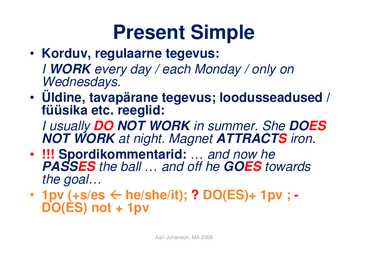
surprise think* sound want* understand Aari Juhanson, MA 2008 weigh* Examples · What do you think about this idea? Turn the music down, please, I'm thinking. · Everyone has something to believe in. We were having a great time at the party yesterday. · They are really tired again. She's being really nasty to us. · Do you see that red car over there? I'm seeing a dentist tomorrow morning. / I'm afraid he's seeing things. · We hear something new each day. I thought I was hearing things when music suddenly began to play. · I consider him to be a very lucky man. I'm considering changing jobs. · Kids love visiting amusement parks. Kids are loving visiting the amusement park. Aari Juhanson, MA 2008 Past Simple · Ära toimunud (regulaarne) tegevus: I WORKED yesterday
6 The food was neither cheap nor 4 financial 9 worthless 2 I agreed to give Jenny a lift into good. 5 costly 10 economical town. 7 There are no easy answers. 3 I had no difficulty repairing the 2 1 economical 7 priceless 8 Few of my relatives live nearby. broken vase. 2 pricey 8 economic 9 My parents have little money.
................................................................................ 6 # Another Brick in the Wall part 2........................................................................................... 7 # Mother.................................................................................................................................. 8 # Goodbye Blue Sky.............................................................................................................. 10 Pink Floyd- What Shall We Do Now?.................................................................................... 12 # Young Lust......................................................................................................................... 13 # One of my Turns................................................................................................................ 14 # Don't Leave Me Now.......................................................................................................... 16
Shakespeare was born and raised in Stratford-upon-Avon. At the age of 18 he married Anne Hathaway, who bore him three children: Susanna, and twins Hamnet and Judith. Between 1585 and 1592 he began a successful career in London as an actor, writer, and part owner of the playing company the Lord Chamberlain's Men, later known as the King's Men. He ap- pears to have retired to Stratford around 1613, where he died three years later. Few records of Shakespeare's private life survive, and there has been considerable speculation about such matters as his sexuality, religious beliefs, and whether the works attributed to him were written by others. Shakespeare produced most of his known work between 1590 and 1613. His early plays were mainly comedies and histories, genres he raised to the peak of sophistication and artistry by the end of the sixteenth century. Next he wrote mainly tragedies until about 1608, including Hamlet, King Lear, and Macbeth, con-
A: 'I'm cold'. A: 'We've run out of milk.' B: 'I'll close the window'. B: 'I know, I'm going to buy some.' 2.Prediction based on opinion: 2.Prediction based on present I think the Conservatives will win the evidence: next election. Look at those boys playing football! 3.A future fact: They're going to break the window. He will be ten next year. 4.Promises / requests / refusal / willingness: I'll help you with your homework. Will you give me a hand? 5.In the same way as the future continuous, but with state verbs: I'll be at the station when you arrive. 'Shall' is used mainly in the forms 'shall I ?' and 'shall we?' in British English. These forms are used when you want to get someone's opinion, especially for offers and suggestions: •Shall I open the window? (=do you want me to open the window). •Where shall we go tonight
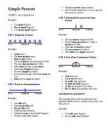
USE 3 Scheduled Events in the Near Examples: Future · You speak English. · Do you speak English? · You do not speak English. USE 1 Repeated Actions Examples: · The train leaves tonight at 6 PM. · The bus does not arrive at 11 AM, it arrives at 11 PM. · When do we board the plane? Examples: · The party starts at 8 o'clock. · When does class begin tomorrow? · I play tennis. · She does not play tennis. USE 4 Now (Non-Continuous Verbs) · Does he play tennis?
We are meeting tonight. We are going to the theatre. Pane tähele! Kestvat olevikku kasutatakse tegevusverbides (I am dancing, you are eating etc.). Mõned verbid on mitte tegevusverbid, näiteks ei saa öelda I am liking või you are knowing, vaid I like ja you know. Järgmiseid verbe ei kasutata tavaliselt kestvas olevikus. like love hate want need prefer know realise suppose mean understand believe remember belong contain consist depend seem Past Simple Lihtmineviku moodustamine Jaatav vorm Eitav vorm Küsiv vorm I asked I did not ask Did I ask? He/she/it went He/she/it did not go Did he/she/it go?
My carry-on item was a parka. In the Olympic Peninsula of northwest Washington State, a small town named Forks exists under a near-constant cover of clouds. It rains on this inconsequential town more than any other place in the United States of America. It was from this town and its gloomy, omnipresent shade that my mother escaped with me when I was only a few months old. It was in this town that I'd been compelled to spend a month every summer until I was fourteen. That was the year I finally put my foot down; these past three summers, my dad, Charlie, vacationed with me in California for two weeks instead. It was to Forks that I now exiled myself-- an action that I took with great horror. I detested Forks. I loved Phoenix. I loved the sun and the blistering heat. I loved the vigorous, sprawling city. "Bella," my mom said to me -- the last of a thousand times -- before I got on the plane. "You don't have to do this."
· And when you begin to miss me, dont forget it was you who let me go. · There is an end to things no matter how much we want to hold into them. · Otsisin keset seda pimedust, sind ja loodetud vabadust,kui mu käed su poole, tegid alguse loole, printsessist ja printsist, ühest kaunist kandist, kus oleme meie kaks, kus lõbutseme, kuni otsas jaks. Sa ei pea muinasmaad looma, sa ei pea tähti taevast tooma. Ole vaid minu kõrval, kui tõuseb päike. Ole vaid mu kõrval kui mind piinab meeleheide. Ole mu kõrval, kui kumab kuu, kui su nime
ühtki selle töövihiku osa paljundada ei elektroonilisel, mehaanilisel ega muul viisil. Töövihik on kooskõlas 2009. a uuendatud õppekomplektiga I Love English 6. Tartu, 2014 ISBN 978-9949-436-59-0 Kirjastus Studium Riia 15b, Tartu 51010 www.studium.ee Trükitud OÜ Greif trükikojas Lohkva, Luunja vald Tartumaa 62207 --- 3 xxx 1. The Big Apple 1. Write the verbs in the present continuous or the past continuous tense. Do you remember? am is are was were verb -ing 1 Sorry. I ... (write) a report at the moment. I can't come with you. 2 When Peter arrived, his friends ... (play) football. 3 I ... (sleep) when the alarm went off in my sister's room. 4 Dad's mobile phone is switched off because he ... (fly) to Paris. He's on the plane at the moment. 5 I ... (read) an interesting book. It's a collection of memories. 6 Leo was late again. He ... (step) out of his father's car when the bell rang. 7 Helen ..
N: I was still having dinner when my friend called. I was reading a book while my brother was playing his guitar. 3)past perfect:had+past participle/had+been+ing. N: my brother had gone to bed by the time I got home. By midnight, all the guests had left. We were tired because we had been playing volleyball all morning. Future tenses: 1)Future simplewill/shall + infinitive. N:Ppl will live on the moon one day. Are you having a party?I will come! I'll ring you tonight if you want. I'll be really angry if youre late again. 2)Going to + infinitive N:I've decided what to get Tom for his birthday, I'm going to buy him a CD. Listen to the thunder! There's going to be a storm!; 3)Present continuous N: I am meeting my girlfriend tonight. 4)Present simple The bus leaves at 8 a.m. I'll meet you as soon as the class finishes.
14. Good institutions help to overcome human moral inertia. 15. I am not one of your little friends. 16. If a dimension is anywhere it's everywhere. 17. If God's not crazy, why are you? 18. If one makes a promise one shouldn't have made it cannot stand against the obligation to do the right thing. 19. If you odn't give a certain amount of attention to filtering distractions, every distraction is a catastrophe. 20. If you don't know what your duty is, your duty is to find out. 21. If you're not an animal, then you must be a vegetable. 22. If you want to get along you have to get along with those who don't want to get along. 23. If you whine whenever anybody messes with your crutches you can't claim not to be crippled. 24. I hate an unfair fight, so I need to be ganged up on. 25. Inattention is not O.K. 26. Injustice in your vicinity is your business--particularly your own. 27. It is not enough to refrain from bearing false witness against your neighbor
Harjumuspärane, korduv tegevus või seisund olevikus. Tom drinks tea every day. He lives in Brussels. 2. Üldtuntud tõed, loodusseadused The earth goes round the sun. 3. Tulevikus toimuv tegevus a) Sõiduplaanid, planeeritud programmid. The train for Tallinn leaves at 10. The course begins on Monday. b) Tingimuslausetes If you want me, just call c) Ajamääruslausetes I shall speak to him when he comes. 2. Spordireportaazid, arvustused. Lepp passes the ball to Kask. Gibson acts well in "Braveheart". 3. Seisundiverbidega (state verbs) verbid, mida tavaliselt ei kasutata kestvates aegades, sest nad kirjeldavad seisundit, mitte tegevust Need on verbid, mis väljendavad: a) meeltetaju (see, hear, feel, smell, taste, look, sound ). Kui meeltetaju verbidega
I suppose. Our facial features are pretty similar same eyes, same-shaped 14 borrowed forehead. I've seen photos of her when 1E Phrasal verbs page 8 5 (possible answers) she was my age and apart from the 1 1 go ahead 5 come to eighties hairstyle we're the spitting 1 Well, you will go to bed late every night. 2 fall through 6 bring about image of each other! Some people 2 Well, you will refuse to wear a 3 tip off 7 go down with say that they can see a strong family
" "Mr. Bennet, how can you abuse your own children in such a way? You take delight in vexing me. You have no compassion for my poor nerves." "You mistake me, my dear. I have a high respect for your nerves. They are my old friends. I have heard you mention them with consideration these last twenty years at least." "Ah, you do not know what I suffer." "But I hope you will get over it, and live to see many young men of four thousand a year come into the neighbourhood." "It will be no use to us, if twenty such should come, since you will not visit them." "Depend upon it, my dear, that when there are twenty, I will visit them all." Mr. Bennet was so odd a mixture of quick parts, sarcastic humour, reserve, and caprice, that the experience of three-and-twenty years had been insufficient to make his wife understand his character. Her mind was less difficult to develop. She was a woman of mean
Will ja shall kasutamine 1) Sarah goes work every day.She is always there from 8.30 until 4.30. It is 11 o clock now.Sarah is at work. At 11 o clock yesterday , she was at work. At 11 o clock tomorrow , she will be at work. Will +infinitive (will be / will win / will come etc.): I/we/you/they Will (`ll Be He/she/it} Will not (won`t Win Eat Come etc. I/we/you/they Be? He/she/it Win? Eat? Will Come? Ect. `ll=will : I`ll (I will) / you`ll/ she`ll etc. Won´t= will not :I won`t (=I will not) / you won`t / she won`t etc. 2.We use will for the future(tomorrow/next week etc.): *Sue travels a lot.Today she is in Madrid.Tomorrow she`ll be in Rome
had to be bought in advance. may might I may call you. He said (that) he might call me. NOTE: modal verbs could, would, might and should do not change. Changes in reported speech now then /at that time /immediately at that moment today / tonight that day /that night here there this / these that / those tomorrow the following day /the next day the day after next week the following week /the next week the week after yesterday the previous day /the day before last week the previous week /the week before (a year) ago (a year) before /earlier the day before yesterday two days before /earlier
Kordamine inglise keele eksamiks A 1.1 Read the text and answer the questions below. Dear Mary-Alice, It's been ages since I last wrote to you, isn't it weird? Yes, so it is, but, I do have a certain reason. Do you remember Sir Thom of the Minquettes'? That fine young man with fascinating blue eyes... Oh, my sweet Mary, you will never guess what happened yesterday! It was about seven o'clock in the evening when Lillian called me out for a walk you know I can't say `no' to my little sis. Anyway we went to the forest near the Swan Lake and, believe it or not, got lost! Awful! I was so scared... We walked and walked, not even knowing the direction we were heading to, until we reached a huge mansion
Yours sincerely, Lee Jones 5. ... I would appreciate a reply at your earliest convenience. I look forward to meeting you to discuss employment opportunities. Yours faithfully, Nicole Porter Paragraph Plan for Letters · salutation · Paragraph 1 reasons for writing · Paragraphs 2, 3 development · Final paragraph closing remarks · Name · Letters are divided into two categories, formal and informal. There are various types of formal and informal letters . · It is important to think about the person who you are writing to before you begin writing a letter. If the wrong style is used, the letter will look impolite, silly or odd. For example, if you used formal language to write to a close friend, the letter would look odd, or if you used informal language to write a letter to a company, the letter would look impolite.
Do I vorm (Do ... play ... ?) KÜSILAUSE Am he Is I vorm+ing (playing) Does she I vorm Are it (Does ... play ... ?) Korduv tegevus: Praegu toimuv tegevus: We have art twice a week. What are you doing there, Püsiv olukord: children? Children start school at the age Praeguse perioodi vältel toimuv of seven in Estonia. tegevus: Sõiduplaanide ja ajagraafikutega They're building a new railway KASUTAMINE seotud tulevik: station in our town.
Do I vorm (Do ... play ... ?) KÜSILAUSE Am he Is I vorm+ing (playing) Does she I vorm Are it (Does ... play ... ?) Korduv tegevus: Praegu toimuv tegevus: We have art twice a week. What are you doing there, Püsiv olukord: children? Children start school at the age Praeguse perioodi vältel toimuv of seven in Estonia. tegevus: Sõiduplaanide ja ajagraafikutega They're building a new railway KASUTAMINE seotud tulevik: station in our town.
Do I vorm (Do ... play ... ?) KÜSILAUSE Am he Is I vorm+ing (playing) Does she I vorm Are it (Does ... play ... ?) Korduv tegevus: Praegu toimuv tegevus: We have art twice a week. What are you doing there, Püsiv olukord: children? Children start school at the age Praeguse perioodi vältel toimuv of seven in Estonia. tegevus: Sõiduplaanide ja ajagraafikutega They're building a new railway KASUTAMINE seotud tulevik: station in our town.
The play had started when I arrived. NO CHANGE POSSIBLE past perfect continuous past perfect continuous I'd already been living in London for five NO CHANGE POSSIBLE years. Other verb forms Other verb forms also sometimes change: will would I'll come and see you soon. He said he would come and see me soon. can could I can swim under water for two He said he could swim under water for two minutes. minutes. had to must He said that all tickets had to be bought in All tickets must be bought in advance.
a leaf leaves , a wolf wolves, a knife knives, a life lives Irregular nouns a man men, a woman women, a child children, a person people, a sheep sheep, a tooth feet, a mouse mice, a goose geese Pronouns Personal : Possessive possessive Object adjective: pronouns: pronouns: I my mine I me wait for me You your yours you-you I love you He his his me-him she isn't in love with him She her hers she her he kisses her it its it it I don't like it
 annaabi.ee