Leidsid 33 sarnast õppematerjali, mis on seotud failiga "Tallinn sightseeing". Need materjalid aitavad sul teemat sügavamalt mõista.
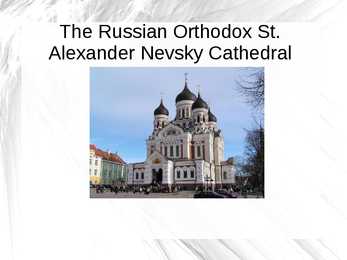
intact, gothic, cathedral, sightseeing, krik, lagedi, included, unesco, heritage, best, protected, medieval, iron, street, cappuccino, wifi, raekoja, square, museum, concert, thomas, orthodox, mikhail, onion, structure, dedicated, alexanderKunda Ühisgümnaasium Tallin Old Town Report Student: Kristin Karu Teacher: Kristi Aron Kunda 2012 The Alexander Nevsky Cathedral The Alexander Nevsky Cathedral is an orthodox cathedral in the Tallinn Old Town,Estonia. It was built to a design by Mikhail Preobrazhensky in a typical Russian Revivalstyle between 1894 and 1900, during the period when the country was part of theRussian Empire. The Alexander Nevsky Cathedral is Tallinn's largest and grandest orthodox cupola cathedral. It is dedicated to Saint Alexander Nevsky who in 1242 won the Battle of the Ice on Lake Peipus, in the territorial waters of present-day Estonia. The late Russian patriarch, Alexis II, started
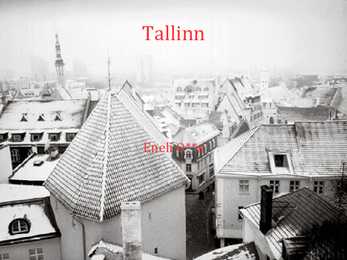
The city's pride and joy is without a doubt its Medieval Old Town, but equally enchanting is the Kadriorg district, a throwback to the time when Estonia was ruled by the Russian Tsars. Tallinn is the capital and largest city of Estonia. It occupies an area of 159.2 km2 with a population of 416,470. It is situated on the northern coast of the country, on the shore of the Gulf of Finland, 80 km south of Helsinki, east of Stockholm and west of Saint Petersburg. Tallinn's Old Town is in the list of UNESCO World Heritage Sites. It is ranked as a global city and has been listed among the top 10 digital cities in the world.The city was a European Capital of Culture for 2011, along with urku, Finland.Tallinn is the oldest capital inNorthern Europe. The city was known as Reval from the 13th century until the 1920s. http://en.wikipedia.org/wiki/Tallinn Old Tallinn The Old Town can historically be divided into two distinct areas: Toompea Hill and the Lower Old
Tallinn's Old Town is one of the most well- preserved old towns in northern Europe The golden era in lies in the period between the early 15th and mid 16th centuries It has three parts: Lower Town, Upper Town + Town Wall, Towers and the Gates Lower Town/Upper Town Town Hall Square Toompea Castle & Tall Tallinn Town Hall Hermann's Tower Town Hall Pharmacy Cathedral of Saint Mary the Virgin Great Guild Hall Danish King's Garden House of the Brotherhood of Black Heads Other Attractions Kadriorg Palace The Kadriorg Art Museum Alexander Nevsky Cathedral Russalka Soviet Legacy KGB Headquarters Soviet Legacy Tallinn TV Tower - Closed from November 26th 2007 Open Air Attractions
There is also The Holy Spirit Church with its colorful Renaissance clock, elaborate altar, and painted pews. The 13th century St. Nicholas got bombed in World War II but was meticulously reconstructed and now houses a display of religious art, including the freaky “Dance Macabre” of cavorting skeletons. Cathedral of St. Mary the Virgin and the Town Hall offer fine views of the city. The most visible church that seems to get on all the postcards is the Russian Orthodox St. Alexander Nevsky Cathedral with its onion domes. Several of the medieval buildings house museums: Epping Tower has a collection of medieval arms and armor, the 15th-century Great Guild Hall houses the Estonian History Museum, a 14th century merchant’s mansion is home to the Tallinn City Museum, and Fat Margaret’s cannon tower from 1530 is now the Maritime Museum. One of the most popular attractions is Kiek en de Kök, an imposing tower on the slopes of Toompea Hill. Its basement connects with a network of tunnels
Renovation was carried out in 1996-2000. Tall Hermann - tower in the south-west corner of the castle; 49 m built in 1371; ten floors and a viewing platform. Estonian flag is raised there every morning at sunrise but not before 7am and lowered at sunset but not later than 10pm; except at midsummer June 23, when it’s not lowered at all. It’s commonly recognised that whoever’s flag flies on top of this tower is the ruler of Estonia. Toompea as a tourist attraction Alexander Nevsky Cathedral - largest and grandest orthodox cathedral crowning the hill of Toompea. It was finished in 1900, when the country was a part of the Russian empire. Time of russification, many estonians against it. Dedicated to the prince of novgorod, alexander nevsky who won the battle of ice. Due to the lack of funds and the building’s massive construction, it was never demolished. Kohtuotsa viewing platform - gives great view to the both parts of the city. blabla
The Russian Orthodox St. Alexander Nevsky Cathedral The Russian Orthodox St. Alexander Nevsky Cathedral is designed by Mikhail Preobrazhensky ( a professor at St. Petersburg Academy of Arts) And built on the order of Alexander III between 1894 and 1900,during the period when the country was part of the Russian Empire The Alexander Nevsky Cathedral is Tallinn's largest and oldest orthodox cathedral It is dedicated to Saint Alexander Nevsky who in 1242 won the Battel of the Ice on Lake Peipus The church's towers' hold Tallinn's most powerful church bell ensemble,consisting of 11 bells (one of them weighing 15 tonnes) Orthodoxy in Estonia is practiced by 12.8 % of the population,making it the second most identifield religion after Lutheran Christianity with 13.6 % Orthodoxy is mostly practiced within Estonia's Russian ethnic minority
Today, Tallinn is the largest city in Estonia, with a population of about 400,000. Tallinn boasts a wonderful medieval Old Town where the atmosphere of the 15th and 15th centuries can still be strongly felt. Its narrow cobbled streets, medieval buildings with various decorative elements, attractive weather-vanes and soaring spires are very special and draw visitors in large numbers. Only a few town in northern Europe have medieval districts as well preserved as in Tallinn. It was included in the UNESCO World Heritage List in 1997. The rest of the capital could be called the New Town, dating mainly from the 19th and 20th centuries. Tallinn is a mixture of the modern and the medieval where tradition goes hand in hand with the most recent trends. Its cross-cultural history has given the city a special charm. It has about 30 museums, 25 galleries and 15 exhibition halls. Among its many twin towns and partners are Helsinki in Finland,
Sweden, German and Russia. The clock of liberty, 2004. Kiek in de Kök ● The cannon tower, founded in 1475-1483. Kiika kööki, peek into the kitchen, from up there it was possible to peek into the enemy’s kitchen. The walls are 4 m thick, can see the cannons stuck in there. Tallinn City Museum. ● Town Wall (Unesco) - one of the greatest towers of Tallinn’s Town Wall, Old Town declared the UNESCO World Heritage Site in 1997 Toompea ● Toompea is a limestone hill in the central of Tallinn. It towers about 30-40 metres above the surrounding areas. According to the legend, its the tumulus moundn over the grave of the national hero Kalev, erected stone by stone by his grieving wife Linda. While we don’t want to question this wonderful theory, there is an alternative version which says that Toompea is just a naturally formed limestone hill.
Estonian cities Tallinn is the capital and largest city of Estonia. It occupies an area of 159.2 square kilometers with a population of 413,000. It is situated on the northern coast of the country, on the banks of the Gulf of Finland, 80 km south of Helsinki, east of Stockholm and west of Saint Petersburg. Tallinn was founded in the 12th century and has been under the rule of Denmark, Sweden, and Germany as well as Russia, and all left their mark on the city's architecture. It is one of the best preserved medieval towns in northern Europe, and makes a beautiful impression from the sea, with its ancient city walls, church spires, and red-tile roofed homes. Tallinn has previously been named as Kolõvan, Lindanise and Reval. Most well-known sights in Tallinn are Freedom Square, Kadriorg Palace, Rotermann Quarter, Tallinn Song Festival Grounds, Toompea Castle and Town Hall Square, the Old Town of Tallinn and many more. Tallinn's Old Town is in the list of UNESCO World Heritage Sites.
Lai Street stretches from Nunne Street to Pikk Street. Parallel with Pikk Street, Lai Street, too, ends at the Great Coast Gate (first mentioned 1359). Lai Street is very wide considering that it was laid out in the Middle Ages. This is because it sprang up on both sides of former city wall. Lai is quite a peaceful street with few shops. However, it has three museums and two theatres. The main entrance into St Olaf´s Church also faces the street. Several Lai Street houses have kept their Gothic appearance and even interiors, although we can also notice moderate Nordic Baroque, Neoclassicicm, Historicism and even Art Nouveau. The origin of the name "Lai" Lai Street belongs among the oldest streets of Tallinn. Despite its length and width its share in the city's inner traffic is fairly modest. The extraordinary width of the street is likely due to the fact that the town wall used to be there and the street then sprang up on both sides of the city wall
Tallinn, general overview Prepared: Hanna Bergmann 16.04.2011 Tallinn's Old Town is in the list of UNESCO World Heritage Sites. Tallinn is ranked as a global city and has been listed among the top 10 digital cities in the world. Tallinn is a European Capital of Culture for 2011, along with Turku, Finland. Location Tallinn is situated on the northern coast of the country, on the banks of the Gulf of Finland, 80 km south of Helsinki, east of Stockholm and west of Saint Petersburg. Tallinn is situated on the southern coast of the Gulf of Finland, in north-western Estonia.
(Cattle) Street. There were some ancient streets in Tallinn which had obviously been named before the qonquest, marking the destination they finally led, like Harju and Viru Street. Foreigners usually had different names for such streets. The streets were paved since the beginning of the 14th century. Pikk Jalg was among the first to be paved. Town Hall Square got its cover in 1310. There were no streetlights. The houses had no numbers and were known by the owner's name. Churches The Cathedral of St. Mary the Virgin (the Dome Church) was consecrated in 1240. The church suffered in the fire of 1684 and was largely reconstructed. A Baroque tower was added in the 18th century and the dated weather-vane (1779) crowning the spire is the only original one on Toompea today. Among other functions, the church served as a burial ground for the rich and the noble. The church also features grave slabs, an oaken Baroque altar by Christian Ackermann and a number of monuments to famous people (e.g
settlement activity throughout the centuries. The oldest trees in the park are now 200 years old. There are many sculptures and buildings of architectural value the former Toome Cathedral, now the History Museum of Tartu University, the Observatory, the Old Anatomical Theatre, State Court, and the Angel's and Devil's Bridges. On the Angel's bridge, the symbolic gate to Toome Hill, are inscribed the words 'otium reficit vires' (rest restores strength). Heritage and Historic Buildings Town Hall Square (Raekoja plats) The central Tartu Town Hall Square is surrounded by buildings built in the classical style. Since 1998 the square is decorated by the "Kissing Students" fountain. Throughout centuries the centre of town activity has been Town Hall Square, the history of which goes back to ancient times. At that time the market place was the square lying between the fortress on Toome Hill and the harbour on the banks of the Emajõgi River
When i was reading that it seemed so real, that i was there to. The city's charms can occasionally be obscured by too many tourists, congested traffic and tacky commercialism. Packed in among thousands of other visitors, trying like crazy to see the city in three days and worrying about getting ripped off, it's not surprising, may think the city is overrated. Just relax, take a deep breath. While the city centre is a mélange of stunning architecture, from Gothic, Renaissance and baroque to neoclassical, art nouveau and cubist, beyond the medieval lanes of the Old Town and the Castle District, there's an entire other cosmopolitan city to explore. Search out the riverside parks, lively bars and beer gardens, music clubs, museums and art galleries. Harness Prague's excellent public-transport system to explore emerging suburbs such as Zizkov, Vinohrady, Smíchov and Holesovice. You'll be guaranteed cheaper prices, a
Estonia re-established its independence on 20 August 1991. There is still a large block of granite on Toompea which recalls the days when people barricaded Lossiplats (Castle Square) to prevent Soviet tanks gaining access. Modern Tallinn and places to visit. Since independence, improving air and sea transport links with Western Europe and Estonia's accession to the European Union have made Tallinn easily accessible to tourists. The picturesque old town, a UNESCO World Heritage Site, and the current novelty of the destination attract many tourists and facilities (hotels, restaurants) have developed to meet their needs. English is widely spoken within the tourist areas. Note that Estonia has made rapid economic progress since independence and that this is reflected in local prices. Although not extortionate, neither are prices as cheap as in other former Eastern Bloc countries. The local tourist office sells the "Tallinn Card" which gives the holder free
G2K Jaana-Kristiina Jõgevest The Four oldest churches of Tallinn Report Supervisor: Ingrid Teigar Tallinn 2009 The Dome Church The Danes began fortification of Toompea after the conquest of Tallinn in 1219 and probably also built the first church there. It was presumably a wooden building located at the site of the present cathedral. However, a serious conflict with the Order of the Brothers of the Sword broke out soon as the latter wanted to gain control of the entire Estonia. The order succeeded in subordinating Tallinn and the whole of North Estonia to its rule in 1227. The monks of the Dominican Order began the construction of a stone church in Toompea in 1229. The first written data on the cathedral date back to 1233, the date of a
A legend tells that the builder of the church, named Olaf, upon its completion, fell to his death from atop the tower. It is said that when his body hit the ground, a snake and a toad crawled out of his mouth. 5. Blackhead's house Pikk tn 26 - Reneissance, 14. cent. It is the house of the brotherhood. It used to unite single young and foreign merchants. 6. Kanuti Gild - 13.cent. It is a union of german craftsmen in Tallinn. Its was at it's best 16 cent. Above the door is the founder of the union, king Knut 7. Suurgildi hoone - gothics. Belonged to Tallinn's Suurgildile, where were the town's most powerful and richest merchants. Hoone Ehitus kestis 14071410, siseviimistlus lõpetati 1417. 8. Holy ghost church - 14. Century. One of Tallinn's oldest churches, and the only sacred building that preserved its original form.and still retains its original exterior, except for the Baroque spire. The clock
means Danish castle. The Castle in question was built by King Waldemar of Denmark in the 13th century. The settlement quickly developed itself into a busy port. -The Old Town In medieval age Tallinn was called Reval and it was as big as the Tallinns Old Town is now. Uniqueness of Tallinn is that it is one of very few European cities, where the historical lay-out is kept in it's original form , and has a lot of monuments of that time. Thanks to that in 1997 Old Tallinn has been included in the list of a world heritage of UNESCO. -The Raekoja Square The Raekoja Square is used for senturies like market and fair square, here took place many festivals, and criminals were executed. In summer on Raekoja Square many open air conserts and fairs of handicraftsmen were arranged, at the same time old traditions are remembered, took place many different party parades, knight tournaments and shooting competitions. In winter Christmas tree is placed and christmas fair is spent
The Pärnu International Documentary and Anthropology Film Festival, founded in 1987, is the oldest film festival in Estonia. The initiator of the festival was writer and former president of the Republic of Estonia Lennart Meri. Since its first appearance, the festival has built an efficient bridge between cultural anthropologists and film makers from the East and the West. The festival is held during the first full week of every July. An international jury awards the grand prize for the best film; awards are also given to the best film about the survival of indigenous peoples and the best scientific research. Two separate competitions take place for documentary films made by children and created for them. The seven best films are aired by Estonian TV during the festival. From these seven outstanding documentaries the audience selects the Estonian People's Award winner
census and also straight roads, central heating and concrete. Anglo- Saxons around AD 400 Anglo- Saxons were warrior farmers from Germany, Denmark and the Netherlands. Later in the 5th century, Anglo-Saxons settled just west of Londinium, around the Strand, and formed the town of Lundenwic. The area of the old Roman city became a landing-place for ships and a centre for trade.The first English King to convert to Christianity, King Ethelbert, founded St Paul's Cathedral in 604. The Vikings 8th and 9th century By the 9th century, London was a very prosperous trading centre, and its wealth attracted the attention of Danish Vikings. The Danes periodically sailed up the Thames and attacked London. In 851 some 350 longboats full of Danes attacked and burned London to the ground. King Alfred the Great totally defeated the Danes in 878 and they split the country between them. The Danes took eastern England including London while Alfred took the South and West
"traveller" in the United Kingdom. Purpose and motivation Reason for traveling include recreation, tourism or vacationing, research travel for gathering information, for holiday to visit people, volunteer travel for charity, migration to begin life somewhere else, religious pilgrimages and mission trips, business travel, trade, commuting, and other reason, such as to obtain health care or fleeing war or for the enjoyment of traveling. World's best places to visit: Paris and Barcelona Why go: Year after year, the Why go: Known around the world magnetic City of Lights draws new for its legendary football team, travelers to its Eiffel Barcelona is known much more than Tower, Louvre and Notre Dame, but just athletic talent. Touring the city is Paris also keeps experienced a feast for the eyes: Visitors walk travelers coming back for more
Monument to the Great Fire of London or the Monument tube station. No matter how you choose to spend your time viewing the London Bridge, the contrast of a modern thoroughfare to the ancient bridges that it has replaced creates an intriguing tourist experience. Tower Bridge Disliked by most when constructed in 1894, the Tower Bridge has become a symbol of London. The Tower Bridge, named after its two impressive towers, is one of London's best known landmarks. This Victorian Bridge is now more than 100 years old. It was designed by Wolfe Barry and Horace Jones, and completed in 1894. The middle of the bridge can be raised to permit large vessels to pass the Tower Bridge. It used to be raised about 50 times a day, but nowadays it is only raised 4 to 5 times a week. The bridge is 60 meter (197 ft) long and its towers rise to a height of 43 meter. From the top of the towers, you have a great view on the centre of London
Sydney Opera House Introduction The Sydney Opera House is a multi-venue performing arts centre in Sydney. It was conceived and largely built by Danish architect Jorn Utzon, opening in 1973. The Sydney Opera House was made a UNESCO World Heritage Site on 28 June 2007. It is one of the 20th century's most distinctive buildings and one of the most famous performing arts centres in the world. Contrary to its name, the building houses multiple performance venues. The Sydney Opera House is among the busiest performing arts centres in the world, hosting over 1,500 performances each year attended by some 1.2 million people. It provides a venue for many performing-arts companies
measure of engineering prowess. In terms of engineering, bridges are discussed by design or type (beam, arch, truss, cantilever, suspension, or moveable); length (usually expressed in terms of clear or overall span); and materials (stone, wood, cast and wrought iron, and what we use today - concrete and steel). The purpose of this contextual essay is to provide parameters of value and significance so that we can focus our attention on those bridges - globally - that best illustrate the history of bridge building, and to encourage their preservation. What is a World Heritage bridge? The World Heritage Committee states that to be of World Heritage status a monument or site must be of outstanding universal value. It must illustrate or interpret the heritage of the world in terms of engineering, technology, transportation, communication, industry, history, or culture. World Heritage industrial sites and monuments must meet one or more of the
boundaries, but the name "London" has long applied more to the whole metropolis that has grown up around it. London has been an important settlement for over two millenniums. It is also one of the world's leading business, financial and cultural centres and its influence in politics, education, entertainment and even fashion contribute to its status as a major global city. London is a major tourist attraction with four world heritage sites, several royal parks and numerous iconic landmarks such as the Houses of Parliament, Towe Bridge, the Tower of London, Westminster Abbey and the London Eye. 2. History Although there is some evidence of a permanent settlement before the Romans came in 43 A.D., it is more accepted by historians that the Romans were the first. The settlement was called Londinium. The first London lasted for just seventeen years, for around AD 61, a tribe of Celts led by
country. 11. The Norman Conquest. The successful Norman invasion of England in 1066 brought Britain into the mainstream of western European culture. Unlike the German invasions, the Norman invasion was small-scale. On 14 October 1066, an invading army from Normandy defeated the English at the Battle of Hastings. The battle was close and extremely bloody. At the end of it, most of the best warriors in England were dead, including their leader, King Harold. On Christmas Day that year, the Norman leader, Duke William of Normandy, was crowned king of England. He is known in popular history as “William the Conqueror” and the date is remembered as the last time that England was successfully invaded. There was no such thing as a Norman area of settlement. Instead, the Norman
handed the local administration over to Estonian politicians. On 12 April 1917, under the pressure of the ever increasing demands for autonomy that the Estonians had been voicing since 1905, the Provisional government issued a decree on the provisional management of the administrative government and local government. Thus, Estonia (North-Estonia) and North- Livonia (South-Estonia) were united into one administrative unit, locally governed and with elements of autonomy included (Estonians were the only nation among all other minorities in Russia to achieve this). The commissar formed the Estonian Provincial Assembly (Diet) -- the first all-Estonian representative body -- and a Land Council as its executive body. The Diet included all the main political parties. With the exception of the Bolsheviks, who propagated the idea of international world revolution, all Estonian parties shared the view that Estonia had to become an autonomous
( or ), in which /t/ and /ts/ were switched or merged. So, ('heron') has been recorded as . Also, the second palatalization of velars did not occur there, so the so-called ² (from the Proto-Slavic diphthong *ai) did not cause /k, , x/ to shift to /ts, dz, s/; therefore, where Standard Russian has ('chain'), the form [kep] is attested in earlier texts. Among the first to study Russian dialects was Lomonosov in the 18th century. In the 19th, Vladimir Dal compiled the first dictionary that included dialectal vocabulary. Detailed mapping of Russian dialects began at the turn of the 20th century. In modern times, the monumental Dialectological Atlas of the Russian Language ( [dlktitskj ats ruskv jzka]), was published in three folio volumes 19861989, after four decades of preparatory work. Orthography Russian spelling is reasonably phonemic in practice. It is in fact a balance among phonemics,
education establishments are also in these towns. 10.Sports The first Estonian mentioned in the Guinness Book of Records was a sportsman. In the Olympic Games of 1912, the Finn Alfred Asikainen and the Estonian Martin Klein wrestled for a record 11 hours and 40 minutes. Klein won and 'Russia' was given as his country of residence. Many Estonian sports heroes have been immortalised in art. For example Amandus Adamson's bronze sculpture of Georg Lurich. Before independence, Estonians were the best in the whole Russian empire in athletics (16 records out of 29), wrestling and weightlifting. Estonian sport was therefore born before the independent state. Several great figures of national politics, among them the first president Konstantin Päts, belonged to the sports association. It is no surprise that sportsmen have always been held in high regard in Estonia. The most popular fields of sport are light athletics such as basketball, chess, sailing and cycling
after the estates and see that the goods were exported back to Rome) Romans developed a number of towns and introduced schools, new language Latin large farms, baths. In AD 410 they had to leave. 11. The battle of hastings. Bayeux Tapestry. On I 4 October 1066 an invading army from Normandy defeated the English at the Battle of Hastings. The battle was close and extremely bloody. At the end of it, most of the best warriors in England were dead , including their leader, King Harold. On Christmas day that year the Norman leader, Duke William of Normandy, was crowned king of England. He is known in popular history as 'William the Conqueror'. The date is remembered for being the last time that England was successfully invaded. The Bayeux Tapestry is technically not a tapestry, but a huge band of embroidered linen, which describes the Norman invasion of England and the events that led up to it
analysis and design were presented in a set of structural framing drawings. Generally, these two-dimensional (2D) drawings were extracted from an engineering three- dimensional (3D) modeling tool; otherwise, they were manually drawn. Subsequently, these engineering drawings served as the contract documents with the structural steel fabricator, describing the detailed configuration of the structure (Reifschneider & Santamont, 2009). The fabricator’s scope typically included tracking and identifying raw materials supplied from the steel mill, arranging for the preparation of connection design calculations, creating a detailing model used to extract shop fabrication drawings, creating computer numerical control (CNC) data used to control the fabrication process, and fabricating and delivering the final assemblies to the project site. 1.2. Problems With the Traditional Practice
reservations when evaluating the works of composers who are still writing. There is no temporal distance between music and the listener. The spirituality and pithiness of music opening up in the course of time pronounce the last word on either the value or worthlessness of any musical composition. I am writing about Estonian symphonists and symphonism. What do I mean by this term? For example, one can speak of the symphonism of Eduard Tubin, Artur Kapp and Arvo Pärt. In its best and exact sense symphonism means the creation of a sublime philosophical idea in music in an intense extensive and developing form. Symphonism is a way of thinking through the medium of music and therefore perhaps the most prefect way in its singularity. Only an artist whose inner world is rich in thought and perception and who is endowed with a strong faculty of logical thinking and powerful fantasy, can develop into a symphonist. In symphonism both the dynamics of inner and
by the law. Henry III and Westminster Abbey The kign of England, his father died when he was 9, minority council governed in the name of his He took teh trone in 1232. He lost several domains, faced opposition bc he had foreign councellors. When Henry agreed to finance Sivily´s conquest and meet teh pope´s debts, the barons took over the power and rebelled under Simon de Montfort. He was buried in teh Westminster Abbey that he had rebuilt in Gothic style Simon de Montfort´s Parliament 1265 The powerful member of the the community, earlof Leicester husband of the king´s sister Summoned a parliament of his own 1265, first steps to democracy 2 burgesses from every town and 2 knights form every shire Insisted on represantatives elected, ultimately failed Had sown the seed of what would beome The House of Commons Model Parliament 1296 Summoning representatives from Commons to
 annaabi.ee