 50 punkti
Autor soovib selle materjali allalaadimise eest saada 50 punkti.
50 punkti
Autor soovib selle materjali allalaadimise eest saada 50 punkti.
 ~ 2 lehte
Lehekülgede arv dokumendis
~ 2 lehte
Lehekülgede arv dokumendis
 2009-04-23
Kuupäev, millal dokument üles laeti
2009-04-23
Kuupäev, millal dokument üles laeti
 17 laadimist
Kokku alla laetud
17 laadimist
Kokku alla laetud
 1 arvamus
Teiste kasutajate poolt lisatud kommentaarid
1 arvamus
Teiste kasutajate poolt lisatud kommentaarid
 pytsu
Õppematerjali autor
pytsu
Õppematerjali autor
The Imperative 141 The Articles 71 The Subject and the Object 143 Demonstrative Determiners 73 Direct and Indirect Objects 144 Interrogative Determiners 74 Positive and Negative Sentences146 Possessive Determiners 75 Questions 147 7 Verbs and Tenses 79 14 Punctuation 150 The Simple Present Tense 80 Period 150 Am, Is and Are 83 Comma 151 The Present Progressive Tense 89 Exclamation Point 152 Have and Has 93 Question Mark 152 The Present Perfect Tense 96 Apostrophe 153 1 What is Grammar?
) This soup tastes strange. (NOT This soup tastes strangely.) 37. Use than after comparatives. My mother is three years older than my father. (NOT My mother is three years older that/as my father.) Petrol is more expensive than diesel. 38. In questions, put the subject immediately after the auxiliary verb. Where are the President and his family staying? (NOT Where are staying the President and his family?) Have all the guests arrived? (NOT Have arrived all the guests?) 39. Used to has no present. I play tennis at weekends. (NOT I use to play tennis at weekends.) Where do you usually have lunch? (NOT Where do you use to have lunch?) 40. Use through, not along, for periods of time. All through the centuries, there have been wars. (NOT All along the centuries, there have been wars.) 41. Use can't, not mustn't, to say that something is logically impossible. It can't be the postman at the door. It's only 7 o'clock. (NOT It mustn't be the postman at the door
· She always forgets her purse. · He never forgets his wallet. Examples: · Every twelve months, the Earth circles the Sun. · I am here now. · Does the Sun circle the Earth? · She is not here now. · He needs help right now. USE 2 Facts or Generalizations · He does not need help now. · He has his passport in his hand. · Do you have your passport with you? ADVERB PLACEMENT Examples: The examples below show the placement for grammar adverbs such as: always, only, never, ever, · Cats like milk
I don't know what the word means. Look it up in a dictionary. 10 ____________________________________________________________________________________________ No, I don't like the Spice Girls. Marks: /10 Words, words, words 4 Complete these sentences using the correct form of the words below. There is one extra word which you do not need to use. aggressive nervous dull funny easy-going ambitious expensive usual experienced successful practical 1 She told a very ________________________ joke and everyone laughed. 2 She's a very ________________________ person. She will do anything to become famous. 3 They didn't give him the job because he was ________________________. He had never done anything like that before. 4 This is a very ________________________ animal
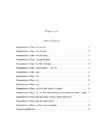
. 7 Prepositions of Place with the words ‘corner’, ‘front’ and ‘back’ ............................ 7 Prepositions of Place with the word ‘arrive’.......................................................... 7 Prepositions of Place – in & on with travelling ..................................................... 8 Prepositional Phrases ......................................................................................... 8 Prepositions of Time – in, on & at • in is used with centuries, decades, years, seasons and months, parts of the day, periods of time • on is used with dates, special days, days of week, day of week + part of day, day + of ... • at is used with holidays, exact time, meals and with night in on at • the 20th century • the 29th of November • Christmas / Easter • the Middle ages /August the first • six o’clock / 7.30
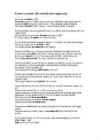
It might have been sent to the wrong address. Active: Somebody should have cleaned the room. Passive: The room should have been cleaned. Present perfect passive have/ has been + III pv (done jne) Have you heard? The concert has been cancelled. Present perfect active: The room looks nice. Somebody has cleaned it. passive: The room looks nice. It has been cleaned. Past perfect passive had been + III pv (done jne) The car was three years old but hadn't been used very much. Past perfect active: The room looked nice. Somebody had cleaned it. passive: The room looked nice. It had been cleaned. Present continuous passive am/ is/ are being + III pv (done jne) There's somebody walking behind us. I think we're being followed. Present continuous active: Somebody is cleaning the room at the moment. passive: The room is being cleaned at the moment. Past continuous passive was/were being + III pv (done jne)
"I've got something to tell you." "What is it, darling? What's the matter?" He had now become absolutely motionless, and he kept his head down so that the light from the lamp beside him fell across the upper part of his face, leaving the chin and mouth in shadow. She noticed there was a little muscle moving near the corner of his left eye. "This is going to be a bit of a shock to you, I'm afraid," he said. "But I've thought about it a good deal and I've decided the only thing to do is tell you right away. I hope you won't blame me too much." And he told her. It didn't take long, four or five minutes at most, and she say very still through it all, watching him with a kind of dazed horror as he went further and further away from her with each word. "So there it is," he added. "And I know it's kind of a bad time to be telling you, bet there simply wasn't any other way. Of course I'll give you money and see you're looked after. But there needn't really be any fuss
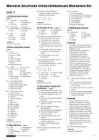
desk isn't interested in the lesson Students' own answers climbers in the group. or perhaps she doesn't understand 6 She had spent a week at high what she has to do. 1C Worst Britons page 5 altitude. 3 Students' own descriptions 1 1 poll 5 commentators 3 Tick: belong, know, imagine, think, 2 public 6 celebrities understand Challenge! 3 Prime Minister 7 figures Students' own answers 4 votes
 annaabi.ee







Kõik kommentaarid