Leidsid 33 sarnast õppematerjali, mis on seotud failiga "National symbols of Australia". Need materjalid aitavad sul teemat sügavamalt mõista.
australia, nation, australian, symbol, symbols, formal, anthem, floral, emblem, stone, first, coat, song, official, until, colours, represent, unique, different, cultural, flown, date, authority, scottish, performed, sung, patriotic, gain, status, following, choose, stephen, 19th, april, advice, prime, informal, years, golden, wattle, july, gift, rainbowAustralia Australia is the only country in the world that covers an entire continent, yet also the smallest and the driest of all the continents. It's almost the same size as continental USA, being the sixth largest country in the world. It's also the oldest some of the rocks are more than 3,000 million years old. Australia is often called `Down Under', because it lies in the Southern Hemisphere. As a result, its seasons are the opposite of ours. Australia, Tasmania and a number of smaller islands form the Commonwealth of Australia. Because of the country's great size, the climate in Australia ranges from tropical regions of the Northern Territory to the cool temperate conditions in the southeast and Tasmania, where it often snows in winter. In the north, half the year is `wet' and half is `dry'. From November to April heavy rain fills the rivers and makes enormous lakes where thousands of birds come for the summer. From
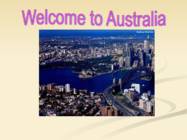
AUSTRALIA CONTENT · Australia · Symbols · Location · States · Language · Religion · Education · Health · Culture · Humour · Video AUSTRALIA · Is a country, and a continent · Is the sixth largest country in the world · The world's smallest continent SYMBOLS · Green and gold were confirmed as Australia's national colours in 1984 · The Golden Wattle was officially proclaimed as the national floral emblem in 1988 · National anthem is Advance Australia Fair · National Gemstone is Opal Coat of arms of Australia LOCATION · Located in oceania, continent between the Indian
Australian symbols DAGNE MARKIINE KOTKAS Offical symbols Flag The flag includes the Southern Cross 3 September Flag of Australia , Union Flag 1901 and Commonwealth Star . Coat of ar ms Granted by King George V; an earlier design was granted by 19 King Edward VII
Australia Fact file: Australia comprises a land area of 7 686 850 square kilometres. Its population is about 21,3 million people. Australia's capital is Canberra. The national language is English. The official name of it is the Commonwealth of Australia. It's divided into six states and two territories: New South Wales, Queensland, South Australia, Western Australia, Tasmania, Victoria, Australian Capital Territory (ACT) and Northern Territory. Symbols: Australia had the British flag as their official flag until 1901, when the Commonwealth of Australia was formed. Over 30 000 entries attracted the official competition. Five of them, which contained almost identical designs, were placed equally first. The Australian flag symbolises Australia's historical links with Britain, because it has
...................................................... ................................. Aborigines and first settlers.......................................................................................... Sports............................................................................................. .................................... Culture............................................................................................. .................................. Factfile Australia is the only country in the worlf that fills the whole continent. The continent is also called Australia, if you want to make clear that you are speaking about the country you may call it by its official name: Commonwealth of Australia. Australia is the smallest continent, but one of the largest countries in the world. Its area is about 7,6 million sq kilometers. Its population is about 20,0 million and most of the people live in bigger cities: Sydney (4.2 million), Melbourne (3
Australia Australia is the smallest continent in the world. It is 7.6 million square kilometres big. It is often called the island continent because it is rather small for a continent and very big for an island. There are only five countries bigger than Australia in the World. There are five states in the mainland. Tasmania is also considered as a state so there are six states. The Northern Territory and Canberra are also independent but they are not states. Canberra is the capital of Australia and it is
Topic Australia Introduction Many people know Australia as the land down under because it is the only continent except for Antarctica that is all on the southern hemisphere. Its name means ,,Southland". The official name of the country is the Commonwealth of Australia. It's capital is Canberra. Australia is the sixth largest country in the world but the smallest continent. Australia has 6 states and 2 territories (New South Wales, Victoria, Tasmania, Queensland, Western Australia , South Australia, The Australian Capital Territory and the Northern Territory). The Australian people are culturally the same as the Anglo Americans. There also live aborigines. Aborigines are the ancestors of the people. Like the US and Canada, Australia was an English speaking colony of Great Britain. Today Australia is a modern developed country with a diversified economy. Australia is an island continent of 7.7 million square kilometres, which makes it a little smaller than the USA.
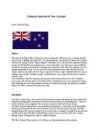
National Symbols of New Zealand New Zealand flag History The idea of the flag of New Zealand was first introduced in 1830, because of trading troubles. At that time, a trading ship built inNZ, Sir George Murray was seized in Sydney by Customs officials for sailing without a flag or register. Australia, which was the most important trading partner for NZ had British navigation laws which ruled that every ship must carry an official certificate detailing construction, ownership and nationality of the ship. The problem was that during that period of time, NZ was not yet a colony ofGreat Britan, thats why the NZ-built ships could not sail under a British flag or register. Without a flag to represent the new nation,
- What is the capital of Australia? a. Sydney b. Melbourne c. Canberra - Which city is the oldest and largest? a. Canberra b. Sydney c. Darwin - Which is a popular Australian animal? a. bear b. kangaroo c. fox - Who are the Australian natives a. Eskimos b. Aborigines c. Indians - Who discovered Australia? a. Columbus b. Captain Cook c. Lewis and Clark - What is the official Language in Australia? a. English b. German c. Spain Australia is situated south of Asia, between the Pacific and the Indian Oceans. Australia is a continent, a country and an island at the same time. Australia is located in the southern hemisphere. OFFITIAL NAME : Commonwealth of Australia CAPITAL: Canberra TOTAL AREA: 7,700,000 sq.km POPULATION: 20 million people HEAD OF STATE: Queen Elizabeth II represented by Governor- General
Introduction, Location Australia is a country between the Indian Ocean and the Pacific Ocean. It is the only country in the world that occupies an entire continent. The mainland covers an area of 7.7 million km² and it is about 3700 km from the most northern point to its most southern point and about 4000 km from east to west. There are also many different seas around Australia, like the Coral and the Tasman Seas in the west or the Timor and the Arafura Seas in the north, where the Indian and the Pacific Oceans meet. Because all seas and oceans near Australia are warm, surfing is a very popular hobby. Political subdivision Australia is divided into six states, which are: · New South Wales · Victoria · Queensland · South Australia · Western Australia · Tasmania New South Wales is the most populous state in Australia. Its capital is Sydney.
..................................................................................................................10 Conclusion....................................................................................................................11 Materials........................................................................................................................11 2 Australia Introduction Australia is the one and only country in the world which fills the whole continent. The continent it fills is called Australia too. So, Australia is both a country and a continent. If you want to make clear that you are speaking about the country, you may call it the Commonwealth of Australia. It’s the official name of the country. Australia is the smallest continent, but one of the largest countries on Earth. It’s 6th largest country. Its area is about 7.6 million sq km
Topic Australia Tallinn English College 2006 Australia 1 . Introduction The name Australia is derived from the Latin Australis, meaning of the south. In land area, Australia is the sixth largest nation, its territory is 7,686,850 sq km and its population reaches today over 20,5 million people. It is the only nation to govern an entire continent and its outlying islands. Australia's capital is Canberra, the only city with its own territory. It was built in the early 1900s just to be the capital. The official language is English and the official name of Australia is the Commonwealth of Australia. Australia is located on the Southern Hemisphere (because of that Australia is also called "A land down under"). 2 . Geographical position
BRITISH NATIONAL SYMBOLS Research work CONTENTS CONTENTS.....................................................................................................................................2 INTRODUCTION............................................................................................................................3 1. BRITISH NATIONAL SYMBOLS..............................................................................................5 1.1 Great Britain and British story................................................................................................5 1.2 National Symbols and Nation Building..................................................................................5 1.3 The Use of Flags throughout History.....................................................................................6 1
Australia Australia is a country and also a continent. If someone wants to make clear, that he is speaking of the country, he may call it by its full name of Commonwealth of Australia. Australia's name means "southland."It is south of the equator. Sometimes it is also called the island continent because it is an island. There are about twenty million people in Australia.It is 1,800 miles from the mainland of Asia and almost half way round the world from Europe. More than 600 miles of ocean separate it from Americas. Since Australia is south of the equator, its seasons are just the opposite of ours. It has summer while we have winter, and the other way round. States and Territories. Australia consists of six states, two territories and eight external territories. The six states are: Western Australia (capital Perth), South Australia (capital Adelaide),
items of government legislation. Discusses domestic matters with the Master of the Household. Towards the end of the day, there is always another pile of official papers and reports waiting to be read or acted upon. The business on constitutional monarchy never ends. 3. Who is the present heir to the throne? Speak about his education. Who are the 2nd and 3rd in line? Present heir is Prince Charles, The Prince of Wales. Has been an exchange student in Australia. Graduated from the university of Cambridge with BA (honors). 2nd and 3rd in line are Prince William of Wales and Prince Henry of Wales, respectively. 4. Make up your list of 5 top British people. Give your motivation. The Queen, Adele, Elton John, Shakespeare, JK Rowling. 5. Which 5 places attract visitors in Wales and Scotland? Edinburgh, Loch Ness, The Highlands, Snowdonia, Cardiff. 6. Name 6 islands, 5 rivers, 3 lakes, 3 mountains in UK.
There are over 1,400 lakes in Estonia, biggest being Lake Peipsi and Lake Võrtsjärv, while the deepest is Rõuge Suurjärv. The two longest rivers are the Võhandu and the Pärnu and the widest is Emajõgi. About 50% of the country is covered by forests while wetlands cover 30%. The landscape of Estonia, through covering a small area, is varied and unique. Lake Peipsi is Estonia's largest lake and Europe's fourth largest freshwater lake. 5. Symbols The flag The Estonian blue-black and white national flag was originally the flag of the Estonian Students' Society and was consecrated in Otepää Church in 1884. Today there is a memorial plaque on the church wall commemorating the event. The Flag Museum, opened in an annex in 1996, attracts tourists who take an interest in the history of the flag. After about half a century, during which it was prohibited by the Soviet authorities, the flag was seen again in public for the first
Sea. Estonia has been a member of the European Union since May 1, 2004 and of the NATO since March 29, 2004. The area of Estonia is about 45000 square kilometres and the population is about 1.4 million people. The capital of Estonia is Tallinn and the official language is Estonian. The currency is Eesti kroon. The main religion is Lutheran. Anniversary of the republic is celebrated on February 20. The national flower is cornflower, national bird is barn swallow and national stone is limestone. It is a land of great natural beauty with a long and varied history and rich culture. It has served as a junction of international trade routes for centuries. History. The oldest marks of habitation on the territory of Estonia date from the 8th millennium BC. Fortified settlements were established in the 1 st century BC. The ancestors of Estonians formed several independent states headed by elected elders.
Scotlan History The history of Scotland begins around 10,000 years ago, when humans first began to inhabit Scotland after the end of the Devensian glaciation, the last ice age. Of the Stone Age, Bronze Age, and Iron Age civilization that existed in the country, many artifacts remain, but few written records were left behind.People lived in Scotland for at least 8,500 years before recorded history dealt with Britain. The written history of Scotland largely begins with the arrival of the Roman Empire in Britain, when the Romans occupied what is now England and Wales, administering it as a Roman province called Britannia. To the north was territory not governed by
Brunswick, Newfoundland and Labrador, Nova Scotia, Ontario, Prince Edward Island, Quebec, and Saskatchewan) and three territories (Northwest Territories, Yukon, and Nunavut). Formally considered a constitutional monarchy, Canada is governed by its own House of Commons. While the governor-general is officially the representative of Queen Elizabeth II, in reality the governor-general acts only on the advice of the Canadian prime minister. Canada is an independent, self-governing nation. However, Canadians recognize Queen Elizabeth II of Great Britain as Queen of Canada. The position symbolizes the country's strong ties to Great Britain, which ruled Canada completely until 1867. Canada and the United States have had a relationship of cooperation and friendship since the 1800's. In Canada a federal form of government is combined with a cabinet system. As a federation, Canada is made up of ten provinces and three territories. Its national
Geography The name Australia means ,,southland". It is both a country and a continent, with an area of 7,617,930 square kilometres and it is also an island, separated from Asia by the Arafura and Timor seas. But Australia is also surrounded by the Indian and Pacific oceans. The Great Barrier Reef is the world's largest coral reef. It lies off the north-eastern coast and extends for over 2000 kilometres. The famous mountain range in the eastern part of Australia is the Great Diving Range and it's highest peak is Mount Kasciusco's 2230m. In the continental part, there are the Macdonnell ranges. Other smaller mountain ranges are the Musgrave Mountains, the Hammessley Mountains and the Darling Mountains. The continental part of Australia is mostly covered with deserts and these deserts are the Great Sandy Desert in the north-western part, the Great Victoria dessert in the southern part and Gibson desert and the Simpson desert
Australia Australia , officially the Commonwealth of Australia, is a country in the Southern Hemisphere comprising the mainland of the Australian continent, the island of Tasmania and numerous smaller islands in the Indian and Pacific Oceans. Australia flag Australia coat of arms. Australia is a cloudless dark blue sky, the bright sun, multikilometer beaches with snowwhite sand and ocean up to horizon. Australia's landmass of 7,617,930 square kilometers is on the IndoAustralian Plate. Surrounded by the Indian and Pacific oceans, it is separated from Asia by the Arafura and Timor seas. It the sixth largest country in area after Russia, Canada,
3. What is the difference between English as a Second Language, English as a Foreign Language and English for Specific Purposes? Give examples of situations where they are used. English as a Second Language (ESL or TESL) is a traditional term for the use or study of the English language by non-native speakers in an English-speaking environment. That environment may be a country in which English is the mother tongue (e.g., Australia, the U.S.) or one in which English has an established role (e.g., India, Nigeria) English as a foreign language A traditional term for the use or study of the English language by non-native speakers in countries where English is generally not a local medium of communication. English for specific purposes - a sphere of teaching English language including Business English, Technical English, Scientific English, English for medical professionals, English for waiters,
History – page 3-4 Religion – page 4-7 Society - page 7-9 The British – page 9-10 Conclusion – page 10-11 Resources – page 11 Appendix – page 11-14 2 Introduction I selected this theme because it was the most interesting one for me. Aborigines have interested me for a long time now so doing this essay is really fun for me. Australian Aboriginal culture is one of the world's longest surviving cultures. Australian Aborigines, also known as Indigenous Australians , are the native people of Australia . Many of them suffered when white people from Britain arrived in Australia, because of disease, the loss of their hunting lands, and unfair laws. Australian Aborigines are those people regarded as indigenous to the Australian continent.
AUSTRALIA Tallinn 2008 Only one country in the world fills a whole continent. That country is Australia. The continent it fills is Australia, too. Australia, then, is both a country and a continent. Australia is one only continent except Antartctica that is all south of the equator. Since it is south of the equator, its seasons are just the opposite of ours. It has summer while we have winter, and the other way round. Sometimes Australia is called the island continent. There is a good reason why. It is an island. It is 1800 miles from the mainland of Asia and almost half way round the world from Europe. More than 6000 miles of ocean separate it from the America. Australia is the world's smallest, flattest and driest continent. It is also the oldest some of the rocks are more than 3,000 million years old. It is the 6th largest country. Its territory is 7 700 000 km2.
Age of Sail in Maritime Canada. Written by Frederick William Wallace. · The Age of Sail was the period in which international trade and naval warfare were dominated by sailing ships. · The Maritime provinces, also called the Maritimes or the Canadian Maritimes, is a region of Eastern Canada. "God Save the Queen", (alternatively "God Save the King") is the national anthem of the United Kingdom and its territories and dependencies. As "God Save the Queen" is the Royal Anthem of Canada, the first verse has been translated into French for use in that country. Land of the Silver Birch is a traditional Canadian folk song. It is sometimes sung to keep time while canoeing, and sometimes sung at campfires in a round. It is in Aeolian, or Natural Minor, but some have performed it with a raised fourth in the forest, creating a dorian feel
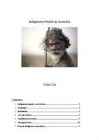
.................................................... 4-5 7. Famous indigenous Australians.................................................................... 5 8. Interesting facts.............................................................................................. 5 9. Used links.........................................................................................................6 Indigenous peoples: an overview Indigenous Australians are the original inhabitants of the Australian continent and nearby islands. The Aboriginal Indigenous Australians migrated from the African continent around 70,000 years ago, and arrived in Australia around 50,000 years ago. The term "Aboriginal" has traditionally been applied to indigenous inhabitants of mainland Australia, Tasmania, and some of the other adjacent islands. There is a great diversity among different Indigenous communities and societies in Australia, each with its own unique mixture of cultures, customs and languages
Tallinna Inglise Kolledz Estonia Topic Alice Tärk, 9b Tallinn 2007 FACTFILE Area: 45 228 sq km Poplulation: under 1.4 million Capital: Tallinn Language: Estonian Currency: Eesti kroon (EEK) Main religion: Lutheran National holiday: 24 February (anniversary of the republic) National flower: Cornflower National bird: Barn Swallow National stone: Limestone LOCATION The Republic of Estonia is the northernmost and smallest of the three Baltic States. It is located on the eastern shores of the Baltic Sea in the north east of Europe. To the east the country borders Russia. Latvia is the countries neighbour to the south. From the west the coast of Estonia is washed by the Baltic Sea and from the north by the Gulf of Finland. The length of the coastline is approximately 3 800 km. The longest distance from east to west is
Australia Topic Koostas: Aineõpetaja: Tallinn 2011 Location Only one country in the world fills a whole continent. That country is Australia. The continent it fills is Australia, too. Australia, then, is both a country and a continent. If someone wants to make clear that he is speaking of the country, he may call it by its full name of Commonwealth of Australia. Sixty million years ago Australia and its nearby islands were separated from the rest of the world by a great upheaval. They were cut off from Asia by the ocean. Very few people and almost no animals visited Australia before English colonists began to settle there in 1788. During all those 60 million years the native Australian mammals developed by themselves, undisturbed by the animals developing elsewhere. Australia is the only continent except Antarctica that is all south of the equator. It's name means "southland"
territory is in daylight. This was a saying refering to the fact that Britian had colonies all around the world. 2. What is the Commonwealth? The Commonwealth is an association of sovereign nations that support each other and work together towards international goals. 3. When was it founded? 1931 4. Who were the founder members? Great Britain, the Irish Free State (now the Republic of Ireland), Canada, Newfoundland (since 1949 part of Canada), Australia, New Zealand, and South Africa. 5. Are they still members? Why? Irish Free State left in 1949 with the republic of ireland acts, Newfoundland (since 1949 part of Canada), 6. What was the difference between the British Empire and the British Commonwealth of Nations? the british Empire has a constitutional monarchy, all countries were a part of the british Empire and the queen was the head of all countries,
Approximately 600 million 5. Who (which tribes) gave the base of the English language?Germanic tribes- Anglo-Saxons. 6. Describe Wales.- Wales is a mountainous country on the western side of Great Britain. The national game of Wales is Rugby. Flag- Red dragon on a green and white field. They have their own language Cymraeg ( Welsh) . Anthem- Land Of My Fathers. Official animal- Dragon. There used to be a lot of coalmines. 7. What are the symbols of the 4 constituent countries? England- The three national symbols of England are St.George's cross; The red Rose and the Three Lions Crest; The oak is national tree; Northen Ireland- Shamrock; St.Patrick ;Scotland-thistle, St.Andrew 's cross . ; Wales-daffodil, leek, Prince of Wales's feathers; St.David, red dragon 8. How did the Romans influence Britain? The Romans built the first bridge(in London), the capital(London) is a
New Zealand is an island country in the south-western Pacific Ocean comprising two main landmasses (the North Island and the South Island), and numerous smaller islands, most notably Stewart Island/Rakiura and the Chatham Islands. The indigenous Mori language name for New Zealand is Aotearoa, commonly translated as land of the long white cloud. Population (1998): 3,801,000.New Zealand is notable for its geographic isolation; it is situated about 2,000 kilometres (1,200 mi) southeast of Australia across the Tasman Sea, and its closest neighbours to the north are New Caledonia, Fiji and Tonga. During its long isolation New Zealand developed a distinctive fauna dominated by birds, a number of which became extinct after the arrival of humans and the mammals they introduced.The majority of New Zealand's population is of European descent; the indigenous Mori are the largest minority. Asians and non-Mori Polynesians are also significant minority groups, especially in urban areas
Table of contents 1. Introduction 2. Geographical position 3. Mountains, lowlands 4. Rivers, lakes 5. The territories and provinces 6. Towns, economy, agriculture 7. Climate 8. Animals, plantlife 9. Population 10. Sports 11. Culture 12. History 13. Political system, symbols 14. Conclusion 15. Materials 1. Introduction If you had to use two words to describe Canada, they might be large and diverse. Canada is the second largest country in the world, bordered by three oceans, and across the country, Canadians experience many different landscapes from rolling plains and mountains to the cold tundra of the north. Despite Canada's great size, it is one of the world's most sparsely populated countries. This fact, coupled with the
New Zealand New Zealand is an island country. It is in the south-western Pacific Ocean comprising two main island, North- and the South Island with lots of smaller islands. New Zealand is notable for its geographic isolation. It's about 1,600 kilometers from Australia and its closest neighbours to the north are New Caledonia, Fiji and Tonga. New Zealand's total land area is 268,021 square kilometers. The country extends more than 1600 kilometers along its main,north - north-east axis and has about 15,000 kilometers of coastline. The South Island is the largest land mass of New Zealand and is divided along its lenght by the Southern Alps and the highest mountain Mount Cook is 3,754 meters high.
 annaabi.ee