Leidsid 33 sarnast õppematerjali, mis on seotud failiga "Inglise keel - future tenses". Need materjalid aitavad sul teemat sügavamalt mõista.
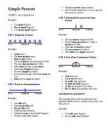
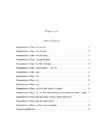
tomorrow, year, going, lihtolevik, exam, kohtumised, work, month, years, come, kindle, pass, working, harder, playing, football, having, party, holidays, train, arrives, morning, drive, today, rutiinne, seeing, wont, lõpetatud, finished, exams, letter, power, studyingWays of expressing the Future Table of Contents Future Simple ...................................................................... 2 Be going to ........................................................................... 3 Present Continuous .............................................................. 3 Present Simple ..................................................................... 4 Future Continuous ............................................................... 4 Future Perfect....................................................................... 6 Other ways of referring to the future .................................
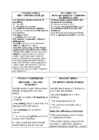
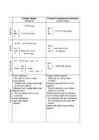
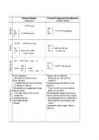
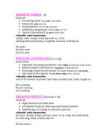
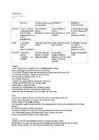
FUTURE SIMPLE BE GOING TO Will + infinitive (will go) Am/is/are going to + infinitive (is going to rain) 1.A decision at the moment of 1.Future plans made before the speaking: moment of speaking: A: 'I'm cold'. A: 'We've run out of milk.' B: 'I'll close the window'. B: 'I know, I'm going to buy some.' 2.Prediction based on opinion: 2.Prediction based on present I think the Conservatives will win the evidence: next election. Look at those boys playing football! 3.A future fact: They're going to break the window. He will be ten next year. 4.Promises / requests / refusal / willingness: I'll help you with your homework. Will you give me a hand? 5.In the same way as the future
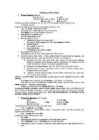
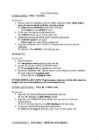
TENSES. ACTIVE VOICE. 1. Present Simple (üldolevik) I (he, she, it s) he works Eitav,küsiv do (I, you, we, they) he does not work does (he, she, it) does he work? Verbidele, mis lõpevad infinitiivis ss, -sh, -ch, -x või o, lisatakse ainsuse 3. pöördes es he touches, she goes Verbidel, mis lõpevad y-ga, mille ees on konsonant, muutub y->ies carry - he carries Vrdl: play he plays 1. Harjumuspärane, korduv tegevus või seisund olevikus. Tom drinks tea every day. He lives in Brussels. 2. Üldtuntud tõed, loodusseadused The earth goes round the sun. 3. Tulevikus toimuv tegevus
Children start school at the age Praeguse perioodi vältel toimuv of seven in Estonia. tegevus: Sõiduplaanide ja ajagraafikutega They're building a new railway KASUTAMINE seotud tulevik: station in our town. The train leaves at 9 o'clock Ettekavatsetud tegevus tulevikus, tomorrow. mis on kahepoolselt kokku lepitud: Loodusseadused My grandparents are celebrating Spordiülekanded their wedding anniversary next Juhised month. Pahameelt näitav sageli toimuv tegevus.
Children start school at the age Praeguse perioodi vältel toimuv of seven in Estonia. tegevus: Sõiduplaanide ja ajagraafikutega They're building a new railway KASUTAMINE seotud tulevik: station in our town. The train leaves at 9 o'clock Ettekavatsetud tegevus tulevikus, tomorrow. mis on kahepoolselt kokku lepitud: Loodusseadused My grandparents are celebrating Spordiülekanded their wedding anniversary next Juhised month. Pahameelt näitav sageli toimuv tegevus.
Children start school at the age Praeguse perioodi vältel toimuv of seven in Estonia. tegevus: Sõiduplaanide ja ajagraafikutega They're building a new railway KASUTAMINE seotud tulevik: station in our town. The train leaves at 9 o'clock Ettekavatsetud tegevus tulevikus, tomorrow. mis on kahepoolselt kokku lepitud: Loodusseadused My grandparents are celebrating Spordiülekanded their wedding anniversary next Juhised month. Pahameelt näitav sageli toimuv tegevus.
Future Forms Future Forms · 1) Future Simple will work · 2) Be going to am/is/are going to work · 3) Present Continuous am/is/are working · 4) Present Simple start(s) Future Forms · 5) Future Continuous will be working · 6) Future Perfect will have worked · 7) Future Perfect Continuous will have been working Future Simple · We do our morning exercises and think, "I think we will have a nice day " · Prediction (ennustused kõhutunde põhjal) · verbs think, believe, guess, expect, hope etc · expressions be sure,
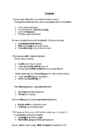
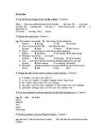
Tests Superstar 1 Luke Prodromou Test 1 Name____________________ Class_______ Use your English 1 Complete these sentences using the correct form (present simple or present continuous) of the verb in brackets. _ 1 She is in a band and she _________________________________ (record) a CD at the moment. _ 2 She is an actress and often _________________________________ (appear) on television. _ 3 At the moment she _________________________________ (have) a rest because she is tired. _ 4 Mike is a doctor and he _________________________________ (live) in Manchester.
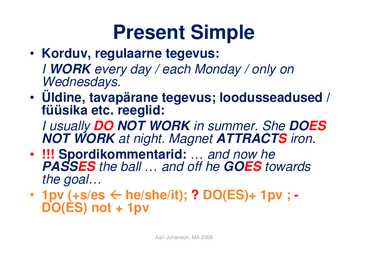
Present Simple · Korduv, regulaarne tegevus: I WORK every day / each Monday / only on Wednesdays. · Üldine, tavapärane tegevus; loodusseadused / füüsika etc. reeglid: I usually DO NOT WORK in summer. She DOES NOT WORK at night. Magnet ATTRACTS iron. · !!! Spordikommentarid: ... and now he PASSES the ball ... and off he GOES towards the goal... · 1pv (+s/es Å he/she/it); ? DO(ES)+ 1pv ; - DO(ES) not + 1pv Aari Juhanson, MA 2008 Present Progressive · Hetkel toimuv, pooleliolev tegevus: S/he IS TALKing on the phone now. I AM READing an interesting book. · Ajutine, regulaarsele ja tavapärasele vastanduv tegevus (tulevikku viitav): This summer they ARE not GROWing
Konspekt 1.Kui me teame tulevikust, me tavaliselt kasutame oleviku. Me kasutame lihtoleviku selle jaoks mis on planeeritud või korraldatud. ● I have concert next week. ● The bus arrives at 7.30 in the morning. ● I have test tomorrow. ● We’ll have party next friday. Me saame kasutada kestva oleviku plaanide või korralduste jaoks. ● I’m playing basketball today. ● They are coming to see us tomorrow. ● I’am celebrating my birthday next week. 2.Me kasutame will et rääkida tulevikust. Kui me teeme ennustusi. ● It will be hard day tomorrow. ● I think my brother will buy me a car. ● I’m sure my ex will be jealous about my new girlfriend. Mõeldes want to(olla) või be willing to (olla valmis ehk abivalmis) ● I hope you will help me at my project. ● Marika says he will help me Teha Offers(pakkumisi) ja promises(lubadusi).
pv I get up at 7 every day. He always works hard. What time do you go to school? Lihtminevik The past simple Minevikus toimunud tegevus. Yesterday, last week, two das ago, last year, in 1999. 2. pv / -ed did + 1. pv I got up at nine last Saturday. Yesterday he worked much. What time did you go to school yesterday? Lihttulevik The future simple Tulevikus toimuv tegevus, mis ei sõltu meie tahtest või mille suhtes teeme otsuse kõnelemise momendil. Next week, tomorrow, in two years time, in 2020. will + 1. pv (will not = won't) Maria will be thirteen next year. Maybe I won't go to the party tomorrow, I'm too tired. Will you help me with my homework tonight? Kestev olevik The present continuous Praegu toimuv tegevus. Now, at the present. am / is / are + -ing We are learning English. Is Mark reading or writing? Where is the teacher standing? 3 Kestev minevik The past continuous
pv I get up at 7 every day. He always works hard. What time do you go to school? Lihtminevik The past simple Minevikus toimunud tegevus. Yesterday, last week, two das ago, last year, in 1999. 2. pv / -ed did + 1. pv I got up at nine last Saturday. Yesterday he worked much. What time did you go to school yesterday? Lihttulevik The future simple Tulevikus toimuv tegevus, mis ei sõltu meie tahtest või mille suhtes teeme otsuse kõnelemise momendil. Next week, tomorrow, in two years time, in 2020. will + 1. pv (will not = won't) Maria will be thirteen next year. Maybe I won't go to the party tomorrow, I'm too tired. Will you help me with my homework tonight? Kestev olevik The present continuous Praegu toimuv tegevus. Now, at the present. am / is / are + -ing We are learning English. Is Mark reading or writing? Where is the teacher standing? 3 4 Kestev minevik The past continuous
Simple Present · · New York is a small city. It is not important that this fact is untrue. [VERB] + s/es in third person USE 3 Scheduled Events in the Near Examples: Future · You speak English. · Do you speak English? · You do not speak English. USE 1 Repeated Actions Examples: · The train leaves tonight at 6 PM. · The bus does not arrive at 11 AM, it arrives at 11 PM. · When do we board the plane?
e.g. I can swim. Do you think I should go? Characteristics of Modal Verbs • There is no -s in the third person singular: She can ski. He must be tired. It might rain. • They are used to form questions and negatives: Shall we go for a walk? What should I do? He can’t dance. You mustn’t tell lies! • Modal auxiliary verbs don’t usually have past forms. Other expressions are used instead: I had to work hard at school. The prisoner was able to/managed to escape by climbing onto the roof of the prison. (NOT *could escape) (=ability / performance on one occasion) In some cases could can be used with a past meaning: I could swim when I was six. (=general ability) • They have no infinitives and no –ing forms. Other expressions are used instead. I’d love to be able to ski. I hate having to get up early. • They are followed by an infinitive without -to
PRESENT SIMPLE [s] lihtolevik · kestvad tegevused. Tom works in the market. · rutiinid. He works every day. · loodusseadused. The sun sets in the west. · ajatabelid ja programmid. The buss leaves at 7 am. · (spordi) kommentaarid. Ben passes ball to Tom. väljendid, mida kasutatakse: usually, often, always, every day/week etc, in the morning/afternoon/evening, at night/the weekend, on Friday etc. He works He don't work Does he work PRESENT CONTINUOUS [ is + ing] kestev olevik · tegevused, mis praegu leiavad aset. Karl is doing his homework at the moment. · plaanitud tegevus lähitulevikus. I am going to school tomorrow. · kui midagi toimub/muutub praegu. The number of burglaries is increasing. · alati sama korduv tegevus. You are always eating, when i wake up. väljendid, mida kasutatakse: now, at the moment, at present, these days, nowdays, still, today, tonight etc. He is working He isn't working
She is afraid her son will fail his exams. · On-the-spot otsus (rääkimise ajal tehtud otsus) Nt: I will buy the blue jacket, not the yellow one. · Lubadused, hoiatused, ähvardused, palve, lootused, pakkumised Nt: I will never speak to you again! Will you give me a hand with the washing-up? · Tegevused/sündmused, mis KINDLASTI toimuvad tulevikus, me ei saa neid kontrollida Nt: Valentine's Day will fall on a Saturday this year. BE GOING TO Kasutan, kui... · plaanid tulevikuks Nt: I am going to travel around the world one day. · otsused, mis on juba LÄHITULEVIKUKS tehtud Nt: We are going to visit our grandparents next week. · Ennustused, põhinedes sellel, mida me näeme; kui on millegi toimumiseks tõendeid Nt: Look at the sky! It is going to rain. Look at that car! It is going to crach. FUTURE SIMPLE ja BE GOING TO-ga kasutame: tomorrow, the day after tomorrow,
recording, or by any information storage and retrieval system, without the written permission of the publisher. ISBN 1-59905-201-6 Printed in the United States of America 13 12 11 10 09 08 07 9 8 7 6 5 4 3 2 1 Introduction Grammar is a very old field of study. Did you know that the sentence was first divided into subject and verb by Plato, the famed philosopher from ancient Greece? That was about 2,400 years ago! Ever since then, students all over the world have found it worthwhile to study the structure of words and sentences. Why? Because skill in speaking and writing is the hallmark of all educated people. Lesson by lesson, this book provides basic instruction in the eight parts of speech--nouns, pronouns, verbs, adjectives, adverbs, prepositions, conjunctions, and interjections--as well as the standard patterns of English sentences. All students of English, be they native speakers or those
2. Present Simple [VERB] + s/es in third person. Tegevus on korduv või tavapärane. You speak English. I play tennis. Cats like milk. The train leaves tonight at 6 PM. I am here now. Active= Once a week, Tom cleans the car. Passive= Once a week, the car is cleaned by Tom. 3. Present Continuous [am/is/are + present participle]. Tegevus toimub/ei toimu praegusel hetkel. You are watching TV. You are learning English now. I am studying to become a doctor. I am meeting some friends after work. Active= Right now, Tom is writing the letter. Passive= Right now, the letter is being written by Tom. 4. Past Simple [VERB+ed] or irregular verbs. Tegevus algas/lõppes minevikus täpsel ajal. . You called Debbie. I saw a movie yesterday. I finished work, walked to the beach, and found a nice place to swim. I lived in Brazil for two years. I studied French when I was a child. Active = Tom repaired the car. Passive= The car was repaired by Tom. 5
She's German or rather, Austrian. (NOT She's German or better, Austrian.) I'll see you on Friday or rather, Saturday. 3. Use the simple present play(s), rain(s) etc to talk about habits and repeated actions. I play tennis every Saturday. (NOT I am playing tennis every Saturday.) It usually rains a lot in November. 4. Use will ..., not the present, for offers and promises. I'll cook you supper this evening. (NOT I cook you supper this evening.) I promise I'll phone you tomorrow. (NOT I promise I phone you tomorrow.) 5. Don't drop prepositions with passive verbs. I don't like to be shouted at. (NOT I don't like to be shouted.) This needs to be thought about some more. (NOT This needs to be thought some more.) 6. Don't use a present tense after It's time. It's time you went home. (NOT It's time you go home.) It's time we invited Bill and Sonia. (NOT It's time we invite Bill and Sonia.) 7. Use was/were born to give dates of birth. I was born in 1975
Moved to Cali 2005 Was Born Traveled to Europe Husband 1978 School graduates @ Oxford 1999 Started Got married School 1983 2008 2 The Six English Verb Tenses Three Simple Tenses Simple continuous Present You walk. You are walking I run. I am running. Past You Walked You were walking. I ran. I was running. Future You will walk. You will be walking. I will run. I will be running. Three Perfect Tenses Perfect continuous
Lihtolevik väljendab: · Antud momendil toimuvat tegevust, mis ei väljenda kestvat aega, näiteks see, hear, know. I see that man who you are pointing at. · Üldist, kogu aeg toimuvat või korduvat tegevust, pole oluline, kas tegevus toimub rääkimise hetkel. Teachers teach in schools. He usually goes to gym on Monday. · Tegevust mingil ajal. I go to school at 8 o´clock. You have to pay taxes once a month. · Kõigile tuntud fakte. Life passes by quickly. Present Continuous Kestva oleviku moodustamine Jaatav vorm Eitav vorm Küsiv vorm I am speaking I am not speaking Am I speaking? He/she/it is going He/she/it is not going Is he/she/it going?
Tenses 27. jaanuar 2012. a. 9:24 SIMPLE CONTINUOUS -ing PERFEFCT PERFECT on alati sees! CONTINUOUS PRESEN I work in school. I am working in I have worked in I have been working T loodusseadused school. school. in school for/since 5 pidev korduv lähituleviku plaanid Surnute kohta EI SAA years. tegevus(hommiku ÖELDA! siiamaani kestab kohvi) aja-graafikud PAST I worked in I was working in the I had worked in school. I had been working. school. school. fakt on tähtis (for since) finito aeg(see et ta
b) for on-the-spot decisions. c) for promises (usually with the verbs promise, swear, guarantee, etc.), threats, warnings, requests, hopes (usually with the verb hope) and offers. d) for actions/events/situations which will definitely happen in the future and which we cannot control. The temperature will reach 40°C tomorrow. Be going to a) for plans, intentions or ambitions we have for the future. Now that they've won the lottery, they are going to buy a big house, (intention/plan) b) For actions we have already decided to do in the near future. They are going to get married in three months. (They have already decided to do it.) BUT: They're getting married next month
Here's a breakdown of how you can express how you really are without complaining too much. · Fine, thanks. / On top of the world, thanks. · OK, thanks · Not so bad, thanks. / Can't complain, thanks. · So so, thanks. / So and so, thanks. · Not so good, actually 1 The English alphabet Spelling Work with your partner and spell out first your name and then some names of places. Write down each letter as you hear it, and then say the word. The English alphabet on the phone: You might find the following alphabet (used by international airlines) useful when trying to spell a word on the telephone. A Alpha O Oscar Ä Alpha-Echo Ö Oscar-Echo B Bravo P Papa
.......blue eyes and blond hair, but her brother ........dark hair. He ........in his late twenties. He........married and........two sons. I........short, but my sister........tall. We........a dog and a cat. Our uncle........two dogs. They........brown. 2. Choose the correct item. ( 5 points ) e.g. The residents were made...D....their homes by the authorities. A leave B leaving C left D to leave 1) Ann is my best friend! We........each other for years A know B knew C knows D have known 2) Nicky........to San Francisco when the accident happened. A flies B has flown C was flying D has been flying 3) Why don`t you let her........her story? A finish B to finish C finishing D have finished 4) Tim........in a cafe at present, but he has already applied for a new job A work B have worked C is working D worked
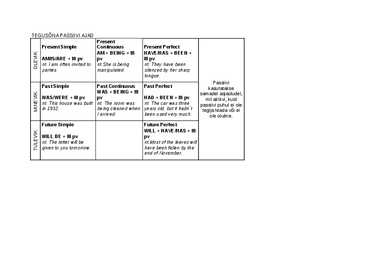
WAS + BEING + III samadel asjaoludel, MINEVIK WAS/WERE + III pv pv HAD + BEEN + III pv mil aktiivi, kuid nt. This house was built nt. The room was nt. The car was three passiivi puhul ei ole in 1932. being cleaned when years old, but it hadn´t tegija teada või ei I arrived. been used very much. ole oluline. Future Simple Future Perfect WILL + HAVE/HAS + III TULEVIK WILL BE + III pv pv nt. The letter will be nt.Most of the leaves will given to you tomorrow
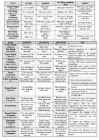
Future Simple Will + be + Will + have/get sth + Tomarrow, soon, next Will + I pv Lihttulevik III pv III pv week, year TENSE POSITIVE NEGATIVE QUESTION USE Present Simple I play tennis on They don't work in Does she know Habitual activities Lihtolevik Mondays. New York. him? Past Simple She went to Paris They didn't drive to Where did she get Actions happening at a defined Lihtminevik last week. work. that hat? moment in the past.
........................... 7 Prepositions of Place with the word ‘arrive’.......................................................... 7 Prepositions of Place – in & on with travelling ..................................................... 8 Prepositional Phrases ......................................................................................... 8 Prepositions of Time – in, on & at • in is used with centuries, decades, years, seasons and months, parts of the day, periods of time • on is used with dates, special days, days of week, day of week + part of day, day + of ... • at is used with holidays, exact time, meals and with night in on at • the 20th century • the 29th of November • Christmas / Easter • the Middle ages /August the first • six o’clock / 7.30
ccc_tracy_fm_i-xviii.qxd 7/7/03 3:22 PM Page vi ccc_tracy_fm_i-xviii.qxd 7/7/03 3:22 PM Page vii Foreword If you are ready to leverage yourself to greatness and achieve giant results, you have the right road map in your hands.You have before you the DNA of your future. All you need to create a wonderful fu- ture for yourself is to read this book, decide how you are going to apply it to your own life, write out a plan, and then go forth with en- thusiasm and make it happen. I have a confession to make. I am one of Brian’s raving fans. I have studied him, his brilliant work, and the extraordinary results he has achieved. I am also one of his close colleagues and friends. We have worked together on many platforms, and met and talked with each other on numerous occasions.
· action taking place in the middle of another action tegevus, mis toimub mingi teise tegevuse keskel. Past Continuous A: He was speaking. · when N: He was not speaking. · action going on at a certain time in · while Kestev minevik Q: Was he speaking? the past tegevus toimus mingil kindlal ajaperioodil minevikus · as long as · then
N: I was still having dinner when my friend called. I was reading a book while my brother was playing his guitar. 3)past perfect:had+past participle/had+been+ing. N: my brother had gone to bed by the time I got home. By midnight, all the guests had left. We were tired because we had been playing volleyball all morning. Future tenses: 1)Future simplewill/shall + infinitive. N:Ppl will live on the moon one day. Are you having a party?I will come! I'll ring you tonight if you want. I'll be really angry if youre late again. 2)Going to + infinitive N:I've decided what to get Tom for his birthday, I'm going to buy him a CD. Listen to the thunder! There's going to be a storm!; 3)Present continuous N: I am meeting my girlfriend tonight. 4)Present simple The bus leaves at 8 a.m. I'll meet you as soon as the class finishes.
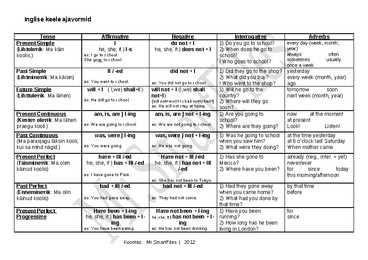
Inglise keele ajavormid Tense Affirmative Negative Interrogative Adverbs Present Simple I do not + I 1) Do you go to school? every day (week, month, (Lihtolevik: Ma käin he, she, it } I-s he, she, it } does not + I 2) When does he go to year) koolis.) ex: I go to school. school? always often She goes to school. ! Who goes to school? sometimes usually
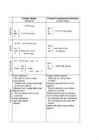
Future Will infinitive Will + have Will+ base+ ing Will + have without to.. + been+ ing He will leave.. I will have a word You will be I will have been with you. watching working Present Future going to-future will-future Simple Present Progressive Progressive infinitive to be (am, are, is) to be (am, are, is) will + be + 3rd person singular + going to + will + infinitive
 annaabi.ee