School name THEATRES IN TALLINN Term Paper Compiler: Tallinn 2013 Introduction Tallinn is the capital city of Estonia. In Estonia there are many theatres. Tallinn has 8 theatres. Most of them are located in the Old Town or near the Old Town. These 8 theatres are: Estonian National Opera, Tallinn City Theatre, Estonian Drama Theatre, Estonian State Puppet & Youth Theatre, Russian Drama Theatre, VAT Theatre, Theatre NO99 and Von Krahl Theatre. Estonian National Opera The song and drama society `'Estonia'' was founded in 1865. Play-acting started in 1871. The following theatre activites were relatively haphazard, theatre as a tradition really came into being since 1895, when the society began to direct song plays, folk plays and comedies, usually with singing and dancing; in the start of the XX century already saw more serious drama on the stage. In year 1906 Paul Pinna a...
Tallinna Lillekyla Gymnasium Report Tallinn in the 20th century Student: ------------ Supervisor: --------------- Tallinn 2008 Table of Content Table of Content..........................................................................................................................2 Introduction .....................................................................................................................................................3 Beginning of 20th century...........................................................................................................4 Independent Estonia (1918-1940) ...............................................................................................................................................
Tallinn Mustamäe College G2K Jaana-Kristiina Jõgevest The Four oldest churches of Tallinn Report Supervisor: Ingrid Teigar Tallinn 2009 The Dome Church The Danes began fortification of Toompea after the conquest of Tallinn in 1219 and probably also built the first church there. It was presumably a wooden building located at the site of the present cathedral. However, a serious conflict with the Order of the Brothers of the Sword broke out soon as the latter wanted to gain control of the entire Estonia. The order succeeded in subordinating Tallinn and the whole of North Estonia to its rule in 1227. The monks of the Dominican Order began the construction of a stone church in Toompea in 1229. The first written data on the cathedral date back to 1233, the date of a battle...
Tallinna Mustamäe College The Most Important Buildings in Lai Street in Tallinn Report Supervisor: Ingrid Teigar Tallinn 2014 Table of Contents Introduction.............................................................................. 3 Lai Street in general.................................................................. 4 The origin of the name "Lai"...................................................... 4 1 Lai Street / 4 Nunne Street...................................................... 5 17 Lai Street............................................................................. 6 23 Lai Street............................................................................. 6 27 Lai Street............................................................................. 8 29 Lai Street...........................................................................
Saint John´s Church situates in Tallinn on the freedom square. It is one of the earliest neogothic churches in Estonia. The architect of the church was Cristoph August Gabler. Building of the church started in 1869 and ended in 1867. The third advent was celebrated the same year the church was built in. Saint John´s church is about 140 years old. On the 1st of January it had its last praying and then the key of the church was handed over to the renovators. Residents of the Saint John´s church moved into the church of Niguliste. When the church was handed over, the people had a very grand goodbye(farewell) to the church even though it was only left temporarily. The first organ was built in 1869 by Gustav Normann. 1905 church started collecting money to get a better organ. In 1913 a real masterpiece of modern organ making was made. On the 16th April Saint John´s church got a new organ that was shipped from Germany. It was 6 metres high an...
My room I live in a comfortable city flat in a 9-stored block of flats not far from the centre of Tallinn. It is not a very green place, but still there are many trees around the house and in summer the yard looks very beautiful and cozy. The house is located comfortably because there a few supermarkets, pharmacies around. My flat is on the first floor. It's very comfortable and well-planned. There are three rooms, a kitchen, a bathroom and a balcony. The largest room in our flat is the living room and me and my husband room too. My family uses it as a sitting room. On the left there is my bed and desk. The desk has a lot of drawers where I keep my text-books, notes, pens, pencils and other necessary things. On the right there is a sofa and a built-in wardrobe. In the right corner there is a comfortable arm-chair. Beside it stands a lamp with blue shade. I like to turn on the lamp, sit in the arm-chair and read an interesting book. Ther...
How to Make Tourism in Tallinn Profitable Nowadays tourism is one of the world`s largest industries. In Estonia it is also developed really largely. First of all, the main what attracts people abroad are journeys. People want to widen their outlook. Tallinn is the right place for tourists who want to get know about the medieval life in Europe. Here are such attractions as the Medieval Old Town, Kadriorg Park and Rusalka monument. These are the main places people usually want to visit. So, we must develop our tourism system. For example, make up some journey programmes with elements of the Estonian tales. That certainly attracts much more tourists in Tallinn. Moreover, Tallinn has the good benefit in its geographical location. Estonia is like a bridge or gate between Europe and Russia. And Tallinn is the heart of Estonia its capital. Estonians could get some profits from such situation, but for some unknown reasons they did not d...
Should a mosque be built in Tallinn? Dear classmates and teacher, Today I want to talk to you about a topic that has brought with it a great deal of controversy in recent years. Namely, should the construction of a mosque in Tallinn be permitted? Estonians often like to pride themselves for being more tolerant and open-minded than those from other post-soviet nations. This sort of a progressive mindset, however, rarely extends to the principles of religious freedom. But why? Why are so many people opposed to something that in its core is just another place of worship much-like any other? After all, the construction of the mosque wouldn't even be funded by tax-payers. In addition, most of us don't oppose the building of churches, even though Estonia is currently the 3rd least religious country on the planet. Many people fear that the building of a mosque would open a door for Islamic radica...
Pirita Convent Anete Samelselg 10th grade About the convent It was founded by St. Birgitta in 1412 and consercrated in 1436. The area is 1360 square meters. It was the biggest church building in the Middle aged Estonia. Name Pirita is orginated from St. Birgitta. The idea and construction The history of the the Pirita Convent dates back to the 15 century. The idea to found a convent in Tallinn, the capital of Estonia, was initiated by some Tallinn merchants already in 1400. Building plot was donated from Livonian Order. The building were built in two different parts. One for nuns and one for monks. Church in the middle and it was used by both. St. Birgitta rules In the convent have to live both - nuns and also monks. Nuns and monks were seperated and did not see each other at all. The Convent could not have more than 85 members 60 sisters and 25 brothers. The leader of the co...
The shights of Estonia Brigita Maria Raave St. Olaf’s Church St. Olaf’s Church in Tallinn, in Estonia is believed to have been build in the 12th century. St. Olaf’s Church is located in Lai Street. St. Olaf’s Church is the city’s biggest medieval structure, took its name from the sainted Norwegian king Olaf Haraldsson. St Olaf Church was part of the united western tradition of Christianity, whose polity continues in the Roman Catholic church today. However, from the Reformation the church has been part of the Lutheran tradition. In 1950 St. Olaf’s Church became a Baptist church.The Baptist congregation continues to meet at St Olaf’s today. Pictures of St. Olaf’s Church cc St Olaf’s Church Tower According to some sources St Olaf’s Church was the tallest building in world from 1549 to 1625, till the Eiffel Tower was built. In 1590 the total height of the tower was 115 meters. After several rebuildings, the height...
About Peter I House Museum Emperor Peter I (1672-1725) expanded the borders of the Russian Empire in the course of the Northern War and managed to annex the whole Estonian territory by the year 1710. Therefore the protection of the new border areas became the priority of the ruler and he paid a lot of attention to the reconstruction of ports in Tallinn and Paldiski and visited Tallinn several times. Together with the site of the would-be palace, a summer estate and a 17th-century cottage that had belonged to town councillor von Drenteln were purchased for the emperor's use in 1713. The small cottage was enlarged with a wing and the outcome was a building with a hall, a kitchen and four rooms. The small summer residence was in use until the emperor's death. The succeeding rulers used the Palace of Kadriorg that had been completed only after Peter's death and the small building was neglected. The building was ...
Majandussotsioloogia Seminar 2 Tekst 1 Jekaterina Bavõkina 193893TABB Tekst 1: Eesti Inimarengu Aruanne (EIA) 2016/2017, Põhisõnumid. Eesti rändeajastul. Tiit Tammaru, Kristina Kallas, Raul Eamets. Kättesaadav: https://inimareng.ee/pohisonumid-eesti-randeajastul/ - Mida tähendab mõiste „hargmaisus“? Kuidas väljendub hargmaisus tänapäevases Eestis? Milliseid probleeme ja ka uusi võimalusi see ühiskonnale endaga kaasa toob? Hargmaisus on inimeste ja ettevõtete ränne, nimelt nende tegevus mitmes riigis. Rändel on üks tunnusjoon: see on tõmme heaolu poole. Inimesed rändavad küll erinevatel põhjustel, olgu see töötamine, perega seotud tegurid, õppimine või põge- nemine tagakiusamise eest, kuid minnakse riikidesse, kus elu on parem. Eesti on pagulast...
I am buying myself an apartment I would like to buy a apartment – I am 25 years old and I have some saving, actually – a lots of savings. I have saved a lot of money to buy my dream apartment in Tallinn. What kind of apartment would I like to buy? The apartment has to be in the downtown, it would be perfect, if it is located in Tallinn’s old town. The apartment should definitely have excellent view to the old town, it should be large and wide. I would love, when the apartment is in old house and if it is renovated, but still has some vintage style. The most important thing is that the apartment has to have two or more floors. Good dream, huh? In fact, in old town, there is an apartment that fits to my requirements – apartments like that are expensive and I have to get a loan. I decided that I will take the loan from Swedbank, SEB or LHV, because they offer a loan, that has better conditi...
Two very different towns of Estonia I would like to write about two very different towns of Estonia. One is Paide and the second is Tallinn. These cities for most people, would be quite incomparable, but if you really are interested in Estonian culture, then you most certainly have to visit them both. Paide most often described as the center of Estonia, is one of the most historic cities in Estonia as its first mentioned in the writings as early as 1265, also it was one of the first cities in Estonia to receive ,,city" title as early as 1295.. Many would say that the city, now, is rather an rundown than an touristy city, but I most certainly believe that maybe although this city isn't even nearly close to being cosmopolitan it is one of the most interesting cities. It is nearly impossible to write about what's fascinating in Paide, but everyone who is interested in Estonia should really consider g...
The aim of this report is to compare hobbies of Estonian and Russian young people in Tallinn. The aim of this report is to give an overview of the current situation involving the Russian and Estonian youth attending hobbies. The report is based on the Estonian Human Development Report. This report describes the ratios regarding to the Estonian and Russian youth living in Tallinn doing sports, learning languages, dancing and singing folk music. The first hobby I am going to compare is sport. 21.0% of Estonian youngsters said that their favorite hobby is sport and 31.5% of Russian young people said that it is their favorite hobby too. So we can say that Russians are more active than Estonians. We can also say that Russian youngsters take more care about their bodies and health than Estonians. The second hobby I questioned them about was dancing. Dancing can actually be considered as a sport too, so it is also go...
The Great Guild Liisbeth Kallakmaa The Great Guild Medieval Tallinn's social institutions were guilds and brotherhoods, whose main function was to provide members with social interactions and ensure their rights, but also played an important political and economic role. Tallinn had three important guilds - The Great Guild, St. Canute's Guild and St. Olaf's guild. The Great Guild was the youngest among them, founded in the 14th century, but soon became the biggest and most important. It was founded as an organization of the wealthiest merchants and shipowners. The name of the Great Guild was introduced in the late 15th century. There were close ties between the guild and the town rules: only members of the Great Guild had the right to belong to the town council and could be elected for mayor. Tallinn's small coat of arms is also the Great Guild's coat of arms. Guild was led by Alderman, with the assistance of t...
Estonia railway history The first railway was opened to traffic in Estonia 24th October 1870th In Paldiski - Tallinn - Narva - Gatshina section. This celebrate birth of Estonian Railways. That same year, from St. Petersburg - Warsaw railway. The Baltic To the Railway Company extended the 1870th In line Gatshinast Tosnoni, whereby the connection was present October Railway. thanks to the Baltic railways quickly began to evolve almost ice-free port of Tallinn, which was built at that time a large cropevator. The first narrow-gauge railway in Estonia was opened in 5th of October 1896 between Pärnu and Valga. In 1897 the railway reached Viljandi and in 1900 Tallinn. The supply railway was owned by the private company. In 1923 the supply railway was nationalized; after that it was joined with the Estonian Railway in 1926. Estonia developed its narrow-gauge railway network as an important economy factor: in 1...
TALLINN History Tallinn is one of the oldest cities in the Baltic Sea region. Tallinn was first mentioned in written sources of the 1154th, when the Arabian geographer Al Idris took a world map the city 'Kaleveny "/ Kolõvan. Through the years, the city of Tallinn had several names: Lindanisa, Kolõvan, Reval and eventually Tallinn. Tallinn was granted the Lübeck law in 1248 and became the member of the Hanseatic League in 1285. General Data l Country - Estonia l County - Harju County l First appeared on map - 1154 l Town rights - 1248 l Mayor - Edgar Savisaar l Aera - Total 159.2 km2 (61.5 sq mi) l Population - (1 Mar 2012) Total - 416,470 Denisty - 2,614.0/km2(6,766.6/sq mi) Tallinn Coat of arms Flag Top 5 Attractions 1. Kiek in de Kök Visitors to the museum will see examples of Medieval firepower, displays detailing how the city's system of walls and towers devel...
Tallina Lillekyla Gymnasium Tallinn Port and Airport Student: Margit Reinsalu Supervisor: Meeri Sild Tallinn 2010 1 Table of Contents Table of Contents.................................................................................................................... 2 Introduction............................................................................................................................. 2 Lennart Meri Tallinn Airport..................................................................................................... 4 Port of Tallinn.......................................................................................................................... 5 Statistics.................................................................................................................................. 6 Introduction The top...
Tallinn English College English Sergo Vainumäe 9A TALLINN Report Supervisor: Inge Välja Tallinn 2006 Order of contents: 1.Introduction 2.Toompea 3.Lower Town 4.Kadriorg and Pirita 5.Museums 1. Introduction Tallinn, the capital of Estonia, lies on the Baltic Sea. It is on almost the same latitude east St. Petersburg in Russia, Stockholm in Sweden and Stavanger in Norway, and covers 158 sq km. Tallinn was first marked on a map of the world by the Arab geographer al-Idrisi in 1154, its name then being Kolyvan (probably derived from the name Kalev). In the 13th-century Chronicle of Henricus de Lettis the town was called Lyndanise. Later came Reval (presumably after the old county of Rävala), the name used by the Germans who ruled the country for seven centuries. Russians then modified Reval...
Report Theatres of Tallinn Student: Supervisor: Tallinn 2008 Table of Contents Table of Contents........................................................................................................................2 Introduction.................................................................................................................................3 The Estonia National Opera........................................................................................................4 Russian Drama Theatre...............................................................................................................5 Tallinn City Theatre.................................................................................................................... 6 Estonian Drama Theatre....................................
Introduction Tallinn, the capital city of the Republic of Estonia and of the Harju county, is a town in North Estonia on the coast of the Gulf of Finland. It has nearly half a million inhabitants and covers an area of almost 160 sqkm. It is also an important economic and cultural centre and one of the main ports in the Baltic States. Tallinn is one of the oldest cities on the Baltic Sea. It is unique for its well-preserved architecture from the 13-15 centuries. In contrast to the ancient town-walls and towers, Tallinn of today offers modern hotels, restaurants, sport and cultural centres. Every five years national song and folk dance festivals take place in Tallinn. The yachting regatta of the 1980 Moscow Olympic Games was held at Pirita. History Tallinn means in English "Danish town". The place is believed to have been settled by Finno-Ugric people about 2500 BC. It was first marked on a map of the world by the Arab geographer al-I...
My Town I live in Tallinn. It's the capital and main seaport of Estonia. Tallinn is a very beautiful city that lies on the Baltic Sea. It covers 158 square kilometres. The Mayor of Tallinn is Jüri Ratas. The population of our capital is about 400000 people. About 55% of them are Estonian, 37% Russians and the other 8% are from different nations. The people here are mostly engaged in industry- mainly the food industry (23%), trade (16%) and transport and communication (14%). History. Tallinn has a great history. It was first marked on a map of the world by the Arab geographer al-Idrisi in 1154, its name then being Kolyvan. In the 13 th- century chronicle of Henricus de Lettis the town was called Lyndanise. Then it was called Reval for some time and finally Estonians started to call the town Tallinn from Taanilinn (Danish town) after the Danish conquest in the 13th century. Th...
Tallinn, general overview Prepared: Hanna Bergmann 16.04.2011 Tallinn's Old Town is in the list of UNESCO World Heritage Sites. Tallinn is ranked as a global city and has been listed among the top 10 digital cities in the world. Tallinn is a European Capital of Culture for 2011, along with Turku, Finland. Location Tallinn is situated on the northern coast of the country, on the banks of the Gulf of Finland, 80 km south of Helsinki, east of Stockholm and west of Saint Petersburg. Tallinn is situated on the southern coast of the Gulf of Finland, in north-western Estonia. Tallinn Population The registered population of Tallinn is 412,341 (as of 1 Dec 2010). According to Eurostat, in 2004 Tallinn had the largest number of non-EU nationals of all EU member states' capital cities.As of 2009 around 22% of its population are not EU citizens. In addit...
Grammar Present Simple (Lihtolevik) and Present Continuous (Kestev olevik) PRESENT SIMPLE - LIHTOLEVIK Lihtolevik väljendab: 1) Harjumuspärast tegevust või seisundit olevikus. What time do you usually get up? 2) Üldtuntud tõdesid ja fakte. It always rains in October. 3) Oskusi ja võimeid. She speaks English well. Juhul kui tegusõna lõpeb häälikuga `s` või ühenditega sh`, `ch`, lisatakse ainsuse kolmandas pöördes tegusõna lõppu ` ES` (switch switches). Täpselt sama reegel kehtib tegusõnade kohta, mis lõpevad häälikuga `o` (go goes). Erandina tuleks välja tuua tegusõna `have`, mille ainsuse kolmas pööre on has. He/She has a nice car. Does he/she have a nice car? He/She does not have a nice car. Juhul kui küsimus algab küsisõnaga (when, where, how, why, what), järgneb küsisõnale alati abitegusõna DO või DOES. Jaatav lause Küsiv lause Eitav lause I live in Tallinn. Do ...
Tallinn Tallinn is situated on the southern coast of the Gulf of Finland, in north-western Estonia. A limestone cliff runs through the city. It is exposed, for instance, at Toompea and Lasnamäe. However, Toompea is not a part of the cliff, but a separate hill. Coastline is 46 kilometres long.The highest point of Tallinn, at 64 meters above the sea level, is situated in the district of Nõmme, in the south-west of the city. The first human steps, that archeologists found, are about 5000 years old. Tallinn`s first fortress was built in Toompea, in 1050. As an important port for trade between Russia and Scandinavia, it became a target for the expansion of the Teutonic Knights and the Kingdom of Denmark during the period of Northern Crusades in the beginning of the 13th century when Christianity was forcibly imposed on the local population. Danish rule of Tallinn and Northern Estonia started in 1219. In 1285...
Tallinn Eneli O**a History City rights were given to Tallinn on May 15, 1248 Independent since 1991 Covers the area of 159.2 km2 Old Town of Tallinn Tallinn's Old Town is one of the most well- preserved old towns in northern Europe The golden era in lies in the period between the early 15th and mid 16th centuries It has three parts: Lower Town, Upper Town + Town Wall, Towers and the Gates Lower Town/Upper Town Town Hall Square Toompea Castle & Tall Tallinn Town Hall Hermann's Tower Town Hall Pharmacy Cathedral of Saint Mary the Virgin Great Guild Hall Danish King's Garden House of the Brotherhood of Black Heads Other Attractions Ka...
Topic Estonia, Tallinn The Republic of Estonia is the northernmost of the three Baltic States on the eastern shore of the Baltic Sea. To the east Estonia borders on Russia and Lake Peipsi and on the south on Latvia. The area of Estonia is 45 100km2, its coastline is 774km long. The geography of the land is surprisingly varied. Islands make up 9,2 per cent of Estonian's total territory, the largest islands are Saaremaa, Hiiumaa and Vormsi. The highest point is Suur Munamägi, which is 317m high. Estonia has a surprisingly mild climate for an area so far north. Sea winds keep the weather from becoming very cold or hot. The population of Estonia is 1.5 million. Of this number 62 per cent are Estonians. Estonians speak the Estonian language, which is closely related to Finnish. Estonia's flag has three horizontal stripes. The blue stripe at the top of the fla...
Tallinna Lillekyla Gymnaasium Report Song Festival Ground Student:Laura Kivistu Supervisor:Meeri Sild Tallinn 2008 Table of Contents 2 Introduction The topic of my report is ,,Song Festival Ground". I chose this topic, because everything what is related with music and singing is very interesting to me. Music is part of our lives. We all know that Estonians made singsong revolution. In this report I want to find out more information with Song Festival ground, it history and what's going on here today. 3 History The history of the Tallinn Song Festival Grounds is closely connected with the Song Festivals. The first Song Festival took place in 1869 in Tar...
2 Towns (Upper & Lower Town) Tallinn used to be divided into 2 parts - Upper Town where lived the aristocracy, gentry and the clergy; and Lower Town with traders, craftsmen and merchants. Legend says the Toompea Hill is actually the tumulus mound of the great Kalev. Linda carried rocks to his grave. It is a naturally- formed limestone hill. Lower Town was a merchantile centre, Tallinn also belonged to the Hansaetic League (1285). It is often referred to as the town of citizens. Any grown-up, married and economically independent person, born in a legal marriage between two free people and having lived in the town for at least 3 months, could apply to the Magistracy for citizenship. Serfs could escape from serdom after having successfully hidden in town for a year and a day. Two parts remained separated until the end of the 19th century. Four Names Lyndanise - mentioned by Henricus de Lettis in his Chronicle; derives from the name Lind...
Tallinn Tallinn is a beautiful city in NorthEstonia. It is washed and influenced by the Gulf of Finland in the north. Tallinn has a lot on sights and I'm going to introduce some of them. Town Hall Square the square in front of Tallinn's Town Hall functioned as a marketplace for centuries, dating back to times even before the Town Hall itself was built. Through the years this served as a place of celebrations as well as executions. St. Olav's Church was the tallest church in Medieval Europe. The earliest data on St. Olav's Church come from 1267. Little is known about the building of this Gothic style church and its early years. Church of the Holy Ghost is the only sacred building from the 14th century in Tallinn that has preserved its original form. The simple, humble Church of Holy Ghost was completed in the 1360's, but for the exception of the baroque spire, it h...
1. Kopeeri fail ABSynnid.sql oma peakausta ikt.khk.ee serveris. 2. Tee aktiivseks oma andmebaas AB ja anna käsk source ABSynnid.sql . Mis toimus? 3. Millised tabelid tekkisid juurde? Kirjelda tekkinud tabeli välju ja andmetüüpe (kasuta sobivat käsku). Missugune väli on primaarvõtme väli, võõrvõtmeväli? Uuri lisaks ER-mudelit. mis on lisatud ülesande juhendile. mysql> SHOW TABLES; +-----------------------+ | Tables_in_eensaara_AB | +-----------------------+ | EMAD | | LAENUTUS | | LUGEJA | | RAAMAT | | SYNNID | +-----------------------+ 5 rows in set (0.00 sec) mysql> DESCRIBE EMAD; +-----------+-------------+------+-----+---------+-------+ | Field | Type | Null | Key | Default | Extra | +-----------+-------------+------+-----+---------+-------+ | Ema_id | int(2) | NO | PRI | 0 | | | Ema_nimi | varchar(20) |...
Estonia Estonia, officially the Republic of Estonia, is a state in the Baltic region of Northern Europe. It is bordered to the north by the Gulf of Finland, to the west by the Baltic Sea, to the south by Latvia, and to the east by Lake Peipus and Russia. Across the Baltic Sea lies Sweden in the west and Finland in the north. The territory of Estonia covers 45,227 km 2, and is influenced by a humid continental climate. The Estonians are a Finnic people, and the official language, Estonian, is a Finno-Ugric language closely related to Finnish, and distantly to Hungarian and to the Sami languages. The population of Estonia is 1.5 million. Of this number 62 per cent are Estonians. The geography of the land is surprisingly varied. Islands make up 9,2 per cent of Estonian’s total territory, the largest islands are Saaremaa, Hiiumaa and Vormsi. The highest point is Suur Munamägi, which is 317m...
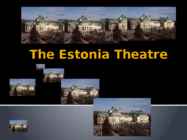
The Estonia Theatre The location Estoniatheatre is situated in the centre of Tallinn. Theatre Estonia winter garden The history The Estonia Theatre is an opera house and concert hall in Tallinn, Estonia. The Jugendstil building was designed by Finnish architects Armas Lindgren and Wivi Lönn. It was built as a national effort with the leadership of Estonia society in 1913 and was opened to the public on 24 August. At the time, it was the largest building in Tallinn. The opera house was heavily damaged in the Soviet air raid on Tallinn on 9 March 1944. It was reconstructed in a classical and Stalinist style, and reopened in 1947. Thebuilding has two large auditoriums in two separate wings. It now houses the Estonian National Opera and the Estonian National Symphony Orchestra. A chamber hall was opened in 2006. Speciality In2003 a new multipurpose chamber hal...
Estonia lies on the eastern shores of the Baltic Sea on the level northwestern part of the rising east European platform. Estonia is a flat country covering 46 226 square kilometers.Estonian's neighbours are Finland, Sweden, Latvia and Russia. Estonia is rich in islands. The two largest are Saaremaa and Hiiumaa . Saaremaa is famous for its big meteorite crater called Kaali and Hiiumaa is famous for its nature and plants. The countries highest point Big Egg hill ( Suur- Munamägi) reaches 318 meters above sea level. Estonia has many uplands too. The uplands are: Pandivere upland, Otepää upland, Vooremaa upland, Karula upland Haanja upland, Sakala upland. Estonia is covered by about 18 000 square kilometers of forest. Estonia is also rich in lakes and rivers The largest lake is Peipsi and the second-largest lake is Võrtsjärv. The largest river is Võhandu whinch is 162 meters long. Estonia has many national parks. A national park is a p...
TALLINN TOWN HALL Britt Viks Haapsalu Gümnaasium 2011 HISTORY Tallinn Town Hall was very important building in the Tallinn Old Town. There were many events like : trading or killings. It was built in 13th century. In the past it was city goverment. It is the only gothic style building in the Northen Europe. NOW Now is the building concert hall and a musem, what is very valued. Every Estonian should know about Christmas in the Tallinn Town Hall. ( There is biggest Christmas Tree in the Estonia ) INTERESTING There is round stone, what put in place all the distances. City Hall Tower, the Old Thomas curious tip of the city of Tallinn is one of the symbols. QUESTIONS What makes it different ? Where is the Tallinn Town (Compared to other buildings Hal...
Tallinn is a small port town in which the population is 371 000 people, and the area is only 159,2 km².( square kilometers). Tallinn, the capital of Estonia, is named after taani linnus, which means Danish castle. The Castle in question was built by King Waldemar of Denmark in the 13th century. The settlement quickly developed itself into a busy port. -The Old Town In medieval age Tallinn was called Reval and it was as big as the Tallinns Old Town is now. Uniqueness of Tallinn is that it is one of very few European cities, where the historical lay-out is kept in it's original form , and has a lot of monuments of that time. Thanks to that in 1997 Old Tallinn has been included in the list of a world heritage of UNESCO. -The Raekoja Square The Raekoja Square is used for senturies like market and fair square, here took place many festivals, and criminals were executed. In summer on Raekoja Square many open air conserts ...
To: Tallinn Tourism Office From: Edgar Rootalu Date: 05.12.2008 Subject: Tourist capabilities in Tallinn Tallinn is a very good city for tourism. It has populatin of 403 547 people to be exact, so its not very crowded and not a hamlet too. There's plenty to do in this historic city. Tallinn really has a long history of its names and flag. There have been many rulers with different nationalities, so there are marks of their architecture too. There are very many positive things connected with that city: · Tallinn has a very special old town that you cannot find in any other countries. It has middle age architecture combined with little modern one. · Kadriorg palace ensemble is beautiful place, especially in Spirng when teh nature is ,,waking up". · Tallinn also has big shopping centres where you can take a cup of good quality coffee in some nice cafes. · Local people are quite helpful, so you can a...
Tallinn The first traces of human settlement found in Tallinn's city center by archeologists are about 5000 years old. In 1050 the first fortress was built on Tallinn Toompea.[3] In 1285 the city became the northernmost member of the Hanseatic League. Medieval Tallinn enjoyed a strategic position at the crossroads of trade between Western and Northern Europe and Russia. On 24 February 1918, the Independence Manifesto was proclaimed in Tallinn, followed by Imperial German occupation and a war of independence with Russia. On 2 February 1920, the Tartu Peace Treaty was signed with Soviet Russia, wherein Russia acknowledged the independence of the Estonian Republic. Tallinn became the capital of an independent Estonia. After World War II started, Estonia was occupied by the Soviet Union (USSR) in 1940, and later occupied by Nazi Germany from 1941–44. After Nazi retreat in 1944, it was occupie...
What Might Attract Tourists to Estonia? What might attract tourists to Estonia? Definately sightseeing. Estonia is a beautiful country and theres alot to see. Tallinn is the most popular place for tourists to visit. Tourists will also like the friendly people of Estonia, and ofcourse they will like the beautiful girls in here too. Tallinn, as the capital of Estonia, has alot of tourist attractions. For instance tourists can take tours in Tallinn or visit the Old town and its colorful shops. In Tallinn tourists can see the beautiful Kadriorg park with its Swan Pond and the Baroque Catharina Palace. Not far from Kardiorg is the Song Festival Grounds. In Pirita they can see the Forest Cemetery, where many important Estonian public figures are buried. Tourist can also visit the ruins of St.Brigitta's Convent in Pirita, Maarjamae Palace, Russalka and the Memorial Monument of Estonia's Shipwreck. Popular places where tourists go are also ...
Estonian cities Tallinn is the capital and largest city of Estonia. It occupies an area of 159.2 square kilometers with a population of 413,000. It is situated on the northern coast of the country, on the banks of the Gulf of Finland, 80 km south of Helsinki, east of Stockholm and west of Saint Petersburg. Tallinn was founded in the 12th century and has been under the rule of Denmark, Sweden, and Germany as well as Russia, and all left their mark on the city's architecture. It is one of the best preserved medieval towns in northern Europe, and makes a beautiful impression from the sea, with its ancient city walls, church spires, and red-tile roofed homes. Tallinn has previously been named as Kolõvan, Lindanise and Reval. Most well-known sights in Tallinn are Freedom Square, Kadriorg Palace, Rotermann Quarter, Tallinn Song Festival Grounds, Toompea Castle and Town Hall Square, the Old Town of Tallinn and many more. Tallinn's Old Town i...
Estland Estland ist ein Staat in Nordeuropa und das nördlichste Land des Baltikums. Es grenzt im Süden an Lettland, im Osten an Russland sowie im Norden und Westen an die Ostsee. Über den Finnischen Meerbusen hinweg bestehen enge Beziehungen zu Finnland und historisch gibt es viele kulturelle Verbindungen nach Deutschland. Der seit 1991 unabhängige Staat ist Mitglied der Vereinten Nationen, seit 2004 der EU. Estland ist zudem Mitglied des Europarats, der NATO sowie der OSZE und seit 2010 der OECD. Tallinn Tallinn ist die Haupt- und größte Stadt von Estland. Es besetzt eine Oberfläche von 159.2 km 2 in denen etwa 400 000Einwohner leben. Der größte See in Tallinn ist See Ülemiste (Abdeckungen 9.6 Kilometer ²). Es ist die Hauptquelle des Tallinns-Trinkwasser. See Harku ist der zweitgrösste See innerhalb der Ränder von Tallinn und sein Bereich ist 1.6 Kilometer ². Anders als viele anderen großen Städte ...
Tallinn Tallinn ist die Haupt- und größte Stadt von Estland. Es besetzt eine Oberfläche von 159.2 km2 in denen etwa 400 000Einwohner leben. Der größte See in Tallinn ist See Ülemiste (Abdeckungen 9.6 Kilometer ²). Es ist die Hauptquelle des Tallinns-Trinkwasser. See Harku ist der zweitgrösste See innerhalb der Ränder von Tallinn und sein Bereich ist 1.6 Kilometer ². Anders als viele anderen großen Städte ist der einzige bedeutende Fluss in Tallinn Pirita Fluss in Pirita. In Tallinn gibt es viele Sehenswürdigkeiten. Die Hauptanziehungskräfte sind in den zwei alten Städten (unterere Stadt und Toompea) die beide sind, die leicht zu Fuß erforscht werden. Östliche Bezirke um Pirita und Kadriorg sind auch wert das Besuchen und das estnische geöffnete Luft-Museum in der Rocca Al Mare, westlich von der Stadt, konserviert Aspekte der estnischen landwirtschaftlichen Kultur und der Architektur. Toompea - o...
Tallinna Lilleküla Gymnasium Legends of Tallinn Referaat Koostaja: Jennifer Scholz Klass: 10B Juhendaja: Liis Olt Tallinna 2010 Table of contents 1. Introduction....................................................... 3 2. Legends of Tallinn............................................... 4 3. Conclusion......................................................... 8 4. References........................................................ 9 2 Introduction I chose this topic beacuse I tought it would be interesting to write. Beacuse of the fact, that I only know a few legends, I decided to read the book ,,Tallinna legendid", and after reading this book I gain much more information. It was interesting to read stories, how Tallinn got its name beac...
Euroacademy Faculty of the international relations Darja Antipina Estonian Business Incubators Essay Tallinn 2012 We can define business incubators as a specially designed programs to maintain successful development of entrepreneurial companies. There are more than 800 business Incubators in Europe and they devise into 2 main groups : 1) Incubators that focused on general business support 2) focused on technological areas. In Estonia exist Incubators in operation and new initiatives are underway. In my essay I allocate those Incubators, which are located in Tallinn. There are: Kopli Business Incubator, Ülemiste Business Incubator, Tallinn Creative Incubator. I focus on two of them : the Ülemiste Business Incubator which is created for technology-based service providers and innovative ...
... Gümnaasium English Project Sights of Estonia Student: .............................. Class: 6 ... Teacher: ............... Harjumaa 2011 1 1. Steamer-icebreaker Suur Tõll The ship was built in 1914 in Stettin (Szczecin) by Vulkan-Werke A. G. Suur Tll is the only pre-war steam ship of the Republic of Estonia remained up to now and, at the same time, the biggest icebreaker in the world preserved through two world wars. All the 3 original steam engines as well as most of the original arrangement of space and late Jugendstil interior of the officers' rooms are preserved. In 1914 the first home port of the ship was Tallinn. The ship ensured a regular winter sea navigation for Tallinn up to the end of the independency period. 2. The Tallinn Song Festival Grounds The Tallinn Song Stage was built in 1959 for arranging the Song Festivals....
Tallinn Lillekyla Gymnasium Report Legends of Tallinn Tallinn 2009 Introduction I chose the topic ,,Legends of Tallinn", because I had heard some splendid myths about Tallinn from my history lessons and I was eager to widen my horizon. I am quite interested in history in general and I especially love tales about medieval Tallinn. I hope that I will find out some entertaining stories to tell my friends. Legends of Tallinn There are many interesting legends about buildings or sights in Tallinn. Nobody can tell, if they are all true or not, but at least they make the medieval capital much more intriguing and attractive for tourists as for the locals. How Ülemiste Elder will drown the town The most known legend of Tallinn is pro...
Tallinn- London Tallinn information: Train operators in Internal trains run by Edelarautee: www.edel.ee, Estonia: www.elektriraudtee.ee Sleeper train Tallinn to Moscow: www.gorail.ee Ferry operators to www.Tallink.ee (Stockholm-Tallinn, Helsinki-Tallinn) Estonia: www.tallinksilja.com/en/ (Rostock-Helsinki-Tallinn) Time: GMT+2 (GMT+3 from last Sunday in March to last Saturday in October) Currency: £1 = approx 16.5 Kroons. Tourist information: www.inyourpocket.com/Estonia/ & http://tourism.tallinn.ee. Hotels in Tallinn: www.hostelbookers.com Visas: UK citizens do not need a visa for Estonia for stays of up to 6 months. London information: Area: ...
Names of town ● Lindanise - it was first used in 1219, derived from mythical Linda, the wife of Kalev and the mother of Kalevipoeg, national hero. ● Koluvan - found in old Russian chronicles, the name possibly deriving from the Estonian mythical hero Kalev ● Reval - used after 1219; comes from two german words ‘reh’ and ‘fall’, meaning the falling of the deer - as they fall down the Toompea hill, probably when escaping from the Danish occupation or just the hunters. ● Tallinn - used after Estonia gained its independence in 1918, origin is definitely estonian; meaning Taani-linn, tali- linn. Liberty Square ● The central square of Tallinn, it was renovated in 2008. There used to be Harju gate, which can now be seen through glass. ● The statue of Liberty, 2009; represents freedom, Estonia has been under many foreign powers, starting with Danes, Sweden, German and Russia. The clock of liberty, 2...
HISTORY The history of rail transport in Estonia starts in 1870 when a line was opened connecting Paldiski, Tallinn, Tapa and Narva; the line extending all the way to St. Petersburg in Russia. The first railway line to be built in Estonia was the Paldiski Tallinn Narva Gatchina line constructed in 1870; Baltic German nobility provided the impetus for the construction of the line, though because of the Russian influence the line was built to 1524mm gauge to connect with the line from St. Petersburg to Warsaw . The construction project was controlled by the Russian Ministry of Roads. The port of Paldiski was chosen because its southerly position made it ice free all the year round. Soon after both Paldiski and Tallinn experienced an upswing in trade, notably exports of grain.In 1877 another line was complete, connecting Tapa and Tartu; later extended to Valga in 1887, which brought ...
 annaabi.ee