Leidsid 33 sarnast õppematerjali, mis on seotud failiga "Enamlevinumad polümeeride algmaterjalid". Need materjalid aitavad sul teemat sügavamalt mõista.
plastic, polümeerid, tselluloos, material, etüleen, nafta, plastid, etaan, petroleum, materials, total, other, atsetaat, gaas, percent, plastics, products, equal, consumption, electricity, structure, straight, polüetüleen, kummid, materjalidest, tootma, toornafta, stüreen, süsinik, eteen, plant, cotton, wood, states, liquid, manufacture, billionIndustry accounts for about one-third of the energy used in the country. There are many different uses and a variety of different energy sources in the manufacturing sector. One main use is as boiler fuel, which means producing heat that is transferred to the boiler vessel to generate steam or hot water. Another use is as process heating, which is when energy is used directly to raise the temperature of products in the manufacturing process; examples are separating components of crude oil in petroleum refining, drying paint in automobile manufacturing, and cooking packaged foods. Picture 2.8. Major end uses of some common energy sources In the manufacturing sector, the predominant energy sources are natural gas and electricity (a secondary source). Manufacturers also use other energy sources for heat, power, and electricity generation. Many uncommon energy sources are also used by manufacturers as a feedstock(a raw material used to make other products).
Tallinn 2013 Ott Speek Subject: English Geodesy Study group: GI-21b PETROLEUM PRESENTATION Petroleum (L. petroleum, from Greek: Πέτρα (rock) + Latin: oleum (oil) is a naturally occurring flammable liquid consisting of a complex mixture of hydrocarbons of various molecular weights and other liquid organic compounds, that are found in geologic formations beneath the Earth's surface. The name Petroleum covers both naturally occurring unprocessed crude oils and petroleum products that are made up of refined crude oil. A fossil fuel, it is formed when large quantities of dead organisms, usually zooplankton and algae, are buried underneath sedimentary rock and undergo intense heat and pressure. Petroleum is recovered mostly through oil drilling. This comes after the studies of structural geology (at the reservoir scale), sedimentary basin analysis, reservoir characterization (mainly in terms of porosity and permeable structures). It is refined and
and even cooling, for homes, businesses, and industry. There are a variety of technologies that have been developed to take advantage of solar energy. These include: Photovoltaic Systems Producing electricity directly from sunlight. Solar cells convert sunlight directly into electricity. Solar cells are often used to power calculators and watches. They are made of semiconducting materials similar to those used in computer chips. When sunlight is absorbed by these materials, the solar energy knocks electrons loose from their atoms, allowing the electrons to flow through the material to produce electricity. This process of converting light (photons) to electricity (voltage) is called the photovoltaic (PV) effect. Solar cells are typically combined into modules that hold about 40 cells; a number of these modules are mounted in PV arrays that can measure up to several meters on a side
However, environmental concerns and increased regulation have led many Canadian mining companies to shift exploration elsewhere. Latin America is becoming a favorite choice for Canadian mining companies. While overall mineral production is dispersed throughout Canada, fuel production is concentrated in the west, with a few major exceptions. Canada is a major exporter of energy and fuels. In 1998, natural gas was the main export with 34.2 percent of total, petroleum was next at 28.6 percent, hydroelectricity at 20.7 percent, coal at 11.4 percent, and atomic energy at 5.1 percent. The United States has traditionally been Canada's largest market for energy exports, purchasing 90 percent of the nation's fuel and energy exports. Energy production accounts for 8 percent of the nation's economy. Approximately 65 percent of energy production is in Alberta, which is also the home of the nation's oil industry. The number-two producer was British
Unintentional production of biogases has been an ongoing issue in many regions of the world, and several nations have also looked to biogas as a potential source of clean energy. India and China have both invested extensively in creative biogas technology to provide fuel for their citizens and there are a number of interesting applications for this gas which appeal to people who are interested in sustainable energy and the health of the environment. The basis for biogas is organic material such as food scraps and feces which are held in an anaerobic area, which can range from a storage tank which is not ventilated to a device which is specifically designed to produce gases. The conditions attract anaerobic bacteria, which start to break down the organic material, producing methane and carbon dioxide as a by-product. Another type of biogas which includes hydrogen, nitrogen, and carbon monoxide can be obtained
blow. Hydropower Power to the Water · By using earth's · 90% energy water cycles and efficient compared running water used to natural gas threw mostly dams being 50% to provide energy. efficient. · Hydropower is · The only problem about 1/3 the cost is, you need water. of using fossil fuels and about 1/6 the cost of natural gas. Biofuels · Using natural I Love you Plants materials to turn into fuel or forms of combustible energy. · Which is mostly plants and plant products Cost Efficient? · A study done by OSU So much for the love.... · Going to biofuels would be like adding a new gas tax. About 25 cents. · And it is not proven to reduce green house gases and may even produce more of them. Geothermal Energy -By using heat from the earth's crust in forms of hot water and steam to power generators for electricity
Margit Tepner k0848752 Sustainability aspects of biofuels 1. Introduction The literature review will discuss the sustainability aspects of biofuels. Food production will be the main concern as it is the most debated issue, but other aspects, such as land use change and water consumption will be also considered as they are essential aspects in the biofuels sustainability criteria. The review will discuss the viability of biofuels based on the current technologies. Second-generation biofuels are not yet commercially viable and therefore will not be discussed; although they could significantly improve the sustainability of biofuels when they break through to the industrial scale. 2. The scale of biofuels production 2.1. Drivers of biofuels production Lal (2010) stated that "three inter-connected challenges face humankind in the 21st century": food security, climate change, and energy security. The world population is projected to reach 9 billion in 205
Natural resources-our treasure Natural resources are land or raw materials like minerals, fluids, gases, organic matters and also woods, groundwater, animals and so on, in other words it's everything that human hasn't created. These resources are also used in industry. We get natural resources from the environment. Many of them are essential for our survival while others are used for satisfying our wants. Renewable resources: Some natural resources can be reproduced within a few years or decades. These are called renewable resources
Alberta is the largest producer of conventional crude oil, synthetic crude, natural gas and gas products in the country. Alberta is the world's 2nd largest exporter of natural gas and the 4th largest producer. Two of the largest producers of petrochemicals in North America are located in central and north central Alberta. In both Red Deer and Edmonton, world class polyethylene and vinyl manufacturers produce products shipped all over the world, and Edmonton's oil refineries provide the raw materials for a large petrochemical industry to the east of Edmonton. The Athabasca Oil Sands (sometimes known as the Athabasca Tar Sands) have estimated unconventional oil reserves approximately equal to the conventional oil reserves of the rest of the world, estimated to be 1.6 trillion barrels. With the development of new extraction methods such as steam assisted gravity drainage, which was developed in Alberta, bitumen and synthetic crude
plants: dry steam, flash, and binary. Geothermal energy is generated in over 20 countries. The United States is the world's largest producer. In Iceland, many of the buildings and even swimming pools are heated with geothermal hot water. Negative aspects of geothermal energy The main concern is the release of hydrogen sulfide, a gas that smells like rotten egg at low concentrations. Another concern is the disposal of some geothermal fluids, which may contain low levels of toxic materials. Although geothermal sites are capable of providing heat for many decades, eventually specific locations may cool down. Biomass energy Biomass is any material that comes from plants or microorganisms that were recently living. Trees, branches, scraps of bark, and recycled paper are common sources of biomass energy. Manure, garbage, and crops such as corn, soy, and sugar cane can also be used as biomass feedstocks. We get energy from biomass by burning it.
For example: a carbon-14 atom (the "parent") emits radiation and transforms to a nitrogen-14 atom (the "daughter"). This is a random process on the atomic level, in that it is impossible to predict when a given atom will decay, but given a large number of similar atoms the decay rate, on average, is predictable. The SI unit of radioactive decay is the becquerel (Bq). One Bq is defined as one transformation (or decay) per second. Since any reasonably-sized sample of radioactive material contains many atoms, a Bq is a tiny measure of activity; amounts on the order of TBq (terabecquerel) or GBq (gigabecquerel) are commonly used. Another unit of radioactivity is the curie, Ci, which was originally defined as the activity of one gram of pure radium, isotope Ra-226. At present it is equal, by definition, to the activity of any radionuclide decaying with a disintegration rate of 3.7 × 10¹⁰ Bq. The use of Ci is presently discouraged by the SI. History of nuclear power
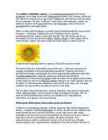
The sunflower head moth is the major insect pest. The moth attacks at flowering time with the larvae feeding on floral parts and tunneling through developing seed. Aphids and whiteflies also can be a problem. Birds can be troublesome near harvest time. Seeds are exposed and the large flower head serves as a feeding perch. To deter birds, use frightening devices and human activity in the immediate area before damage is expected. Flower heads can be covered with plastic netting or cheesecloth. Harvesting Harvest begins in mid-September and can run into October. A check of the flower head will indicate maturity; florets in the center of the flower disk are shriveled, heads are downturned, and a lemon yellow color is on the backside. Pull a few seeds and split them with a knife to check if seed meat has filled. Poorly filled seeds may be due to a lack of pollinating insects.
, Publication Edition first published 2010 © 2010 Blackwell Publishing Blackwell Publishing was acquired by John Wiley & Sons in February 2007. Blackwell’s publishing program has been merged with Wiley’s global Scientific, Technical, and Medical business to form Wiley-Blackwell. Editorial Office 2121 State Avenue, Ames, Iowa 50014-8300, USA For details of our global editorial offices, for customer services, and for information about how to apply for permission to reuse the copyright material in this book, please see our website at www.wiley.com/ wiley-blackwell. Authorization to photocopy items for internal or personal use, or the internal or personal use of specific clients, is granted by Blackwell Publishing, provided that the base fee is paid directly to the Copyright Clearance Center, 222 Rosewood Drive, Danvers, MA 01923. For those organizations that have been granted a photocopy license by CCC, a separate system of payments has been arranged. The fee codes
Current environmental problems make us vulnerable to disasters and tragedies, now and in the future. Unless we address the various issues seriously we are surely doomed for disaster. Current environmental problems require urgent attention. 1. Pollution: Pollution of air, water and soil require millions of years to recoup. Industry and motor vehicle exhaust are the number one pollutants. Heavy metals, nitrates and plastic are toxins responsible for pollution. While water pollution is caused by oil spill, acid rain, urban runoff; air pollution is caused by various gases and toxins released by industries and factories and burning of fossil fuels; soil pollution is majorly caused by industrial waste that deprives soil from essential nutrients. FIND OUT 5 WAYS HOW TO STOP POLLUTION. 2. Global Warming: Climate changes like global warming is the result of human practices like emission of Greenhouse gases
BARRIERS TO DISTRICT HEATING DEVELOPMENT IN SOME EUROPEAN COUNTRIES Abstract District heating (DH) offers low primary energy demand, high security of supply and small CO 2 emissions. Barriers to DH in the UK, Ireland, France, Romania and the Czech Republic have been compiled through publications and interviews. DH systems require large investments, have negative initial cash flow and long payback time, which obstructs financing. One actor should control DH from source to consumption. If the value chain is fragmented, contracts are required between the links. It increases risks and financing costs, like in the UK and Ireland, where DH is not established. There are few multi- family houses with central heating and it is expensive to build DH networks in built areas. Most French DH systems are operated according to long-term concessions by companies that sell electricity and gas. No strong actor provides unbiased DH support. In the Czech Republic, gas
Another big family of native plants is acacias. They are also known as wattles. There are about 900 species of wattles. The golden wattle is Australia's native flower. Its gold flowers and green leaves have inspired the colours worn by many Australian sporting teams. In Australia bushfires are very often to happen. Because the trees and shrubs do not lose their leaves in winter, but grow throughout the year. But when the dry leaves and branches fall down, then there is a lot of dry material and theat helps busfires to burn. Animals Scientists estimate that the continent is home to more that one million animal and plant species. Many of these are found nowhere else on the planet. Among these animals are kangaroos, wombats and koalas. They carry their babies in pouches. There are platypuses and tiny anteaters (echidnas)too, which are the only mammals in the worls that lay eggs. Among the birds are emus, lyrebirds and black swans. When a platypus specimen
Milk cattle, also pigs and poultry are the main farm animals raised in Estonia. Field crops include cereal crops, potatoes and vegetables. Plant products are mostly for internal use, a considerable amount of meat is imported. Some dairy products and some specific products e.g. cultivated and wild berries, mushrooms, ecologically pure produce etc are for export. The forest is among Estonia's most important natural resources and a source of a considerable amount of raw material. Wooden construction details, wooden furniture and wooden houses are being exported. The main export destinations are Finland, Sweden, Germany, Norway and Great Britain. Estonian cellulose and paper industries have a long history, some factories have been in operation since the mid-19th century. Today the raw material comes from local forests as well as from Russia, Latvia and Lithuania. The most important branch among processing industries in Estonia is timber, paper
................................................................................................9 History.............................................................................................................................9 Government...................................................................................................................10 Conclusion....................................................................................................................11 Materials........................................................................................................................11 2 Australia Introduction Australia is the one and only country in the world which fills the whole continent. The continent it fills is called Australia too. So, Australia is both a country and a continent. If
TRADERUN MOODUL TRADERUN MODULE BUSINESS PECULIARITIES IN THE EU, RUSSIA AND EASTERN PARTNERSHIP COUNTRIES ÄRI ERIPÄRAD EUROOPA LIIDUS, VENEMAAL JA IDAPARTNERLUSRIIKIDES Lecturers: Ryhor Nizhnikau (responsible) Giorgi Gaganidze, Sergei Proskura, Andres Assor P2EC.00.202 (UT code), RIE 7044 (TLU code) Reading materials: Business peculiarities in Ukraine and Belarus Lugemismatejal: Äri eripärad Ukrainas ja Valgenenes Created by Andres Assor Tartu 2013 TABLE OF CONTENTS INTRODUCTION ................................................................................................................... 4 1. UKRAINE ......................................................................................................
The revenues of these four companies almost outstripped the revenues of all the 50 Black Africa countries south of the Sahara combined. Let’s take a country like Nigeria for instance. It is the so-called giant of Africa, the leader of the Black world. Nigeria is the seventh largest oil producing country in the world. Nigerians pride themselves as one of the most educated people in the world. It has all kinds of engineers, including petroleum and geological engineers. Oil was discovered in Nigeria in1948. But you know what? Nigeria still imports refined oil at exorbitant rates. It does not have engineers who prospect for the oil; it does not have engineers who drill for the oil; it does not have engineers who refine the oil. It imports the oil. Nigeria has two oil refineries – all built by foreigners. To maintain these refineries they must import the experts (whites) who built the refineries to repair any minor problems
In all cases, absorption appears to be limited to cell layers immediately adjacent to the point of contact. Entry of formaldehyde into the blood (i.e., systemic absorption) occurs to a very limited extent, if at all. ENVIRONMENTAL FATE In reviewing the fate of formaldehyde in the environment, it should be noted that the environmental factors that influence the bioavailability to humans of formaldehyde from contaminated air, water, or plant material have not been studied. Air Formaldehyde is removed from the atmosphere by direct photolysis and oxidation by photochemically produced hydroxyl radicals. Formaldehyde absorbs ultraviolet (UV) radiation at wavelengths of 360 nm and longer; therefore, it is capable of photolyzing in sunlight. A half-life of 6 hours has been measured for photolysis in simulated sunlight. There are two photolytic pathways, one producing H2 and CO, and the other producing H and HCO radicals. When the rates of these
largest economies. Texas' economy is the fourth-largest of any country subdivision globally, behind England, California, and Tokyo Prefecture. Its Per Capita personal income in 2009 was $36,484 ranking 29th in the nation. Texas's large population, abundance of natural resources, thriving cities and leading centers of higher education have contributed to a large and diverse economy. Since oil was discovered, the state's economy has reflected the state of the petroleum industry. In recent times urban centers of the state have increased in size containing two-thirds of the population in 2005. The state's economic growth has led to urban sprawl and its associated symptoms. Energy Ever since the discovery of oil at Spindletop, energy has been a dominant force politically and economically within the state. If Texas were its own country it would be the sixth largest oil producer in the world
provinces are dependent on agriculture and mineral fuels. British Columbia's primary sectors are forestry and mining, as well as tourism. Major Exports: automobile vehicles and parts, machinery and equipment, high- technology products, oil, natural gas, metals, and forest and farm products. Major Imports: machinery and industrial equipment including communications and electronic equipment, vehicles and automobile parts, industrial materials (metal ores, iron and steel, precious metals, chemicals, plastics, cotton, wool and other textiles), along with manufactured products and food. Sports Canada's official national sports are ice hockey and lacrosse. Ice Hockey is the most popular winter sport in Canada and it has one of the best ice hockey team in the world. Lacrosse is the most popular summer sport. Basketball, soccer, curling, baseball and golf are also widely played in Canada. Education
I'll speak about 15min to allow time for questions at the end. Firstly clay bricks are known for centuries as one of the most solid and reliable structural elements is set to play a role in reducing global warming. Apart form the many benefits obtained from using clay bricks in construction, such as their durability, insulation properties and aesthetic qualities, recent findings show that they also produce less carbon emissions than any other masonry material. History (slide 3) In more detail the earliest bricks were dried bricks, meaning they were formed from clay- bearing earth or mud and dried usually in the sun until they were strong enough for use. The oldest discovered bricks, originally made from shaped mud and dating before 10000 BC, were found in Mesopotamia related to the first known cities. Ceramic or fired bricks were first introduced by the Romans. These were mainly flat, broad
............................................................................................................13 5.3 Fusion reaction initiations....................................................................................................14 5.3.1 How inertial confinement fusion should work............................................15 Conclusion.....................................................................................................................................16 Used materials:...............................................................................................................................17 2 Introduction With the advancement of technology ideas that used to be futuristic are nowadays already being researched with impressive headway made. One such research project is the railgun.
Tallinn University Natural and exact sciences Molecular Biochemistry and Ecology Maria Gnidenko Capillary electrophoresis Essay Supervisor: Kert Martma Tallinn 2015 Table of contents Acronyms and symbols used Introduction History and development Physical basis and principle of separation Elektrophoresis Electroosmotic flow Separation process Electrodispersion Various methods of separation Capillary zone�
Soviet Union. After that in the 1960s and 1970s the Americans fought in the Korean and in the Vietnam War, and in the1990s in the Gulf War and now they are fighting in Iraq. Industry The US is extremely rich in natural resources. The western mountains are especially rich in them. The US is among the leading countries in the value of its mineral production. The US is third, after Russia and Saudi Arabia, in the production of petroleum. Mining has been the key of development of the USA. The US has large deposits of coal, iron ore, natural gas, and petroleum, which are vital to the country's industrial strength. Its many other important minerals include copper, gold, lead, silver and zinc. To meet its needs the US must import additional amounts of iron ore, petroleum, and other minerals. Most American industry is located in the eastern and mid-western parts, around the Great Lakes and also on the Pacific coast.
Topic Canada Tallinn English College 2006 1. Introduction If you had to use two words to describe Canada, they might be large and diverse. Canada is the second largest country in the world with a territory of about 10 million square kilometers and it is bordered by three oceans: the Arctic, the Pacific and the Atlantic Oceans. The population of Canada is about 31 million people. About 77% of the people live in cities which lie in a band about 100 miles wide above the border of the United States. The capital of Canada is Ottawa. Other large cities are Montreal, Toronto, Vancouver, Winnipeg and Quebec. 2. Geographical position Canada is a huge country in the continent of North America. It is bordered with the Atlantic Ocean in the east, the Pacific Ocean in the west, the United States of America in the south and the Arctic Ocean in the north. Canada is a vast country, with a territory of 3.8 million square
Offshore natural gas is distributed through high-pressure pipelines and is one of the main natural resources Britain has to offer. It is used by industries which require a fine degree of accuracy, but, because it is easily transportable, it has not created industrial areas the way coal did. Britain is the world's fifth largest oil producer and although production is expected to start declining, Britain should remain an important producer in the 21st century. Other natural resources include: petroleum, paper and paper products, textiles, clothing and other consumer goods. 9. Culture The official literacy rate is 99%, which is normal by developed country standards. Universal state education was introduced for the primary level in the end of the 19 th century and secondary level at the beginning of the 20 th. Education is mandatory from ages five to sixteen. (Except when you are born in late July of August)
exports have grown from US$203 million in 1970 to US$4.8 billion in 2000, while imports have risen from US$360 million in 1970 to US$3.5 billion in 2000. Syria's foreign trade is highly dependent on its oil revenues and oil prices on the international markets. For the year 2000, the EIU reported that increasing oil prices have continued to boost export revenue and Syria recorded a surplus of more than US$1 billion for the first time since the Gulf War. Syria's chief exports are petroleum, textiles, food, live animals, and manufactured goods which are exported to Germany (which received 21 percent of exports in 1999), Italy (12 percent), France (10 percent), Saudi Arabia (9 percent), and Turkey (8 percent). Syria's main import products are machinery, food and live animals, transport equipment, and chemicals. The country's main import partners include France (which purchased 11 percent of imports in 1999), Italy (8 percent),
INTRODUCTION OF SUPPLY CHAIN MANAGEMENT (SCM) A supply chain is a network of facilities and distribution options that performs the functions of procurement of materials, transformation of these materials into intermediate and finished products, and the distribution of these finished products to customers. Supply chains exist in both service and manufacturing organizations, although the complexity of the chain may vary greatly from industry to industry and firm to firm. Supply chain management is typically viewed to lie between fully vertically integrated firms, where the entire material flow is owned by a single
Tallinna Inglise Kolledz Topic United States of America Mari-Liis Pakats Tallinn 2007 2 Introduction..................................................................................................................4 Geographical Position..................................................................................................4 Geographical Regions..................................................................................................5 Climate ........................................................................................................................6 Natural Resources........................................................................................................ 7 History..........................................................................................................................8 Culture................................................................................................
Tallinn English College Topic The United States of America Tallinn 2007 1. Introduction The United States of America's territory is over 3.7 million square miles (over 9.6 million km²) and population more than 300 million people. The capital city is Washington D.C. Although the United States has no official language at the federal level, English is the de facto national language. English is the most common language for daily interaction among both native and non-native speakers. Spanish is the second language. The largest city is the New York City. The Government is Federal constitutional republic and the president is George W. Bush. 2. Geographical position The United States of America is located on the continent of North America. It has borders with two countries Mexico and Canada. There are also the Atlantic Ocean, the Pacific Ocean and the Gulf of Mexico surrounding the big country. There are 50 states in America.
 annaabi.ee