struggle for control over North America started between England and France. For almost a century Canada was caught up in the struggle for power, until in 1763 England finally gained control over almost all of Canada. Gradually the British started to move westward and new provinces and territories appeared. During this settlement process the native Canadians were treated with more respect than the natives of the USA. Canada's real birthdate is July 1, 1867 when the British created the Dominion of Canada under British rule. In 1931 Canada peacefully broke away from direct British rule. In 1965 a new flag with a red maple leaf on a white background was adopted. The name Canada is believed to come from the Huron-Iroquois word Kanata, which means "village" or "settlement". In 1535, locals used the word to tell Jacques Cartier the way to Stadacona, site of present-day Quebec City. Cartier used Canada to refer
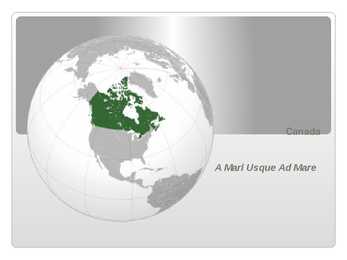
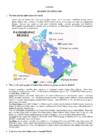
) Population density 3.5 inhabitats per km2 Among the lowest in the world Currency Canadian Dollar (CAD) 2 Official Languages English and French Government system constitutional monarchy and federal parliamentary diplomacy POLITICAL SYSTEM Constitutional monarchy Elizabeth II, Queen of Canada, head of state Governor General appointed by the monarch Parliamentary democracy Similar parliamentary system to other Commonwealth realms Federation "One Dominion under the name of Canada" with the Constitution Act of 1867 GEOGRAPHY Located in North America, north of USA Territory - 9,984,670 km2 World's second largest country CLIMATE Due to large territory, climate varies in greatly ECONOMY One of world's wealthiest nations 1,406,000 GDP 9th in the world About ¾ of Canadians employed in service industry Unusually high importance of primary sector Logging and oil industry two of Canada's most important
In 1608 the first permanent settlement was established, it was called Quebec by Champlain and after that Canada was called New France. During 1689-1763 there was constant fighting and wars between the british and the french. In 1774 the English parliament passed the Quebec Act. It gave the French Canadians complete religious freedom and restored the French form of civil law. The Canada's were merged into a single colony United Province of Canada by the Act of Union in 1840. In 1867 the Dominion of Canada was created - an independent country within the British Empire consisting of 4 provinces: Ontario, New Brunswick, Quebec and Nova Scotia, with the monarch represented in Canada by governor-general Canada took part in WWI because it was under the rule of British empire. Canada also took parti in WWII, because the government made it's own decision. Economy Most of Canada's manufacturing industry is in Ontario and Québec, where motor
Modern humans have inhabited Southern Africa for more than 100,000 years. In 1652 the Dutch East India Company founded a refreshment station at what would become Cape Town. The discovery of diamonds and later gold triggered the conflict known as the Anglo-Boer War, as the Boers and the British fought for the control of the South African mineral wealth. Although the Boers were defeated, the British gave limited independence to South Africa in 1910 as a British dominion. South Africa contains some of the oldest archaeological sites in the world. Flag I flag After the Anglo-Boer War the English people desided to make British Union Flag a national flag of South Africa II flag The second flag was designed in 31 May 1928, because the Dutch founded South Africa and compromise was found with english to make this flag. III flag The new flag was chosen for Nelson Mandela to become president. It was made 31 May 2004. The flags design was made by Frederick Brownell
12. Selgita järgmised mõisted: koloonia - poliitilise ja majandusliku iseseisvuseta maa, mille mingi teine, harilikult sotsiaalselt ja majanduslikult enam arenenud riik on allutanud šovinism - mingi inimgrupi üleolekut pooldav mõtteviis. anti-Semitism - termin, mida kasutatakse tähistamaks vaenulikkust juutide suhtes, mis tuleneb vastumeelsusest nende religioossele, kultuurilisele või etnilisele taustale. dominion - Suurbritannia autonoomne liikmesriik, millel on oma parlament, valitsus, kohtusüsteem ja seadusandlus. urbaniseerumine - linnade arvu ja suuruse kasv, linnaelanikkude osatähtsuse suurenemine maa rahvastikus ja linnalise eluviisi levimine. autonoomia - osaline iseseisvus, mis on antud osale riigi territooriumist, näiteks ühele rahvusele. globaliseerumine - protsess, mida iseloomustavad kasvav rahvusvaheline
Ireland has emerged as an attractive destination for foreign immigrants who now make up approximately 10% of the population. Ireland's population is the fastest growing in Europe with an annual growth rate of 2.5%. Ireland is a member of the EU, the OECD, and the UN. Ireland's policy of neutrality means it is not a member of NATO, although it does contribute to peacekeeping missions sanctioned by the UN. History Ireland is the successor-state to the Dominion called the Irish Free State. That Dominion came into being when all of the island of Ireland seceded from the United Kingdom of Great Britain and Ireland on 6 December 1922. However, the following day the Parliament of Northern Ireland exercised its right under the Anglo-Irish Treaty to opt back into the United Kingdom. This action, known as the Partition of Ireland, followed four attempts to introduce devolved autonomous government over the whole island of
15. Mail 1776. Aastal kuulutas Virginia end iseseisvaks. Yorktownis leidis 1781. A. Aset Ameerika Iseseisvussõja otsustav lahing. Kodusõja ajal (1861-1865) oli Virginia lõunaosariikide konföderatsiooni keskus ja ka peamine lahingutanner. 1863. Aastal eraldus Lääne-Virginia omaette osariigiks. Nimi: Virginia sai oma nime Inglise kuninganna Elizabeth I auks, keda nimetati Virgin Queen'iks 'neitsikuningannaks'. Hüüdnimed: Virginia kõige varasem hüüdnimi on The Old Dominion 'vana dominioon'. 1663. Aastal koondas Inglise kuningas Charles II Virginia väed oma egiidi alla ja liitis koloonia Prantsusmaal, Iirimaal ja Sotimaal asunud dominioonidega. Virginia kohta on sageli kasutatud ja nimetust The Cavalier State nende varaste asunike pärast, kes olid inglismaale lojaalsed ja Mother of States 'osariikide ema' , sest ta oli kõige esimene koloonia. Et ühendriikide varases poliitikas ja diplomaatias domineeris Virginia aristokraatia, on osariik
world. Some facts The land that is now Canada was inhabited for millennia by various groups of Aboriginal peoples beginning in the late 15th century, British and French France ceded nearly all of its colonies in North America in 1763 after the Seven Years' War Historical Background in 1867, with the union of three British North American colonies through Confederation, Canada was formed as a federal dominion of four provinces this began an accretion of provinces and territories and a process of increasing autonomy from the United Kingdom widening autonomy was highlighted by the Statute of Westminster 1931 culminated in the Canada Act 1982, which severed the vestiges of legal dependence on the British parliament Click to edit Master text styles Second level Third level Fourth level Fifth level
English for tourism, English for Art Purposes, etc 4. What is the difference between settlement colonies and the trading empire (dependencies)? Settlement colonies were regions colonized by the UK that later established governments and became dominions and independent. Dependencies were regions in the world that became trading partners and where English became a second language. 5. Which British colonies became dominions? What was their status? Is the name dominion used for these countries nowadays? The first dominions were Canada (1867), Australia (1901), and New Zealand (1907) The name "dominion" is not used anymore. 6. Which organisation unites Britain and most of its former colonies nowadays? The Commonwealth unites Britain with its former colonies. Ireland 1. Who were the early inhabitants of Ireland? Seafarers, fisheremen and hunter-gatherers from mainland Europe arrived around 8000 BC 2. When was Christianity established in Ireland?
Let us then endeavour to find what account he gives us of this fatherly authority, as it lies scattered in the several parts of his writings. And first, as it was vested in Adam, he says,Not only Adam, but the succeeding patriarchs, had, by right of fatherhood, royal authority over their children, p. 12. This lordship which Adam by command had over the whole world, and by right descending from him the patriarchs did enjoy, was as large and ample as the absolute dominion of any monarch, which hath been since the creation, p. 13.Dominion of life and death, making war, and concluding peace, p. 13. Adam and the patriarchs had absolute power of life and death, p. 35. Kings, in the right of parents, succeed to the exercise of supreme jurisdiction, p. 19. As kingly power is by the law of God, so it hath no inferior law to limit it; Adam was lord of all, p. 40. The father of a family governs by no other law, than by his own will, p. 78
; focusing more on people's attitudes, political developments etc; Victorian age was inspired by Elizabethan era; Britain became an empire · What were the most important changes in politics, religion and social life that occurred during the Victorian age? Politics: 1848 Chartist movement (voting right for the working class); women's suffrage movements; feminist outburst (wanted to have business openly; own property, voting etc.); world dominion (British empire); Economy: Industrialization; urbanization (people moved to towns no agriculture & food); laissez- faire economy new type, where government has no control over economy; booming economy- needed new markets and endless supply of raw materials; 1845- potato famine in Ireland, 1846- Corn Laws (import of cheap corn to feed hungry people); Social life: religious doubts (Darwin's The Origin of Species 1859)- question raised: is there a God at all
Trading Empire (dependencies) mainly ESL countries; British people were seen more as a small ruling class (India, Africa) 5. Australia, The USA, Canada, Sri Lanka, India & Pakistan, Irish Free State, Newfoundland, New Zealand, South Africa were the British colonies that became dominions. They were given "responsible government" and became part of the Commonwealth. The Head of State was the British monarch. Nowadays, the word "dominion" is not used. 6. The British Commonwealth of Nations freely unites Britain and its former colonies. Ireland 1. The first inhabitants were hunters and fishers from the European mainland in 6000 BC. In 200 BC, the Celts arrived. 2. Christianity was established during the 5th century by Saint Patrick, who is also Ireland's patron saint. His feast day is on 17th of March, the day he died. 3. The English conquest of Ireland began in the 12th century by Henry II. 4
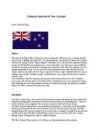
treated with respect. The New Zealand Flag may be flown on any day of the year, usually during normal working hours, and in a variety of places. The New Zealand Flag should never be flown in a bad and unrespectful condition. New Zealand's Coat of Arms History of the New Zealand Coat of Arms Until 1911, New Zealand used the same national coat of arms as the United Kingdom. When New Zealand became a Dominion in 1907, it was decided that a new Coat of Arms was required. The competition was hold in 1908 and 75 designs sent their version. Three entries were sent to England for final judging. The winning entry was a design by James McDonald, a draughtsman in the Department of Tourist and Health Resorts. Although the Royal Warrant of 1911 gave a description of the New Zealand Coat of Arms, by the mid 1940s it was found that there were at least 20 versions of the design in use. A
They become provinces of Ontario and Quebec in 1867. Uniting all the Canadian provinces soon became a necessity. There were five reasons why it was good to unite the provinces: they wanted to be protected from the USA, they wanted to defend themselves against the Fenians, trading would be much easier, they wanted to build a railway from east to west and Britain didn't want to support Canadian provinces anymore likewise Canadian provinces wanted to break away from Britain. 1st July 1867 the Dominion of Canada was formed of Quebec, Ontario, New Brunswick and Nova Scotia. The first Prime Minister of Canada was MacDonald. The railway was finished on 7th November 1885, after five years of building. Provinces Canada consists of five regions: the Pacific Region, the Prairie Provinces, Central Canada, the Atlantic Provinces and the North. The Pacific Region, which is the western part of Canada, consists of one province: British Columbia. It became a province in 1871
In 1840, an agreement was signed between the British Crown and Maori. It established British law in New Zealand. As more and more settlers arrived, conflicts over land led to several wars between the British and Maori in the North Island. The South Island remained rather peaceful until in 1863 gold was found there, and thousands of people hurried to New Zealand to look for gold. New Zealand became a separate colony in 1841. In 1907, New Zealand became an independent Dominion, and a fully independent nation in 1947. British culture dominated New Zealand life throughout the 19th and first half of the 20th centuries. However, since World War II, New Zealand has moved towards its own unique national identity and place in the world. New Zealand is a constitutional monarchy with a parliamentary democracy. Queen Elizabeth II is Queen of New Zealand. In 1893, New Zealand was the first country in the world to give women the right to vote.
2. Inglismaa · Peale I MS laiendati demokraatiat: valimisõiguse laiendamine, piiratud valimisõigus naistele · Liberaalne partei kaotas oma positsiooni Leiboristidele (esindas tööliste huve) -> esialgu võimul lühikest aega; põhilistel kujundasid poliitikat konservatiivid · 1926 esimene üldstreik 4milj töölist streikisid 9 päeva · Iirimaa iseseisvumine ülestõus Iirimaal; vabadusvõitlus inglastega -> 1921 Iirimaa dominion; 1937 kuulutati välja Iirimaa Vabariik · Üritas hoiduda konfliktidest; tihendada sidemeid kolooniate ja dominioonidega · Osad asumaad kuulutati dominioonideks (Kanada, Lõuna-Aafrika, Austraalia) oma seadusandlus, parlament, kohtusüsteem, kuid riigipeaks Inglise kuningas · 1931 Westminsteri statuut dominioonid said sõltumatuks sise- ja välispol · Briti Rahvaste Ühendus üritati kolooniaid hoida oma mõjusfääris
The land occupied by Canada was inhabited for millennia by various groups of Aboriginal people. Beginning in the late 15th century, British and French expeditions explored, and later settled along, the Atlantic coast. France ceded nearly all of its colonies in North America in 1763 after the Seven Years' War. In 1867, with the union of three British North American colonies through Confederation, Canada was formed as a federal dominion of four provinces. It is a bilingual and multicultural country, with both English and French as official languages. Geography: Covering most of the northern part of the North American continent and with an area larger than that of the United States, Canada has an extremely varied topography. In the east, the mountainous maritime provinces have an irregular coastline on the Gulf of St. Lawrence and the Atlantic. The St. Lawrence plain, covering most of southern
The French influence continues to be felt in Canada. The French there were allowed to keep their religion, law system and language. Quebec was then divided into the English and French-speaking colony. Eventually, those colonies became the provinces of Ontario and Quebec. Today, more than five million French-speaking descendants of those settlers live in Quebec. In 1867, four colonies (Ontario, Quebec, New Brunswick, Nova Scotia) were united into the Dominion of Canada. In the following years, the others followed. Only Newfoundland, discovered first by the British, remained independent until 1949. Canada is a democratic country. Political representatives are elected by citizens 18 years old and over. Canada has 3 levels of government: federal, provincial and municipal. The federal representatives are called Members of Parliament or MPs. Provincial representatives are called Members of the Legislative Assembly
ja praktiliseks eetikaks. Teoreetiline eetika jaotab teod ,,heaks" ja ,,halvaks" või ,,õigeks" ja ,,valeks" ehk siis kirjeldav ja normatiivne, praktiline eetika on eetika rakendamine praktiliste probleemide käsitlemisel. Üha rohkem on hakanud meid kõiki ümbritsema arvutimaailm. Juba 1970 a hakati kasutama terminit ,,arvutieetika", mis tähendab rakenduseetika ala ja tegeleb eetiliste küsimustega, mida arvutikasutus endaga kaasa tõi.[1] 1976 aastal tõstatas Walter Maner (Old Dominion University) arvutieetika probleemid oma Meditsiinieetika kursuses öeldes, et" on olemas täiesti uued eetilised probleemid, mida ei oleks olnud ilma arvutiteta". Ta tegi ettepaneku tekitada eraldiseisev rakenduseetika haru nii nagu on meditsiinieetikal või ärieetikal. See haru käsitleks infotehnoloogia poolt tekitatud või mõjutatud eetika probleeme. Üliõpilaste nõudmisel sai sellest eraldiseisev loengukursus.[11] Informatsioonieetika on veidi uuem ja laiem mõiste. 21
From this came the flow of foreigners to New Zealand, first contacts with the Maori people were full of misunderstanding and conflicts. In 1840 the Treaty of Waitangi was signed between the Maori and the British, with what the Maori accepted the British colonization in exchange for the protection of their lands. But still, 20 years later a war between the Maori and white people or pekaha broke out and finally the native people of New Zealand were defeated. New Zealand was given dominion status in the British Empire in 1907 and granted autonomy by Britain in 1931, independence was formally proclaimed 1947. Today the Maori population is increasing faster than the pekaha, and Maori culture has had a major impact on New Zealand's society. The word "aboriginal" means "the first" or "the earliest known". The Aborigines reached Australia more than 40 000 years ago. They are dark-skinned people who probably came from Asia
After the American War of Independence immigrants from Britain began to arrive, among them there were also poor Irishmen and Scotsmen. Indeed, all the Canadians except the Indians and Eskimos, are really immigrants or their descendants. Canada is politically a young country. In 1967 the people celebrated its first century of independence. It was on the first of July, 1967, that four provinces of British North America joined together and formed the Dominion of Canada. Geographical facts. Canada occupies the northern portion of North America. It shares land borders with the United States to the south and with Alaska to the northwest. It shares territorial water boundaries with the United States, Greenland to the northeast, and Saint-Pierre and Miquelon (an overseas community of France) to the southeast. Canada stretches from the Atlantic Ocean in the east to the Pacific Ocean in the west. To the north lies the Arctic Ocean.
This was largely a French country for a century and a half, although New Brunswick and the mainland of Nova Scotia were coded to Britain in 1713. In 1735 a war began between France and England over the fur trade in North America. Since 1759 and on to this day Canada became British. In the middle of the 19th century it seemed practical to unite the colonies into one self- governing country. In 1867 the Dominion of Canada was created - an independent country within the British Empire consisting of 4 provinces: Ontario, New Brunswick, Quebec and Nova Scotia, with the monarch represented in Canada by governor-general. HOW CANADA GOT THE NAME CANADA There have been many theories about the origin of the name Canada but there can be a little doubt that the word is Indian in origin. When Jacques Cartier sailed up the St. Lawrence River in
and Lower Canada, and each entity would then have its own representative government and its own preferred language. Lower Canada in the east, which is the present-day Quebec, and Upper Canada in the west, which is now Ontario. The two parts were separated by the Ottawa River. 13. What is the importance of the British North America Act (1867)? The British North America Act of 1867 (also known as The Constitution Act) was the law passed by the British Parliament creating the Dominion of Canada at Confederation. Three British colonies in North America--Nova Scotia, New Brunswick, and Canada--were united as "one Dominion under the name of Canada". It also divided the province of Canada into the provinces of Quebec and Ontario and provided them with constitutions. The act served as Canada's "constitution" until 1982, when it was renamed the Constitution Act, 1867, and became the basis of Canada's Constitution Act of 1982.
scholars. Philosophers Ibn Sina (Avicenna) and Al-Farabi sought to incorporate Greek principles into Islamic theology, while others like the 11th century theologian Abu Hamid al-Ghazzali argued against them and ultimately prevailed. Sufism became a full-fledged movement that had moved towards mysticism and away from its ascetic roots, while Shi'ism split due to disagreements over the succession of Imams. The spread of the Islamic dominion induced hostility among medieval ecclesiastical Christian authors who saw Islam as an adversary in the light of the large numbers of new Muslim converts. This opposition resulted in polemical treatises which depicted Islam as the religion of the antichrist and of Muslims as libidinous and subhuman. Córdoba, the largest Muslim city of the world in 1000, was home to about half a million people. Public hospitals established during this time, are considered "the first hospitals"
dual party system. The Whigs became the Liberal Party and the Tories became the Conservative Party. *The Glorious Revolution 1688 was the overthrow of King James II of England by a union of Parliamentarians with an invading army led by William of Orange. The Glorious Revolution is also sometimes called the Bloodless Revolution, but it was not completely bloodless. In England there were two significant clashes between the two armies. The revolution led to the collapse of the Dominion of New England and the overthrow of the Maryland's government. James's overthrow began modern English parliamentary democracy: never again would the monarch hold absolute power, and the Bill of Rights became one of the most important documents in the political history of Britain. *The Bill of Rights 1689, the Act of Settlement 1701 Bill of Rights registered the struggle between the Stuart kings and Parliament. It stated that no Roman Catholic would rule England
dissolution a century later in 1031 to no less than 23 small kingdoms, called Taifa kingdoms. The governors of the taifas proclaimed themselves each Emir of his province and established diplomatic relations with the Christian Kingdoms of the north. Most of Portugal fell into the hands of the Taifa of Badajoz of the Aftasid Dynasty, and after a short spell of an ephemera taifa of Lisbon in 1022, fell within the dominion of the Taifa of Seville of the Abbadids poets. The Taifa period ended with the conquest of the Almoravids that came from Morocco in 1086 with a decisive victory in the Battle of Sagrajas followed one century later by the Almohads also coming from Marrakesh in 1147 after the second period of Taifa. Al-Andalus was divided into different districts called Kura. Gharb Al-Andalus at its largest was constituted of ten kuras, each with a distinct capital and governor. The main cities of the
principles into Islamic theology, while others like the 11th century theologian Abu Hamid al Ghazzali argued against them and ultimately prevailed. Finally, Sufism and Shi'ism both underwent major changes in the 9th century. Sufism became a fullfledged movement that had moved towards mysticism and away from its ascetic roots, while Shi'ism split due to disagreements over the succession of Imams. The spread of the Islamic dominion induced hostility among medieval ecclesiastical Christian authors who saw Islam as an adversary in the light of the large numbers of new Muslim converts. This opposition resulted in polemical treatises which depicted Islam as the religion of the antichrist and of Muslims as libidinous and subhuman. In the medieval period, a few Arab philosophers like the poet AlMa'arri adopted a critical approach to Islam, and the
George with the Union Jack in the canton) used by the Royal Navy. The Royal Standard displaying two quarters of three golden lions on red and two quarters, one with the Irish golden harp on blue and the other with the Scottish rampant red lion on yellow, ought to be mentioned as the design is the same as that of the national arms. The Royal Standard is the flag of the head of state and the banner refers to the monarch's arms of dominion (excluding Wales). Its present form has been dated back to the accession of Victoria as Queen of the Kingdom of Great Britain and Ireland, on June 20,1837. (Stilling, 1995) No other flags in British flag history have ever rivalled the Union Jack. The flag began as a distinguishing flag of a ship, as an auxiliary of the principal flag, and evolved into the main flag of Britain and its empire. Today the Union Jack is flown for government and military purposes and, at sea, as the flag of
Established the Commonwealth of Australia with capital in Canberra New Zealand as british colony 18 C captain Cook visited the islands Missionary conquest in 19 C First permanent european settlement in Wellington Maories recognised british sovereignty for guaranteed posession of the land. New Zealand became a separate colony, from Australian Several wars between settlers and Maoris Gold was discovered In 20 C New Zealand was given dominion status, 1947 full independence The British expansion in South Africa In late 15 C Portuguese reached the Cape of Good Hope In 17 C permanent colony, Cape colony, by the Dutch 1814 British annexation was formalized. Slave trade and slavery was abolished by Act of Parliament First Boer republic founded Diamonds and gold found Wars between british and Boers The great Trek and the foundation of the two independent Boer republic
British armies defeated the French in Canada and India. 1783 Britain recognized the USA. 1788 The first British settlers (convicts and soldiers) arrived in Australia. 1801 The Act of Union formed the United Kingdom of Great Britain and Ireland. The separate Irish Parliament was closed. 1921 The ‘Irish Free State’ was given dominion status (it was proclaimed a republic in 1937). Ulster remained within the United Kingdom of Great Britain and Northern Ireland. Appendix 3 Titles of the English (British) Nobility (Титул, употребляемый с именем или фамилией его обладателя, пишется с заглавной буквы) 1. nobleman 1. дворянин
7 B #295 Korea Electric Power South Korea $169.8 B #296 Johnson Controls International Ireland $50 B #296 Saint-Gobain France $51.5 B #298 Mitsubishi Electric Japan $40.1 B #299 CaixaBank Spain $472.8 B #300 Baidu China $42.8 B #300 Ecopetrol Colombia $42.5 B #302 Dominion Resources United States $77.4 B #303 Fubon Financial Taiwan $232.1 B #304 Nippon Steel & Sumitomo MetalJapan $71.4 B #305 Northrop Grumman United States $34.8 B #306 Humana United States $33.5 B #307 Nomura Japan $381.7 B #308 Merck Germany $43.3 B #309 Standard Chartered United Kingdom $663.5 B
TN Volunteer State Texas 20,851,820 2nd Austin Houston TEX. TX Lone Star State Utah 2,233,169 34th Salt Lake City Salt Lake City (none) UT Beehive State Vermont 608,827 49th Montpelier Burlington VT. VT Gree n Mountain State Virginia 7,078,515 12th Richmond Virginia Beach VA. VA Old Dominion Washington 5,894,121 15th Olympia Seattle WASH . WA Evergreen State West Virginia 1,808,344 37th Charleston Charleston W.VA. WV Mounta in State Wisconsin 5,363,675 18th Madison Milwaukee WIS . WI Badger State Wyoming 493,782 50th Cheyenne Cheyenne WYO. WY Equality State
rate. On November 21, 1941, a Japanese diplomatic solution was given number 097975; on December 12, another Japanese diplomatic solution was numbered 098846;— indicating almost 300 solutions a week at that time (not Japanese alone, of course). A typical distribution of these solutions would send three copies each to the director of the department, the Foreign Office, and the War Office, two to the India Office, and one each to the Admiralty, the Air Ministry, the Colonial Office, the Dominion Office, M.I. 5 (counterintelligence), and Sir Edward Bridges, secretary to the Cabinet. The appearance of Bridges' name on the list suggests that some of the British intercepts may have been read aloud at Cabinet meetings. In addition, Churchill, on August 5, 1940, ordered that a daily selection of original intelligence documents be submitted to him personally "in their original form," which almost certainly included intercepts. Much of the cryptanalytic output must
 annaabi.ee