Leidsid 33 sarnast õppematerjali, mis on seotud failiga "Different types of forests and their forms of usage.". Need materjalid aitavad sul teemat sügavamalt mõista.
forest, forests, tropical, these, rainforestod, land, plant, animal, north, season, trees, subtropical, found, products, northern, types, ample, asia, include, east, crops, farm, different, planet, seasonal, known, broad, species, regions, there, areas, light, fall, those, done, density, cover, approximately, responsible, leave, mostly, africa, south2. Where is prairie, pampas, steppe, and veldt situated? EurasiaSteppe, North America-Prairie, South AmericaPampa, South AfricaVeldt 3. Using the climate diagram describe the climate of the region. Temperate deciduous forest -Well-defined seasons with a distinct winter characterize this forest biome. Moderate climate and a growing season of 140-200 days during 4-6 frost-free months distinguish temperate forests. Temperature varies from -15° C to 25° C. Precipitation (750-1500 mm) is distributed evenly throughout the year. Temperate grassland- Semiarid, continental climates of the middle latitudes typically have between 25 cm and 50 cm of precipitation a year. Much of this falls as snow, serving as reservoir of moisture for the beginning of the growing season. Warm to hot summers are experienced, depending on latitude. In the winter, grassland temperatures can be as low as
1. Key features for all studied biomes. Tundra The main seasons are winter and summer. The tundra is the world's coldest and driest biomes. The average annual temperature is -28° C. Nights can last for weeks when the sun barely rises during some months in the winter, and the temperature can drop to -70° C. During the summer the sun shines almost 24 hours a day. Summer are usually warm. Average summer temperatures range from 3° to 16°C. TaigaTaiga is the Russian word for forest and is the largest biome in the world. It stretches over Eurasia and North America. The taiga is located near the top of the world, just below the tundra biome. The winters in the taiga are very cold with only snowfall. The summers are warm, rainy, and humid. Some of the animals in the taiga hibernate in the winter, some fly south if they can, while some just cooperate with the environment. GrasslandsGrassland biomes can be found in the middle latitudes
TARTU VEERIKU KOOL New Guinea animals and plants Koostaja: Tauri-Viljar Vahesaar Juhendaja: Priit Pensa Tartu 2009 Table of content Introduction................................................................................................................................................3 The forests of New Guinea .......................................................................................................................5 The problem with trading wildlife.....................................................................................................6 Animals of the lowlands....................................................................................................................8 Reptiles...................................................................
Savanna A savanna is a grassland ecosystem with scattered trees or shrubs. In savannas trees are small or widely spaced so that the canopy does not close. It is often believed that savannas are characterized by widely spaced, scattered trees, however in many savanna communities tree densities are higher and trees are more regularly spaced than in forest communities. The open canopy allows sufficient light to reach the ground to support an unbroken herbaceous layer consisting primarily of C4 grasses. Savannas are also characterised by seasonal water availability, with the majority of rainfall being confined to one season of the year. Savannas can be associated with several types of biomes. Savannas are frequently seen as a transitional zone, occurring between forest and desert or prairie.
Temperate deciduous forests, woodlands and shrub Tartu 2008 Location: Temperate forests are typical of all European continent, the Eastern region of Asia (in special, Chinese and Japan) and North America. Also are finded in tempered areas of South America. Climate: The average temperature in temperate forests is 50° F. Summers are mild, and average about 70° F, while winter temperatures are often well blow freezing. The average yearly precipitation is 30-60 inches. This precipitation falls throughout the year, but in the winter it falls as snow. There are four seasons in this biome, with warm summers and cold winters, often snowy. In autumn, the leaves change color and fall from the trees. The leaves decay on the forest floor, so the soil is very rich.
Palm oil Palm oil is a type of edible vegetable oil that is derived from the palm fruit, grown on the African oil palm tree. Oil palms are originally from Western Africa, but can flourish wherever heat and rainfall are abundant. Today, palm oil is grown throughout Africa, Asia, North America, and South America, with 85% of all palm oil globally produced and exported from Indonesia and Malaysia; but most of the time not using sustainable measures. The industry is linked to major issues such as deforestation, habitat degradation, climate change, animal cruelty and indigenous rights abuses in the countries where it is produced, as the land and forests must be cleared for the development of the oil palm plantations. According to the World Wildlife Fund, an
http://www.bbc.co.uk/nature/programmes/tv/jungle/vjungle.shtml Virtual Jungle worksheet I 1. Structure 1.1. Describe these layers Emergents The canopy trees are tall, but some species grow even taller until they stick right out above the canopy. These are called 'emergents' and can reach almost 90m in height. Up here they don't have to compete with other trees for light, but they are exposed to the high winds that lash the canopy during tropical storms. Emergents are the favourite nest sites of jungle eagles such as the harpy eagle of South America. Canopy Suspended 40m above the ground is the canopy - a belt of tree crowns supported by enormous rainforest tree trunks
It is impossible to capture on film, to describe in words, or to explain to those who have never had the awe-inspiring experience of standing in the heart of a primary rainforest. Rainforests have evolved over millions of years to turn into the incredibly complex environments they are today. Rainforests represent a store of living and breathing renewable natural resources that for eons, by virtue of their richness in both animal and plant species, have contributed a wealth of resources for the survival and well-being of humankind. These resources have included basic food supplies, clothing, shelter, fuel, spices, industrial raw materials, and medicine for all those who have lived in the majesty of the forest. However, the inner dynamics of a tropical rainforest is an intricate and fragile system. Everything is so interdependent that upsetting one part can lead to unknown damage or even destruction of the whole
Topic Australia Tallinn English College 2006 Australia 1 . Introduction The name Australia is derived from the Latin Australis, meaning of the south. In land area, Australia is the sixth largest nation, its territory is 7,686,850 sq km and its population reaches today over 20,5 million people. It is the only nation to govern an entire continent and its outlying islands. Australia's capital is Canberra, the only city with its own territory. It was built in the early 1900s just to be the capital. The official language is English and the official name of Australia is the Commonwealth of Australia.
Palm oil Kristiina Pällo LU1 EMÜ 2016 • Edible vegetable oil that is derived from the palm fruit • Oil palm trees are grown in tropical areas • Widely used in food industry due to its semi-solid state in room temperature and long shelf-life • It is in a lot of everyday products – makeup, shampoo, soap, biodiesel. Also in food – sweet treats (chocolate, biscuits etc), margarine, nut butters, crisps. The Two kinds of palm oil • Palm oil comes from palm fruit. It is rich in vitamin E and it has a red colour due to beta-caroten in it. High in saturated fats. Used mostly in food industry
Senators are elected for six year terms. The Executive power in Australia is in the hands of the Commonwealth Government lead by the Prime Minister. Today the Prime Minister is John Howard, the leader of the Liberal Party. History Australia was once a part of the giant continent Gondwana. It included Africa, South America and Antarctica. First Australia and Antarctica split from Gondwana, then Australia broke away from Antarctica and began to move north. Aborigines arrived there about 50 000 years ago. They had occupied the whole continent by 30 000 years ago. At that time Tasmania was still part of the mainland. About 20 000 years ago the ice began to melt and the rising water level cut Tasmania off from the mainland. Traders from what is now Indonesia are thought to have been visiting Australia well before the 17th century. Chinese, Malaysian and Arab sea
Topic Australia Introduction Many people know Australia as the land down under because it is the only continent except for Antarctica that is all on the southern hemisphere. Its name means ,,Southland". The official name of the country is the Commonwealth of Australia. It's capital is Canberra. Australia is the sixth largest country in the world but the smallest continent. Australia has 6 states and 2 territories (New South Wales, Victoria, Tasmania, Queensland, Western Australia , South Australia, The Australian Capital Territory and the Northern Territory).
and it is bordered by three oceans: the Arctic, the Pacific and the Atlantic Oceans. The population of Canada is about 31 million people. About 77% of the people live in cities which lie in a band about 100 miles wide above the border of the United States. The capital of Canada is Ottawa. Other large cities are Montreal, Toronto, Vancouver, Winnipeg and Quebec. 2. Geographical position Canada is a huge country in the continent of North America. It is bordered with the Atlantic Ocean in the east, the Pacific Ocean in the west, the United States of America in the south and the Arctic Ocean in the north. Canada is a vast country, with a territory of 3.8 million square miles of land and fresh water it is the second biggest country in the world after Russia. Canada covers most of the northern part of North America. Canada has over 151,480 miles of coastline
Forestry Importance: · Environmental-protective importance Oxygen Cleans the air/soils/ground water Protects the soil from erosion · Timber Firewood Woodwork Building materials Timber cellulose paper · Mushrooms/berries/juices · Habitat of different species Measuring the amount of forest: · Fixing the area under the forests (ha/%) -> In Estonia 47.4%, 2.143 mil/ha It doesn't take into account the amount of timber · To measure the amount of timber (m3) -> 352.7 mil/m3 It doesn't take into account the annual increase · To fix different species of trees (%) -> Pine 40%, Birch 30%, Spruce 20% · To measure the annual increase of timber (m3, ha, year) -> 9 mil. m3/ha/year Main principle of the economy of forests: Annual cutting should be equal to annual increase. Trees are divided into:
Some scientists still do not think that the effects of global warming are as severe as some people say. They think that droughts, hurricanes, and floods often blamed on global warming might actually have other causes. One major difficulty in studying global warming is the fact that weather data only exists for the last century and a half. As a result, understanding the present and predicting the future are very difficult. Rain forest destruction The atmosphere and oceans are not the only parts of the environment being damaged. Rain forests are being quickly destroyed as well, and their survival is questionable. E.O. Wilson, a biologist at Harvard, called the depletion of rain forest areas "the greatest extinction since the end of the age of dinosaurs." Unlike some environmental issues, rain forest depletion has fortunately received significant public and media attention.
written in 1814 by Francis Scott Key. There are 6 time zones. From east to west they are: Eastern Standard Time, which is 5 hours behind Greenwich Time, Central Standard Time, Mountain Standard Time, which is 7 hours behind Greenwich Time, Pacific Standard Time. Alaska and Hawaii have their own time zones: Alaska Standard Time and Hawaii Standard Time. Geographical Position The USA lies in the Northern Hemisphere in North America. It covers a big part of the continent and is also the third largest country in the world. The country consists of 50 states, but two of them lie separately. One of them is Alaska, which is near the Arctic Circle. And the other state is Hawaii, which is a group of island is the Pacific Ocean. The USA shares the border with Canada in the north and Mexico in the south. In the east the coast is washed by the Atlantic Ocean and in the west by the Pacific Ocean
Tallinn English College Report of Canada 8a Teacher: Merike Sisask Composer: Kärt Kalvet 2010 Canada, Kärt Kalvet 8a Canada General Information Canada is in North America. It's area is 9220970 sq km. Canada's population is 313.612.000 people. Canada is divided into 10 provinces and 3 territories. The capital of Canada is Ottawa. Canada has constitutional monarchy. The head of state in Canada's government is the Queen of England. There are two main languages in Canada: English and French. Canada's curreny is Canadian dollar (1 dollar=100 cents[Can$]). The highest peak of Canada is Mount Logan, 5959 metres. The lowest point is sea level
Australia Australia is surrounded by the Indian and Pacific oceans, it is separated from Asia by the Arafura and Timor seas. Australia presents an enormous range of climatic conditions, since it covers thirty degrees of latitude. It is mostly temperate, but one third of the continent is tropical, and there are large desert areas. The two largest cities are Sydney and Melbourne. The capital of Australia is Canberra. It is a small city and was built in the early 1900s. History. Two hundred years ago there were no white people in Australia. The only inhabitants were dark-skinned people who were still living in a Stone Age. Their only weapons were stone knives and boomerangs. But their tribes had very well-worked- out customs
still exists in different forms, by the Roman invasion begun in 43. AD. The Romans ruled Britain for over two hundred years and left behind three things of importance: their roads, the sights of important cities notably London, and the seeds of Christianity. The Latin way of life villas, arts, language and political organization all vanished, however after the invasions from Northern Europe by the Anglo-Saxons and Jutes from the 5th century onwards. These pagan peoples' were easily converted to Christianity and the preachers from Rome brought with them learning and civilization. Christianity was an important factor in enabling the various kingdoms created by the Nordic invaders to be united in the 9th century. The Vikings first raided England to plunder it, then in the days of Alfred of Wessex. They began to win wide lands `to plow and rule'. In the 10 th century England fell under
Australia Fact file: Australia comprises a land area of 7 686 850 square kilometres. Its population is about 21,3 million people. Australia's capital is Canberra. The national language is English. The official name of it is the Commonwealth of Australia. It's divided into six states and two territories: New South Wales, Queensland, South Australia, Western Australia, Tasmania, Victoria, Australian Capital Territory (ACT) and Northern Territory. Symbols:
Natural Zones and Flora. There are five distinguishable natural zones in Australia. In the very east there are wet forests (1.) that occupy the space between the Great Dividing Range and the eastern coast. Westward from the Great Dividing Range the wet forests give place to beautiful grasslands with some trees . These grasslands are called the savannas (2.). Farther west the trees disappear and the bushlands (3.) begin. The real desert (4.) occupies the centre of the Western Plateau. In the very southwest there are thin forests of evergreen trees (5.). Most of Australian trees are kinds of eucalyptus trees (or gum trees to Australians) and acacia ( wattle to Australians). Eucalyptus trees are found everywhere in Australia. There are many kinds of them and they greatly differ in size. One kind, the
cultural diversity of different nations in Canada. All the communities living in the country are encouraged to remember their origins and hold their own ethnic events and national festivals. Cultural diversity makes Canada even more interesting. In spite of this, in recent years there is a strong movement in French-speaking Quebec to become an independent country. There are many different native people throughout Canada like the Crees, Mohawks, Troquois and Sioux. In the north of the country, the Inuit (Eskimos) now have a self-governing homeland called Nunavut, meaning our land. It is over two million square kilometers and it is inhabited by 17,500 Inuits. The national symbol of Canada is the maple leaf. The national tree is the maple. Canada is also the most tolerant societies in the world because only 13% of Canadians say that they would object their children marrying somebody of a different race, compared with 32% in the USA.
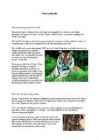
Researchers have confirmed that a wild tiger, photographed by a farmer in the Qinba Mountains of Shaanxi Province, Central China, is indeed that of the critically endangered South China tiger. The South China tiger classified as one of only five subspecies of tiger still alive today is extremely rare, with only an estimated 20 to 30 still remaining in the wild. The wildlife and conservation group WWF says the South China tiger is actually native to the Hainan most forests of south-east China, and because there are so few individuals left, it is regarded by many scientists as being "functionally extinct" in the wild. But a group called Save China's Tigers has been working on a captive- breeding programme and hopes to reach an agreement with China's State Forestry Administration to reintroduce captive-bred animals into the wild. If all goes well, the first individuals could be reintroduced to coincide with the Beijing Olympic Games in 2008.
.............................................................................................5 Relief............................................................................................................................6 Climate ........................................................................................................................7 Plants............................................................................................................................7 Animal life................................................................................................................... 7 Natural Resources........................................................................................................ 8 Economy...................................................................................................................... 8 Population and Ethnicity.............................................................................................
1. Loopealsed 2. Nõmmemetsad 3. Palumetsad 4. Laanemetsad 5. Salumetsad 6. Soovikumetsad 7. Rabastuvad metsad 8. Rohusoometsad 9. Samblasoometsad 10. Kõdusoometsad ALVAR FORESTS LOOPEALSED METSAD This groupof types includes forests of low productivity and with a peculiar xeromesophilous ground vegetation, which grow on a layer of limestone, gravel, grit or shingle. See metsa kasvukohatüüp sisaldab madala tootlikkuse ja iseloomulikult suure või keskmise kuivusnõudlikkusega alustaimestikku, mis kasvab pae-, kruusa- , peenkruusa või klibukihil. This layer is close to surface, with thickness of soil up to 30 centimetres. See rinne on maapinnale lähemal, mullatüsedus on kuni 30 sentimeetrit.
Võnnu Keskkool ESTONIA Referaat Autor: Klass : 9 Juhendaja: Võnnu 2013 Estonia officially the Republic of Estonia, is a state in the Baltic region of Northern Europe It is bordered to the north by the Gulf of Finland, to the west by the Baltic Sea, to the south by Latvia and to the east by Lake Peipus and Russia.Across the Baltic Sealies Sweden in the west and Finland in the north. The territory of Estonia covers 45,227km2 The Estonian climate resembles that of other countries on the Baltic littoral. On account of the country's proximity to the sea, the skies are often cloudy, and rain often falls in the spring and autumn, in the winter the rain turns to snow. The highest point in Estonia is Suur Munamäg It is in fact the highest point in the Baltic region Forest cover over one half of Estonia. The most common types of tree are pine, spruce and birch
Barrier Reef is the world's largest coral reef. It lies off the north-eastern coast and extends for over 2000 kilometres. The famous mountain range in the eastern part of Australia is the Great Diving Range and it's highest peak is Mount Kasciusco's 2230m. In the continental part, there are the Macdonnell ranges. Other smaller mountain ranges are the Musgrave Mountains, the Hammessley Mountains and the Darling Mountains. The continental part of Australia is mostly covered with deserts and these deserts are the Great Sandy Desert in the north-western part, the Great Victoria dessert in the southern part and Gibson desert and the Simpson desert. The Murray River is the largest river of the country and it is 2,375 kilometres long, it rises in the Australian Alps and flows to the south-west. The waters of Murray flow through several lakes, such as Lake Alexandrina and The Coorong. Other Lakes are L.Eyre
6 million square kilometres big. It is often called the island continent because it is rather small for a continent and very big for an island. There are only five countries bigger than Australia in the World. There are five states in the mainland. Tasmania is also considered as a state so there are six states. The Northern Territory and Canberra are also independent but they are not states. Canberra is the capital of Australia and it is situated between Sydney and Melbourne because both of these cities wanted to be the capital. The population is about 19 million people and growing. New South Wales is the most populated state and Victoria is the most densely populated state. The national language is English. It is English because British settlers came to live in Australia in the past and they brought convicts with them who were also British. Symbols. The Australian Flag came into being after the federation of the
The currency used in Estonia is Eesti kroon. The Estonian national flag is blue-black-white. It was originally the flag of the Estonian Students' Society. The flag was first consecrated in Otepää Church in 1884. For a while, during the Soviet occupation, the flag was banned but it was again seen in public in Tartu in May 1988. The national flower is cornflower, the national bird is barn swallow and the national stone is limestone. The Estonian national anthem called "My Native Land, My Pride and Joy" was composed in 1848 by Friedrich Pacius. The Estonian language words were written by J. V. Jannsen. It was officially adopted after the War of Independence in 1920.The same melody with different words is also Finland's national anthem. The current coat of arms of Estonia is a golden shield which includes three slim, blue leopards (or lions) in the middle, with oak branches along the side of the shield. It originates from Denmark. It was officially adopted in 1925.
If you want to make clear that you are speaking about the country, you may call it the Commonwealth of Australia. It’s the official name of the country. Australia is the smallest continent, but one of the largest countries on Earth. It’s 6th largest country. Its area is about 7.6 million sq km. One third of it is occupied by deserts. It’s both the flattest and, except for Antarctica the driest. Neighbouring countries include Indonesia, East Timor and Papua New Guinea in the north, the Solomon Islands, Vanuatu in the northeast, and New Zealand in the southeast. Its capital is Canberra. Other big cities are Melbourne, Sydney, and Brisbane. National language in Australia is English. Monetary unit is Australian dollar. Their national holiday is on the 26th of January. In 1788 on the 26th of January the first fleet arrived at Botany Bay and established a penal colony near modern-day Sydney. Geographical Position Australia is located in the Southern Hemisphere. It’s the
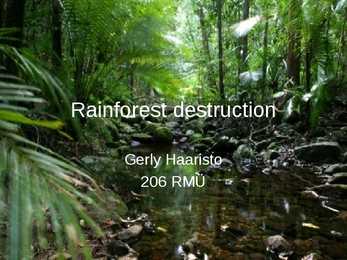
Rainforest destruction Gerly Haaristo 206 RMÜ The Disappearing Rainforests Kaduvad Vihmametsad · Rainforests once covered 14% of the earth's land surface; now they cover a mere 6% and experts estimate that the last remaining rainforests could be consumed in less than 40 years. · Vihmametsad katsid kunagi 14% maapinnast, praegu katavad nad ainult 6% ja eksperdid arvavad et viimased alles olevad vihmametsad nö. tarvitatakse ära vähema kui 40 aasta pärast. Causes of rainforest destruction Vihmametsa hävitus põhjused. · Logging · Agriculture · Fuelwood- küttepuud
6. Towns, economy, agriculture 7. Climate 8. Animals, plantlife 9. Population 10. Sports 11. Culture 12. History 13. Political system, symbols 14. Conclusion 15. Materials 1. Introduction If you had to use two words to describe Canada, they might be large and diverse. Canada is the second largest country in the world, bordered by three oceans, and across the country, Canadians experience many different landscapes from rolling plains and mountains to the cold tundra of the north. Despite Canada's great size, it is one of the world's most sparsely populated countries. This fact, coupled with the grandeur of the landscape, has been central to the sense of Canadian national identity. 2. Geographical position Canada is the second largest country in the world after Russia. In the Arctic, Canada reaches almost as far north as Greenland. To the south it extends to the same latitude as southern France. The distance from Canada's west coast, the Pacific Ocean, to its
Forestry and the Forest Industry in Japan Today I'm going to do a presentation about a book called ,,Forestry and the Forest Industry in Japan", edited by Yoshiya Iwai. --------------------- Participants in private forestry are classified into six categories: forestry households; companies; shrines and temples; joint holdings; various groups and cooperatives; and habitual joint holdings. Except for shrines and temples, these groups manage forests to produce income. In general, these forests are not very large: the average forest area per establishment was 3.7 ha in 1990. Groups operating forests of less than 100 ha control 67% of the total area. Hence forests are not necessarily owned by a few large concerns. Private ownership of forestland was officially permitted after the Meiji restoration of 1868, which marked the end of feudalism. Previously, forestland was legally owned collectively for the use of local communities
 annaabi.ee