Vajad kellegagi rääkida?
Küsi julgelt abi LasteAbi
Logi sisse

Different types of forests and their forms of usage. (0)

1 Hindamata
Punktid
Different types of forests and
their forms of usage
TARTU 2010
Forest
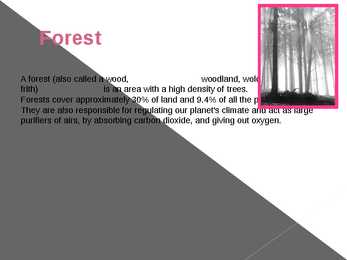
A forest (also called a wood, woodland, wold, weald, holt,
frith) is an area with a high density of trees.
Forests cover approximately 30% of land and 9.4% of all the planet earth.
They are also responsible for regulating our planet's climate and act as large
purifiers of airs, by absorbing carbon dioxide, and giving out oxygen.
Different types of forests
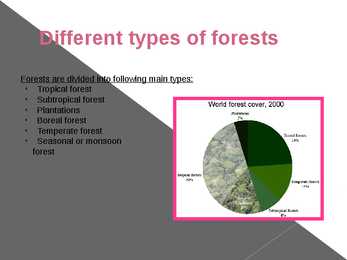
Forests are divided into following main types:
o
Tropical forest
o
Subtropical forest
o
Plantations
o
Boreal forest
o
Temperate forest
o
Seasonal or monsoon
forest
Tropical and Subtropical
Forests
Tropical and subtropical forests, also known as
rainforests or tropical rainforests, are lavish and
ample forests with broad leave tree.
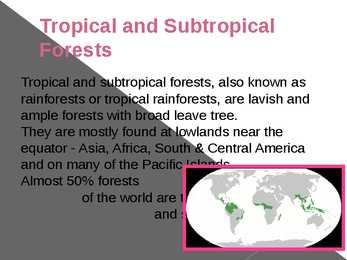
They are mostly found at lowlands near the
equator - Asia, Africa, South & Central America
and on many of the Pacific Islands.
Almost 50% forests
of the world are tropical
and subtropical in nature.
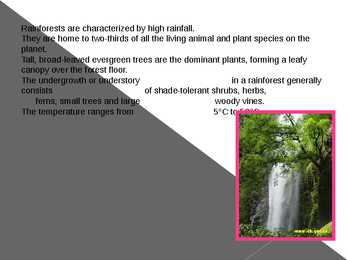
Rainforests are characterized by high rainfall.
They are home to two-thirds of all the living animal and plant species on the
planet.
Tall, broad-leaved evergreen trees are the dominant plants, forming a leafy
canopy over the forest floor.
The undergrowth or understory in a rainforest generally
consists of shade-tolerant shrubs, herbs,
ferns, small trees and large woody vines.
The temperature ranges from 5°C to 50°C.
Human uses of tropical and subtropical forests:
o Habitation - Humans have and do exploit rainforests for
food and shelter in several parts of the world.
o Cultivated foods and spices - Coffee, chocolate, bananas
etc. all originally came from tropical rainforests, and are still
mostly grown in regions that were formerly primary forest.
o Pharmaceutical and biodiversity resource - Tropical
rainforests are called the 'world's largest "pharmacy"'
because of the large amount of natural "medicines" there.
o Tourism - People travel both nationally and internationally to
experience rainforests firsthand.
o Animal products - Rainforests provide numerous animal
products including honey, game meat, hides and ivory.
o Ecosystem services - Rainforests play an important role in
maintaining biological diversity, modulating precipitation
infiltration and flooding, increasing scientific knowledge and
in the spiritual well-being of humans.
Boreal forests
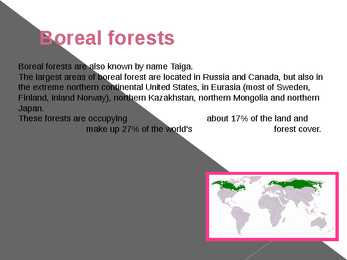
Boreal forests are also known by name Taiga.
The largest areas of boreal forest are located in Russia and Canada, but also in
the extreme northern continental United States, in Eurasia (most of Sweden,
Finland, inland Norway), northern Kazakhstan, northern Mongolia and northern
Japan.
These forests are occupying about 17% of the land and
make up 27% of the world's forest cover.
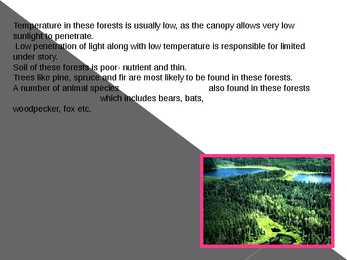
Temperature in these forests is usually low, as the canopy allows very low
sunlight to penetrate.
Low penetration of light along with low temperature is responsible for limited
under story.
Soil of these forests is poor- nutrient and thin.
Trees like pine, spruce and fir are most likely to be found in these forests.
A number of animal species also found in these forests
which includes bears, bats,
woodpecker, fox etc.
Human uses of boreal forests:
o
Wood products - One of the most important human uses of these forests
­ for example wood for house construction and paper pulp.
o
Animal products - Most valuable animal products of the cold forests and
mountains are animal pelts for clothing and beaver for hats.
o
Grazing & agriculture - Upland forests are often cleared for grazing and
lowland forests for agriculture.
o
Habitation ­ Population is not dense, but many people live there.
Temperate forests
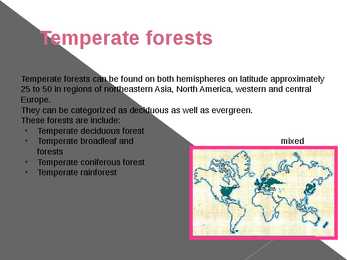
Temperate forests can be found on both hemispheres on latitude approximately
25 to 50 in regions of northeastern Asia, North America, western and central
Europe.
They can be categorized as deciduous as well as evergreen.
These forests are include:
o
Temperate deciduous forest
o
Temperate broadleaf and mixed
forests
o
Temperate coniferous forest
o
Temperate rainforest
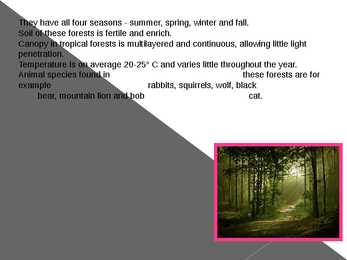
They have all four seasons - summer, spring, winter and fall.
Soil of these forests is fertile and enrich.
Canopy in tropical forests is multilayered and continuous, allowing little light
penetration.
Temperature is on average 20-25° C and varies little throughout the year.
Animal species found in these forests are for
example rabbits, squirrels, wolf, black
bear, mountain lion and bob cat.
Human uses of temperate forests:
o
Habitation - Population density very closely corresponds to the distribution
of Temperate Forests. Many forests have been cleared to build
communities.
o
Wood products - We use the wood of these trees for construction,
firewood and art.
o
Farming ­ Many areas of temperate forests have been cleared for farms.
Seasonal/Monsoon Forests
These forests are also known as dry forests.
Forests of this type can be found in Southeast Asia, West and East Africa,
eastern Brazil and northern Australia.
These forests go through two extreme seasons; the season of heavy rainfall
and a long season of complete dryness.
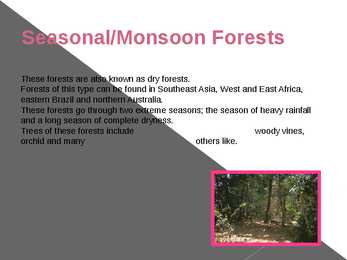
Trees of these forests include woody vines,
orchid and many others like.
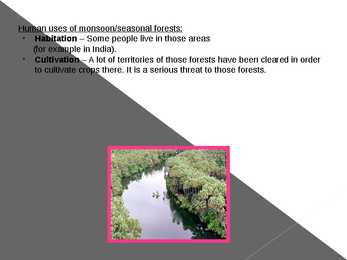
Human uses of monsoon/seasonal forests:
o
Habitation ­ Some people live in those areas
(for example in India).
o
Cultivation ­ A lot of territories of those forests have been cleared in order
to cultivate crops there. It is a serious threat to those forests.
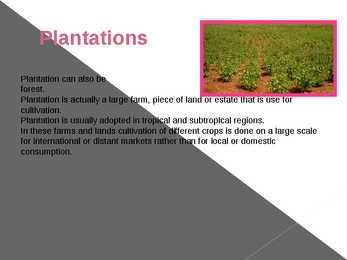
Plantations
Plantation can also be classified as type of
forest.
Plantation is actually a large farm, piece of land or estate that is use for
cultivation.
Plantation is usually adopted in tropical and subtropical regions.
In these farms and lands cultivation of different crops is done on a large scale
for international or distant markets rather than for local or domestic
consumption.
These crops include rubber seeds, oil seeds, sugar cane, cotton, tobacco,
coffee and sisal. Plantation done for industrial purpose is called forestry.
It is it done to get larger amount of wood in a shorter span of time.
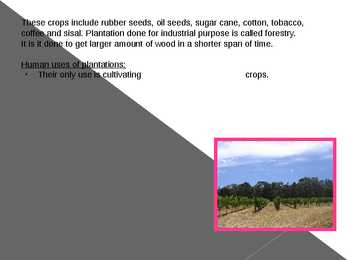
Human uses of plantations:
o
Their only use is cultivating crops.
Used sources
http://hubpages.com/hub/Types-Of-Forests
http://www.sabalolodge.com/tropical-rainforest.html
Vasakule Paremale
Different types of forests and their forms of usage #1 Different types of forests and their forms of usage #2 Different types of forests and their forms of usage #3 Different types of forests and their forms of usage #4 Different types of forests and their forms of usage #5 Different types of forests and their forms of usage #6 Different types of forests and their forms of usage #7 Different types of forests and their forms of usage #8 Different types of forests and their forms of usage #9 Different types of forests and their forms of usage #10 Different types of forests and their forms of usage #11 Different types of forests and their forms of usage #12 Different types of forests and their forms of usage #13 Different types of forests and their forms of usage #14 Different types of forests and their forms of usage #15 Different types of forests and their forms of usage #16 Different types of forests and their forms of usage #17
Punktid 50 punkti Autor soovib selle materjali allalaadimise eest saada 50 punkti.
Leheküljed ~ 17 lehte Lehekülgede arv dokumendis
Aeg2011-04-11 Kuupäev, millal dokument üles laeti
Allalaadimisi 9 laadimist Kokku alla laetud
Kommentaarid 0 arvamust Teiste kasutajate poolt lisatud kommentaarid
Autor GGGreta Õppematerjali autor
Slideshow

Sarnased õppematerjalid

Geograafia KT-8 klass
2
doc

Geograafia KT-8.klass

2. Where is prairie, pampas, steppe, and veldt situated? Eurasia­Steppe, North America-Prairie, South America­Pampa, South Africa­Veldt 3. Using the climate diagram describe the climate of the region. Temperate deciduous forest -Well-defined seasons with a distinct winter characterize this forest biome. Moderate climate and a growing season of 140-200 days during 4-6 frost-free months distinguish temperate forests. Temperature varies from -15° C to 25° C. Precipitation (750-1500 mm) is distributed evenly throughout the year. Temperate grassland- Semiarid, continental climates of the middle latitudes typically have between 25 cm and 50 cm of precipitation a year. Much of this falls as snow, serving as reservoir of moisture for the beginning of the growing season. Warm to hot summers are experienced, depending on latitude. In the winter, grassland temperatures can be as low as

Inglisekeelne geograafia
All studied biomes
2
docx

All studied biomes

1. Key features for all studied biomes. Tundra The main seasons are winter and summer. The tundra is the world's coldest and driest biomes. The average annual temperature is -28° C. Nights can last for weeks when the sun barely rises during some months in the winter, and the temperature can drop to -70° C. During the summer the sun shines almost 24 hours a day. Summer are usually warm. Average summer temperatures range from 3° to 16°C. TaigaTaiga is the Russian word for forest and is the largest biome in the world. It stretches over Eurasia and North America. The taiga is located near the top of the world, just below the tundra biome. The winters in the taiga are very cold with only snowfall. The summers are warm, rainy, and humid. Some of the animals in the taiga hibernate in the winter, some fly south if they can, while some just cooperate with the environment. GrasslandsGrassland biomes can be found in the middle latitudes

Inglisekeelne geograafia
New Guinea-inglise keeles
11
doc

New Guinea (inglise keeles)

TARTU VEERIKU KOOL New Guinea animals and plants Koostaja: Tauri-Viljar Vahesaar Juhendaja: Priit Pensa Tartu 2009 Table of content Introduction................................................................................................................................................3 The forests of New Guinea .......................................................................................................................5 The problem with trading wildlife.....................................................................................................6 Animals of the lowlands....................................................................................................................8 Reptiles...................................................................

Loodus
Savanna
5
doc

Savanna

Savanna A savanna is a grassland ecosystem with scattered trees or shrubs. In savannas trees are small or widely spaced so that the canopy does not close. It is often believed that savannas are characterized by widely spaced, scattered trees, however in many savanna communities tree densities are higher and trees are more regularly spaced than in forest communities. The open canopy allows sufficient light to reach the ground to support an unbroken herbaceous layer consisting primarily of C4 grasses. Savannas are also characterised by seasonal water availability, with the majority of rainfall being confined to one season of the year. Savannas can be associated with several types of biomes. Savannas are frequently seen as a transitional zone, occurring between forest and desert or prairie.

Inglise keel
Temperate deciduous forests-woodlands and shrub
4
sxw

Temperate deciduous forests, woodlands and shrub

Temperate deciduous forests, woodlands and shrub Tartu 2008 Location: Temperate forests are typical of all European continent, the Eastern region of Asia (in special, Chinese and Japan) and North America. Also are finded in tempered areas of South America. Climate: The average temperature in temperate forests is 50° F. Summers are mild, and average about 70° F, while winter temperatures are often well blow freezing. The average yearly precipitation is 30-60 inches. This precipitation falls throughout the year, but in the winter it falls as snow. There are four seasons in this biome, with warm summers and cold winters, often snowy. In autumn, the leaves change color and fall from the trees. The leaves decay on the forest floor, so the soil is very rich.

Inglise keel
Palm oil
4
docx

Palm oil

but can flourish wherever heat and rainfall are abundant. Today, palm oil is grown throughout Africa, Asia, North America, and South America, with 85% of all palm oil globally produced and exported from Indonesia and Malaysia; but most of the time not using sustainable measures. The industry is linked to major issues such as deforestation, habitat degradation, climate change, animal cruelty and indigenous rights abuses in the countries where it is produced, as the land and forests must be cleared for the development of the oil palm plantations. According to the World Wildlife Fund, an area the equivalent size of 300 football fields of rainforest is cleared each hour to make way for palm oil production. This large-scale deforestation is pushing many species to extinction, and findings show that if nothing hanges, species like the orangutan could become extinct in the wild within the next 5-10 years, and Sumatran tigers less than 3 years.

Inglise keel
Inglisekeelne geograafia
3
doc

Inglisekeelne geograafia

Up here they don't have to compete with other trees for light, but they are exposed to the high winds that lash the canopy during tropical storms. Emergents are the favourite nest sites of jungle eagles such as the harpy eagle of South America. Canopy Suspended 40m above the ground is the canopy - a belt of tree crowns supported by enormous rainforest tree trunks. This is the most productive and diverse habitat on Earth - perhaps 40% of the world's species spend their lives among its branches. The canopy's function is to photosynthesise. Canopy trees arrange their leaves to soak up as much of the sunlight as possible and supply them with a continuous stream of water and nutrients from the soil far below, so that the process is uninterrupted from dawn to dusk. 1.2. Describe these features Light gap A common event in the tropical rainforest is the fall of an emergent tree, usually during a tropical thunderstorm

Geograafia
The importance of the rainforest
1
doc

The importance of the rainforest

The beauty, majesty, and timelessness of a primary rainforest are indescribable. It is impossible to capture on film, to describe in words, or to explain to those who have never had the awe-inspiring experience of standing in the heart of a primary rainforest. Rainforests have evolved over millions of years to turn into the incredibly complex environments they are today. Rainforests represent a store of living and breathing renewable natural resources that for eons, by virtue of their richness in both animal and plant species, have contributed a wealth of resources for the survival and well-being of humankind. These resources have included basic food supplies, clothing, shelter, fuel, spices, industrial raw materials, and medicine for all those who have lived in the majesty of the forest. However, the inner dynamics of a tropical rainforest is an intricate and fragile system. Everything is so

Inglise keel


Meedia

Kommentaarid (0)

Kommentaarid sellele materjalile puuduvad. Ole esimene ja kommenteeri


Sellel veebilehel kasutatakse küpsiseid. Kasutamist jätkates nõustute küpsiste ja veebilehe üldtingimustega Nõustun