Leidsid 33 sarnast õppematerjali, mis on seotud failiga "Charlie Chaplini elulugu". Need materjalid aitavad sul teemat sügavamalt mõista.
chaplin, film, films, charlie, work, while, child, slapstick, character, became, 16th, april, both, parents, started, still, father, alcoholism, mother, hannah, found, difficult, find, 1895, entered, workhouse, part, billy, west, production, sherlock, holmes, later, joined, states, discovered, mack, couple, years, series, these, developed, wore, pantsCharlie Chaplin was one of the greatest and widely loved silent movie stars. From "Easy Street" (1917) to "Modern Times" (1936), he made many of the funniest and most popular films of his time. He was best known for his character, the naive and lovable Little Tramp. The Little Tramp, a well meaning man in a raggedy suit with cane, always found himself wobbling into awkward situations and miraculously wobbling away. More than any other figure, it is this kind-hearted character that we associate with the time before the talkies. Born in London in 1889, Chaplin first visited America with a theater company in 1907. Appearing as "Billy" in the play "Sherlock Holmes", the young Chaplin toured the country twice. On his second tour, he met Mack Sennett and was signed to Keystone Studios to act in films. In 1914 Chaplin made his first one-reeler, "Making a Living". That same year he made
Charlie Chaplin Early years · Charles Spencer Chaplin was born in London on 26 April 1889. · Chaplin's childhood was fraught with poverty and hardship. Because of this poverty, Chaplin was sent to a workhouse at seven years old. · He was briefly reunited with his mother at age of nine, before Hannah was forced to readmit her family to the workhouse in July 1898. · In September 1898, Hannah Chaplin was committed to Cane Hill mental hospital. So Charlie and his brother had to live with their father who soon passed away. · For a while Charlie's mom was in good health but in 1903 she became ill again and was readmitted.Charlie was 14 years old at that time. · His mother was released eight months later but in 1905 her madness returned, this time permanently and she remained in care until her death in 1928. Young performer · Chaplin's first stage appearance came when he was 5 years old.
Lesson 20 Topic Charles Spencer Chaplin Charles Chaplin was born on April 16, 1889 as a son of a small vaudeville actor. His early years at his home in South London passed in great poverty. For a time he was cared for in an orphanage. He received very little schooling. At an early age he appeared on the music hall stage with his father and brother taking small parts in vaudeville. At the circus Charles admired the art of the clown called Rabbit. Before meeting him Charles had never thought of becoming a comic actor.
Which began in Rome in 59 B.C. It reported the proceedings of the Roman Senate and such news as births and deaths.The first printed newspaper was a Chinese circular called Dibao. It was printed from carved wooden blocks during the A.D. 700's. The first regular published printed newspaper in Europe was Avisa Relation oder Zeitung of Strasbourg, Germany (now France). It started in 1609. A weekly newssheet established in 1622 was the first printed newspaper in England. The ground work for mass communications in the 20th century was laid in the 19th century by two inventions, which allowed people to communicate by wire: the electric telegraph and the telephone. As the telegraph came into widespread use, inventors searched for a way to transmit sound without wires. In 1885 the German scientist Hertz made a machine that produced radio waves and a receiver which could detect them from distance the radio. Soon after that the
3) JAMES WATT He was born in the small port of Greenock on the river Clyde in Scotland in 1736. His father was a mathematical-instrument maker and also kept a shop to supply ships with goods for their voyages. James was a delicate boy and often suffered from headaches. That is why he could not go to school at the age when other children did. His mother taught him to read and his father taught him writing and arithmetic. He had very good memory and a natural love of work. He liked mathematics and was also fond of designing and making things. James was an observant and thoughtful boy. When James was able to go to school, he was sent to a private school. He learnt many subjects there. In his spare time James began to make experiments. He built a small electrical apparatus with which he gave his friends shocks that made them jump. When James was 18 he decided to become a professional instrument- maker. He could not find anyone to teach him, so he went to London
Filmikunsti ajalugu 31.01.12 The age of pioneers: the early history of film How the horses helped to ivent the cinema. Cinema was invented by accident. 1872, west coast: leland standford, party, rich people, end of the 19 century, bored. Stanfrod talks friends about horses: problem: question is, what happens with the hooves while its moving, running. Bet, with eyes, can't settle this. Cannot ever see if the hooves touch the ground. Stanford has enough money, hires most famous photographer. Eadwerd muybridge, comes to usa. Tells him to settle this with photography. That time with photography you cannot get any informatio either. Started to install boxes, in each box, there was a camera. Does the hooves touch the ground or not? Fast shutter, can freeze the moment. Makes fast shutters, to record this
Marilyn Monroe Marilyn Monroe (born Norma Jeane Mortenson;[1] June 1, 1926 August 5, 1962), was a Golden Globe award winning[2] American actress, singer, model, Hollywood icon,[3] cultural icon, fashion icon,[4] pop icon and sex symbol. She is known for her comedic acting roles and screen presence. Monroe became one of the most popular movie stars of the 1950s and early 1960s. During the later stages of her career, she worked towards serious roles and her fame surpassed that of many entertainers of her time.[5] Her death at thirty six was classified as "probable suicide."[6] Many individuals including Jack Clemmons, the first LAPD Police officer to arrive at the death scene[7] believed that she was murdered.[8] She is the only female on the Forbes top earning dead celebrities list.[9] Contents
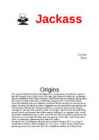
The concept of Jackass dates back to 1999 when struggling-actor-turned-writer Johnny Knoxville birthed the idea to test different self defense devices on himself as the basis for an article. He pitched the idea to a couple of magazines and was turned down until meeting with Jeff Tremaine of Big Brother. Tremaine hired him as a journalist and convinced Johnny to videotape this idea and other stunts for stories. The footage, which involved Knoxville being tasered, maced, and ultimately shot while wearing a bulletproof vest, appeared in the second Big Brother skateboarding movie (which is also the title of the second Jackass theatrical film). Future Jackass castmember Wee-Man made an appearance in the videos, and Florida clown Steve-O would send in submissions to be part of the videos. During this time, Bam Margera released a movie entitled Landspeed:CKY, consisting of himself and his friends, which he dubbed the "CKY Crew", in West Chester, Pennsylvania,
But the legend of the White Lady of Haapsalu, which is at the heart of the festival, is perhaps the most famous tall tale of the many that are so abundant in Estonia's folklore. It is the story of a poor girl who falls in love with the son of the village elder, and disguises herself as a choirboy in order to sneak into the castle. But, alas, the lord of the manor's son discovers the deception. He is overcome by jealous rage and orders his men to seal the girl inside the thick stone walls while still alive. Turned into an incarnation of undying love, the White Lady now appears every August, on the night of the full moon, in the Dome Church chapel window. Haapsalu is seven-and-a- quarter centuries old this year, and the townsfolk intend to make it a celebration to remember. The annual dance and light show dedicated to the Lady alone involves over 100 performers - and you'll have several chances to catch it over the four days of the event
[2] Early life and career Marley was born in the small village of Nine Mile in Saint Ann Parish, Jamaica. His father, Norval Sinclair Marley, (born in 1895), was a Jamaican of English descent, with parents from Sussex. Norval was a Marine officer and captain, as well as a plantation overseer, when he married Cedella Booker, a black Jamaican then eighteen years old. Norval provided financial support for his wife and child, but seldom saw them, as he was often away on trips. Marley was ten years old when his father died of a heart attack in 1955 at age 60. Marley suffered racial prejudice as a youth, because of his mixed racial origins,[3] and faced questions about his own racial identity throughout his life. He once reflected: I don't have prejudice against myself. My father was a white and my mother was black. Them call me half-caste or whatever. Me don't dip on nobody's side. Me don't dip on the black man's
The Roman Empire came under increasing attack across Europe and in AD 410 they retreated. The Romans gave us a language based on Latin, the calendar, law and legal system, the census and also straight roads, central heating and concrete. Anglo- Saxons around AD 400 Anglo- Saxons were warrior farmers from Germany, Denmark and the Netherlands. Later in the 5th century, Anglo-Saxons settled just west of Londinium, around the Strand, and formed the town of Lundenwic. The area of the old Roman city became a landing-place for ships and a centre for trade.The first English King to convert to Christianity, King Ethelbert, founded St Paul's Cathedral in 604. The Vikings 8th and 9th century By the 9th century, London was a very prosperous trading centre, and its wealth attracted the attention of Danish Vikings. The Danes periodically sailed up the Thames and attacked London. In 851 some 350 longboats full of Danes attacked and burned London to the ground.
The area is 45,227 square kilometres of which more than 4,000 square kilometres are made up by islands and islets (over 1,000); there are more than 1,400 lakes that form nearly 5% of the total area. More than 40% of the entire area is woodland. The country is flat; the average elevation is 50 metres above sea level. The highest peak, Suur Munamägi rises to only 317 metres. High limestone features characterise the north of the country, while the south has a drumlin terrain. The maritime climate is temperate, summers are warm and winters mildly cold, the average annual temperature is 5 degrees Celsius and the average annual precipitation is 550 millimetres. The most important assets of the soil are oil shale, phosphorite and peat. The designation “Aestii” was first mentioned by the Roman historian Tacitus in “Germania” (98 AD). By the end of the first millennium the people of Western Europe
and The movie : South park bigger longer, uncut) Trey Parker and Matt Stone created the show and continue to do most of the writing, directing, and voice acting. The narrative revolves around four children -- Stan Marsh, Kyle Broflovski, Eric Cartman, and Kenny McCormick -- and their bizarre experiences in the titular mountain town. Has won 3 daytime Emmys Total of 188 episodes since the show's debut in 1997. Two feature-length movies have also been released; the musical film South Park: Bigger, Longer & Uncut in 1999, and the three-episode Imaginationland story arc was reissued straight-to-DVD in 2008 CHARACTERS Main protagonists: Stan Marsh, Kyle Broflovski, Eric Cartman, and Kenny McCormick There are many recurring characters on the show, including the boys' families, school staff, and other students. These include Leopold "Butters" Stotch, Chef (who no longer appears in the show), Mr. Hankey, Towelie, Jesus, and Satan.
English Literature ,Victoria Age 1) Overview of the Victorian age · Periodization During the reign of Queen Victoria (1837-1901) · Why is the Victorian Age compared to the Elizabethan Age? Both are associated with the reign of a very popular queen; Victorian age idealised the Elizabethan Age; many changes in different fields- economy, religion etc.; focusing more on people's attitudes, political developments etc; Victorian age was inspired by Elizabethan era; Britain became an empire · What were the most important changes in politics, religion and social life that occurred during the Victorian age? Politics: 1848 Chartist movement (voting right for the working class); women's suffrage movements; feminist outburst (wanted to have business openly; own property, voting etc.); world dominion (British empire); Economy: Industrialization; urbanization (people moved to towns no agriculture & food); laissez-
Further information: List of James Fenimore Cooper writings. He anonymously published his first book, Precaution (1820). He soon issued several others under his own name. In 1823, he published The Pioneers; this was the first of the Leatherstocking series, featuring Natty Bumppo, the resourceful American woodsman at home with the Delaware Indians and especially their chief Chingachgook. Cooper's most famous novel, Last of the Mohicans (1826), became one of the most widely read American novels of the nineteenth century. The book was written in a second-story storefront-apartment in Warrensburg, New York, just north of where most of the book's plot takes place. Washington Irving Washington Irving was born in New York City (near present-day Wall Street) at the end of the Revolutionary War on April 3, 1783. His parents, Scottish-English immigrants, were great admirers of General George Washington, and named their son after their hero.
Kingsland until he was at the age of three, where they then moved to Dyess, Arkansas; a Colony in Northeast Arkansas. The Cash family farmed nearly 20 acres filled of cotton, there Ray, Kerry and all seven of their children worked side by side in the crops; including little Johnny. Johnny as a Kid... Cash spent his childhood in Guns & Girls Dyess Colony until he graduated high school in 1950, where he then fled off to D e t r o i t in search of work only to find himself in Pontiac, Michigan working in the automotive business. However, Cash soon after enlisted in the U.S. Air Force and was sent off to basic training in Te x a s . While in Texas Cash accidentally stumbled upon love and met his first wife Vivian Liberto, than was almost immediately shipped off to Landsberg, Germany. Cash started his first band in the military named The Landsberg Barbarians. Cash
Chapter1: An unknown woman was found lying in the street and brought into the workhouse. She delivered a sickly child who had trouble breathing. The woman, without a word of who she was, died and left her new born boy, Oliver, to the drunken nurse that stood by. Chapter2: The State gave Oliver to Mrs. Mann who housed a number of orphaned children. Mrs. Mann took a large portion of the money given to her by the authorities for each child's food so Oliver grew up small and malnourished. On his ninth birthday, the town beadle, Mr. Bumble, came to collect Oliver and take him to the board for an interview
Human independence and solitarity. Jordan dies, he is left to die. Maria problably is pregnant. Towards the end of his life Heingay wrote short stories. 1952 novella ,,The old man and the sea". The protagonist is an old cuban fisherman. Cuba was that time almost the colony of usa. Santiago is an old fisherman who isn't able to catch anything for several days. One day he catches enormous fish. He is exhausted from trying to fight that fish and has to tie the fish to the boat. While he is rowing back to village the sharks eat the fish when he arrives back to village. It is a moral victory of defeat. Man may be destroyed but not defeated. Even the names are quite important in the novels. Santiago (in spanish-saint) is almost a christ like figure. He has scars that are similiar to stigmata. The novella can be guarded as a religious story, even though hemingway wasn't very religious man. Hemingway commited suicide by blowing his head off. 1930's in American literature
playwrights, fiction and non-fiction writers, scholars, and fans of pop culture all over the world. Discover a set of useful myth-inspired storytelling paradigms like "The Hero's Journey," and step-by-step guidelines to plot and • character development. Based on the work of Joseph Campbell, The Writers Journey is a must for all writers interested in further developing their craft. This updated and revised Third Edition provides new insights and observations from Vogler's ongoing work on mythology's influence on stories, movies, and man himself. In revealing new material, he explores key principles like polarity and catharsis, plus: • A revised chapter which looks back at the Star Wars phenomenon and analyzes
a near-constant cover of clouds. It rains on this inconsequential town more than any other place in the United States of America. It was from this town and its gloomy, omnipresent shade that my mother escaped with me when I was only a few months old. It was in this town that I'd been compelled to spend a month every summer until I was fourteen. That was the year I finally put my foot down; these past three summers, my dad, Charlie, vacationed with me in California for two weeks instead. It was to Forks that I now exiled myself-- an action that I took with great horror. I detested Forks. I loved Phoenix. I loved the sun and the blistering heat. I loved the vigorous, sprawling city. "Bella," my mom said to me -- the last of a thousand times -- before I got on the plane. "You don't have to do this." My mom looks like me, except with short hair and laugh lines. I felt a spasm of panic as I stared at her wide, childlike eyes
õppis École des Beaux-Arts kunstikoolis (18971899). Aastatel 19021904 õppis Pariisis Academie Humbert'is. Georges Braque teenis Esimese maailmasõjas Prantsuse sõjaväes ja sai raskelt haavata. Ta kasutas maalis esimesena kirjatähti, imiteeris puu ja marmori faktuuri ning leiutas kollaazitehnika Robert Delaunay Robert Delaunay (12 April 1885, Paris 25 October 1941) was a French artist who used Orphism, which is similar to abstract art, abstraction and cubism in his work. Delaunay concentrated on Orphism, while his later works were more abstract, reminiscent of Paul Klee. His key influence related to bold use of colour, and a clear love of experimentation of both depth and tone. While he was a child, Delaunay's parents divorced, and he was raised by his uncle, in La Ronchère (near Bourges). He took up painting at an early age and, by 1903, he was producing mature imagery in a confident, impressionistic style.
founded Sir Jamsetjee Jeejeebhoy School of Art and Industry in Bombay. Later in life Kipling illustrated many of Rudyard Kipling's books, and other works. Kipling also remained editor of the Journal of Indian Art and Industry, which carried drawing works from the students of the Mayo School. COUPLE named their son after the place they had first met Rudyard Lake. Alice Kipling Fleming - Sister of British author Rudyard Kipling who became a well-known psychic, producing automatic writing under the name "Mrs. Holland." Born June 11, 1868, Alice Kipling was privately educated. She went to India at age 16 and married British army officer John Fleming. While in India she wrote a number of poems, and in 1893 initially experimented with automatic writing. After a long illness she returned to England in 1902 and in the following year read the classic study Human Personality and Its Survival of Bodily Death, by F. W. H. Myers
The Beatles at number one. They have been honoured with 7 Grammy Awards, and they have received 15 Ivor Novello Awards from the British Academy of Songwriters, Composers and Authors. The Beatles were collectively included in Time magazine's compilation of the 20th century's 100 most important and influential people. The Who are an English rock band which was formed in 1964: vocalist Roger Daltrey, guitarist Pete Townshend, bassist John Entwistle, and drummer Keith Moon. They became known for energetic live performances which often included instrument destruction. The Who have sold about 100 million records and have charted 27 top forty singles in the United Kingdom and United States with 17 top ten albums, including 18 Gold, 12 Platinum and 5 Multi-Platinum album awards in the United States alone. The Who rose to fame in the UK with a series of top ten hit singles, boosted in part by pirate
century and the humanist period during the Renaissance, the Enlightenment took scientific reasoning and applied it to human nature, society, and religion. American Enlightenment a gradual but powerful awakening that established the ideals of democracy, liberty, and religious tolerance in the people of America. If there were just one development that directly caused the American Revolution and uplifted the intellectual culture of the continent while it was only a British colony, it would be the American Enlightenment. Broadly, the Enlightenment was an intellectual movement that changed the fundamental perspective of the masses, urging them to foster skepticism and apply scientific principles in matters of religion and morality. Its chief values were: Liberty, Democracy, Republicanism, Religious Tolerance. The movement gained momentum with the publication of landmark texts like Thomas
figures of African American history during the 1800s, and one of the most influential lecturers and authors in American history. Douglass was a firm believer in the equality of all people, whether black, female, American Indian, or recent immigrant. He spent his entire life advocating the brotherhood of all humankind. One of his favorite quotations was: "I would unite with anybody to do right and with nobody to do wrong." Life as a slave Frederick Augustus Washington Bailey, who later became known as Frederick Douglass, was born a slave in Talbot County, Maryland near Hillsboro. He was separated from his mother, Harriet Bailey, when he was still an infant. She died when Douglass was about 7. The identity of Douglass' father is obscure; Douglass originally stated that his father was a white man, perhaps his master, Captain Aaron Anthony, but later said he knew nothing of his father's identity. When Anthony died, Douglass was given to Mrs. Lucretia Auld, wife of Captain Thomas Auld
students of Slavic studies. In the 1922/1923 academic year, an independent Section of Russian Language and Literature was founded within the School of Slavic Studies. The section was, from its foundation until 1945, headed by Valerij Alexandrovic Pogorielov. In 1945 another member of the post-revolutionary wave of Russian emigrants, Prof. Alexander Vasilievic Isacenko, was appointed Professor in Russian Philology. In 1946 Prof. A. V. Isacenko became the director of the newly established School of Russian, which transformed itself into the Department of Russian Literature and Modern Language Studies in 1948. Prof. Isacenko was still holding the leading post in 1950 when the Department of Russian Language and Literature came into being. In 1955, when Prof. A. V. Isacenko left Bratislava for Olomouc, the department already had ten full-time teachers. Russian studies continued developing in the second half of the 1950s and in the 1960s when
Romans brought a lot with them. Their brought paved roads, the sites of important cities, the seeds of Christianity, the Roman law, Roman baths, language and advanced civilization. They also built Hadrian's Wall in 122 A.D. Romans occupied Britain for four centuries. The Roman way of life all vanished after the invasions from Northern Europe by the Angles, Saxons and Jutes from the 5th century onwards. They ruined Londinium, but they were easily turned into Christianity and religion became more and more important. The Vikings, who came in the 9th century, first raided England to plunder it, but then they decided to stay. In the 10th century England fell under Danish Rule, with King Canute finally managing to unite the Anglo-Saxons and Danes at the beginning of 11th century. Medieval England After defeating the Anglo-Saxon King Harold at the Battle of Hastings in 1066, William of Normandy (who became William I, also called William the Conqueror) introduced
well as a vigorous social campaigner. Considered one of the English language's greatest writers, he was acclaimed for his rich storytelling and memorable characters, and achieved massive worldwide popularity in his lifetime. Charles Dickens was born in Landport, Portsmouth in Hampshire, the second of eight children to John Dickens n 7 February 1812. The 12-year-old Dickens began working ten hour days in a Warren's boot-blacking factory. In May 1827, Dickens began work in the office of Ellis and Blackmore as a law clerk. At the age of seventeen, he became a court stenographer and, in 1830, met his first love, Maria Beadnell. Maria's parents disapproved of the courtship and effectively ended the relationship when they sent her to school in Paris. In 1834, Dickens became a political journalist, reporting on parliamentary debate and traveling across Britain by stagecoach to cover election campaigns for the Morning Chronice.
An important legacy of the Romans was its roads, agriculture and cities. In the Roman times the land was dominated by rules and reguations. *Christianity in Roman Britain The Roman authorities were suspicious of Christianity because followers of Jesus Christ refused to take an oath of loyalty to the Roman emperor. For this reason the early Christians were regarded as dangerous enemies of the Empire. That ceased when the emperor Constantine converted to Christianity. Christianity became the official state religion of the Roman Empire in the early fourth century A.D. As the century progressed Christianity spread very quickly. Despite official recognition there was no mass conversion to Christianity; worship of the pagan gods and goddesses was not even formally banned until late in the fourth century. *Boadicea/Boudica At his death bed, Boudica's husband left half his possession to the emperor, expecting that this would protect his family
Like psychoanalysis, surrealistic painting and writing explores the inner depths of the unconscious mind. Freudian ideas have provided subject matter for authors and artists. Critics often analyze art and literature in Freudian terms. 2. Literary Modernism and its sub-movements. The influence of Structuralism and psychoanalysis. Main characteristic features of Modernism. Denial of conventions, traditional structure, plot and presentation of character. The stream of consciousness. Allusiveness. Virginia Woolf's Modern Fiction as a theoretical platform for Modernism. Criticism of Realist literary method. Literary modernism: end of the 19th century-1920 (reached its height) and ended 1940s. A self- conscious break with traditional aesthetic forms. Rejecting the sentiment and discursiveness typical of Romanticism and Victorian literature for poetry that instead favored precision (täppis) of imagery and clear, sharp language
Exactly two years later, the fledgling Moscow Arts Theatre, under the guidance of Stanislavsky and Nemerovich-Danchenko, began the first of twenty-six rehearsals of The Seagull. The director, Vladimir Nemirovich-Danchenko, had recognised the potential of Chekhov's innovative dramatic technique and it was his enthusiasm that ensured the first highly successful production of the play. Th e plot of Chekhov's sixteen-page masterpiece is not complicated. A man meets a woman while both are vacationing -- without their spouses -- in the southern resort villa of Yalta. Th ey have an aff air and return to their respective spouses -- he to his wife in Moscow, she to her husband in Saratov. While at fi rst the man, Dmitrij Gurov, regards the aff air as just another pleasant fl ing, soon to be forgotten, he later begins to remember and cherish the time he has spent with Anna in Yalta. He gradually becomes consumed with a desire to see her and travels to Saratov to fi nd her
Salmagundi Papers (1807-1808), a serial publication, later reissued as a book, which depicted life in New York in the first decade of the cent. This was followed by A History of New York (1809), a satirical attack on the upper class old Dutch families of New York. Irving's early works were very heavily influenced by neo-classical satirists such as Alexander Pope and Jonathan Swift. After he met Sir Walter Scott and became familiar with imaginative German lit, a new romantic note became evident in works such as The Sketch Book (1819-1820), which includes Rip Van Winkle, The Legend of Sleepy Hollow and Bracebridge Hall (1822). Irving was the first Am writer to win the respect of British lit critics. (also the first internationally famous author from the USA) James Fenimore Cooper was perhaps the most popular writer of the period. He drew inspiration for his five volume series of Leatherstocking Tales (1823-1841) from Walter Scott's Waverley novels
John Lilburne – Leveller party. Contrasts between rich and poor. Equal distribution of property. 9. Milton. Paradise Lost Lengthy works of religious convictions discarded today, wanted to remove his poetry to greater extent than that of others, for material: the fall of man, the restoration of the human race in Christ, destruction of God’s enemies, from the heavnely point of view, his poetry must teavh, purify and elevate the heart (his work assume great knowledge of Bible); purpose: assert Eternal Providence, justify the ways of God to men, his God mysterious and inscrutable, to understand God’s message men must purigy their hearts. Paradise lost: a prayer to God from mankind. 10. 17th century autobiographical writing (Pepys, Evelyn) Diarists like Pepys and Evelyn depicted everyday London life and the cultural scene of the times. In 17th increase in autobiographical writing
 annaabi.ee