 100 punkti
Autor soovib selle materjali allalaadimise eest saada 100 punkti.
100 punkti
Autor soovib selle materjali allalaadimise eest saada 100 punkti.
 ~ 8 lehte
Lehekülgede arv dokumendis
~ 8 lehte
Lehekülgede arv dokumendis
 2017-02-20
Kuupäev, millal dokument üles laeti
2017-02-20
Kuupäev, millal dokument üles laeti
 1 laadimist
Kokku alla laetud
1 laadimist
Kokku alla laetud
 0 arvamust
Teiste kasutajate poolt lisatud kommentaarid
0 arvamust
Teiste kasutajate poolt lisatud kommentaarid
 mammumannik
Õppematerjali autor
mammumannik
Õppematerjali autor
A feeling of helplessness. Delay or refusal to learn the lg of the host country. Excessive fear of being cheated. Excessive concern over minor pains. Terrible longing to be back home. Reverse CS- re-entry shock- the unexpected confrontation with the familiar. Cultural dimensions. Non-verbal communication Nonverbal communication is usually understood as the process of communication through sending and receiving wordless messages. Such messages can be communicated through gesture; body language or posture; facial expression and eye contact; object communication such as clothing, hairstyles or even architecture; symbols and infographics. Speech may also contain nonverbal elements known as paralanguage, including voice quality, emotion and speaking style, as well as prosodic features such as rhythm, intonation and stress. 1
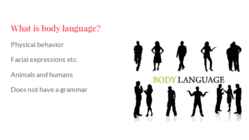
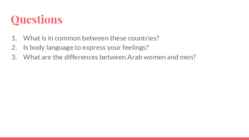
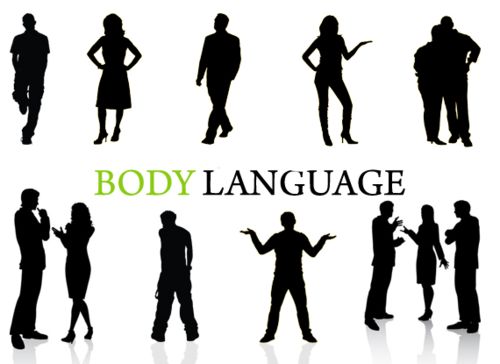
Body language Body language means communication with the movement or position of the human body. It can be conscious or unconscious. It is something that is noticed by everybody but is not always given enough attention. We sometimes ignore it and try to hide behind words, but we should never forget that we cannot fool everyone! Children react to body language because they experience the world through intuition. The same can be true for adults when feelings are involved. People who are in bad shape emotionally will often place great importance in it. In fact, they often pick up the smallest hint of a lapse in attention in the person they are speaking to. And they frequently jump to the conclusion that they are boring or a nuisance - thus compounding any sense of depression or poor self-esteem.
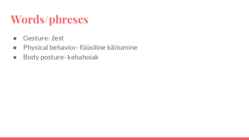
BODY LANGUAGE Denis Horenzenko What is Body Language? Body Language is the communication of personal feelings, emotions , attitudes(), thoughts through body movements gestures(), postures() , facial expressions, walking styles, positions & distance - either consciously(c) or involuntarily( ) .Its not only your tongue you communicate with but also you speak with your body movements and gestures. The Main Aspects of Body Language Gestures: A gesture is the verbal or non-verbal body movement used to express or emphasize() an idea , an emotion or a state of mind. Body Movements: This includes the head, eyes, eyebrows , lips , neck , shoulders, fingers and so on. One can distinguish() four main kinds of gesticulation(): Emblem, illustrators, regular and self-touching. Behavior : This refers quite simply , to everything we do which is overt or observable()
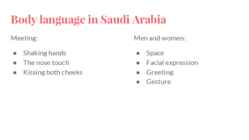
*meeting and greeting · The British are reserved, which may cause them to appear cool and indifferent or overly formal. In fact, they are very friendly and helpful to foreigners. · Shake hands with everyone present men, women, and children at business and social meetings. Shake hands again when leaving. · Use last names and appropriate titles until specifically invited by your British hosts or colleagues to use their first names. *body language · The English tend to keep about an 23 feet between them while speaking. · Touching is usually kept to a minimum. · Family members are more relaxed and familiar with each other, so touching of the arms, elbows, or hands is acceptable. However in a business environment, touching is very minimal and personal space is respected much more than in a family setting. · Direct eye contact is generally maintained during conversations, but not to the point of
.. "Smith here!" or simply "Hello". · Many people think it is rude when you use call waiting to talk to someone else in the middle of the conversation you are having with them. · When using a cell phone, try to find a quiet spot to answer a call. It is considered particularly rude to leave a cell phone turned on in public places like: classrooms, libraries, movie theaters, churches, etc. 2. CLOTHES AND DRESS · Also, pay attention to how much of your body you are exposing (have uncovered) and whether it is appropriate for the situation. (Ex. shorts, sandals, a very short or very tight skirt, or low cut or too tight shirt, are really not appropriate for meetings, interviews, etc.) Wearing this type of clothing can also communicate the same negative things. · Men: socks should match their suit. No leg should show between pants and shoe. Remove your their when indoors.
Analysis. Butterworth-Heinemann, Oxford. Reisinger, Y. (2009) International Tourism Cultures and Behaviour. Butterworth-Heinemann, Oxford. Reuters (2013) Factbox: Women's rights in the Arab world http://www.reuters.com/article/2013/11/12/us-arab-women-factbox-idUSBRE9AB00I20131112 - accessed 17/03/2014 Singh, T., V. (2004) New Horizons in Tourism: Strange Experiences, and Stranger Practices. CABI Publishing, UK. Small, J. (2007) The Emergence of the Body in the Holiday Accounts of Women and Girls. CAB International, Wallingford. Surfer (2014) The plastic problem: Bali surfers seek to ban plastic bags across the province http://www.surfermag.com/features/bali-garbage/ - accessed 19/03/2014 Swarbrooke, J., Beard, C., Leckie, S., Pomfret, G. (2003) Adventure Tourism: The new frontier. Elseiver Science Ltd, Oxford. The Gutsy Traveler (2013) Women Travel Statistics Explained by Travel Expert http://gutsytraveler
GETTING PHYSICAL Tallinn 2012 "Delivery is more important than content." Arch Lustberg, speech trainer According to wellknown social anthropologist Edward T. Hall, 60% of our communication is nonverbal. That means whenever we stand before an audience, our stance, our posture, our facial expressions, our hand gestures, our whole body dynamic communicate more than our actual spoken words. A stiff, immobile speaker is often a boring and usually ineffective speaker as. It is therefore essential to know how to be physically relaxed, which will allow your actions to complement your words. Before we start, two important definitions: A podium is the raised platform at the
the fabliau (a comic, often anonymous tale that is characterised by an excess of sexual and other types of obscenity) and (3) literature on religious topics – either moralistic (teach right from wrong) or ecclesiastical (biblical subject). Middle ages – English becomes a literary language. Geoffrey Chaucer (1343–1400) – Father of English literature, The Canterbury Tales in English, increased the prestige of the language, provided a standardised form. The Canterbury Tales: frame story. Majority in verse, some prose. Intended to contain 124 stories, only finished 24
 annaabi.ee








Kõik kommentaarid