 100 punkti
Autor soovib selle materjali allalaadimise eest saada 100 punkti.
100 punkti
Autor soovib selle materjali allalaadimise eest saada 100 punkti.
 ~ 10 lehte
Lehekülgede arv dokumendis
~ 10 lehte
Lehekülgede arv dokumendis
 2015-03-03
Kuupäev, millal dokument üles laeti
2015-03-03
Kuupäev, millal dokument üles laeti
 8 laadimist
Kokku alla laetud
8 laadimist
Kokku alla laetud
 0 arvamust
Teiste kasutajate poolt lisatud kommentaarid
0 arvamust
Teiste kasutajate poolt lisatud kommentaarid
 ergoasd
Õppematerjali autor
ergoasd
Õppematerjali autor
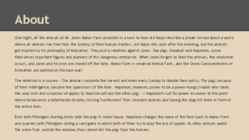
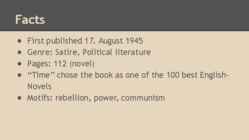
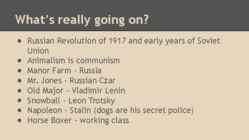
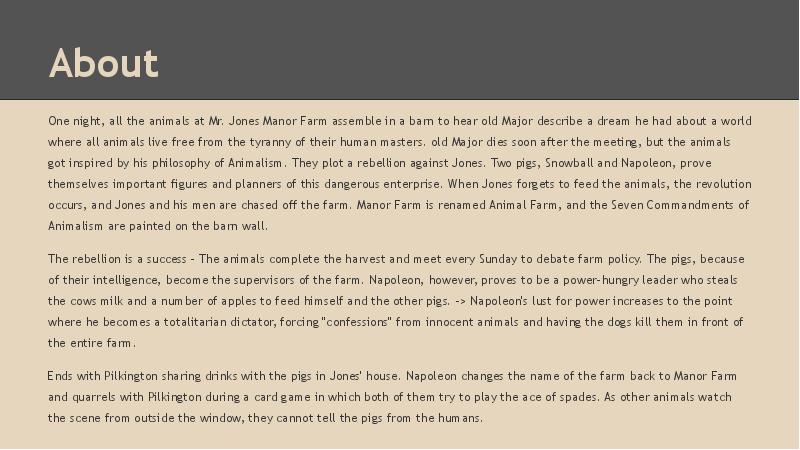
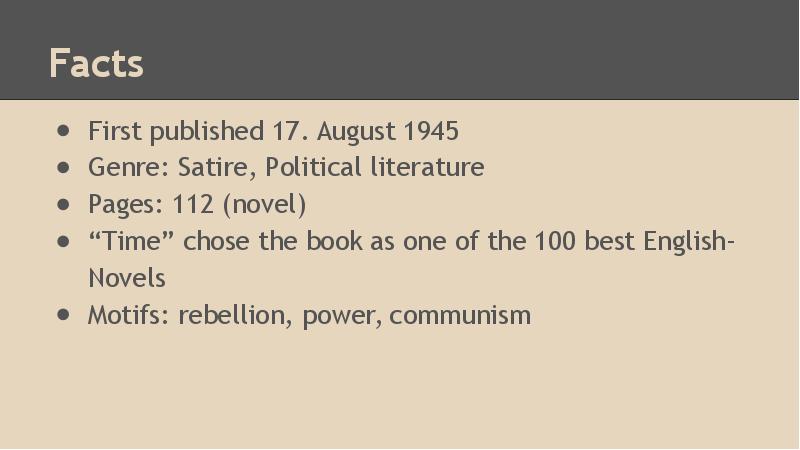
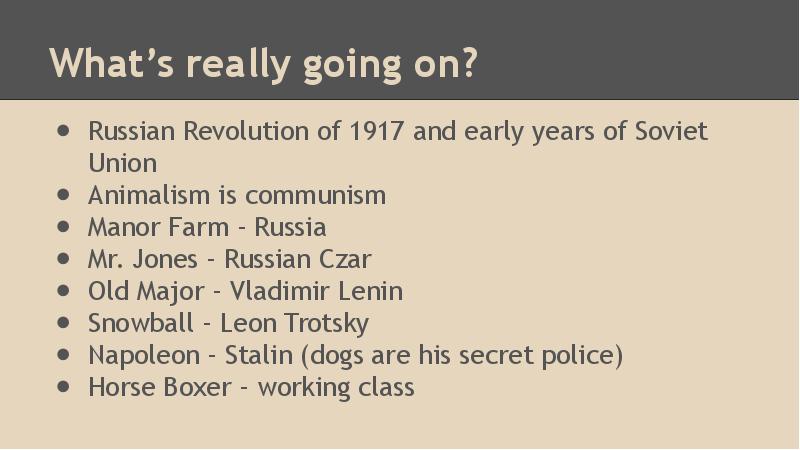
Power Destroys Ideals Throughout the centuries people have fought for power. Leadership has been a reason for many wars and fights. For some people one of the most important things in life is to have power over everybody else. Very often those who become leaders destroy or forget about the ideals they had before and about the promises they made. G. Orwell's book "Animal Farm" is an excellent example of how easy it is to forget about the ideals. In his novel George Orwell pictures a human society through the animal farm. He uses exagerations which help to feel the atmosphere of spoiled society. Society ruined by dictators, false ideas and corruption. In the novel the animals are shown as the exagerated copies of human beings with all their characters, habits and feelings. The story took place on the farm where the animals led a rebellion against the human beings. The revolution was started by the pigs who were considered the most intelligent animals
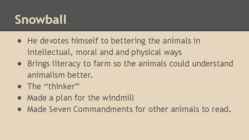
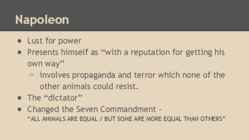
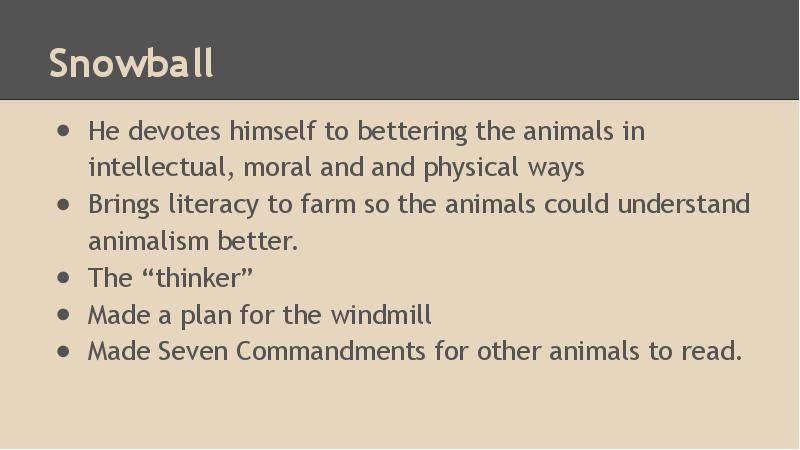
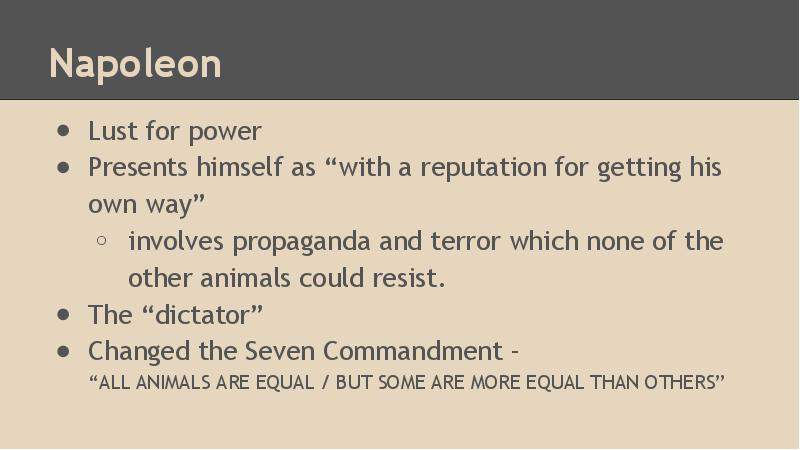
It could be control over some group, over a person and his mind, actions and thoughts or just over a certain situation where we want to gain a higher role so everything could be under their command. People are willing to do everything to get others under their control. In "Animal Farm" Napoleon's first act to gain his leadership was the betrayal of his fellow leader and friend Snowball. Napoleon and Snowball did not agree on their views of leading the farm and Napoleon, who could not deal with divided power, drove Snowball away. So do humans nowadays. The moment they feel threatened by others' support for someone else's ideas, views and power, a certain protective reflex pushes them to defend and fight for their position. Humans are too selfish, self-centered and egoistic to share their desired position with someone else. Besides the thirst for individual power, the methods people use to gain it are even more absurd
Chapter Two, marks the reader's first encounter with the meaninglessness of death and the cheapness of life in the war. Joseph Behm - The first of Paul's classmates to die in the war. Behm did not want to enlist, but he caved under the pressure of the schoolmaster, Kantorek. His ugly, painful death shatters his classmates' trust in the authorities who convinced them to take part in the war. Detering - One of Paul's close friends in the Second Company. Detering is a young man with a wife and a farm at home; he is constantly homesick for his farm and family. Gérard Duval - A French soldier whom Paul kills in No Man's Land. Duval is a printer with a wife and child at home. He is the first person that Paul kills in hand-to-hand combat, one of Paul's most traumatic experiences in the war. Leer - One of Paul's classmates and close friends during the war. Leer serves with Paul in the Second Company. He was the first in Paul's class to lose his virginity.
him of my sympathy," said Lady Constance stiffly. "Yes, I suppose you could," said Lord Emsworth, having considered the point. "Not that he deserves any sympathy. The man's an ass." "Nothing of the kind. A most intelligent young man, as young men go." "Young? Would you call him young? Fifty, I should have said, if a day." "Are you out of your senses? Heacham fifty?" "Not Heacham. Smithers." 4) "Are you employed on a farm?" "I was employed on a farm." "Pigs?" said Lord Emsworth in a low, eager voice. "Among other things." Lord Emsworth gulped. His fingers clutched at the tablecloth. 5) "Hullo, guv'nor" "Well, Frederick?" "How are you feeling?" "Extremely ill." "Might have been worse, you know." "Bah!" "Watery grave and all that." "Tchah!" 6) "I'll er I'll think it over, McAllister." "Mphm." "I have to go to the village now. I will see you later
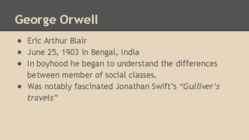
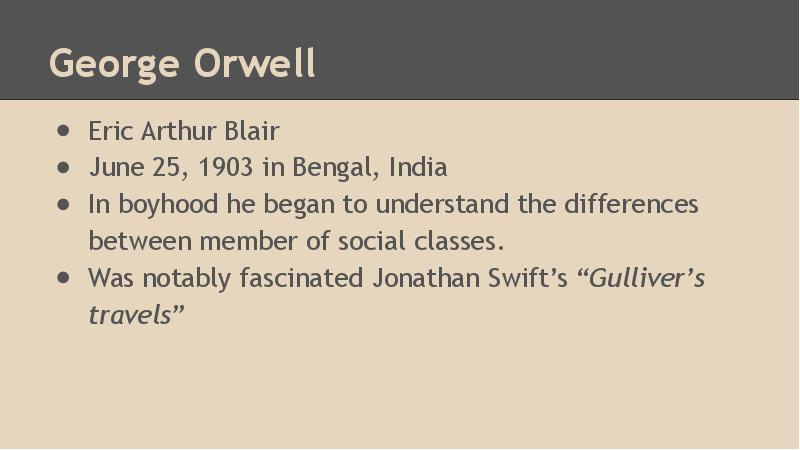
,,The Road to Wigan Pier" George Orwell AUTHOR George Orwell was the pen name of the English author, Eric Arthur Blair. He was born on June 25 in 1903 in Motihari, Bengal, in the then British colony of India, where his father, Richard, worked for the Opium Department of the Civil Service. His mother, Ida, brought him to England at the age of one. Orwell was educated in England at Eton College. After service with the Indian Imperial Police in Burma from 1922 to 1928, he returned to Europe to become a writer. He lived in Paris for the next two years, and then came to England as a school-teacher. He lived for several years in poverty. By 1936, Orwell had joined the Republican forces in the Spanish Civil War. He was wounded in the fighting. Late in the war, Orwell fought the Communists and eventually had to flee Spain for his life
goat whale These are words for places. They are common nouns. beach park Word File Here are more words for places: airport market cave mountain library church playground shop farm restaurant hill school Everfresh Co. hospital seashore hotel stadium house supermarket island temple mall zoo 10 These are words for things. They are common nouns. basket bed
the Southern Cross on it. The large seven-pointed star represents the six original states and the territories of Commonwealth. There is also the Indigenous Australian flag, which represents the Aboriginal Australians. The flag with its colours of red (representing the land), black (representing the people) and the yellow in the middle (representing the sun) is a source of pride for Indigenous Australians. The present coat of arms was granted by King George V in 1912. It consists of a shield containing the badges of six Australian states, enclosed by an ermine border. The shield is a symbol for the federation of the states, which took place in 1901. The crest, which is above the shield, is a seven-pointed gold star on a blue and gold wreath. The seven points of the star represent exactly the same thing that they do on the flag. The supporters of the shield are native Australian animals: the red kangaroo and the emu. Usually the coat of arms is
Characteristic to Charles I’s court Carew: Sir John Suckling: The Constant Lover Richard Lovelace: celebrates the beauties of heroine, but against very different background. To Althea, from Prison: Song; The Grasshopper: To My Noble Friend, Mr Charles Cotton: Ode Waller: wrote of queen as the queen of love. Cowley: Robert Herrick: The Argument of His Book, Delight in Disorder 6. The Caroline „beauty of holiness” Sermons and religious verse, witty preaching. George Herbert, Caroline piety expressed. His verse is sensitive and decorous, monument to „beauty of holiness”, practice of liturgy with good order and ritual which was the essence of Charles I’s religious policy. High Anglican piety. Herbert celebrates wat Puritans wished to sweep away. Beauty and significance of ritual, of the mystery of the sacraments offering praise to the angles, to the saints and Virgin Mary. We are in Heaven that can only be Anglican, filled with deep
 annaabi.ee







Kõik kommentaarid