Leidsid 33 sarnast õppematerjali, mis on seotud failiga ""Wild animals in danger". Ettekanne inglis keeles.". Need materjalid aitavad sul teemat sügavamalt mõista.
animal, wild, animals, rest, danger, forest, habitat, place, other, places, there, activities, nature, even, species, forests, these, several, bird, circle, hunter, kill, fact, agriculture, disturb, serious, habitats, years, sometimes, grow, again, change, balance, wood, jungle, marsh, needs, result, taken, green, houses, farms, dying, addition, insectWhat are the biggest dangers to wild animals in Estonia? Wild animals in Estonia, like in many other places in the world, are in danger. Forest industry, agriculture and other human activities in the nature, as well as pollution, disturb and even endanger the life of wild animals. Firstly, big forest machines disturb animals. For example, in winter the machines disturb animals who hibernate in winter. As a result, animals can leave their habitations and go somewhere else where is quiter. In addition to disturbing animals, the forest industry endanger wild animals' lives. Some machines can simply kill some animals accidentally. Besides, there are some species which are rear in Estonian forests. These species should be protected. A further problem is poaching- although it is not a very big problem in Estonia, it affects the number of animals.
Hansen's report, and the debate over global warming continues today. Current fears stem largely from the fact that global warming is occurring at such a rapid pace. Models are predicting that over the next century, the global temperature will rise by several degrees. Some scientists still do not think that the effects of global warming are as severe as some people say. They think that droughts, hurricanes, and floods often blamed on global warming might actually have other causes. One major difficulty in studying global warming is the fact that weather data only exists for the last century and a half. As a result, understanding the present and predicting the future are very difficult. Rain forest destruction The atmosphere and oceans are not the only parts of the environment being damaged. Rain forests are being quickly destroyed as well, and their survival is questionable. E.O
I'd like to present the main issues of our planet and today i'll name 5 of them. These are air pollution, water pollution, endangered animals, deforestation and rubbish. Air pollution Firstly, lets talk about air pollution, which endangeres our life in cities and also the forests near by. Cars and factories blow poisoned gas in the air and it mixes with the oxygen, so the air that we breathe, becomes dangerous to our health. The ozone layer around the Earth, there is a special type of oxygen called ,,ozone"
Protecting endangered species will make a difference in humans' life In the nature of humankind it is natural to hunt animals. However, nowadays hunting endangered species will make humans be just killers, because it is not necessary to kill something just to have a trophy on the wall at home. People can be proud of what they have done, but decreasing the population of a species largely will cause the specific animal breed to go extinct faster than it would happen via natural causes. Therefore, humans should stop hunting endangered species to slow down their extinction, as these species offer balance in the wildlife, are used without purpose in medicine, and may even reduce poverty. Species on the brink of extinction affect us more than we realize. Sure, pandas are cute, and rhinos are fun to look at, but is there anything more to that
garbage and dumping their waste in the oceans and, less developed countries. Nuclear waste disposal has tremendous health hazards associated with it. Plastic, fast food, packaging and cheap electronic wastes threaten the well being of humans. FIND OUT 5 WAYS HOW TO MANAGE WASTE. 5. Loss of Biodiversity: Human activity is leading to the extinction of species and habitats and loss of bio- diversity. Eco systems, which took millions of years to perfect, are in danger when any species population is decimating. Another example is the destruction of coral reefs in the various oceans, which support the rich marine life. FIND OUT 5 WAYS HOW TO HALT THE LOSS OF BIODIVERSITY 6. Deforestation: Our forests produce fresh oxygen and help in regulating temperature and rainfall. At present forests cover 30% of the land but every year tree cover is lost amounting to the country of Panama due to growing population demand for more food, shelter and cloth
Kool Tallinn, 2009 How can we make our planet a safer place to live Essay Nimi Klass Juhendaja notice the cars. But to put this in pracitce, public Is our problems and transport should be improved the buses planet a safe therefore we should be cleaner, they should drive more place to live can't fight frequently and there must be buses driving for animals, them. This to more destinations. This way people would
2. Where is prairie, pampas, steppe, and veldt situated? EurasiaSteppe, North America-Prairie, South AmericaPampa, South AfricaVeldt 3. Using the climate diagram describe the climate of the region. Temperate deciduous forest -Well-defined seasons with a distinct winter characterize this forest biome. Moderate climate and a growing season of 140-200 days during 4-6 frost-free months distinguish temperate forests. Temperature varies from -15° C to 25° C. Precipitation (750-1500 mm) is distributed evenly throughout the year. Temperate grassland- Semiarid, continental climates of the middle latitudes typically have between 25 cm and 50 cm of precipitation a year. Much of this falls as snow, serving as reservoir of moisture for the beginning of the growing season
Table of content Introduction................................................................................................................................................3 The forests of New Guinea .......................................................................................................................5 The problem with trading wildlife.....................................................................................................6 Animals of the lowlands....................................................................................................................8 Reptiles...................................................................................................................................................8 Crocodiles, leaving New Guinea as skins and back straps ...............................................................9 Vital waterways for people and wildlife.......................................
Zoos are sometimes seen as necessary alternatives to a natural environment. Not only people are trying to keep endangered species and rare animals in the nature reserves, but also the number of zoos built around the world is slowly growing. Do we actually need those kind of man-made "homes" for animals or is it better for them to live outside cement walls in their natural habitat? First of all, nowadays we need to help the nature and animals that are the ones facing quite big danger of becoming extinct. Mostly it is caused by our selfish attitude: we do not take care of nature. Zoo is one of the solutions to help to preserve nature and to protect it from poachers. For example Loxodonta africana is an African elephant who has been hunt down and whose population was significantly reduced in 20th century.The population in the Tanzanian Selous Game Reserve, once the largest of any reserve in the world, dropped from 109 000 in 1976 to 13 000 in 2013
.... A) carry out B) put up C) get away D) deal with e) More people in cities should…..... cycling instead of using cars. A) rely on B) take up C) set up D) get around to f) Most governments seem to…..... dealing with environmental problems. A) put off B) make up for C) do without D) take after g) In some countries environmental organizations have been ….....to inform people and gain their support. A) set off B) make up C) set out D) set up h) Unless we ….....the problem, many animals could become extinct. A) face up to B) look up to C) turn up to D) get up to i) Quite soon, the world is going to…..... energy resources. A) run out of B) get into C) keep up with D) come up against j) We must believe that problems can be solved, and not just …..... A) make up B) look up C) give up D) put up 4 Replace the words in italics with a word or phrase from the box. Banned ignored increased polluted solved flooded improved
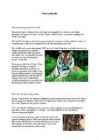
Rare animals Rare Chinese tiger seen in the wild Researchers have confirmed that a wild tiger, photographed by a farmer in the Qinba Mountains of Shaanxi Province, Central China, is indeed that of the critically endangered South China tiger. The South China tiger classified as one of only five subspecies of tiger still alive today is extremely rare, with only an estimated 20 to 30 still remaining in the wild. The wildlife and conservation group WWF says the South China tiger is actually native to the Hainan most forests of south-east China, and because there are so few individuals left, it is regarded by many scientists as being "functionally extinct" in the wild. But a group called Save China's Tigers has been working on a captive- breeding programme and hopes to reach an agreement with China's State Forestry Administration to reintroduce captive-bred animals into the wild. If
Subject: Animals in danger of extinction Date: 20.04.11 The aim of this report is to make an overview of the status of wild animals in the world. The report is based on up-to-date statistics related to the topic. There are several disappointing facts and figures. a) Over the last couple of years the list of animals in danger of extinction has grown rapidly. The International Union for Conservation of Nature (IUCN) has calculated the percentage of endangered animals as 40 percent of all organisms. Recent research indicates that 70% of the world's most threatened mammal species are currently receiving little or no conservation attention.On 29 January 2010, the IUCN Red List of Threatened Species identified 842 extinct species and subspecies. b) The rarest animal on Earth today is the Pinta Island Tortoise (originating from the Galapagos Islands) , which is critically endangered, since there is only
Natural Zones and Flora. There are five distinguishable natural zones in Australia. In the very east there are wet forests (1.) that occupy the space between the Great Dividing Range and the eastern coast. Westward from the Great Dividing Range the wet forests give place to beautiful grasslands with some trees . These grasslands are called the savannas (2.). Farther west the trees disappear and the bushlands (3.) begin. The real desert (4.) occupies the centre of the Western Plateau. In the very southwest there are thin forests of evergreen trees (5.). Most of Australian trees are kinds of eucalyptus trees (or gum trees to Australians) and acacia ( wattle to Australians). Eucalyptus trees are found everywhere in Australia
The seas and oceans that wash the coasts of Australia are warm. The Coral Sea is the warmest that is why many corals live in the seas. The skeletons of these tiny organisms have formed a great belt of coral- called the Great Barrier Reef. Its is 2000 km long and 2-150 km wide. There are five distinguishable natural zones in Australia. In the very east there are wet forests that occupy the space between the Great Dividing Range and the eastern coast. The wet forests give place to beautiful grasslands with some trees called the savannas. Farther west the trees disappear and the bushlands begin. The real desert occupies the centre of the Western Plateau. In the very southwest there are thin forests of evergreen trees. Most of Australian trees are kinds of eucalyptus (or gum tree to Australians) and acacia (wattle of Australians). Eucalyptuses give the people timber and eucalyptus oil.
During the brief summers, the top section of the soil may thaw out allowing plants and microorganisms to grow and reproduce. However, these plants and microorganisms become dormant during the cold winter months. Soil is formed slowly. The constant freezing and thawing in the tundra helps to break the rocks into smaller pieces. Permafrost consists mostly of gravel and finer material. The arctic tundra is also a windy place and winds can blow between 48 to 97 kilometres. The tundra is basically like a desert when it comes to precipitation. Only about 150-250 millimetres of precipitation (mostly snow) fall each year. When water saturates the upper surface, bogs and ponds may form, providing moisture for plants, and breeding thousands of insects that attract many migrating birds. Animals are adapted to handle cold winters and to breed and raise young quickly in the very short and cool summers
Many diseases could be caused by air pollution without their becoming apparent for a long time. Diseases such as bronchitis, lung cancer, and heart disease may all eventually appear in people exposed to air pollution. Air pollutants such as ozone, nitrogen oxides, and sulfur dioxide also have harmful effects on natural ecosystems. They can kill plants and trees by destroying their leaves, and can kill animals, especially fish in highly polluted rivers. SOLUTIONS Air pollution has many disastrous effects that need to be curbed. In order to accomplish this, governments, scientists and environmentalists are using or testing a variety of methods aimed at reducing pollution. There are two main types of pollution control. Input control involves preventing a problem before it occurs, or at least limiting the effects the process will produce. Five major input control methods exist
It is three kilometers long and 348 metres high. There is another 2000 meters under the ground. Uluru is 600 000 000 years old and it is the largest rock in the world. The Great Barrier Reef. One of the natural wonders of the modern world is the Great Barrier Reef. It is located off the northeast coast of Australia. It is the biggest coral reef in the world extending 2000 kilometers along the coast of Queensland. It consists of more than 600 coral islands. Some of them are true coral islands, other are the tops of submerged mountain ranges covered with lush tropical growth. Most of the islands are inhabited and many of them have been developed as tourist resorts. Scientists estimate that the reef is more than thirty million years old. It had its beginning as a tiny animal known as the polyp. It protects itself by forming an external skeleton of lime. When it dies its shell hardens. It has been growing for thirty million years. There are more
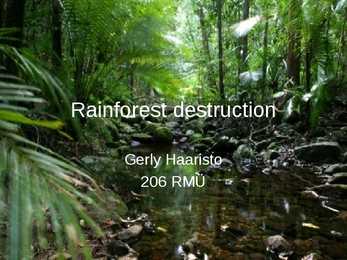
Vihmametsa hävitus põhjused. · Logging · Agriculture · Fuelwood- küttepuud · Large Dams- suured tammid · Mining and industry- kaevandus ja tööstus. · Tourism turism. · Poverty and overpopulation vaesus ja ülerahvastatus. · Colonialism kolonialism. Why save it? · The rainforest is home to over · Vihmamets on koduks rohkem fifty percent of all plants and kui 50 % maa loomadele ja animals on earth. It is the taimedele. See on maa elav earth's living lung--it breathes kops see hingab sisse karbon in carbon dioxide and breathes dioksiide ja hingab välja out oxygen. Some rainforests hapniku. Mõned vihmametsad are an unexplored frontier, with on uurimata piiralaga, kus on all kinds of new animals and igasuguseid uusi loomi ja isegi even new tribes of people. The uusi inimeste hõime. NWF pani
grown on the African oil palm tree. Oil palms are originally from Western Africa, but can flourish wherever heat and rainfall are abundant. Today, palm oil is grown throughout Africa, Asia, North America, and South America, with 85% of all palm oil globally produced and exported from Indonesia and Malaysia; but most of the time not using sustainable measures. The industry is linked to major issues such as deforestation, habitat degradation, climate change, animal cruelty and indigenous rights abuses in the countries where it is produced, as the land and forests must be cleared for the development of the oil palm plantations. According to the World Wildlife Fund, an area the equivalent size of 300 football fields of rainforest is cleared each hour to make way for palm oil production. This large-scale deforestation is pushing many species to extinction, and findings show that if nothing hanges, species like the
Conditions of the productive animals in farms. The inescapable fact is that the conditions in big farms, especially in factory farms, are unacceptably bad. Recent proof of that was the Põima farm case in Estonia were 260 cows are starving. Animals are wet because of their own excrements, some spots on their body are furless, their bones poke out from their skin and they can hardly stand up. What is more, they do not have food or litter, so they lie on cold cemented floor that is covered with dung. This problem is not actual only in Estonia.Also the reality of Finnish factory farming was recently revealed. Producers arguments as there are severe problems related to intensive
Savanna A savanna is a grassland ecosystem with scattered trees or shrubs. In savannas trees are small or widely spaced so that the canopy does not close. It is often believed that savannas are characterized by widely spaced, scattered trees, however in many savanna communities tree densities are higher and trees are more regularly spaced than in forest communities. The open canopy allows sufficient light to reach the ground to support an unbroken herbaceous layer consisting primarily of C4 grasses. Savannas are also characterised by seasonal water availability, with the majority of rainfall being confined to one season of the year. Savannas can be associated with several types of biomes. Savannas are frequently seen as a transitional zone, occurring between forest and desert or prairie.
Animal rights movements and their views on hunting Koostaja: In Wikipedia there are listed 34 animal rights organizations [8], so in this report author has picked out some of these organizations and will introduce their views on game management and hunting. First hypothesis before deeper research is that all such organizations are against all sort of hunting. When mentioned animal rights people usually think about people fighting against wearing furs and keeping animals in cages, but when delving deeper into this there are many problems that animal rights organizations/ movements are addressing. There are also those organizations that have not made any statements about hunting, some of those concentrate only on pets (mostly cats and dogs) but some just don’t mention hunting in any way. These types of organizations have been left out from this report. Below are listed some organizations, their goals and views on hunting.
It is impossible to capture on film, to describe in words, or to explain to those who have never had the awe-inspiring experience of standing in the heart of a primary rainforest. Rainforests have evolved over millions of years to turn into the incredibly complex environments they are today. Rainforests represent a store of living and breathing renewable natural resources that for eons, by virtue of their richness in both animal and plant species, have contributed a wealth of resources for the survival and well-being of humankind. These resources have included basic food supplies, clothing, shelter, fuel, spices, industrial raw materials, and medicine for all those who have lived in the majesty of the forest. However, the inner dynamics of a tropical rainforest is an intricate and fragile system. Everything is so interdependent that upsetting one part can lead to unknown damage or even destruction of the whole
an island but rather small for a continent. Australia is 1,800 miles from the mainland of Asia and almost half way round the world from Europe. More than 6,000 miles of ocean separate in from the America. Australia is the only continent except for Antarctica that lies all south of the equator. The natural zones of Australia are very various. There are deserts, semi deserts, grasslands, savannas, bushlands and rainforests. The wet forests occupy the narrow region in the east. Most of the animals, birds and insects live in that region, because there is enough food. The savannas which are grasslands with some trees are mostly in the west. Farther west are the bushlands. The real deserts occupy the centre of the Western Plateau. In the very south west there are thin forests of evergreens trees. Australia is the driest inhabited continent, the flattest, and has the oldest and least fertile soils. Only the south-east and south-west corners of the continent have a temperate climate
1. Key features for all studied biomes. Tundra The main seasons are winter and summer. The tundra is the world's coldest and driest biomes. The average annual temperature is -28° C. Nights can last for weeks when the sun barely rises during some months in the winter, and the temperature can drop to -70° C. During the summer the sun shines almost 24 hours a day. Summer are usually warm. Average summer temperatures range from 3° to 16°C. TaigaTaiga is the Russian word for forest and is the largest biome in the world. It stretches over Eurasia and North America. The taiga is located near the top of the world, just below the tundra biome. The winters in the taiga are very cold with only snowfall. The summers are warm, rainy, and humid. Some of the animals in the taiga hibernate in the winter, some fly south if they can, while some just cooperate with the environment. GrasslandsGrassland biomes can be found in the middle latitudes
Distilled water(doesn't contain CO 2), has pH level 7. Liquids with pH level less than 7 are acidic, liquids with pH level greater than 7 are alkaline. Unpolluted rain has a pH level over 5.7, so it is slightly acidic. Affected areas Places significantly impacted by acid rain around the globe include most of eastern Europe from Poland northward into Scandinavia, the eastern third of the United States and southeastern Canada. Other affected areas include the southeastern coast of China and Taiwan Causes · It is caused when sulfur dioxide and nitrogen oxides are released into the air. In the atmosphere they react with water, oxygen and other chemicals to form more acidic pollutants, known as acid rain. Sulfur dioxide and nitrogen oxides dissolve very easily in water and can be carried very far by wind
Living in the countryside a pleasant experience or a never-ending hardship? People have always had a choice where they want to live. Many years ago, a most of people did not have a choice where to live. It used to be that poor people lived in the countryside and rich people in the city. Nowadays it has changed. People can choose and most of them choose to live in the city. City and countryside are both different places where to live. Both have their positive and negative sides. There are differences in the environment, in job opportunities and how expencive or cheap is to live in the countryside. Those differences are making people to think about advantages and disadvantages of living in a countryside. There are several advantages, why to live in the countryside. First, environment in the countryside is very different. There is less pollution and there is no danger because there are no´t
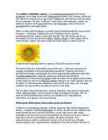
andma) to all plants of the genus(perekond, sugu) Helianthus, many of which are perennial(alaline, aastaringne) plants. What is usually called the flower is actually a head (formally(ametlikult) composite(liit-, komposiit- ; korvõieline, komposiit) flower) of numerous flowers (florets) crowded(täistuubitud, tunglev, rahvarohke) together. The outer flowers are the ray florets(pähik (õisiku osa) and can be yellow, maroon, orange, or other colors, and are sterile(steriilne, viljatu). The florets inside the circular head are called disc florets. Sunflower head displaying florets in spirals of 34 and 55 around the outside The florets within this cluster(kobar, kimp, klaster, parv ; kobarasse kogunema) are arranged (korraldatud, ettekavatsetud)spirally(spiraalselt). Typically each floret is oriented(suunitlusega) toward(poole) the next by approximately(umbkaudu, ligikaudu)
cooling, cleaning, preparing food, transportation, and communication devices. They discovered that the amount of energy used for any purpose could be measured in different ways. Light bulbs are measured in watts. Air conditioners and hot water heaters are measured in BTUs, while energy used by cars is measured in gallons of fuel. They used a spreadsheet to figure out how much energy they consumed for each of their activities. Each of the lights, car miles, games, and other appliances was converted to a common unit of power consumption called kilowatt-hours. The spreadsheet was used to determine how many kilowatt-hours were used during each day, each week, and each year for each energy consumption activity. The spreadsheet converted their energy consumption to show them the amount of money it costs for each energy consumption activity. In the end, they were shocked to see how much money Jules' energy using habits cost compared to Les' habits. USES OF ENERGY
Australians. The flag with its colours of red (representing the land), black (representing the people) and the yellow in the middle (representing the sun) is a source of pride for Indigenous Australians. The present coat of arms was granted by King George V in 1912. It consists of a shield containing the badges of six Australian states, enclosed by an ermine border. The shield is a symbol for the federation of the states, which took place in 1901. The crest, which is above the shield, is a seven-pointed gold star on a blue and gold wreath. The seven points of the star represent exactly the same thing that they do on the flag. The supporters of the shield are native Australian animals: the red kangaroo and the emu. Usually the coat of arms is depicted on the background of sprays of golden wattle with a scroll beneath it containing the word `Australia'.
Tallinn English College Topic Great Britain 2007 1. Introduction The official name of Great Britain is `the United Kingdom of Great Britain and Northern Ireland (or short United Kingdom)' The population is about 60.4 million. The capital is London. Other biggest cities include Birmingham, Bristol, Portsmouth, Glasgow and Swansea. English is the main language of Great Britain, but Welsh is officially recognized in Wales and Gaelic in Scotland. 2. Geographical position The British Isles is the geographical term for a group of about 5000 islands off the coast of mainland Europe. The largest island is Great Britain, which is also the largest island in Europe. It consists of England, Wales and Scotland. The next largest island is
Global Warming One of the biggest issues our planet and its inhabitants are facing nowadays is global warming. Global warming, also often referred to as the greenhouse effect, has not always been a problem. However, over the last centuries, since the Industrial Revolution things have changed. Polar regions are melting, species are dying, climate zones are shifting, migration patterns for animals such as polar bears and birds are being disrupted our world as we know it is changing. Some scientists believe that the climate will reach a tipping point, a point at which even a tiny additional increase would throw the system into violent change. We started doing harmful things and only now do we realize what we have done and what we are doing. At this current rate by the middle of next century the Earth's temperature may rise a predicted from 2 to 6 degrees Celsius
No trees grow in the tundra so houses can not be made from wood unless it is transported from elsewhere. However, during a large part of the year, the cold part, there is a lot of snow in the tundra. And it turns out that snow can be a very good construction material. In the winter, Inuit lived in round houses made from blocks of snow called "igloos". In the summer, when the snow melted, Inuit lived in tent-like huts made of animal skins stretched over a frame. Although most Inuit people today live in the same community year-round, and live in homes built of other construction materials that have to be imported, in the past Inuit would migrate between a summer and winter camp which was shared by several families. Getting Around To travel from one place to another, Inuit used sleds made of animal bones and skins pulled over the snow and ice by dogs. Strong dogs with thick fur like huskies, bred by Inuit, were used. On
 annaabi.ee