ELECTRIC CARS 2016 Electric car – what is it? • Powered by one or more electric motors, using electrical energy • Energy is stored in rechargeable batteries or another energy storage device • Require charging. Can be charged from home or special station History • First electric cars were produced in 1880s • Were popular in 19th and 20th cebtury •Then ICEs became more advanced Advantages • 3 x more efficient as ICE • Quieter • Do not emit tailpipe pollutants • Instant, strong and smooth acceleration • Lower running costs • Government discounts Disadvantages • Battery wears out over time • Batteries are expensive • Limited driving range (best range Tesla S – about 400km) • Charging takes a long time (unless using superchargers) • Lack of charging stations
of energy and good health. Sangaste castle Sangaste castle was once the home of Count Fredrich Georg Magnus von Berg (1845-1938), whose most notable achievement was the breeding of winter- rye. He became deaf 50 years before his death. Otepää church The tricolour flag of estonia dates from the 1880s, when it was the flag students` society.It was first used as a national flag in 1918.The blue represents the country beautiful blue skies, seas, and lakes; the black represents the rich soil of the land, and the white represents winter snows and the countery`s long fight for independence. Famous athletics live in Otepää Andrus Veerpalu
Art nouveau Beginning There was a reaction against the cluttered designs and compositions of Victorian-era decorative art, --------> the second was the current vogue for Japanese art, particularly wood-block prints, that swept up many European artists in the 1880s and 90s, including the likes of Gustav Klimt, Emile Gallé, and James Abbott McNeill Whistler. Art Nouveau, ornamental style of art that flourished between about 1890 and 1920 throughout Europe and the United States. Art Nouveau was aimed at modernizing design Artists drew inspiration from both organic and geometric forms, evolving elegant designs that united flowing, natural forms resembling the stems and blossoms of plants
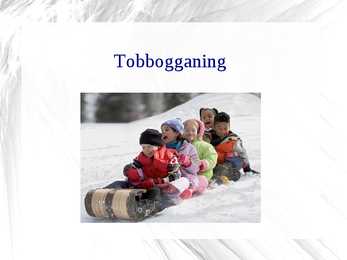
of changes and modification. Tobogganing is the forerunner of bobsledding The only kind of a sled used today, is the bobsled with fancy racing colors. How it works? Aerodynamics takes a huge part in this. Every member of the team pushing with all their might. Who could make it down the farthest. Tobogganing as sport Probably originated on the slopes of Mount Royal in Montreal. During the late 1880s it spread to the United States, where it had considerable popularity until the early 1930s. During the heyday of tobogganing, many artificial chutes were constructed. Sides of ice or wood and frequently were built with several parallel tracks to accommodate more than one toboggan at a time. The chutes were quite steep Speeds of up to 60 miles (96.6 km) per hour were attained. Many of the chutes are still in use. Penguins way of moving on ice is also
ancient ruler of Estonia. Another achievement of this period was the establishment of Estonia's first regularly published Estonian-language newspaper, Perno Postimees , originally published in Pärnu by Johann Voldemar Jannsen in 1857. In 1878 Carl Robert Jakobson established the newspaper Sakala , which would soon become a major promoter of the cultural renaissance. Jakob Hurt, a schoolteacher and Lutheran minister, organized a collection of folk songs in the 1880s and gave several speeches extolling the value of Estonian culture. Estonia capital of culture is Tallinn
Some of the books he wrote are: "Story of the American Flag" Profusely illustrated. "The Real Abraham Lincoln" "The Life of Alexander Hamilton" "The Real Robert Morris" (A Pennsylvania banker known as "the financier of the American Revolution.") "Story of the Great Seal of the United States." "History of American Emblems" "The History of American Heraldry" The Father of Flag Day Bernard J. Cigrand was first and foremost an American patriot. From the 1880s through the 1930s, he preached respect and honor for the nation and its flag. In 1885, however, Cigrand still a teenager and only at the beginning of his journey. He entered dental college later that year, mixing his professional studies with the promotion of the flag. In June 1886 he made his first public proposal for the annual observance of the birth of the flag when he wrote an article titled "The Fourteenth of June" in the old Chicago Argus newspaper.
and may have made one in 1864. He is considered by many Italians as the inventor of the telephone. Johann Philipp Reis - In 1860 Reis was the first who produced a functioning electromagnetic device that could transmit musical notes, indistinct speech, and occasionally distinct speech by means of electric signals. Antonio Meucci - An early voice communicating device was invented around 1854 by Antonio Meucci, (who called it a telettrofono.) In the 1880s Meucci was credited with the early invention of inductive loading of telephone wires to increase long-distance signals. Unfortunately, serious burns from an accident, a lack of English, and poor business abilities resulted in Meucci failing to develop his inventions commercially in America. Alexander Graham Bell is commonly believed as the inventor of the first practical telephone. Bell was born on March 3, 1847, in Edinburgh, Scotland, and educated at the universities of Edinburgh and London
Mississhippi. / He wrote about his experiences in his book Life on the Mississhippi. 3 The Civil War broke out in 1861 / He travelled on the West, where he started working as a journalist and took Mark Twain as his pen name. 4 In 1870 he got married and went to live in Hartford, Connecticut / Amond these were The Adventures of Tom Sawyer and The Adventures of Huckleberry Finn, which describes the adventures of a boy and black slave, Jim. 5 In the 1880s Mark Twain opened his onw publishing house but it wasn´t a success. / However, his books were nos less humorous than his earlier works. He was also popular as a lecturer in different parts of the world and returned to the United States as a hero. 6 His oldest daugher died in 1896 and eigh years later he lost his wife / On 21 April 1910 Mark Twain died of heart disease.
In 1801, this colonial parliament was abolished and Ireland became an integral part of a new United Kingdom of Great Britain and Ireland under the Act of Union. Catholics were still banned from sitting in that new parliament until Catholic Emancipation was attained in 1829, the principal condition of which was the removal of the poorer, and thus more radical, Irish freeholders from the franchise. The Irish Parliamentary Party strove from the 1880s to attain Home Rule self-government through the parliamentary constitutional movement eventually winning the Home Rule Act 1914, though suspended on the outbreak of World War I. In 1922, after the Irish War of Independence, the southern twenty-six counties of Ireland seceded from the United Kingdom (UK) to become the independent Irish Free State -- and after 1948, the Republic of Ireland. The remaining six north eastern counties, known as Northern Ireland, remained part of the UK.
The Dog Fence When you think about the world's longest manmade structures, China and Great Britain (Stonehenge) spring to mind. Very rarely does the Australian continent get a mention, which is a shame, because the Dog Fence, or Dingo Fence, is the longest structures on earth. The Dingo Fence is a barrier that was built in Australia during the 1880s and finished in 1885.This fence was built only on one purpose: to stop dingoes (Australia’s wild dogs) from killing sheep. It is one of the longest structures on the planet, and the world's longest fence. it’s 3,307 miles long. That makes about 5,320 km. That is about two and a half times longer than the Great Wall of China. The fence starts near the coast of Great Australian Bight and ends up in the eastern part of Queensland in the Bunya Mountains, not far from the Pacific Ocean.
The Victorian Era was named for Queen Victoria. [10] Later years Victoria never fully recovered from Albert's death in 1861 and she remained in mourning for the rest of her life. Her subsequent withdrawal from public life made her unpopular, but during the late 1870s and 1880s she gradually returned to public view and, with increasingly pro-imperial sentiment, she was restored to favour with the British public. After the Indian Mutiny in 1857, the government of India was transferred from the East India Company to the Crown. In 1877, Victoria became empress of India. Her empire also included Canada, Australia, New Zealand, and large parts of Africa.
Product) grew 8% in 2007 alone. In the first quarter of 2008, however, GDP grew only 0.1%. Estonia is nearly energy independent, producing 90% of its electricity needs with locally mined oil shale. Oil shale energy along with electronics, banking and IT solutions are some of the key sectors of the economy. The flag of Estonia is a tricolour featuring three equal horizontal bands of blue, black and white in the downwards order. The Estonian flag first came to prominence in the 1880s as the flag of the Estonian Students' Society at the University of Tartu. The flag became associated with Estonian nationalism and was used as the national flag when the Declaration of Independence was issued in 1918. During occupations, the flag has been banned several times. In a good, snowy winter, the Estonians' favourite leisure activity is probably skiing. In spring, Estonians often leave the cities for the weekends. Many families have a cottage in the countryside
British made an attempt to understand the unknown culture and failed. The Aborigines also did not like the idea of bringing British criminals to their native land. Thousands were killed by diseases the British brought with them. When they fought back whole tribes were massacred. The Aborigines who survived were put into reservations and church missions (which often have been like prison camps). So-called pacification by force culminated in the late 1880s, leading to a massive depopulation and extinction for some groups. By the 1940s almost all aborigines were missionized and assimilated into rural and urban Australian society as low-paid laborers with limited rights; many aborigine children were taken from their natural parents and given to foster parents to promote assimilation. Nowadays many Aborigines live in the desert area, there are estimated of 200 000 of them in all over Australia. They have begun to forget their traditions and heritage
Subsidiary artists: James A. M. Whistler, John S. Sargent, Eastman Johnson, Frank Duveneck, William M. Chase, Thomas P. Anshutz, John F. Weir, William M. Harnett, John F. Peto. Romanticism. Romanticism persisted but was altered after the Civil War. Spiritual essence and mood stood above story and idea. Artists: William M. Hunt, John La Farge, Albert P. Ryder, Ralph A. Blakelock. Impressionism. Direct reaction to Impressionism occurred during the 1880s. Hassam painted urban scenes which were an innovation in American painting. An informal alliance, "The Ten", emerged who by way of Impressionistic paintings that refreshed the image of America (cityscapes, gardens, parades, society, landscapes). Artists: Theodore Robinson, Frederick C. Hassam. C20 till WWI General Trends. In early-C20, national consciousness started to develop. Sympathy was expressed for the oppressed workers
Subsidiary artists: James A. M. Whistler, John S. Sargent, Eastman Johnson, Frank Duveneck, William M. Chase, Thomas P. Anshutz, John F. Weir, William M. Harnett, John F. Peto. Romanticism. Romanticism persisted but was altered after the Civil War. Spiritual essence and mood stood above story and idea. Artists: William M. Hunt, John La Farge, Albert P. Ryder, Ralph A. Blakelock. Impressionism. Direct reaction to Impressionism occurred during the 1880s. Hassam painted urban scenes which were an innovation in American painting. An informal alliance, "The Ten", emerged who by way of Impressionistic paintings that refreshed the image of America (cityscapes, gardens, parades, society, landscapes). Artists: Theodore Robinson, Frederick C. Hassam. C20 till WWI General Trends. In early-C20, national consciousness started to develop. Sympathy was expressed for the oppressed workers
a second home for humanity. The first men and women to go to Mars are going there to stay. Answer the following questions: 1 What kind of rockets did the Chinese make in the 13th century and what were they used for? 2 How were these rockets used in the 15th and 16th century in North America and Europe? 3 What did the British learn from their defeat in Seringapatam, India? 4 What other fields of application the rockets had by the 1880s? 5 Which invention made the rockets even more powerful and where did it lead to? 6 How did the Germans use rockets in the World War II? 7 Speak about the first steps in conquering the space. 8 How long have people explored the Mars and which invention enhanced the exploration? 9 Find the main points about the Mars One mission. 10 What is the difference between a cosmonaut, astronaut and taikonaut?
A bookmark is a thin marker, commonly made of paper or card, used to keep one's place in a book. Bookmarks were used throughout the medieval period, consisting usually of a small parchment strip attached to the edge of folio (or a piece of cord attached to headband). Bookmarks in the 18th and 19th centuries were narrow silk ribbons bound into the book and become widespread in the 1850s. They were usually made from silk, embroidered fabrics or leather. Not until the 1880s did paper and other materials become more common. Some large reference books such as dictionaries may have a thumb index which is a round cutout in the pages with some printing, allowing the user to see approximately where the wanted entry may be, and open the book to the appropriate section, without looking at the table of context, or index. The process of physically assembling a book from a number of folded or unfolded sheets of paper is bookbinding.
far out-numbering the southern whites. [3, p.35] The nineteenth century saw a massive increase in American immigration, as people fled the results of revolution, poverty, and famine in Europe. Large numbers of Irish came following the potato famine in Ireland in the 1840s. Germans and Italians came, escaping the consequences of the failed 1848 revolutions. And, as the century wore on, there were increasing numbers of Central European Jews, especially fleeing from the pogroms of the 1880s. In the first two decades of the twentieth century, immigrants were entering the USA at an average of three-quarters of a million a year. In 1900, the population was just over 75 million. This total had doubled by 1950. [3, p.35] Within one or two generations of arrival, most of these immigrant families had come to speak English, through a natural process of assimilation. Grandparents and grandchildren found themselves living in very different linguistic worlds
national movement. Liberal and socialist anti-monarchy ideas reached Estonia both from the West and East and began spreading rapidly. Workers' movements emerged and the first strike was organised in the Narva Kreenholm factories (1870). On the initiative of politically radical students who had come to (the now Russian-language) Tartu University from all over the tsarist empire, the first Marxist organisations sprang up in the 1880s. During the ever more vigorous period of industrialisation in the second half of the 19th century, large textile, metal and machine works, as well as timber, paper, cellulose and foodstuff enterprises and factories were established in Estonia. A railway network connecting Estonia with the domestic
gender and society issues, position of the woman. Ivory Tower (an ideal place disconnected from the real world where academics and artists find refuge). The role of the artist; setting art aside means death for the artist. Decadence/aestheticism and Oscar Wilde Appeared in the 1880s–90s, i.e. late Victorian era. Decadence used in Continental Europe, aestheticism in England. Abandonment of Victorian society. Proud of being different from the philistines (the middle class of Victorian society that were not interested in art and proud of it).
it was during his lifetime that she was most active as a ruler. Britain was evolving into a constitutional monarchy in which the monarch had few powers and was expected to remain above party politics, although Victoria did sometimes express her views very forcefully in private. Victoria never fully recovered from Albert's death in 1861 and she remained in mourning for the rest of her life. Her subsequent withdrawal from public life made her unpopular, but during the late 1870s and 1880s she gradually returned to public view and, with increasingly 6 pro-imperial sentiment, she was restored to favour with the British public. After the Indian Mutiny in 1857, the government of India was transferred from the East India Company to the Crown. In 1877, Victoria became empress of India. Her empire also included Canada, Australia, New Zealand, and large parts of Africa
of Nathaniel Hawthorne's The Scarlet Letter (1850). Later Transcendentalist writers such as Henry David Thoreau and Ralph Waldo Emerson still show elements of its influence and imagination, as does the romantic realism of Walt Whitman. The poetry of Emily Dickinson--nearly unread in her own time--and Herman Melville's novel MobyDick can be taken as epitomes of American Romantic literature. By the 1880s, however, psychological and social realism was competing with romanticism in the novel. The first great American writer of this period was Washington Irving, whose Sketch Book of Geoffrey Crayon, first published in 1819, was a sensation in England and helped build the United States' reputation for creative literature. Over the remainder of his career, which included Tales of the Alhambra and many other books, Irving was the most famous and most widely respected literary figure in America
monumental Dialectological Atlas of the Russian Language ( [dlktitskj ats ruskv jzka]), was published in three folio volumes 19861989, after four decades of preparatory work. Orthography Russian spelling is reasonably phonemic in practice. It is in fact a balance among phonemics, morphology, etymology, and grammar; and, like that of most living languages, has its share of inconsistencies and controversial points. A number of rigid spelling rules introduced between the 1880s and 1910s have been responsible for the former whilst trying to eliminate the latter. The current spelling follows the major reform of 1918, and the final codification of 1956. An update proposed in the late 1990s has met a hostile reception, and has not been formally adopted. The punctuation, originally based on Byzantine Greek, was in the 17th and 18th centuries reformulated on the French and German models.
may be impossible to identify.) If a male inherits 1 red gene he will be red. If he inherits 1 red gene AND dilution gene he will be cream. If he inherits 1 red gene AND dilution gene AND caramelising gene he will be apricot. In reds, there are genes for rufism i.e. for the depth of the red colour. This is why show- quality reds are a rich, deep red colour while alley cats are more often marmalade or ginger. Early reds (1880s) were known as yellows; the depth of colour was improved over many generations of selective breeding. In 1924, a series of breeding experiments between a Siamese female and a tabby male resulted in black offspring that themselves produced tabby offspring. This suggests a gene for black that is dominant to tabby, the opposite of the known behaviour of tabby and black! It is possible that the Siamese female, one of a pair imported from Bangkok, had a mutation for
those deductions wrong. Presenter Do you mean they used a 7 wish I hadn't voiced 2 1 c 2 d 3 b 4 b 5 c 6 a 8 object to me / my wearing CT scan? 7 a 8 d 9 c 10 b Moira No, they couldn't; it was in the 9 if she hadn't seen 1880s. But modern scientists have. 10 is said to have been invented Geffen and his team applied to Egypt's Review 1 page 97 2 1 a 2 b 3 d 4 a 5 c 6 c Supreme Council of Antiquities, and 1 1 about 7 aside
Bornhöhe (1862-1923), Tasuja (Avenger), novels by Andres Saal (1861-1931), such as 1 Its subject matter included articles about Estonian and European music, musicians, folk music, composing, etc. Vambola. These were romantically inspired scenes from the heroic and desperate struggle against the German knightly orders in the 13th and 14th centuries. Under the harsh conditions of the Russification programme initiated in the 1880s such books stimulated the national spirit and willpower to resist all alien oppression. The poetess and playwright Lydia Koidula (1843-1886, daughter of Johann Voldemar Jannsen) played an exceptionally important role in the two decades before her death; her poetic talent emotionally and inspirationally expressed the national spirit, glorifying her homeland and its people. Koidula’s song, Mu Isamaa on Minu Arm (My
 annaabi.ee