Leidsid 33 sarnast õppematerjali, mis on seotud failiga "Tigutorn". Need materjalid aitavad sul teemat sügavamalt mõista.
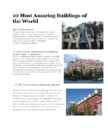
building, tigutorn, floors, height, discussion, tall, march, construction, suit, located, shore, emajõgi, highest, residential, designed, künnapuu, padrik, bottom, upper, structure, seashell, spiral, built, july, achievement, full, connection, compete, church, opinions, good, projects, pläsku, seem, landmarks, could, however, suitable, based, listening10 Most Amazing Buildings of the World The Crooked House Though it looks like some sort of painting by a drunk painter. But this is a real house located in Rezydent Shopping Center in Sopot, Poland. It is claimed to be the most photographed building in Poland. It is spread to an area of 4,000 square meters. Designed by Architect: Szotynscy Zaleski 2. Forest Spiral - Hundertwasser Building Architect: Heinz M. Springmann This is a residential building complex located in Darmstadt, Germany. The building has a unique façade which doesn’t follow a regular grid pattern and the windows appear as if they are dancing out of line and appear out of order. It was designed by Viennese artist Friedensreich Hundertwasser and finally planned and implemented by architect Heinz M. Springmann. It contains 105 apartments, an inner courtyard, a small artificial lake and also a playground for children. The building has 12 floors. 3. The Torre Galatea Figueras (Spain)
EHITUSTEADUSKOND Ehitustootluse instituut KUIDAS MUUDAB MUDELPROJEKTEERIMINE TERASKONSTRUKTSIOONIDE PROJEKTEERIMIST, VALMISTAMIST JA EHITAMIST? HOW ARE 3D AND BIM CHANGING THE DESIGN, FABRICATION AND CONSTRUCTION OF COMPLEX STEEL STRUCTURES? EPJ 60 LT Üliõpilane: Tanel Friedenthal Juhendaja: Prof. Roode Liias Kaasjuhendaja: Prof. Carrie S. Dossick Tallinn, 2010.a. Olen koostanud lõputöö iseseisvalt. Kõik töö koostamisel kasutatud teiste autorite tööd, olulised seisukohad, kirjandusallikatest ja mujalt pärinevad andmed on viidatud.
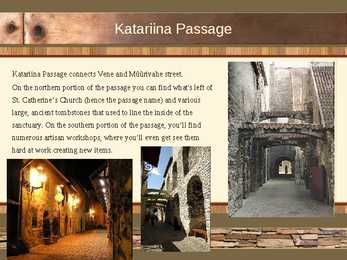
St. Catherine's Church (hence the passage name) and various large, ancient tombstones that used to line the inside of the sanctuary. On the southern portion of the passage, you'll find numerous artisan workshops, where you'll even get see them hard at work creating new items. City wall Tallinn's medieval city wall is a sub-facility that was built to protect the lower Tallinn and upper Tallinn (Toompea). The building of the city wall began in 1310th years, and by improving over time it formed the city wall with defensive buildings (towers). It was finished by the end of the 1561. Then it was 2.35-kilometer-long circular wall, which had 27 wall gate, 8 tower gate and 21 other stone fortifications. Many parts of the town wall have survived until today Great Coastal Gate (Suur Rannavärav) and Fat Margaret's Tower (Paks Margareeta)
Estonians became conscious of their national identity. Tartu was the centre of the movement of national awakening. On 24 February 1918, Estonia was proclaimed an independent democratic republic. Tallinn developed into a modern European capital. A period of prosperity followed, but independence only lasted for 20 years. During World War II Estonia was occupied by both German and Russian invaders, and Tallinn suffered heavily. The bombing of the city by the Soviet air forces on 9 March 1944 left over 20,000 people homeless. During the Russian occupation which followed (and which lasted for five decades) attempts were made to Russify the local people. Large scale industry was developed in Tallinn, workers were resettled from Russia and new blocks of flats sprang up on the outskirts to provide housing for the newcomers. Tallinn was the biggest grain-handling port in the Soviet Union. Russian speakers outnumbered Estonians in Tallinn.
was toppled by the Danes shortly after 1219 - who then constructed an impressive stone edifice, much of which still remains today. In the summer of 1227 the castle at Toompea was conquered by the Order of the Brothers of the Sword, who remained there for the following ten years and played a key role in the history of the development of Toompea. The Order divided the stronghold into two parts: castrum maius or the Great Castle, and castrum minus or the Small Castle. The Great Castle was located in the place where the Dome Church stands today and it became an episcopal centre. The Small Castle stood in the same place as today’s castle and became the centre of secular power. Immediately after the conquest the Order started to fortify the hill. The first castle- type stone fortess (the Small Castle) was built in the southwestern corner of the hill in 1227-1229, perfectly protected by deep moats and towers. You can see one of them on the south-west corner of the castle -it´s Pikk
Baroque, Neoclassicicm, Historicism and even Art Nouveau. The origin of the name "Lai" Lai Street belongs among the oldest streets of Tallinn. Despite its length and width its share in the city's inner traffic is fairly modest. The extraordinary width of the street is likely due to the fact that the town wall used to be there and the street then sprang up on both sides of the city wall. But that city wall was eliminated in the construction of a new wall to the west. The freed area became a beautiful wide street with local significance, its main purpose was to create a link between the monastery of St Michael's female Cistercians (founded in 1294) and St Olaf's church. Previous names of the street also refer to it: Susterstrate 1361; Platea sororum 1364-1380; 1606 Süsterstrasse and Schwestergasse, all of which include the concept of a nun or a sister.
Tallinn in 1870. Tallinn grew into a major port and an industrial centre, with huge shipyards. Interest in culture grew and Estonians became conscious of their national identity, dreams of independence gained ground. On 24 February 1918 Estonia was declared an independent country and Tallinn became the capital of the Republic of Estonia. During World War II Estonia was occupied by both German and Russian invaders and Tallinn suffered heavily. The bombing of the city by the Soviet air force on 9 March 1944 left over 20,000 people homeless. During the Russian occupation which followed attempts were made to Russify the local people. Estonia re-established its independence on 20 August 1991. Toompea Toompea is the oldest and the most respectable part of the city. For centuries there was only one means of access to Toompea Pikk Jalg Street. In the middle of the 15th century the Lower Town fenced itself off with these walls from the Upper Town because
the Great Fire of London. London Bridge The home of the London Bridge is the Thames River, and a bridge has existed on the spot for at least the last 2000 years. The first bridge on record was constructed by the Romans, and since then many bridges have risen at the hands of various empires. London Bridge today remains one of the most popular tourist attractions in Britain as well as an icon for the City of London. London Bridge history records the building of a wooden bridge by the Romans about 2000 years ago. Historians suspect that the location was chosen for its relatively convenient access to the deeper ocean waters, as well as the excellent land conditions available for bridge building. The home of the London Bridge as it appeared in Roman times was in virtually the same spot as the home of the London Bridge today, suspended over the Thames River. The Romans were not the only people in London Bridge history to construct a wooden bridge
Art Museum of Estonia Art Museum of Estonia was founded on November 17th, 1919, but it was not until 1921 that it got its first permanent building the Kadriorg Palace, built in the 18th century. In 1929 the palace was expropriated from the Art Museum in order to rebuild it as the residence of the President of Estonia. The Art Museum of Estonia was housed in several different temporary spaces, until it moved back to the palace in 1946. In September, 1991 the Kadriorg Palace was closed, because it had totally deteriorated by then. At the end of the year the Supreme Council
It is named after the engineer Gustave Eiffel, whose company designed and built the tower. · Constructed from 188789 as the entrance to the 1889 World's Fair, it was initially criticized by some of France's leading artists and intellectuals for its design, but it has become a global cultural icon of France and one of the most recognisable structures in the world. · The Eiffel Tower is the most-visited paid monument in the world. Introduction · It's 324 metres tall, what maks it the tallest building in Paris(It's about as tall as a 80-storey building!). · Its base is square, measuring 125 metres on each side. · During its building, the Eiffel Tower surpassed the Washington Monument to become the tallest man-made structure in the world, a title it held for 41 years until the Chrysler Building in New York City was finished in 1930. Due to the addition of a broadcasting aerial at the top of the tower in
Sightseeing in Estonia Tallinn TV Tower The Tallinn TV Tower (Tallinna teletorn) is a free-standing structure with an observation deck, built to provide better telecommunication services for the 1980 Moscow Summer Olympics regatta event (see Sailing at the 1980 Summer Olympics). It is located near Pirita, six km north-east of the Tallinn city center. The tower has a specified height of 314 m (1030.2 ft), though some sources put it at 312.6 m (1026.6 ft). The building is administered by the public company Levira (formerly Estonian Broadcasting Transmission Center Ltd) and is a member of the World Federation of Great Towers. The tower was designed by architects David Baziladze and Juri Sinis. The cornerstone was laid on September 30, 1975, and the building was inaugurated July 11, 1980 (although the first transmission took place in 1979). The tower body was constructed of reinforced concrete
Tallinn Mustamäe College G2K Jaana-Kristiina Jõgevest The Four oldest churches of Tallinn Report Supervisor: Ingrid Teigar Tallinn 2009 The Dome Church The Danes began fortification of Toompea after the conquest of Tallinn in 1219 and probably also built the first church there. It was presumably a wooden building located at the site of the present cathedral. However, a serious conflict with the Order of the Brothers of the Sword broke out soon as the latter wanted to gain control of the entire Estonia. The order succeeded in subordinating Tallinn and the whole of North Estonia to its rule in 1227. The monks of the Dominican Order began the construction of a stone church in Toompea in 1229. The first written data on the cathedral date back to 1233, the date of a
As the tensile Experiments in the testing device, tensile stress the material is subjected force is applied, the specimen (for as well as our own daily experience, to, and the corresponding relative example, in the testing machine) ini- show that as long as the material is elongation or strain for several materi- tially elongates in proportion with the stressed to less than its "yield point", als used in aircraft construction. stress. Here the aluminum obeys this it has the ability to return to almost (Stress is the stretching load per unit "law of proportionality" quite well. its original shape, as soon as the cross section in pounds/square inch However, at a certain point - let us load disappears. (To be precise, this or, in short, psi ... with 1,000 psi = 1 call it a "yield point" - on the elasticity of the material does not
Then there are live loads these are the impermanent loads, that may be shifted around and change in value, for instance people, furniture, equipment and other stored goods. In addition, there are dead loads, which are permanently there and support their own weight these are the heavy elements like columns, beams, floors, arches, domes, but also ceiling and inslulation material. Finally, it leaves us with other loads corrosion, fire and loads during construction. First of all, thermal loads are sometimes called hidden or locked-in loads and caused by daily or seasonal change in air temperature. To clarify its effect, let´s assume that a steel bridge 100 m long was erected in winter at an average temperature of 2oC. On a summer day, when the air temperature reaches 32oC, the bridge lengthens, since all bodies expand when heated. The increase in length of the bridge can be computed to be only 3 cm. It is
business district. From thereon there has been a heated debate between the locals and Pro Kapital over the developing plans. The detailed plan of Kalaranna neighbourhood expands on more than 7 hectares and it has been processed for over a decade. Pro Kapital believes that the area of Kalaranna should be one of Tallinn’s gateways and landmarks. Currently Pro Kapital sees it as an epoch of desolate wasteland which is located in the heart of Tallinn. Pro Kapital believes that the future of Kalaranna should be as a promenade open to the sea, a harmonious whole of the greenery and buildings shaping the urban space. People of Kalamaja overall agree with the views of Pro Kapital but they are not fond of the idea of losing natural sandy coastal line, which by the detailed plan will be replaced by a promenade. This year in August tensions between the Kalamaja community and the developer had hit a
Right now there’s third Old Thomas, first one can be seen at Tallinn City Museum. Toompea as a symbol of power Toompea palace - wooden fortification was originally built in the 9th century, Danes made the castle the centre of secular power; Toompea palace hosts the parliament of the Republic of Estonia, designed by Eugen Habermann and Herbert Johanson. The parliament has 101 members and is chosen for 4 years. Stenbock House - the official seat of the Estonian Government since 2000; the building started in 1787, originally meant to be a courthouse. After russians ran out of fund, house went into Jakob Pontus Stenbock’s possession. Renovation was carried out in 1996-2000. Tall Hermann - tower in the south-west corner of the castle; 49 m built in 1371; ten floors and a viewing platform. Estonian flag is raised there every morning at sunrise but not before 7am and lowered at sunset but not later than 10pm; except at midsummer June 23, when it’s not lowered at all
when speaking on the telephone to a friend. · Logically Connected Ideas Finally, your ideas must be suitably connected so that the reader can identify related ideas while reading through and gradually understanding the message. Text 1 and Text 2 below clearly show these five aspects of writing in the business world. Evaluation Exercise 1 In the Field Services Department of the Melbourne Construction Company (MCC), a problem has arisen over the maintenance of company vehicles work which is carried out by a sub contractor, the Autocheck Maintenance Company (AMC). Several vehicles have been unavailable for use for long periods because of a deterioration in the quality of AMC's services, and this has caused considerable operational difficulties. When the MCC Transport Manager heard of the problem, he immediately telephoned the
or effective as a piece of writing. Why? How would you improve them? The induction courses have so far been the responsibility of the Personnel Administration Department. They could also be run by individual line departments. However, this would cause more disruption. The company might also lose some production. Therefore, line managers may refuse to cooperate. It has been decided to finance the construction of a further COC housing complex which will be located in the vicinity of the main offices and will provide extra accommodation for twenty families, but the 50% increase in manpower which is expected to have occurred by 2010 means that the company's provision of accommodation will still be inadequate, and so the proposal for COC to share the new Al Rumaithy Building with MEOC should still be considered. Discussion 2
Roman armies were recalled from Britain to defend Rome itself. Once they had left Anglo-Saxons invaded and settled in Britain. They were farming people who preffered to live outside towns. For a while London probably lay in ruins, but it eventually developed again, partly because of its position on the river was good for trading. The Tower of London There is more of London's history in the Tower than anywhere else in London. It is the oldest surviving building in the capital. The Tower of London was begun by William the Conqueror in 1078 as a castle and a palace but even before the site had been used by the Romans and Anglo-Saxons. The tower comprises not one, but 20 towers, the oldest, the White Tower, dates back to the 11 th Century. The Roman stone wall, parts of which can still be seen on the territory of the Tower, may have been a small Roman fort near the river. The White Tower, called so on account of the white Caen stone Brought from
ground. Tartu was the centre of the movement of national awakening. On 24 February 1918, Estonia was proclaimed an independent democratic republic. Tallinn developed into a modern European capital. A period of prosperity followed, but independence only lasted for 20 years. 1 During World War II Estonia was occupied by both German and Russian invaders, and Tallinn suffered heavily. The bombing of the city by the Soviet air force on 9 March 1944 left over 20,000 people homeless. During the Russian occupation which followed (and which lasted for five decades) attempts were made to Russify the local people. Large-scale industry was developed in Tallinn, workers were resettled from Russia and new blocks of flats sprang up on the outskirts to provide housing for the newcomers. Tallinn was the biggest grain-handling port in the Soviet Union. Russian speakers out- numbered Estonians in Tallinn.
In 2005, for the Main Heating Fuel and Equipment: · 27% use Natural Gas · 42% use Electricity · 3% use Fuel Oil · 19% use LPG · 4% use Kerosene 8 84% of mobile homes have air conditioning(central system, wall/window units - or both. For Appliances: · 87% have a clothes washer · 78% have a clothes dryer · 49% have a personal computer 2.4 Commercial Energy Use Commercial buildings include a wide variety of building types--offices, hospitals, schools, police stations, places of worship, warehouses, hotels, barber shops, libraries, shopping malls--and that's just the beginning of the list. These different commercial activities all have unique energy needs but, as a whole, commercial buildings use more than half their energy for heating and lighting. Picture 2.5. How energy is used in commercial buildings Electricity and natural gas are the most common energy sources used in commercial
Current use is in primary energy equivalent. For comparison, the global primary energy use was 402 EJ per year in 2001. Source: World Energy Assessment 2001[53] Current use is in primary energy equivalent. For comparison, the global primary energy use was 402 EJ per year in 2001. Source: World Energy Assessment 2001[53] Why Don't We Use More Renewable Energy? In the past, renewable energy has generally been more expensive to use than fossil fuels. Plus, renewable resources are often located remote areas and it is expensive to build powerlines to the cities where they are needed. The use of renewable sources is also limited by the fact that they are not always available (for example, cloudy days reduce solar energy, calm days mean no wind blows to drive wind turbines, droughts reduce water availability to produce hydroelectricity). The production and use of renewable fuels has grown more quickly in recent years due to higher
At the end of 1913, research work commenced on constructing an airfield which was to be built as part of the Peter the Great's sea fortress (nowadays Patarei). For this purpose, 6,000 square fathoms of land was appropriated a couple of hundred meters in the direction of Paljassaare. The construction of Noblessner's shipyard had already begun on the adjacent plot and pursuant to the basic principles and plans of Tallinn's fortifications as approved by Nikolai II in 1911; the plan foresaw the construction of two identical and adjacent hangar complexes. At the beginning of March in 1916, Colonel Aleksandr Jaron, who was responsible for the construction works, sent 11 local and foreign companies calls for proposals for designing these hangars, which were then modestly referred to as reinforced concrete sheds. The deadlines were quite short due to the ongoing World War and bids were already expected by the end of March. Construction was set to start during the period of April 15th and June 1st, 1916
Ergo Pikas Integration of Lean Construction and Building Information Modelling DISSERTATION Tallinn 2010 2 UNIVERSITY OF APPLIED SCIENCES Author: Ergo Pikas- Civil Engineering student, Faculty of Construction, Tallinn University of Applied Sciences Supervisor: Rafael Sacks- Associate Professor, Faculty of Civil and Env. Engineering, Technion Israel Institute of Technology Consultant: Roode Liias- Professor and Dean, Faculty of Civil Engineering, Tallinn University of Technology Title: Integration of Lean Construction and Building Information Modelling
and the third-tallest free-standing clock tower in the world. The clock first ticked on 31 May 1859. The pendulum is installed within an enclosed windproof box sunk beneath the clockroom. It is 3.9m long, weighs 300 kg and beats every 2 seconds. The clockwork mechanism in a room below weighs 5 tons. · Buckingham Palace is the official London residence of the British monarch. Originally known as, the building which forms the core of today's palace was a large townhouse built for the Duke of Buckingham in 1703 on a site which had been in private ownership for at least 150 years. During the 19th century it was enlarged, principally by architects John Nash and Edward Blore, forming three wings around a central courtyard. Buckingham Palace finally became the official royal palace of the British monarch on the accession of Queen Victoria in 1837.
couldn't reproduce it in most of the US either. What does it take to make a silicon valley even here? What it takes is the right people. If you could get the right ten thousand people to move from Silicon Valley to Buffalo, Buffalo would become Silicon Valley. That's a striking departure from the past. Up till a couple decades ago, geography was destiny for cities. All great cities were located on waterways, because cities made money by trade, and water was the only economical way to ship. Now you could make a great city anywhere, if you could get the right people to move there. So the question of how to make a silicon valley becomes: who are the right people, and how do you get them to move? Two Types I think you only need two kinds of people to create a technology hub: rich people and nerds
Burj al-Arab Hotel - The tourist magnet of Dubai The Burj Al Arab : literally, Tower of the Arabs is a luxury hotel located in Dubai, United Arab Emirates. Construction Construction of Burj Al Arab began in 1994. In 1999 the tower that resembles the sail of a dhow, became the world's tallest hotel with the height of 321 m. The architect Tom Wright has said that the client wanted a building that would become an iconic or symbolic statement for Dubai. This is very similar to Sydney with its Opera House, or Paris with the Eiffel Tower. It had to be a building that would become synonymous with the name of the country. The world's tallest hotel is also popularly described as the world's only 7-Star hotel - although its formal rating is 5 Star Deluxe, the highest the international rating system offers.
Foreword Bridging rivers, gorges, narrows, straits, and valleys always has played an important role in the history of human settlement. Since ancient times, bridges have been the most visible testimony of the noble craft of engineers. A bridge can be defined in many ways, but Andrea Palladio, the great 16th century Italian architect and engineer, hit on the essence of bridge building when he said "...bridges should befit the spirit of the community by exhibiting commodiousness, firmness, and delight." In more practical terms, he went on to explain that the way to avoid having the bridge carried away by the violence of water was to make the bridge without fixing any posts in the water. Since the beginning of time, the goal of bridge builders has been to create as wide a span as possible which is commodious, firm, and occasionally delightful
Christ The Redeemer Or the Statue of Christ Redeemer (Portuguese: Cristo Redentor) is a statue of Jesus Christ with the largest Art Deco architectural style and located in Rio de Janeiro, Brazil. The statue has a height 38 meters and is located at the top of Corcovado Mountain is 710 m high in the Tijuca Forest National Park, overlooking the city. Chichen Itza It is a Mayan archaeological heritage in Mexico is the most complete and still well maintained. According to the Mayan culture of Chilam Balam, the temple complex was built between the years 502-522 AD. Mayans occupy just over 200 years, then they migrate to coastal areas in Campeche. Itza is the central point of the complex and other buildings such as the Pyramids of
pyramids in the Giza Necropolis and is the only one of the Seven Wonders of the Ancient World that survives mostly intact. Originally the Great Pyramid was covered by casing stones that formed a smooth outer surface, and what is seen today is the underlying core structure. Some of the casing stones that once covered the structure can still be seen around the base. There have been different scientific and alternative theories regarding the Great Pyramid's construction techniques. Most accepted construction theories are based on the idea that it was built by moving huge stones from a quarry and dragging and lifting them into place. There are three known chambers inside the Great Pyramid. The lowest chamber is cut into the bedrock upon which the pyramid was built and was unfinished. The so-called Queen's Chamber and King's Chamber are higher up within the pyramid structure. Building of the Great pyramid of Giza
Tokyo Sydney Bangkok New Delhi London Denver the Grand Canyon New York Central Park the Leaning Tower of Pisa Paris the Eiffel Tower Brooklyn Bridge Beijing Big Ben Pike's Peak 15 The days of the week and months of the year are proper nouns. Days Sunday March March March March Monday 1 2 3 4 Sunday Monday Tuesda es day y Wedn Tuesday Wednesday March March Mar Thursday ch Friday
kitchen" in Low German. Compared to the other Tallinn towers Kiek in de Kök was predominant in its fire power, due to its 27 embrasures for cannons and 30 for handguns. The floors of the embrasures were initially stepped to enable the men handle the guns better. Reconstructions in the 16th and 17th century changed the original looks of the tower considerably. 4. Suur Munamägi ("Big Egg Hill")
conductor, one of the most recognized symphonists throughout history. He served as concert master and conductor at the Vanemuise Theatre. In 1944, when the theatre was destroyed, he left Estonia to Sweden. Monument to Gustav II Adolf In 1632, King Gustav II Adolf of Sweden, then at the war camp near Nürnburg, signed the charter to found Tartu University, which was also named Academia Gustaviana in his honour. The memorial statue to King Gustav II Adolf (1594-1632) stood next to the main building of the university from 1928, until 1950, when it was removed by the Soviet occupation forces. With Swedish assistance, it was repaired and re-mounted 42 years later, in 1992. The King of Sweden was present both at the original and the re-opening of the monument. Elisabeth Tebelius-Myren authored the restored work. Karl Ernst von Baer monument Karl Ernst von Baer was a naturalist, the founder of comparative embryology and
 annaabi.ee