Leidsid 33 sarnast õppematerjali, mis on seotud failiga "The Great Guild/Suurgild". Need materjalid aitavad sul teemat sügavamalt mõista.
guild, century, museum, important, building, exhibition, late, coat, gothic, 19th, grand, ajaloomuuseum, medieval, social, members, founded, became, there, street, same, year, moved, vane, events, centuries, known, suurgildi, onepagefree, institutions, whose, function, provide, ensure, rights, political, economic, role, olaf, youngest, among, them, 14thLower Town was a merchantile centre, Tallinn also belonged to the Hansaetic League (1285). It is often referred to as the town of citizens. Any grown-up, married and economically independent person, born in a legal marriage between two free people and having lived in the town for at least 3 months, could apply to the Magistracy for citizenship. Serfs could escape from serdom after having successfully hidden in town for a year and a day. Two parts remained separated until the end of the 19th century. Four Names Lyndanise - mentioned by Henricus de Lettis in his Chronicle; derives from the name Linda - the wife of Kalev and mother of Kalevipoeg Koluvan - mentioned in Russian chronicles; derives from the hero Kalev from our national epic Reval - comes from the German words “REH” and “FALL”, meaning the falling of the deer; could be deers trying to escape from the Danes, running down the Toompea hill
Turu Kael sidestreet. The market location perfectly suited for trade: five trade routes started there. The square is connected to Town Hall Square by a short sidestreet. Town Hall Square Was used as marketing place, for festivities as well as for executions. In summer it is filled with outdoors cafes In winter it becames a magical christmas market The L-shaped sigh There has been a town hall in Tallinn since at least 1322. Town Hall Built in 13th century The management of the city worked in the Town Hall until the year 1970 The only gothic town hall on Northern Europe Weathervane Old Thomas The height of the towe is 64 metres Town Hall pharmacy Is one of the oldest working pharmacies in Europe and the oldest company in Tallinn Was first mentioned in 1422 There were also sold other goods like: ground bats, dried frog feet etc You can try spiced wine claret which was known and valued during the middle
In winter, an annual Christmas Market enchants the crowds on the square, as does the town's Christmas tree (a tradition whose roots stretch back to 1441), which stays up for a month or more. Town Hall Square has also become the traditional centre of the Old Town Days festival, a modern version of a medieval carnival. Traditions from the Middle Ages are kept alive here, including parades, a knights' tournament, a parrotshooting contest and the election of the May Count. Tallinn`s late Gothic Town Hall building is one of the most famed symbols of the city, recognized throughout Estonia as a venerable, unique architectural treasure. The Town Hall was established on the central square, probably at the beginning of 13th century. In 14021404, the building was substantially reconstructed. The exterior we know today dates from this period, and the basic room plan has also been preserved, as it was reconstructed for hosting receptions.
Introduction Tallinn, the capital city of the Republic of Estonia and of the Harju county, is a town in North Estonia on the coast of the Gulf of Finland. It has nearly half a million inhabitants and covers an area of almost 160 sqkm. It is also an important economic and cultural centre and one of the main ports in the Baltic States. Tallinn is one of the oldest cities on the Baltic Sea. It is unique for its well-preserved architecture from the 13-15 centuries. In contrast to the ancient town-walls and towers, Tallinn of today offers modern hotels, restaurants, sport and cultural centres. Every five years national song and folk dance festivals take place in Tallinn. The yachting regatta of the 1980 Moscow Olympic Games was held at Pirita. History
Art Museum of Estonia Art Museum of Estonia was founded on November 17th, 1919, but it was not until 1921 that it got its first permanent building the Kadriorg Palace, built in the 18th century. In 1929 the palace was expropriated from the Art Museum in order to rebuild it as the residence of the President of Estonia. The Art Museum of Estonia was housed in several different temporary spaces, until it moved back to the palace in 1946. In September, 1991 the Kadriorg Palace was closed, because it had totally deteriorated by then. At the end of the year the Supreme Council of the Republic of Estonia decided to guarantee the construction of a new building for the Art Museum of Estonia in Kadriorg. Untill then the Knighthood House at Toompea Hill served as the temporary main building of the Art Museum of Estonia
in 1346. The Swedes came next in 1561. Tallinn weathered plague and the Great Northern War and became part of Russia in 1710. In 1918, Estonia declared independence from Russia and fought a bitter war against Bolshevik Russia. Independence didn’t last long, however, and the fledgling nation fell first to the Nazis and then the Soviets during World War II. Despite all this conquering, Tallinn’s historic core has survived remarkably intact. Much of the 14th century city wall still stands, including a couple of stretches where you can climb the narrow spiral staircases of the towers and end up on the medieval catwalk. The Viru Gates, flanked by thin pointed towers from the 14th century, makes a nice entrance into Old Town. Dominating the town atop Toompea Hill is Toompea Castle and Pikk Hermann Tower. It was used as the center of government since 1229 and is now the site of Estonia’s parliament. Nearby stands the inappropriately named Maiden’s Tower
Tallinn Mustamäe College G2K Jaana-Kristiina Jõgevest The Four oldest churches of Tallinn Report Supervisor: Ingrid Teigar Tallinn 2009 The Dome Church The Danes began fortification of Toompea after the conquest of Tallinn in 1219 and probably also built the first church there. It was presumably a wooden building located at the site of the present cathedral. However, a serious conflict with the Order of the Brothers of the Sword broke out soon as the latter wanted to gain control of the entire Estonia. The order succeeded in subordinating Tallinn and the whole of North Estonia to its rule in 1227. The monks of the Dominican Order began the construction of a stone church in Toompea in 1229. The first written data on the cathedral date back to 1233, the date of a
Dominic envisioned the creation of a body of trained theologians who would scatter throughout Europe and proclaim the gospel in the most remote areas. The nordic countries appear very early on the Dominic anagenda. To reach Tallinn the friars followed the trade route along the southern coast of the Baltic Sea, and reached Estonia some 750 years ago. The monastery in Tallinn was certainly in existence by1246.Constructed in the gothic style, it exhibits a number of Interesting architectural features,and contains the largest collection of carved stones in Estonia. The site of the monastery in the Old City was carefully chosen in order to facilitate both the ministry of the friars and their business interests.They traded in fish in order to support themselves,but their reason for existing was preaching the word of God. The seal of the monastery bore the words `Order of Preachers". The people, however, knew it as
then being Kolyvan (probably derived from the name Kalev). In the 13th-century Chronicle of Henricus de Lettis the town was called Lyndanise. Later came Reval (presumably after the old county of Rävala), the name used by the Germans who ruled the country for seven centuries. Russians then modified Reval to Revel. For Estonians, the town came to be called Tallinn from Taanilinn (Danish town) after Danish conquest in the 13th century. Over the course of time, Taanilinn was shortened to Tallinn The place is believed to have been settled by Finno-Ugric peoples about 2500 BC. The Danes, led by King Valdemar II, conquered northern Estonia in 1219. Legend has it that one day, when the Danes were about to lose a bloody battle, the sky suddenly opened and a red flag with a white cross on it dropped down upon them from the heavens. This is allegedly how the Danes obtained
Tallinna Mustamäe College The Most Important Buildings in Lai Street in Tallinn Report Supervisor: Ingrid Teigar Tallinn 2014 Table of Contents Introduction.............................................................................. 3 Lai Street in general.................................................................. 4 The origin of the name "Lai"...................................................... 4 1 Lai Street / 4 Nunne Street.............................................
It was built to a design by Mikhail Preobrazhensky in a typical Russian Revivalstyle between 1894 and 1900, during the period when the country was part of theRussian Empire. The Alexander Nevsky Cathedral is Tallinn's largest and grandest orthodox cupola cathedral. It is dedicated to Saint Alexander Nevsky who in 1242 won the Battle of the Ice on Lake Peipus, in the territorial waters of present-day Estonia. The late Russian patriarch, Alexis II, started his priestly ministry in the church. Interior of the Cathedral. The Alexander Nevsky Cathedral crowns the hill of Toompea where the Estonian folk hero Kalevipoeg is said to have been buried according to a legend. (There are many such legendary burial places of him in Estonia.) The cathedral was built during the period of late 19th century Russification and was so disliked by many Estonians as a symbol of oppression that
Sculptures and monuments St. John's Lutheran Church St John's Church was probably built in the first third of the 14th century. There is no other brick church decorated with so much terracotta plastic in Europe Eduard Tubin Monument The Eduard Tubin monument, marking the 100th birthday of the composer, was dedicated in 2005. The authors of the statue are sculptor Aili Vahtrapuu, architect Veronika Valk, with sound installations by Louis Dandrel.Eduard Tubin (1905-1982) was a versatile composer and conductor, one of the most recognized symphonists throughout history. He served as concert
trade (16%) and transport and communication (14%). History. Tallinn has a great history. It was first marked on a map of the world by the Arab geographer al-Idrisi in 1154, its name then being Kolyvan. In the 13 th- century chronicle of Henricus de Lettis the town was called Lyndanise. Then it was called Reval for some time and finally Estonians started to call the town Tallinn from Taanilinn (Danish town) after the Danish conquest in the 13th century. The Knights of the Sword took Tallinn from the Danes in 1227 and made Toompea their fortress. In the middle of the 14th century Denmark sold its possessions in Estonia to the German Teutonic Order; Toompea became the seat of German-born gentry. A fortified wall was built between the Toompea (the Upper Town) and the Lower Town (inhabited by people of a lower social standing), as there were conflicts between the two. The doors and the gates of the wall were locked at night, a
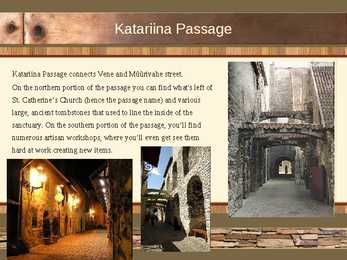
St. Catherine's Church (hence the passage name) and various large, ancient tombstones that used to line the inside of the sanctuary. On the southern portion of the passage, you'll find numerous artisan workshops, where you'll even get see them hard at work creating new items. City wall Tallinn's medieval city wall is a sub-facility that was built to protect the lower Tallinn and upper Tallinn (Toompea). The building of the city wall began in 1310th years, and by improving over time it formed the city wall with defensive buildings (towers). It was finished by the end of the 1561. Then it was 2.35-kilometer-long circular wall, which had 27 wall gate, 8 tower gate and 21 other stone fortifications. Many parts of the town wall have survived until today Great Coastal Gate (Suur Rannavärav) and Fat Margaret's Tower (Paks Margareeta)
Tallinn was granted the Lübeck law in 1248 and became the member of the Hanseatic League in 1285. General Data l Country - Estonia l County - Harju County l First appeared on map - 1154 l Town rights - 1248 l Mayor - Edgar Savisaar l Aera - Total 159.2 km2 (61.5 sq mi) l Population - (1 Mar 2012) Total - 416,470 Denisty - 2,614.0/km2(6,766.6/sq mi) Tallinn Coat of arms Flag Top 5 Attractions 1. Kiek in de Kök Visitors to the museum will see examples of Medieval firepower, displays detailing how the city's system of walls and towers developed through the centuries and an exhibit on crime and punishment in Old Tallinn. 2. Kadriorg Palace - Kadriorg Art Museum A trip to Tallinn isn't a trip to Tallinn without a visit to this magnificent northern baroque palace, built by Peter the Great for his wife, Catherine I, in 1718. The grandiose palace with its surrounding manicured gardens is
1. Fat Margareta - 16. Cent. Tallinn's most impressive defensive structures, the Great Coastal Gate (Suur Rannavärav) and Fat Margaret's Tower. They were built not only to defend the city from the seaward side of town, but also to impress any visitors arriving via the harbour. Fat Margareta used to be a prison. It is a town wall's building. Now it's home to the Estonian Maritime Museum, which provides a detailed look at the nation's seafaring past. 2. The Great Coastal Gate - with the Viru Gates, are the last of six gates that controlled access to the town in Medieval times. 3. Kolm Õde - a hotel. In 2003, three of Tallinn's splendid merchant houses, built in 1362, were renovated and united to create The Three Sisters, which now offers modern amenities with great design and a backdrop of medieval history. 4. Oleviste church baptism
It is situated on the northern coast of the country, on the shore of the Gulf of Finland, 80 km south of Helsinki, east of Stockholm and west of Saint Petersburg. Tallinn's Old Town is in the list of UNESCO World Heritage Sites. It is ranked as a global city and has been listed among the top 10 digital cities in the world.The city was a European Capital of Culture for 2011, along with urku, Finland.Tallinn is the oldest capital inNorthern Europe. The city was known as Reval from the 13th century until the 1920s. http://en.wikipedia.org/wiki/Tallinn Old Tallinn The Old Town can historically be divided into two distinct areas: Toompea Hill and the Lower Old Town, which were separated by a dividing wall since medieval times. The elevated area of Toompea Hill with its castle was occupied by the residences of Tallinn's rulers and gentry. The Lower Old Town meanwhile developed as an autonomous merchantile centre, flourishing during the 13th-16th
The interior design process follows a systematic and coordinated methodology, including research, analysis, and integration of knowledge into the creative process, whereby the needs and resources of the client are satisfied to produce an interior space that fulfills the project goals. Baroque Baroque (pronounced /brok/ b-ROHK in American English or /brk/ in British English) is an artistic style prevalent from the late 16th century to the early 18th century in Europe.[1] It is most often defined as "the dominant style of art in Europe between the Mannerist and Rococo eras, a style characterized by dynamic movement, overt emotion and self-confident rhetoric". The popularity and success of the Baroque style was encouraged by the Roman Catholic Church, which had decided at the time of the Council of Trent, in response to the Protestant Reformation, that the arts should communicate religious themes in direct and emotional involvement. The
London History The Romans AD 43- AD 410 The Romans finally invaded Britain in AD 43 from Kent. The Romans lead by Julius Caesar attempted to invade Britain twice before that in 55 and 54 BC but the invasions were unsuccessful. They made their way to the river Thames and sailed up it. The Romans knew it was important to control a crossing point at the river Thames, so they decided to build a settlement on the north bank. Although small settlements had been built on the banks of the Thames, the Romans were the ones who built the first city. They called their city Londinium. The Roman engineers noticed that the point where the swampy river narrowed would make an ideal crossing point, they built London Bridge. Less than 20 years later the native Iceni tribe,
its 27 embrasures for cannons and 30 for handguns. The floors of the embrasures were initially stepped to enable the men handle the guns better. Reconstructions in the 16th and 17th century changed the original looks of the tower considerably. 4. Suur Munamägi ("Big Egg Hill") Mountain Suur Munamägi, or Big Egg Hill, is the highest point in Estonia and other two Baltic countries. It is 318 meters high. The mountain is located in the middle part of Haanja uplands. It is in Haanja national park in Võrumaa. On the top of the mountain there is an observation tower the view from 346,7 meters is 50 km in radius. 5
London important sights guide Roman period 20th century · Big Ben is the nickname for the great bell of the clock at the north end of the Palace of Westminster in London and is often extended to refer to the clock or the clock tower as well. It is the largest four-faced chiming clock and the third-tallest free-standing clock tower in the world. The clock first ticked on 31 May 1859. The pendulum is installed within an
Tallinn English College Topic Estonia Tallinn 2008 1. Introduction Estonia is a small country about the size of Switzerland, or New Hampshire and Massachussetts combined. Estonia is named after the people called "Ests" who lived in the region in the 1 st century AD. The Republic of Estonia is one of the three countries commonly known as the "Baltic States". The other Baltic States are Latvia and Lithuania. 2. Geographical position Estonia is situated in northeastern Europe. Estonia is bounded on the north by the Gulf of Finland, on the east by Russia, on the south by Latvia and on the west by the Baltic Sea. In the north it borders on Finland. The coastline of the Baltic
The Renaissance In the history the Middle Ages were followed by the Renassance period. During this period a new class called bourgeoeisie came into being. This is the period when monarchies based on nationality were estabilished. The Renaessance started in Italy In the 14th century. Then it spread all over Europe, reached England in 16th century. The struggle for power culminated in a war called The War of Roses. It was a civil war between two dynasties, families. They had different emblems on one side the Yorks (white rose) other Lancasters (red). They couldn't decide who gets the throne. War ended 1485. A new dynasty came to throne, Tudor, the first king in this dynasty was Henry Vll. When he came to throne a period of stability followed because he built a nation based state. He was good at diplomacy
Anniversary of the republic is celebrated on February 20. The national flower is cornflower, national bird is barn swallow and national stone is limestone. It is a land of great natural beauty with a long and varied history and rich culture. It has served as a junction of international trade routes for centuries. History. The oldest marks of habitation on the territory of Estonia date from the 8th millennium BC. Fortified settlements were established in the 1 st century BC. The ancestors of Estonians formed several independent states headed by elected elders. Until the beginning of the 13th century Estonia was politically independent. Then began a long chain of occupation and control by foreign powers. In the 1200s the German crusaders converted Estonia into a Christianity by force and took control over South Estonia. In 1219 Denmark conquered Northern Estonia. About a century later, in 1346 Denmark sold its territory to Germany
There used to be Harju gate, which can now be seen through glass. ● The statue of Liberty, 2009; represents freedom, Estonia has been under many foreign powers, starting with Danes, Sweden, German and Russia. The clock of liberty, 2004. Kiek in de Kök ● The cannon tower, founded in 1475-1483. Kiika kööki, peek into the kitchen, from up there it was possible to peek into the enemy’s kitchen. The walls are 4 m thick, can see the cannons stuck in there. Tallinn City Museum. ● Town Wall (Unesco) - one of the greatest towers of Tallinn’s Town Wall, Old Town declared the UNESCO World Heritage Site in 1997 Toompea ● Toompea is a limestone hill in the central of Tallinn. It towers about 30-40 metres above the surrounding areas. According to the legend, its the tumulus moundn over the grave of the national hero Kalev, erected stone by stone by his grieving wife Linda
Introduction I choose this topic because I want to get know more about local Theatres I hoped to get more information about their location, for whom each theatre is designed and a little overview about their history. The history of Estonian theatre does not differ much from that of the neighbor countries. The first play was performed in the 16th century at the Tallinn Town Hall. The town school children, who were Germans, staged Terence's The Andria in Latin. The first theatre house in Tallinn was mentioned in written materials which date from the late 17th century; the house was used by travelling theatre groups. Tallinn was already known then as a theatre-loving city. The first prominent name in Estonian history of theatre, August von Kotzebue, dates from the same period. The Russian authorities sent him from St
Toompea Castle is also one of the most potent symbols of the reigning power. Today Toompea is the seat of the Government of Estonia as well as the Riigikogu, both of which are often simply colloquially referred to as Toompea. For centuries there was only one access to Toompea - Pikk Jalg - but there is also another way leading up to Toompea - Lühike Jalg, which was made in the 14th century. At present Pikk Jalg and Lühike Jalg are used only by pedestrians. Until the 20th century there was no way down from the western side of Toompea except for a foot-path. The stairs were built in 1903 and called Patkul Stairs after Dietrich Friedrich von Patkuli who had been the deputy Governor in Tallinn during the Great Northern War. Pikk Jalg (Long Leg) - the original road leading to the ancient Estonian stronghold (therefore the oldest street in Tallinn) and the only public road connecting the upper and lower town. It was paved with cobblestones already in the 14th
Kildu Basic School Viljandi by Eisi Kõiv Supervisor: Margit Kirss Kildu 2008 Our 700 years old Viljandi Viljandi is a town (24,000 inhabitants) in Estonia, 160 km south of the capital Tallinn. The town is the administrative capital of the county with the same name as the town. In Viljandi there is theater Ugala, cinema Rubiin, museum, art gallery. Give a concert in Culture centre, Jaani- and Pauluse church, but in Cultureacatemy, too. Folk Summer in Viljandi culminates with the annual folk music festival. The Viljandi Folk Music Festival is a music festival in Estonia with a central focus on European folk music.In the year 2006, over 24,000 people attended the concerts, but many more just came to take part in the festivities. As such, it is the largest annual music festival in
TALLINN TOWN HALL Tallinn Town Hall is the only surviving Gothic town hall in Northern Europe. Built in the heart of Tallinn, next to a marketplace, the Town Hall has witnessed trade and social activities for over 700 years. It has still remained the most important representational building in town. The building history of the Town Hall goes back to the 13th century, but it acquired its medieval appearance in 140204. It was as early as 1248 when King Eric IV Ploughpenny of Denmark granted the Lübeck Charter to Tallinn. Relying on that document a town council was elected from amongst merchants of the Hanse and started convening in the Town Hall. It is possible to state on the basis of research findings that a meeting place of the magistracy and a goods depot in the form of a small, fortified
festival tradition moved to Tallinn. It began in 1947, during the first song festival (Laulupidu) held after the Soviet occupation, when a centuryold national poem, forbidden by the Soviets, was set to music. "Mu Isamaa on minu arm" ("Lands of My Fathers, Land That I Love") was set to music and the song became the unofficial Estonian national anthem that miraculously slipped by the Soviet censors. In 1969, more than a hundred thousand participants gathered for the century anniversary of a national song festival and, in a spontaneous act of nonviolent resistance, sang this song. For fifty years, it was a musical statement of every Estonian's desire for freedom. http://www.blogto.com/events/3626 Pärnu Hanseatic Days 2008 June 27th 28th Pärnu prepares for the International Hanseatic Days of 2010 by holding handicraft fairs every summer. Traditionally, the
..................................... 14 Our opinion............................................................................................................................ 18 References............................................................................................................................ 19 2|Page 17101850 The century and a half following the Great Northern War, which ended with the Peace of Uusikaupunki, was a relatively static period in Estonian history with few momentous events. This was the time of the crystallization and the culmination of serfdom, when various socio- political and cultural undercurrents were also active, preparing the ground for the industrial society and the national-democratic movement in the second half of the 19th century.
Soon you will see The Devils Bridge. From what stone do you think it is made of? To go to the next object, you need to turn around and walk back along the Lossi street. Then you should see the famous Angels Bridge. What is written on the bridge? When do you think it was built? After that, go along the Lossi street, until you reach Jaani street. Then turn left on Jaani street, walk approximately 100 meters along the Jaani street. On your left you should see the Main Building of Tartu University. How many pillars has The University Building? What has been written on the under them? Whose statue is behind this building? If you are done with the tasks, walk again approximately 100 meters forwards along the Jaani street. You should soon notice a church, this is Tartu Jaani (St. John's) Church. About how high is this churches tower? Now walk back to the Munga street, on the corner turn left to the Munga street and walk to the Rüütle street.
Lisanna: "Yoko Ono" She was born in 1933 in Tokyo, Japan in a wealthy family. In 1953 she moved to the USA, she was an excellent student and studied music and philosophy. She has studied in 4 schools, her art is influenced by avant-garde. She has won many awards. She has been married 3 times. In 1975 she got a son Sean. She has released 26 albums, 7 of them with John. Son Sean is a singer, songwriter and an actor. Danek: "Manchester" First mentioned in the 1st century. It´s an industrial city. There is canal system, railway(1st in the world) and telephone, cotton mills, crime level is high. It has the second biggest airport in the UK after London. No tickets on certain buses. Mainly nightlife economy, over 10 000 visitors per night. 2 universities, 2 football clubs, 2 big stadiums, largest is Manchester United Football stadium. Granada television, BBC, Hollywood films, The Guardian, red brick houses, second greatest after London. Mihkel: "Liverpool"
 annaabi.ee