Tallinn's Old Town Tallinn is the largest and the capital city of Estonia. Tallinn occupies an area of 159 km2. It's situated on the northern coast of the country. Tallinn's Old Town has been listed among the top 10 digital cities in the world.It is not easy to determine the beginning of Tallinn history. The location probably attracted attention as a suitable port area. Many countries have ruled Estonia, for example Denmark, Sweden, Russia, Germany. Upper Town has always been the seat of whatever power that has ruled Estonia. The Lower Town has been demaged.
History of Different cultures Maile Kikerpill 2013 The Roman Empire began as a farming community on the Tiber River in central Italy was occupied in the 700 BC by 500 BC the area was dominated by Etruscans by 300 BC the Latins ruled central and southern Italy in 264 BC the Latins began to dispute the territorial ambitions of the Carthaginians known as the ,,Punic Wars,, finally destroyed in 146 BC By 70 AD Rome ruled every country that touched the Mediterranean was not the largest empire in total territory in world history until 27 BC the Roman Empire was a Republic Julius Caesar declared war on the Roman Senate itself became sole ruler Brutus, Cassius and others assasinated Julius Caesar Octavius declared himself "Caesar Augustus" and first Emperor of Rome 200 years of peace followed by 100 years of warfare in 284 AD Diocletian divided the Roman empire into two halves: East and West
They started building individual graves. 1300BC the farming society became more important than the henge society. 55BC the Romans arrived. The Celts The Celts arrived from central Europe or further east around 700BC. They were tall and had fair or red hair and blue eyes. They knew how to work with iron. They are the ancestors of many people living in Britain today. Celtic languages are still spoken today. The Celts lived in tribes which were ruled by a chief. They did a lot of trading and the main trading centres were the capitals of England and Scotland. The Celtic tribes were ruled over druids who memorised religious teaching, tribal laws, history etc. The Romans The Romans invaded Britain because The Celts of Britain helped the Celts of Gaul to fight the Romans and because Britain had become a great food producer. Romans brought reading and writing skill to Britain
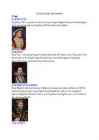
British kings and queens Kings King Henry VIII King Henry VIII is arguably the most well-known king of England. Famous for beheading his wives, of which he had six, King Henry VIII also had several children. King James I King James I was already King of Scotland when he got the English crown. King James I was the first ruler to call himself King of Great Britain, as he ruled England, Scotland and Wales. King James was the first King of Great Britain. King William I, the Conqueror King William I, otherwise known as William the Conqueror was born in France on 1028. He became friendly with the current English King, Edward the Confessor. He invaded and attacked England on Edward's death, as he was promised the English crown, but then denied it by the Saxon Harold. King George VI
1) · Monarch: a ruler of a state, such as a king or queen, who has a right to rule by birth, and does not have to be elected. · Monarchy: the system by which a state is ruled by a king or queen. Also a state ruled by a king or queen. Monarchy is the oldest form of government in the United Kingdom. · There are many monarchy contries like Canada , denmark , norway, Sweden, United kingdom, Thailand, and so one 2) · The British monarchy is known as a constitutional monarchy. This means that, while The Sovereign is Head of State, the ability to make and pass legislation resides with an elected Parliament. · The monarch, at present Queen Elizabeth II, is the Head of State (the official ruler of the country)
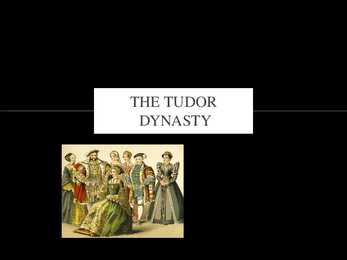
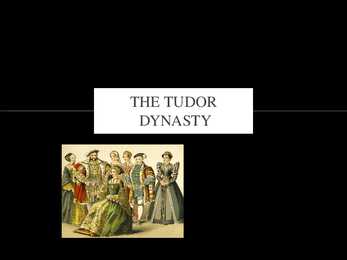
THE TUDOR DYNASTY THE TUDOR DYNASTY The Tudor dynasty or House of Tudor was a European royal house of Welsh origin that ruled the Kingdom of England and its realms, including the Lordship of Ireland, later the Kingdom of Ireland. Its first monarch was Henry VII. Henry VII THE TUDOR DYNASTY The Tudors extended their power beyond modern England, achieving the full union of England and the Principality of Wales in 1542 and successfully asserting English authority over the Kingdom of Ireland
ago In AD 43 the Roman conquest of Britain began; the Romans maintained control of their province of Britannia through to the 5th century. The Roman departure opened the door for the Anglo-Saxon invasion Raids by the Vikings were frequent after about AD 800, and the Norsemen took control of large parts of what is now England In 1066, the Normans invaded and conquered England. 1348 was the Blach Death, which killed half on England population During the Renaissance, England was ruled by the Tudors England had conquered Wales in the 12th century and was then united with Scotland in the early 18th century to form the Kingdom of Great Britain Following the Industrial Revolution, Great Britain ruled a worldwide Empire, the largest in the world in the 20th century the vast majority of the empire became independent cultural impact is widespread and deep in many countries of the present day.
With an average elevation of 4,900 metres, it is the highest region on Earth and has in recent decades increasingly been referred to as the "Roof of the World". In the history of Tibet, it has been an independent country, divided into different countries, and a part of China each for a certain amount of time. Tibet was first unified under King Songtsän Gampo in the seventh century. A government nominally headed by the Dalai Lamas, a line of spiritual leaders, ruled a large portion of the Tibetan region at various times from the 1640s until 1950s. During most of this period, the Tibetan administration was subordinate to the Chinese empire of the Qing Dynasty. The 13th Dalai Lama proclaimed Tibet independent in 1913, but this declaration was not accepted by China. Furthermore, Tibet was not recognized by any country as a de jure independent nation. As a measure of the
The 17th century In England 17th century was a time of political and religious turmoil. It is known as a struggle between Parliament and the throne. 1625 came to rule Charles I, who was proved to be politically stubborn. In 1642 civil war broke out between the Cavaliers and the Roundheads. Oliver Cromwell was a puritan who brought the Roundheads to the victory and temporarily ended the monarchy in 1649. Charles I was beheaded. Oliver Cromwell ruled England for 9 violent years. The return of the oldest son of Charles I in 1660 is called the Restoration. In 1660 the Royal Society of London was established to promote scientific research. In 1688 the Glorious Revolution was without bloodshed or violence. The 1689 Bill of Rights limited monarch's powers. Parliamtary government was established. 1665 the Great Plague, 1666 the Great Fire.
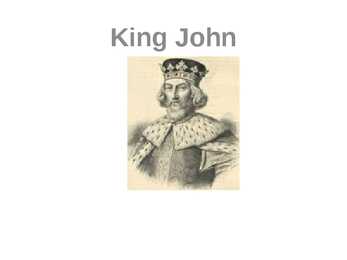
campaigns. The Magna Carta I, King John, accept that I have to govern according to the law. So I agree: 1. Not to imprison nobles without trial 2. That trials must be in courts; not held in secret by me 3. To have fair taxation for the nobles 4. To let freemen travel wherever they like 5. Not to interfere in Church matters... Rule King John ruled 1199 to 1216. He faced the following problems. Problems 1. John raised taxes in England to pay for the wars. This upset his BARONS! He ordered them to pay far more tax than earlier kings had done! 2. John went to war twice against the French king. His army was badly beaten both times. He lost almost all the land that his father had gained in France!
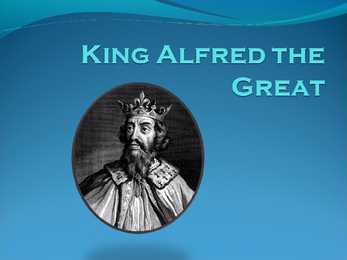
translation of scholarly works from Latin and promoted the development of the Anglo-Saxon Chronicle. ·A new legal code came into force during his reign. ·At the age of 19 in 868 he is recorded as fighting beside his brother in Mercia against the Danes In 878, the Danes under their leader, Guthrum overran Wessex. Alfred and his remnants went into hiding. At Easter time in 879, Alfred set up a base in the region of Athelney. The great Saxon kingdoms of England had been reduced to one man who ruled a small area of swamp. It was from this hidden base in the swamps that King Alfred became Alfred the Great Alfred sent messages to those fighting men that were still loyal to him. Seven weeks after taking refuge at Athelney, Alfred emerged from the swamps with a new army. Guthrum surrendered to Alfred and even accepted baptism with Alfred as his Godfather
Introduction I chose this topic because I am intrested in Roman history and ruled by the people and their life story. My theme is Julius Caesar because this intrested me. Julius Caesar's life Caius Julius Caesar His family isn't rich. born 13. July BC and died 15. March BC. He was Ancient Rome commander, politician and writer His family had noble, patrician roots. Julius Caesar's woman He married with youngest The second marriage Casar daughter Cornela Cinna
The Great Wall of China Main Facts · approximately 6700 km long · over 2000 years old · up to 16m high, 9.1m wide at base and 3.7m wide at top · average height 10m, witdh 5m History of the Wall · 1st wall in 218-208 BC (3000 miles long) · 4th wall in 1368-1620 · Ming dynasty ruled China · They built thousands of towers and forts · Over 1 million people died Construction of the Wall · made of quarried limestone or granite · in some areas made of fired brick · again over 1 million men died · that's over 300 men per mile · Qin made 70% of population build the wall Importance of the Wall · at first it was ment to keep enemies away, later to keep away semi- nomadic thiefs · nowadays a very popular tourist attraction
Italy Robi kivi LGA18 Italy, officially known as the Italian Republic (Repubblica Italiana in Italian), is a country in Europe. Italy is situated on a boat-shaped apennine peninsula 800 km in the Mediterranean. In the north form the natural boundary of the Alps. Italy includes Sicily, Sardinia and a number of smaller islands. Rome, a settlement around a ford on the river Ancient Rome Tiber conventionally founded in 753 BC, was ruled for a period of 244 years by a monarchical system, initially with sovereigns of Latin and Sabine origin, later by Etruscan kings. The tradition handed down seven kings: Romulus, Numa Pompilius, Tullus Hostilius, Ancus Marcius, Tarquinius Priscus, Servius Tullius and Tarquinius Superbus. In 509 BC, the Romans expelled the last king from their city and established an
Some even are, but that doesn't mean that all white people in America are good intelligent. In my opinion white people aren't more intelligent than black people. Mostly black people live in poor South countries, wich can't give a good education to their people. There aren't any racism in Estonia with skin color. People don't discriminate black people. But there is racism between russians and estonians. Russia has declared war many times on Estonia and has ruled Estonia for many centuries. And now, when Estonia is an independent country, estonians don't like that there are so many russians living here. Big part of russians can't speak estonian language properly, so that makes things worse. I think that if estonian russians would learn estonian language and speak it properly, then estonians would accept them. Russians children are in estonian schools, where they learn to speak estonian properly. So this problem will be better in about 50 years.
RICHARD II Richard II (6 January 1367 14 February 1400) was King of England. He ruled from 1377 - 1399. Richard was a son of Edward, the Black Prince, and was born during the reign of his grandfather, Edward III. At the age of four, Richard became second in line to the throne when his older brother Edward of Angouleme died. Richard succeeded to the throne at the age of ten in 1377. Richard was tall, good-looking and intelligent. As earlier historians used to believe, he may have suffered from a personality disorders. Richard's mental state has been a major
Traditional Estonian food has its roots firmly in the countryside, relying heavily on pork, potatoes and garden variety vegetables. The main culinary influences were from Germans, who ruled over Estonia for so many centuries. The eating habits of the Estonian population are related to the season, which severely affect the availability of fresh food. The spring and summer are the seasons of fresh food, in this period are used vegetables, berries and herbs, with the warmer climate the Estonians also like to cook meat grilled outdoors. During the winter are used mushrooms, jams, and preserved foods. Among the typical Estonian dishes
compiled. It is a detailed survey of England ordered by William the Conqueror. The reign of King William Rufus who was the son of William started in 1087 and lasted until 1100. Next king was Henry I who was the brother of William Rufus. His reign was from 1100-1135. In 1135 Henry I nephew Stephen got to the throne of England and reigned the country for 19 years. He was the last Norman king of England and his reign ended in 1154. From 1154 until 1377 the Plantagenet Kings of England ruled the English. The first Plantagenet King was Henry II. He was the grandson of Henry I. He had struggles with Thomas Beckett, who was the Archbishop of Canterbury. Beckett ended up being murdered in Canterbury's cathedral in 1170. Henry II reign ended in 1189 and the next King of England was his third son Richard. Richard lead the country for 10 years and he was succeeded by Henry II's fifth son John. In 1215 King John was
Then they settled in a place on the north bank, where the river was not to wide. This settlement was called Londinium. A bridge was later built across the Thames. Roman London Tribes in England fought the Romans. The Iceni tribe, led by Queen Boudicca, burned down Londinium in 61 AD. The Romans later defeated the tribes and restored Londinium. It became the capital of Roman Brittan. A Basilica, forum and fort were built, plus a wall around the city. The Romans ruled until 410. Medieval London After Edward came King Harold in1066. Later that year he was defeated by William, Norman duke. William I was crowned king in Westminster Abbey. In the following years London grew rapidly and by 1300 about 80,000 people lived there. The Black Death killed of 134850 killed about half this population. Tudor London London grew in importance under Tudor rule. King Henry VIII created palaces such as St James's
THE TUDOR DYNASTY THE TUDOR DYNASTY The Tudor dynasty or House of Tudor was a European royal house of Welsh origin that ruled the Kingdom of England and its realms, including the Lordship of Ireland, later the Kingdom of Ireland. Its first monarch was Henry VII. Henry VII THE TUDOR DYNASTY The Tudors extended their power beyond modern England, achieving the full union of England and the Principality of Wales in 1542 and successfully asserting English authority over the Kingdom of Ireland
quickly and had 6 wives. His first wife couldnt give birth to a baby boy and they only had a daughter. His next wife only gave birth to a girl too. His next wife gave birth to a boy but died after the labor. He didnt like his 4th wife so he sent her back. His fifth wife was young and beautiful but had many lovers and Henry didnt like it so she was sent to the Tower and was beheaded. HIs 6th wife survived. 3. Edward- was sickly and ruled only for a few years and then he died 4. Mary Tudor/Bloody Mary- was catholic and killed many protesntants. Ruled only for a few years and then died 5. Elizabeth I - very clever and educated,she was fluent in several languages. She wanted to unite England and make it a very important force in Europe. She never married and was called the "Virgin Queen". It was a very peaceful time, she loved theatre and plays
· Problems: Philip II of France (much weaker, but technically Henry II's overlord for his French lands) was stirring up trouble and revolts · Henry II had problems with the Archbishop of Canterbury, Thomas Becket · Once his close ally · Several disagreements · The bishop tragically murdered by four overly eager knights (1170) Richard I · Henry II's older son · Ruled 1189-1199 · Known as Richard the Lionheart · Reputation as a great military leader and warrior · A central Christian commander during the Third Crusade · Put down rebellions against his father before becoming king · Spent very little time in England · Seen as a pious hero · One of the few Kings of England remembered by his epithet John Lackland · Ruled 1199-1216 · Got into trouble
aims, views of the Indians, government, tolerance). English: religious persecution, space to settle; refused to live near Indians, were ready to kill if they didn’t leave; own rules and laws, independent assemblies; in some no other religions, most open to different people, diverse. French: catholicism, trade, wealth to homeland; friendly, admired them, learned from them, catholicizing; ruled from mother country, temporary laws made in europe; no outsiders, french catholics. Spanish: catholicism, treasure; interested in gold, didn’t care about Indians, cruel, catholicizing; ruled from mother country, temporary laws made in europe; no outsiders, spanish catholics. 6. From the English point of view, what was the purpose of establishing colonies? English protestants etc. wanted to escape from religious persecution by catholics back in Europe,
· about 700 by an unknown minstrel · an epic - a long narrative poem in splendid/majestic language about the achievements of a hero, often a national hero who embodies national ideas · 3182 = 80 or 90 pages in book lenght · two parts: 1st - Beowulf's battle with Grendel and Grendel's mother, 2nd - aged Beowulf's victory over a dragon, death and funeral Background of Beowulf: · primitive and harsh environment · great importance · wars - life brief, fate ruled over human beings · Beowulf - sense of fatal doom, dark and sombre tone · fate and fame - vital ideas in the literature of Anglo-Saxon period · Beowulf - monsters slaying in Scandinavia = struggles between good and evil Christian Poetry · 55 B.C. Julius Ceasar - christianity to British Isles · 449 A.D Anglo-Saxons - pagans = christianity declined · 597 A.D. St. Augustine - within 100 years all country into christianity Caedmon and Alfred the Great Ceadmon
stone and wood, built the first roads. corn as well as tamed and bred animals. · There can be find Neolithic burial · Also learned the art of pottery and chambers and huge temples. made things of wool, metal and copper. · Stonehenge as the best known · The celtic tribes were ruled by a prehistoric monument in Britain and one warrior class, priests or Druids. of the world's greatest mysteries. · Druids couldn't read or write, but · It was built in several stages. they memorised all the religious teachings, the tribal laws, history,
The Saxons & Vikings Fragmentary knowledge of England in the 5th & 6th centuries comes from the British writer Gildas, the Anglo-Saxon Chronicle, saints' lives, poetry, archaelogical findings and place- name studies. British landlords ruled small, unstable kingdoms and continued some Roman traditions of governance. In the mid-5th cent, Vertigern, a British leader, hired Germanic mercenaries to help defend against peoples of the north (Picts & Scots). In the end they revolted & the process of invasion and settlement began. The first Saxon ,,kings" were Hengist & Horsa in Kent, Aelle in Sussex, Cerdic / Cynric in Wessex. So the first ,,English" became mainly from Northern Germany & Denmark. The resistance of the Celts was long
The Medieval period The Middle Ages began in 1066, when the Normans defeated Anglo-saxons at the Battle of Hastings. Now England had a Norman king William the Conquer. Norman kings ruled in England less than 100 years, during that time Normans brought England closer to the mainstream of European society. William introduced the feudalism. Under it, land was divided among noble overlords, or barons. Knights pledged their wealth and services to the overlords. In return overlords let them use their land. At the lowest end of the social scale were the serfs, peasants bound to the land. In 1154 the Norman time was at the end. In 1154 Henry II started to reign
It is the thirdlargest standing army in the world and ranks tenth in military expenditure among nations. The map of India Click to edit Master text styles Second level Third level Fourth level Fifth level India as a part of the British Empire For most of the 19th Century, India was ruled by the British. India was considered the jewel in the crown of the British Empire between 1858 and 1947. Queen Victoria had been made Empress of India and the British had a major military presence there. The British who lived in India were the elites of the country. Under the British Empire the nation flourished as a center of textiles, which soon became India's number one export. Tourist destinations of India
year later. After winning almost every snowboard competition he took part, he was became sponsored by Burton, the worlds most famous snowboarding company, and became a pro when he was only 13. Shaun was given a nickname Future Boy, when he first started as a pro. He was only 13 but he was already pushing the limits of snowboarding. White got his reputation by doing big air and tying together snowboarding tricks in ways that had never been done before. In 2003 Shaun ruled over everybody in Winter X Games and every other event he decided to take part. Shaun won a gold medal in the slopestyle and the superpipe and also took the games' "best athlete" award. A month later Shaun became the youngest winner of the US Open Slopestyle Championships. In 2004 he won the X games again. In december 2005 Shaun qualified for the Winter Olympics of 2006 in halfpipe snowboarding by winning two US Olympic team qualifying events in Colorado
era, beginning from around 8500 BC. Before the Germans invaded in the 13th century proto-Estonians of the Ancient Estonia worshipped the spirits of nature. Since the Northern Crusades Estonia became a battleground for centuries where Denmark, Germany, Russia, Sweden and Poland fought their many wars over controlling the important geographical position of the country as a gateway between East and West. Being conquered by Danes and Germans in 1227, Estonia was ruled initially by Denmark in the north, by the Livonian Order, an autonomous part of the Monastic state of the Teutonic Knights and Baltic German ecclesiastical states of the Holy Roman Empire. From 1418–1562 the whole of Estonia was part of the Livonian Confederation. After the Livonian War, Estonia became part of the Sweden from the 16th century to 1710/1721, when it was ceded to the Russian Empire as the result of the Great Northern War.
• Offical lagunges: English • National symbol: the shamrock • National symbol: The Eagle Ireland and UK Ireland And UK Differents • Ireland is a big island to the west of great Britain.England is a country on Great Britain. • Irelandeuro, UKdollar • There is a greater proportion of Catholics in Ireland than in England. • England is ruled by a Monarch, Ireland is a Republic. Common • Travel area • Lagunge • Time Ireland intresting facts • Ireland has won seven times the Eurovision Song Contest (in 1970, 1980, 1987, 1992, 1993, 1994 and 1996), more than any other • Titanic, the Unsinkable ship, which country. There are more Irish people living sunk in its maiden voyage, was made
) Bangor Newport(the latest,marking the Queen`s Golden Jubilee in 2002,today a centreof high technology industry) NAME The name Wales comes from the Cymraeg word Gwalia, meaning in English "Homeland". It later became Latinized as Walia, then by the Normans to something like Wal~es....then Wales. Wales has not been politically independent since 1282,when it was conquered by King Edward I of England. Until 1999,Wales was ruled directly from London;that year saw the first elections to the National Assembly of Wales,which has limited domestic powers and cannot make law. Wales doesn`t issue its own currency and isn`t in control of any armed forces.These are the powers of the national government of the UK. SPORT Cricket Rugby Boat race Boxing day hunts Horse racing Polo Bowls Darts NATIONAL EMBLEMS
the stronghold From that time on the stronghold of Toompea belonged to foreign rulers After the subjugation, the Danes immediately set out to fortify it In the following years, the Danish stronghold was repeatedly besieged All attempts ended in failure Timeline Occupied in 1227 by the Order of the Brethren of the Sword In 1238 the rights of the Danes in North Estonia were restored and Toompea was once again ruled by Danes In 1346 Denmark sold its possessions to the Teutonic Order Until 1561 Toompea belonged to the Livonian Order According to the Altmark peace treaty of 1629, Estonian territories went to the king of Sweden Already earlier (1561), new rulers had come to Toompea In 1710 the knighthood of North Estonia signed the Harju capitulation treaty At first Russians could not initiate any changes in the country they had conquered.
architecture. The stronghold construction, widening and reconstruction went on throughout several centuries, with architecture changing according to the development of weapons. The fortress achieved its final dimensions area of more than 3 hectares, thickness of the wall between 1.2 and 1.8 meters, and maximum height over 10 metres under the reign of Bishop Johannes IV(fourth). In the 17th century, the castle was no longer used as a defensive building by the Swedes who now ruled the Swedish Estonian Province. In the course of the Great Northern War in 1710 (seventeen ten), Estonia fell under Russian rule and the walls were partially demolished at the command of the Peter I of Russia, turning the castle in effect into ruins. It was at this time that the fortress that once displayed seven towered circular wall 803 (eight hundred free) meters long and 12 (twelve) meters high became a pile of ruins.
When Aguilera's parents divorced, her mother took her, and her younger sister Rachel, to her grandmother's home in Rochester, Pennsylvania, a suburb outside of Pittsburgh. According to both Aguilera and Fidler, her father was very controlling, as well as physically and emotionally abusive.[16] She later wrote about her difficult childhood in the songs "I'm OK" in Stripped, and "Oh Mother" in Back to Basics. Although her father has written to Aguilera, she has ruled out any chance to reunite with him.[17] Since then, Fidler has married a paramedic named Jim Kearns, and changed her name.[18] As a child, Aguilera aspired to be a singer. She was known locally as "the little girl with the big voice", singing in local talent shows and competitions.[19][20] According to VH1's Driven, whenever competitors learned they would be up against her in any given week, they would immediately withdraw, prompting insiders to claim it was "like sending a lamb to the
Independence in Pärnu on February 24, 1918. after winning the Estonian Liberation War against Soviet Russia and at the same time German Freekorps volunteers (the Tartu Peace Treaty was signed on 2 February 1920), Estonia maintained its independence for 22 years. Initially a parliamentary democracy, the parliament was disnaded in 1934, following political unrest caused by the global economic crisis. Subsequently the country was ruled by decree by Konstatin Päts, who became President in 1938, the year parliamentary elections resumed. Estonia was occupied by the Soviet Union in June 1940, after Stalin gained Hitler's agreement to divide Eastern Europe into ,,spheres of special interest" according to the MolotovRibbentrop Pact and its secret protocol. Subsequently, the country was occupied by Nazi Germany from 1941 to 1944. Germans pillaged the country for the war effort and unleashed the Holocaust.
he had to recognise the king of France as his lord, whereas in England he was king with no lord above him. The last Norman kings William II (Rufus) (1087 - 1100) When William died, in 1087, he left the Duchy of Normandy to his elder son, Robert. He gave England to his second son, William. William II was a short stout man with red face, from which came his nickname of Rufus. He was a strong king and ruled his subjects firmly. In 1095, he crushed with great severity a revolt by some of his barons. He acquired control of Normandy from his older brother Robert, by lending him money to go on a crusade. To raise funds for the war, William taxed his English subjects. William died in 1100 while hunting in New Forest in southern England. He was killed by an arrow shot by one of his lords, Walter Tirel. Historians are not sure whether Tirel deliberately fired the arrow at William
Estonia became a vital link in the sea-trade between East and West. The oldest preserved book written in Estonian, a catechism, dates from 1535. Tartu University was established in 1632, on orders from Sweden's King Gustav II Adolf. Literacy spread. The Bible was translated into Estonian in 1739(pole vaja teada). A period of wars began in the 16th century, bringing parts of Estonia under the control of Russia, Denmark, Poland and Sweden. For most of the 17th century, Sweden ruled Estonia. In the 18th century Russian Tsar Peter the Great joined Estonia to his empire. The first true political parties emerged(Where established) at the turn of the century, demanding autonomy for Estonia. Following the Russian Revolution of 1917, Estonia declared independence from Russia on Feb. 24, 1918. Independent Estonia made large strides between wars. World War II ended Estonia's independence. The country was occupied by the Soviet Army in June 1940
1.SLAID Queen Mary I of England was born February 18, 1516. She was the daughter of King Henry VIII and his first of six wives, Catherine of Aragon. Mary was the only child from that union to survive infancy. She ruled as Queen of England from July 19, 1553 until her death on November 17, 1558. This era was known as the Marian Exile 2.SLAID Queen Mary I was rejected by her father during his divorce from her mother. Her parents' marriage was thought meaningless so for a while she was stripped of her statud as and heir to the throne.
them. They have given people hope and dreams and aspirations to become better, stronger and braver. The need for a hero has always existed but the definition and the purposes of a hero have changed. Centuries ago a hero was reckoned to be someone with super human courage, abnormal powers or with abilities to use magic items. A hero used to be somebody who fought magical creatures of evil and conniving kings or lords. A past hero usually saved the world from being ruled by evil forces (Eragon) or a clan from being destroyed (Beowulf killed Grendel and his mother to help the village). A hero like that was respected by the elderly people and always glorified by his family (in case they were still alive at the end of the story). It used to take a long journey and a fascinating victory to be recognized as a hero but nowadays it has become much easier. We give the title "hero" away much faster and there is actually no
Normans broke the power of the Anglo-Saxons. Medival period Social order:1)The King-the most powerful person-owned land,led the army,made laws,demanded money through taxes,had absolute power2)Aristocracy:Barons,Lords-got lands from the King3)Middle classes:Knights,Merchants,Yeomen- freefarmers-owned land,protected Lords,had to got to war4)Villeins or Serfs-didn`t own land,products went to Lord,had to do any job that the Lord asked them to do5)Slaves- had to work hard System of government:King-ruled throughly the system of patronage,he gave hands and privileges to people who were loyal to him when he needed it. The Domesday Book was the record of the great survey of England, executed for 'William the Conqueror'. The survey was similar to a census by a government of today. Magna Carta is an English legal charter. The Magna Carta required King John of England to proclaim certain rights, respect certain legal procedures, and accept that his will could be bound by the law.
(the second one was Antonine Wall) The function of the wall was to keep the enemy away. Hadrian's wall was added to the UNESCO's list of World Heritage Sites in 1987. It is about 115-120 km long. Christianity in Roman Britain - Christianity became the state religion of Roman Empire in 4.century. Boadicea(Boudicca) was the queen of the British Iceni tribe who led an uprising against the occupying forces of the Roman Empire. Boudica's husband Prasutagus, ruler of the Iceni tribe, who had ruled as a nominally independent ally of Rome, left his kingdom jointly to his daughters and the Roman Emperorin his will. However, when he died, his will was ignored --the kingdom was annexed as if conquered, Boudica was flogged, her daughters were raped, and Roman financiers called in their loans. Obviously Boudicca was not happy about it and start an uprising. Boudicca's revolt was in 60-62 AD.
colony after another gained its independence. After studying the topic I would say that it cannot be said whether the British Empire was a very good or a very bad thing. Of course any kind of oppression should not be approved of and actually the Empire and native British forced on their way of life and culture to the colonies. On the other hand the Empire also helped its subjects to develop in a positive sense. In overall Britain ruled several parts of the world, like India, parts of Africa, New Zealand, Canada, and Australia, but also Ireland. Just to prove my point I will give some examples how the British Empire affected its subjects. In the 19th century British culture and way of life became predominate in Ireland. In the 1840s the potato crop failed two years in a row and a terrible famine occurred. Millions of peasants, those with Irish Gaelic language and customs either died or emigrated
duke's page finding strength and warmth by following in the footsteps of his master as they carried food, wine and firewood to a poor peasant on a freezing cold Boxing Day. The unfortunate Wenceslas was murdered by his own brother, Boleslav; the Chapel of St Wenceslas in St Vitus Cathedral is decorated with scenes from the saint's life. In 950 the German king Otto I conquered Bohemia and incorporated it into the Holy Roman Empire. By 993 Pemysl princes had forged a genuine Slav alliance, and ruled Bohemia on the Germans' behalf until 1212, when the pope granted Otakar I the right to rule as a king. Otakar bestowed royal privileges on the Staré Msto (Old Town), and Malá Strana (Little Quarter) was established in 1257 by Otakar II. Pemysl lands stretched at one point from modern-day Silesia (a region on the Czech-Polish border) to the Mediterranean Sea. Their Austrian and Slovenian domains, however, were lost
history ü The War however between England and Spain lasted until 1604, despite the defeat of the Spanish Armada. Yet the defeat brought about English nationalism, securing Protestantism as England's state religion. In contrast, for Spain it was a humiliating defeat, nearly destroying the national treasury of Spain. Janeli Õim 11A Her era saw the advancement of England as a military might Ruled her country effectively through council for 45 years in a time when women were still being looked upon as being inferior to men as England's greatest monarch. So ended the amazing tale of the Tudor Monarchy Janeli Õim 11A She had said.. I have already joined myself in marriage to a husband, namely the kingdom of England. (Elizabeth to Parliament)
nobles was even more. He gave them lands, but scattered them all over England so that he would not have the same faith as French Monarch. He also demanded that each freeman in England would utter the oath of loyalty to him(not to the feudals as they used to). · Henry II and the Angevin Empire- Henry II was the King of Angevin Empire. The term Angevin Empire is a modern term describing the collection of states once ruled by the Angevin Plantagenet dynasty, which was an empire, that included one-third of France(he got it from the marriage with Elanor of Aquitaine), England and a part of Ireland. Henry II is known for his legal reforms. He hanged the law by having the state, not private individuals, bring suspects to trial(before that private individuals had to do that and if it turned out that they were wrong they had to pay fines). He also establised grand juries who gathered evidence.
Test 9 1 Translate. 1 Ma loen sageli ajaloolisi romaane. I often read historical novels. 2 Paljud riigid on Eestit valitsenud. Many countries have ruled Estonia. 3 Rooma villas olid keskküte ja mosaiikpõrandad. A Roman villa had central heating and mosaic floors. 4 Roomlastel ei õnnestunud Sotimaad vallutada. The Romans didn´t manage to conquer Scotland. 5 See imeerium on eksisteerinud umbes 400 aastat. This empire existed foir about 400 years. 6 kohalikud elanikud inhabitants 7 lossivaremed ruins of a castle 8 restaureeritud mõis a restored manor house 2 Use the words who, whose, which or where to complete the sentences.
The flag of the United Kingdom is the Union Flag (also referred to as the Union Jack). It was first created in 1606 by the superimposition of the Flag of England on the Flag of Scotland and updated in 1801 with the addition of Saint Patrick's Flag. Wales is not represented in the Union Flag as Wales had been conquered and annexed to England prior to the formation of the United Kingdom; the possibility of redesigning the Union Flag to include representation of Wales has not been completely ruled out.[436] The national anthem of the United Kingdom is "God Save the King", with "King" replaced with "Queen" in the lyrics whenever the monarch is a woman. Britannia is a national personification of the United Kingdom, originating from Roman Britain. Britannia is symbolised as a young woman with brown or golden hair wearing a Corinthian helmet and white robes. She holds Poseidon's three-pronged trident and a shield, bearing the Union Flag.
Paranormaalsed nähtused Referaat Riivo Nukk Lähte 2008 Kasutatud kirjandus: Jenny Randles; Peter Hough "Mõitatuslike nähtuste entsüklopeedia" "Crossfire: The Plot That Killed Kennedy" ehk "Risttuli: Vandenõu, mis tappis Kennedy") "AlienAgenda" ehk "Võõrad Plaanid" "Ruled by Secrecy" ehk "Valitsejate Saladused". "PSI Spies" ehk "Ekstrasensoorsed Spioonid". "Inside Job" ehk "Sisekuriteod" "War on Freedom" ehk "Sõda Vabaduse vastu". Www.cropcircles.org "The Bermuda Triangle", Charles Berlitz. "The Bermuda Triangle Mystery Solved", Lawrence David Kusche.
Tristan & Isolde is set in Britain and Ireland, in the Early Middle Ages, after the fall of the Roman Empire in the 5th century. The scattered British settlements are in the process of becoming unified under Lord Marke (Rufus Sewell), who wishes to fortify England against attacks by the Irish king Donnchadh (David O'Hara). The Cornish knight Tristan of Aerygone (James Franco) engages in combat with Morholt, leader of Donnchadh's army and to whom Princess Isolde (Sophia Myles) has been promised in marriage. Though he kills Morholt and Donnchadh's army is overrun, Tristan is severely wounded in the fight and believed dead, though he is in fact only suffering the effects of having been sliced in the abdomen by Morholt's poisoned sword. Tristan's body is put out to sea on a funeral boat which eventually washes up along the shores of Ireland. He is discovered by Isolde and her maid Bragnae, who administer an antidote that revives him and t...
 annaabi.ee