Leidsid 33 sarnast õppematerjali, mis on seotud failiga "Report: New Zealand". Need materjalid aitavad sul teemat sügavamalt mõista.
zealand, island, south, there, than, mountain, west, country, north, england, language, year, cultural, economy, australia, biggest, islands, highest, rings, comes, introduction, conclusion, english, cook, easter, dollar, japan, areas, taken, export, tourism, green, tourist, came, scotland, fact, western, springs, nature, secondary, report, southwestNEW ZEALAND Geography: New Zealand is situated midway between the Equator and the South pole in the southern Pacific Ocean. It consists of two large islands, North Island and South Island, plus several smaller ones of which Stewart Island is the largest. North and South Islands are separated by the 32km wide Cook Strait. The total land area is 270,535 sq Km, about the size of Italy, the United Kingdom or the US state of Colorado. North Island is volcanically active with three active volcanoes. South Island has the high snow covered mountain peaks and glaciers of the Southern Alps, a range running almost 500Km along the Island. The longest river is the Waikato on North Island (425 Km), the largest inland stretch of water is Lake Taupo also on North Island (607 sq Km) and the highest point is Mount Cook on South Island (3754 m). Over 75% of New Zealand is above 200m.
Misso Keskkool New Zealand Precis Compiler: Maiki Joakit Instructor: Mailis Teppo Misso 2011 New Zealand is an island country in the south-western Pacific Ocean comprising two main landmasses (the North Island and the South Island), and numerous smaller islands, most notably Stewart Island/Rakiura and the Chatham Islands. The indigenous Mori language name for New Zealand is Aotearoa, commonly translated as land of the long white cloud. Population (1998): 3,801,000.New Zealand is notable for its geographic isolation; it is situated about 2,000 kilometres (1,200 mi) southeast of Australia across the Tasman Sea, and its closest neighbours to the north are New Caledonia, Fiji and Tonga
Geography New Zealand is an island country in the Southwest Pacific Ocean. It lies about 1600 kilometres southeast of Australia, its nearest continental neighbour. New Zealand belongs to Polynesia, a large island group. The country consists of two main islands The North Island and the South Island and several dozen much smaller islands. The population is 4.1 million. New Zealand is a beautiful country of snowcapped mountains, green lowlands, beaches and many lakes and waterfalls. No place is more than 130 kilometres from the coast. Lakes, rivers, and waterfalls are found throughout New Zealand. Most of the lakes lie in the volcanic plateu of the North Island and in glacial valleys near the Southern Alps of the South Isaland. On both islands the rivers rise in the mountains and flow down to the sea. The rapid flow of New Zealand's rivers makes them important sources of
New Zealand New Zealand is an island country. It is in the south-western Pacific Ocean comprising two main island, North- and the South Island with lots of smaller islands. New Zealand is notable for its geographic isolation. It's about 1,600 kilometers from Australia and its closest neighbours to the north are New Caledonia, Fiji and Tonga. New Zealand's total land area is 268,021 square kilometers. The country extends more than 1600 kilometers along its main,north - north-east axis and has about 15,000 kilometers of coastline. The South Island is the largest land mass of New Zealand and is divided along its lenght by the Southern Alps and the highest mountain Mount Cook is 3,754 meters high. There are 18 peaks over 3000 meters in the South Island. The highest North Island mountain is Mount Ruapehu and it is an active cone volcano. There are also two other volcanoes in the centre of the North Island
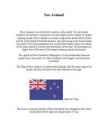
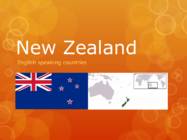
New Zealand New Zealand is on of the first countries in the world. It to be located southeast of australia.It consists of two main islands and a number of smaller outlying islands. New Zealand's two main components are the North Island and the South Island.The North Island is only half as big as the South Island, but nearly 75% of the population live on the North Island. About two-thirds of the south Island is covered with mountains. More than 220 mountains are higher than 2000 meters.The largest outlying island is Auckland. The capital of New Zealand is Wellington, it is the southermost national capital city in the world. It is New Zealand's sixth largest city behind the Auckland. The Flag of New zealand is a defaced blue Ensign with the union flag in the canton, and four red stars with white borders to the right.
SOCIETY AND CULTURE OF ENGLISH-SPEAKING COUNTRIES Introduction 1. Nowadays, English is so widely spoken that it can hardly be considered "a one nation's" language. The main countries where English is spoken are: the U.K, the U.S, Canada, Australia, the Republic of Ireland, New Zealand, West Indies 2. There are approx. 300-400 million speakers of English in the world. English occupies the 3rd place by its number of speakers; it is right behind Mandarin and Spanish. 3. ESL (English as a Second Language) used in your own country (e.g. India) EFL (English as a Foreign Language) used in a foreign country ESP (English for Specific Purposes) used in business, airlines, hotels etc. 4
............................................................10 Conclusion....................................................................................................................11 Materials........................................................................................................................11 2 Australia Introduction Australia is the one and only country in the world which fills the whole continent. The continent it fills is called Australia too. So, Australia is both a country and a continent. If you want to make clear that you are speaking about the country, you may call it the Commonwealth of Australia. It’s the official name of the country. Australia is the smallest continent, but one of the largest countries on Earth. It’s 6th largest country. Its area is about 7.6 million sq km. One third of it is occupied by deserts. It’s both
After which language? English occupies second place by its number of speakers after Mandarin Chinese. 3. What is the difference between English as a Second Language, English as a Foreign Language and English for Specific Purposes? Give examples of situations where they are used. English as a Second Language (ESL or TESL) is a traditional term for the use or study of the English language by non-native speakers in an English-speaking environment. That environment may be a country in which English is the mother tongue (e.g., Australia, the U.S.) or one in which English has an established role (e.g., India, Nigeria) English as a foreign language A traditional term for the use or study of the English language by non-native speakers in countries where English is generally not a local medium of communication. English for specific purposes - a sphere of teaching English language including Business English,
New Zealand has an exceptionally long coastline compared to the size of the country (over 15,000 km) which makes it almost the same size as the mainland USA's coastline. Even though New Zealand is only about the same size as Colorado, the large coastline is possible because it is extremely iregular and indented. New Zealand's coastline is packed with deep coves, bays, intricate harbours, long sounds, and steep fiords. Its territorial waters stretch from the sub-tropical through to the sub-antarctic. Both islands tend to have better swimming beaches on their eastern coasts and the further north you go. The west coasts of both islands are quite rugged with cliffs and more unsettled
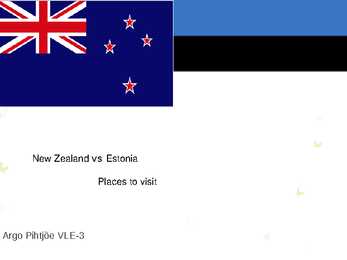
New Zealand vs Estonia Places to visit Argo Pihtjõe VLE-3 Some facts: Full name: Republic of Estonia Full name: New Zealand Population: 1.3 million (UN, 2010) Population: 4.3 million (UN, 2010) Capital: Tallinn Capital: Wellington Area: 45,227 sq km (17,462 sq miles) Area: 270,534 sq km (104,454 sq miles) Major languages: Estonian Major languages: English, Maori Major religion: Christianity Major religion: Christianity Life expectancy: 69 years (men), 79 Life expectancy: 79 years (men), 83 years (women) (UN)
Topic Australia Tallinn English College 2006 Australia 1 . Introduction The name Australia is derived from the Latin Australis, meaning of the south. In land area, Australia is the sixth largest nation, its territory is 7,686,850 sq km and its population reaches today over 20,5 million people. It is the only nation to govern an entire continent and its outlying islands. Australia's capital is Canberra, the only city with its own territory. It was built in the early 1900s just to be the capital. The official language is English and the official name of Australia is the Commonwealth of Australia.
Data of New Zealand. · Capital - Wellington. · Largest city - Aucland. · Official languages - English, Maori, NZ Sign Language. · Government - Constitutional monarchy . · - Head of State Queen Elizabeth II . · - Governor-General Anand Satyanand . · - Prime Minister Helen Clark . · Independence from the UK in September 26, 1907. · Area- 268 680 km². Water (%)2.1. · Population - 4,143,279 . · Currency New Zealand dollar. New Zealand geography. · New Zealand is a country in the southwestern Pacific Ocean. · New Zealand comprises two main islands . · NZ has got many smaller islands. · NZ is mountanious country. The highest peak is Aoraki/Mount Cook at 3754 meters. · NZ have an active volcano Mount Ruapehu. · The climate throughout the country is mild, mostly cool temperate to warm temperate, with temperatures rarely falling below 0°C (32°F) or rising above 30°C (86°F) · The climate in West is different from South.
.................................................................. 8 Economy...................................................................................................................... 8 Population and Ethnicity..............................................................................................9 3 Introduction The official name of the country is the United Kingdom. The United Kingdom is an island country. It consists of the island of Great Britain and Northern Ireland. Great Britain can be divided into three parts England, Wales and Scotland. Each of them has their own capital city. Glasgow in Scotland, Cardiff in Wales and London in England. The country is situated in the north-western Europe. The territory of the United Kingdom is about 244,000 square kilometres and about 60 million people live there.
................................ ................................. Aborigines and first settlers.......................................................................................... Sports............................................................................................. .................................... Culture............................................................................................. .................................. Factfile Australia is the only country in the worlf that fills the whole continent. The continent is also called Australia, if you want to make clear that you are speaking about the country you may call it by its official name: Commonwealth of Australia. Australia is the smallest continent, but one of the largest countries in the world. Its area is about 7,6 million sq kilometers. Its population is about 20,0 million and most of the people live in bigger cities: Sydney (4.2 million), Melbourne (3
These settlers developed into a distinct culture known as Mori First European Abel Janszoon Tasman in 1642 British explorer James Cook in 176871 Culture and sports Large festivals are held in celebration of Diwali and Chinese New Year. The world's largest Polynesian festival, Pasifika, is an annual event in Auckland. Diwaliis a major Indian and Nepalese holiday. Popular sports are rugby, cricket, bowls, netball, soccer, golf , swimming and tennis. New Zealand has won more Olympic gold medals than any other country. Main tourist attractions Mount Cook Mount Ruapehu and Lake Taupo White Island Bay of Islands Things to do in New Zealand Birdwatching Black Water rafting Bungee Jump in Auckland Swimming with dolphins in Kaikoura Whale watching Shark cage diving White water sledging and dam dropping Interesting facts To become a New Zealand citizen, you must swear an oath of loyalty to Queen Elizabeth.
New Zealand English speaking countries Where? o It is in the southwestern Pacific Ocean o Next to the Australia About Capital-Wellington Largest city-Auckland Government-Unitary parliamentary constitutional monarchy • Monarch - Queen Elizabeth II • Governor-general - Jerry Mateparae • Prime minister - John Key About Area-268,021 km2 Population-4,509,461 ( January 2014 ) Anthem-"God Defend New Zealand„ New Zealanders are calling their country Aotearoa. History o Māori were the first to arrive in New Zealand, journeying in canoes from Hawaiki about 1,000 years ago. A Dutchman, Abel Tasman, was the first European to sight the country In 1840, the Treaty of Waitangi was signed, an agreement between the British Crown and Maori Nature New Zealand is made up of two main islands and a number of smaller islands The South Island is the largest landmass of New Zealand
Pre-Intermediate (Opportunities) Questions about Auckland 1. Where's A. situated? Auckland is situated in the Nort Island of New Zealand. 2. What's the population of A? It's the home of more than 400,000 people in Auckland City, that's 32.4% of the national population. 3. What kind of city is it? It is the biggest city of New Zealand, and it's waterside location has fostered the locals love affair with the sea, earning this place the nickname "City of Sails". 4. Who inhabited the city first? The first sailors to settle here were the Maori, and in later years migrants from the Pacific Islands have contributed to the Polynesian population. 5. When did the Europeans come? Europeans setteled in Auckland in 1840, a thousand years after Maori's did. 6. What kind of centre is Auckland?
..................................................................................................................8 Culture..........................................................................................................................9 Materials.................................................................................................................... 11 3 Introduction The United States of America is an enormous country. It is the third largest in the world after Russia and Canada. In the USA there are 50 states of which 48 lie together. The population of The USA is about 300 million people. The territory is about 10 million square kilometers. Its geography is very diverse ranging from moist rainforests to dry deserts and bald mountain peaks. There are two big mountain ranges, one of them is the Rocky Mountains and the other is The Appalachian Mountains. The Capital of The USA is Washington D.C
This was a saying refering to the fact that Britian had colonies all around the world. 2. What is the Commonwealth? The Commonwealth is an association of sovereign nations that support each other and work together towards international goals. 3. When was it founded? 1931 4. Who were the founder members? Great Britain, the Irish Free State (now the Republic of Ireland), Canada, Newfoundland (since 1949 part of Canada), Australia, New Zealand, and South Africa. 5. Are they still members? Why? Irish Free State left in 1949 with the republic of ireland acts, Newfoundland (since 1949 part of Canada), 6. What was the difference between the British Empire and the British Commonwealth of Nations? the british Empire has a constitutional monarchy, all countries were a part of the british Empire and the queen was the head of all countries,
Topic Australia Introduction Many people know Australia as the land down under because it is the only continent except for Antarctica that is all on the southern hemisphere. Its name means ,,Southland". The official name of the country is the Commonwealth of Australia. It's capital is Canberra. Australia is the sixth largest country in the world but the smallest continent. Australia has 6 states and 2 territories (New South Wales, Victoria, Tasmania, Queensland, Western Australia , South Australia, The Australian Capital Territory and the Northern Territory). The Australian people are culturally the same as the Anglo Americans. There also live aborigines. Aborigines are the ancestors of the people. Like the US and Canada, Australia was an English speaking colony of Great Britain. Today Australia is a modern developed country with a diversified economy. Australia is an island continent of 7.7 million square kilometres, which makes it a little smaller than the USA.
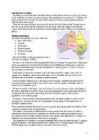
Introduction, Location Australia is a country between the Indian Ocean and the Pacific Ocean. It is the only country in the world that occupies an entire continent. The mainland covers an area of 7.7 million km² and it is about 3700 km from the most northern point to its most southern point and about 4000 km from east to west. There are also many different seas around Australia, like the Coral and the Tasman Seas in the west or the Timor and the Arafura Seas in the north, where the Indian and the Pacific Oceans meet. Because all seas and oceans near Australia are warm, surfing is a very popular hobby. Political subdivision Australia is divided into six states, which are: · New South Wales · Victoria · Queensland · South Australia · Western Australia · Tasmania New South Wales is the most populous state in Australia. Its capital is Sydney. Victoria is one of the most densely populated states in Australia. Its capital city is Melbourne
Australia Australia is the only country in the world that covers an entire continent, yet also the smallest and the driest of all the continents. It's almost the same size as continental USA, being the sixth largest country in the world. It's also the oldest some of the rocks are more than 3,000 million years old. Australia is often called `Down Under', because it lies in the Southern Hemisphere. As a result, its seasons are the opposite of ours. Australia, Tasmania and a number of smaller islands form the Commonwealth of Australia. Because of the country's great size, the climate in Australia ranges from tropical regions of the Northern Territory to the cool temperate conditions in the southeast and Tasmania, where it often snows in winter.
Australia Australia is a country and also a continent. If someone wants to make clear, that he is speaking of the country, he may call it by its full name of Commonwealth of Australia. Australia's name means "southland."It is south of the equator. Sometimes it is also called the island continent because it is an island. There are about twenty million people in Australia.It is 1,800 miles from the mainland of Asia and almost half way round the world from Europe. More than 600 miles of ocean separate it from Americas. Since Australia is south of the equator, its seasons are just the opposite of ours. It has summer while we have winter, and the other way round. States and Territories. Australia consists of six states, two territories and eight external territories.
The United States of America is a big country. People speak English in America. Washington is the capital of the United States. New York City is the largest city in the country, the centre of business. Los Angeles is the second largest city, the film capital. Chicago is the third largest city in the country, the world`s tallest building Sears Towers. The flag of the United States has thirteen stripes. These show the number of states in 1776. It has fifty stars that show the number of states now. I love to see the starry flag That floats above my head. I love to see its waving folds With stripes of white and red. "Be brave," say the red stripes. "Be pure," say the white. "Be true," say the bright stars,
Tallinn English College Topic The United States of America Tallinn 2007 1. Introduction The United States of America's territory is over 3.7 million square miles (over 9.6 million km²) and population more than 300 million people. The capital city is Washington D.C. Although the United States has no official language at the federal level, English is the de facto national language. English is the most common language for daily interaction among both native and non-native speakers. Spanish is the second language. The largest city is the New York City. The Government is Federal constitutional republic and the president is George W. Bush. 2. Geographical position
In my essay I will describe the most characteristic features of the Maori people and the aborigines. I will divide the essay in 3 parts the Maori people, the aborigines and their comparison. Maori are the host people of New Zealand. Their name is derived from Ma-Uri which means the children of heaven. The arrival of the Maori people to New Zealand is considered to be somewhat of a mystery. It is known that first Polynesians arrived to New Zealand about 1000 years ago, when navigator Kupe discovered the land in 950 AD. He named it Aotearoa The Land of the Long White Cloud. Although these facts can be debatable, I will focus my attention on this interpretation of Maori history. After the Maori arrived to New Zealand, they started to develop into tribes and sub tribes, this tribal system is still in use
(New Zealand). Standard English (British English) is the most widely accepted and understood among native speakers, learned by foreigners. It is used in broadcasting, TV, news etc. It doesn't concern pronounciation (accent), but grammar and vocabulary. It includes formal and informal styles. British Standard English grammar and vocabulary, together with the RP accent should be called English English. RP (Received Pronounciation) is an accent that originates from South-East of England. A social accent, associated only with England. 12-15% of native speakers in England use Standard English (BrEng). 3-5% of them use RP (EngEng). Non-standard varieties of English are often called dialects. They are any other dialect of English other than Standard English. They are stigmatized as shameful and inferior, socially lower. Judging people by their accent might, however, be offensive. These varieties are connected to race in US and class in UK. Grammatical and lexical
Australia Australia is surrounded by the Indian and Pacific oceans, it is separated from Asia by the Arafura and Timor seas. Australia presents an enormous range of climatic conditions, since it covers thirty degrees of latitude. It is mostly temperate, but one third of the continent is tropical, and there are large desert areas. The two largest cities are Sydney and Melbourne. The capital of Australia is Canberra. It is a small city and was built in the early 1900s. History. Two hundred years ago there were no white people in Australia. The only inhabitants were dark-skinned people who were still living in a Stone Age. Their only weapons were stone knives and boomerangs. But their tribes had very well-worked- out customs. A few aborigines still live in the emptier part of the continent
Today more and more disputes are caused by the enormous spread of the English language throughout the world. Some scholars claim that it has already become the first global language. And this statement isn't far from truth. But what does it mean to say that a language is a global language? Why is English the language which is usually cited in this connection? How did the situation arise? And could it change? Or is it the case that, once a language becomes a global language, it is there for ever? [1, pg.2] These are fascinating questions to explore, whether your first language is English or not. A global language is a language that is spoken internationally and is learned and spoken by a large number of people as a second language. A global language is characterized not only by the total number of speakers (native and second language speakers), but also by its geographical distribution, as well as use ininternational organizations and diplomatic relations. [4]
Australia Fact file: Australia comprises a land area of 7 686 850 square kilometres. Its population is about 21,3 million people. Australia's capital is Canberra. The national language is English. The official name of it is the Commonwealth of Australia. It's divided into six states and two territories: New South Wales, Queensland, South Australia, Western Australia, Tasmania, Victoria, Australian Capital Territory (ACT) and Northern Territory. Symbols: Australia had the British flag as their official flag until 1901, when the Commonwealth of Australia was formed. Over 30 000 entries attracted the official competition. Five of them, which contained almost identical designs, were placed equally first. The Australian flag symbolises Australia's historical links with Britain, because it has
Tallinn English College Report of Canada 8a Teacher: Merike Sisask Composer: Kärt Kalvet 2010 Canada, Kärt Kalvet 8a Canada General Information Canada is in North America. It's area is 9220970 sq km. Canada's population is 313.612.000 people. Canada is divided into 10 provinces and 3 territories. The capital of Canada is Ottawa. Canada has constitutional monarchy. The head of state in Canada's government is the Queen of England. There are two main languages in Canada: English and French. Canada's curreny is Canadian dollar (1 dollar=100 cents[Can$]). The highest peak of Canada is Mount Logan, 5959 metres. The lowest point is sea level
Australia Topic Koostas: Aineõpetaja: Tallinn 2011 Location Only one country in the world fills a whole continent. That country is Australia. The continent it fills is Australia, too. Australia, then, is both a country and a continent. If someone wants to make clear that he is speaking of the country, he may call it by its full name of Commonwealth of Australia. Sixty million years ago Australia and its nearby islands were separated from the rest of the world by a great upheaval. They were cut off from Asia by the ocean. Very few people and almost no animals visited Australia before English colonists began to settle there in 1788. During all those 60 million years the native Australian mammals developed by themselves, undisturbed by the animals developing elsewhere.
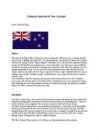
National Symbols of New Zealand New Zealand flag History The idea of the flag of New Zealand was first introduced in 1830, because of trading troubles. At that time, a trading ship built inNZ, Sir George Murray was seized in Sydney by Customs officials for sailing without a flag or register. Australia, which was the most important trading partner for NZ had British navigation laws which ruled that every ship must carry an official certificate detailing construction, ownership and nationality of the ship. The problem was that
 annaabi.ee