Leidsid 33 sarnast õppematerjali, mis on seotud failiga "New Guinea (inglise keeles)". Need materjalid aitavad sul teemat sügavamalt mõista.
guinea, species, forest, bird, forests, plant, birds, here, turtle, wild, plants, wildlife, island, lowland, crocodile, than, south, diversity, crocodiles, river, feathers, animals, islands, other, trees, soil, demand, increase, part, such, east, found, ecosystems, there, threat, survival, tropical, indonesia, nose, trading, back, grow, rivers, coastalThe island of Tasmania is in the south-east of Australia. The capital of Tasmania is Hobart. The seas and oceans that wash the coasts of Australia are warm. The Coral Sea is the warmest that is why many corals live in the seas. The skeletons of these tiny organisms have formed a great belt of coral- called the Great Barrier Reef. Its is 2000 km long and 2-150 km wide. There are five distinguishable natural zones in Australia. In the very east there are wet forests that occupy the space between the Great Dividing Range and the eastern coast. The wet forests give place to beautiful grasslands with some trees called the savannas. Farther west the trees disappear and the bushlands begin. The real desert occupies the centre of the Western Plateau. In the very southwest there are thin forests of evergreen trees. Most of Australian trees are kinds of eucalyptus (or gum tree to Australians) and acacia (wattle of Australians)
If you want to make clear that you are speaking about the country, you may call it the Commonwealth of Australia. It’s the official name of the country. Australia is the smallest continent, but one of the largest countries on Earth. It’s 6th largest country. Its area is about 7.6 million sq km. One third of it is occupied by deserts. It’s both the flattest and, except for Antarctica the driest. Neighbouring countries include Indonesia, East Timor and Papua New Guinea in the north, the Solomon Islands, Vanuatu in the northeast, and New Zealand in the southeast. Its capital is Canberra. Other big cities are Melbourne, Sydney, and Brisbane. National language in Australia is English. Monetary unit is Australian dollar. Their national holiday is on the 26th of January. In 1788 on the 26th of January the first fleet arrived at Botany Bay and established a penal colony near modern-day Sydney. Geographical Position Australia is located in the Southern Hemisphere
Savanna A savanna is a grassland ecosystem with scattered trees or shrubs. In savannas trees are small or widely spaced so that the canopy does not close. It is often believed that savannas are characterized by widely spaced, scattered trees, however in many savanna communities tree densities are higher and trees are more regularly spaced than in forest communities. The open canopy allows sufficient light to reach the ground to support an unbroken herbaceous layer consisting primarily of C4 grasses. Savannas are also characterised by seasonal water availability, with the majority of rainfall being confined to one season of the year. Savannas can be associated with several types of biomes. Savannas are frequently seen as a transitional zone, occurring between forest and desert or prairie.
This brought along the great gold rush. Thousands of people went to the new land to find fortune. Forty years later the gold was found in the west. The miners of the east had a very hard time, the water was scarce and the roads were bad. But then the railway was built. Many of people who came to Australia to find gold stayed on to do other kinds of work. The found that Australia has other riches too, such as coal, copper, ironore, nickel, natural gas and more. The forests had good timber. Along seashorepearls and tortoise shells could be gathered. Some needed to manufacture such things as butter, cheese, shoes and clothing. Geographical position Australia is located in southern hemisphere. It's the only continent except for Antarctica that is all south of equator. Sometimes Australia is called the Island Continent. There is a great reason why. It really is an island. It is
an island but rather small for a continent. Australia is 1,800 miles from the mainland of Asia and almost half way round the world from Europe. More than 6,000 miles of ocean separate in from the America. Australia is the only continent except for Antarctica that lies all south of the equator. The natural zones of Australia are very various. There are deserts, semi deserts, grasslands, savannas, bushlands and rainforests. The wet forests occupy the narrow region in the east. Most of the animals, birds and insects live in that region, because there is enough food. The savannas which are grasslands with some trees are mostly in the west. Farther west are the bushlands. The real deserts occupy the centre of the Western Plateau. In the very south west there are thin forests of evergreens trees. Australia is the driest inhabited continent, the flattest, and has the oldest and least fertile soils.
best time to visit England is from May to September. July and August are the hottest months, but unfortunately the wettest too. In September and October the temperatures drop slightly. January and February are the coldest months and there's often snow on highland areas, especially in Scotland. Plants The mild climate, plenty of rain and a long growing season in Britain support a great variety of plants, which grow exceptionally well. Most of Britain was once covered with thick deciduous forests in which oak trees predominated. The impact of centuries of dense human population has massively altered the flora of Britain and only small parts of those forests remain today. Although about 10 percent of Britain is still forested, most of this area consists of commercially planted coniferous forests in Wales. Before they were affected by the people, the oak forests spread over the best soils of Britain. Forests were unable to establish themselves in the poorer soils of the mountains,
1. Key features for all studied biomes. Tundra The main seasons are winter and summer. The tundra is the world's coldest and driest biomes. The average annual temperature is -28° C. Nights can last for weeks when the sun barely rises during some months in the winter, and the temperature can drop to -70° C. During the summer the sun shines almost 24 hours a day. Summer are usually warm. Average summer temperatures range from 3° to 16°C. TaigaTaiga is the Russian word for forest and is the largest biome in the world. It stretches over Eurasia and North America. The taiga is located near the top of the world, just below the tundra biome. The winters in the taiga are very cold with only snowfall. The summers are warm, rainy, and humid. Some of the animals in the taiga hibernate in the winter, some fly south if they can, while some just cooperate with the environment. GrasslandsGrassland biomes can be found in the middle latitudes
Eastern England the most extreme. Annual rainfall is fairly evenly distributed but the amount of precipitation varies greatly between the mountainous areas of the west and the central and eastern parts. 7. Animals, plants Animals The diversity of animals is modest because of several factors: the size of the land area, seasonal changes and the age of habitats on the island. Because GB has a small area, it means that the number of species that can evolve is limited because there is not enough land mass to support the diversity of animals. The environment is very young due to the Ice Age, so there has not been enough time for such diversity to develop. The seasonal changes that occur across the country mean that the animals have less to eat. Since industrialization began in England in the mid eighteenth century, it has had a big impact on indigenous animal populations. Song
Different types of forests and their forms of usage TARTU 2010 Forest A forest (also called a wood, woodland, wold, weald, holt, frith) is an area with a high density of trees. Forests cover approximately 30% of land and 9.4% of all the planet earth. They are also responsible for regulating our planet's climate and act as large purifiers of airs, by absorbing carbon dioxide, and giving out oxygen. Different types of forests Forests are divided into following main types: o Tropical forest o Subtropical forest o Plantations o Boreal forest o Temperate forest o Seasonal or monsoon forest Tropical and Subtropical Forests Tropical and subtropical forests, also known as rainforests or tropical rainforests, are lavish and ample forests with broad leave tree. They are mostly found at lowlands near the equator - Asia, Africa, South & Central America and on many of the Pacific Islands
Some scientists still do not think that the effects of global warming are as severe as some people say. They think that droughts, hurricanes, and floods often blamed on global warming might actually have other causes. One major difficulty in studying global warming is the fact that weather data only exists for the last century and a half. As a result, understanding the present and predicting the future are very difficult. Rain forest destruction The atmosphere and oceans are not the only parts of the environment being damaged. Rain forests are being quickly destroyed as well, and their survival is questionable. E.O. Wilson, a biologist at Harvard, called the depletion of rain forest areas "the greatest extinction since the end of the age of dinosaurs." Unlike some environmental issues, rain forest depletion has fortunately received significant public and media attention.
deep on average) and rich in shoals. The water of the Baltic Sea is brackish. Its average saltinity is only one fourth of that of the sea in general. Thus, most Estonian freshwater fish (about 30 species) also inhabit the sea. There are some 1450 lakes in Estonia (6.1% of its territory). The two largest of them are Lake Peipsi (the fifth largest in Europe) at 3555 sq km and Võrtsjärv with its 270 sq km area. About 1440 vascular plant species grow in Estonia, while ¾ of the total number of species are found in the coastal lowlands and islands. There are 82 species of fish living in Estonia, which are hard to divide into freshwater and sea species. 357 bird species have been recorded in Estonia, 221 of them breed in Estonia. The bird life in Estonia is at its peak from the end of April to the beginning of July. By August the first breeding birds start the journey back to the South. The autumn migration lasts, for much longer
Natural Zones and Flora. There are five distinguishable natural zones in Australia. In the very east there are wet forests (1.) that occupy the space between the Great Dividing Range and the eastern coast. Westward from the Great Dividing Range the wet forests give place to beautiful grasslands with some trees . These grasslands are called the savannas (2.). Farther west the trees disappear and the bushlands (3.) begin. The real desert (4.) occupies the centre of the Western Plateau. In the very southwest there are thin forests of evergreen trees (5.). Most of Australian trees are kinds of eucalyptus trees (or gum trees to Australians) and acacia ( wattle to Australians). Eucalyptus trees are found everywhere in Australia
hunters. After whales were locally cleared the whalers went there for tortoises, an estimated 200 000 or more adults had been removed. The island of Floreana was populated with a group of convicts' in October 1832. Charls Darwin visited the island in 1835, he spent there 5 weeks. Nowadays five of the islands are populated with about 40 000 inhabitants. The name Island of Galapagos means island of tortoises. Every animal or plant had to cross about 1000 km of open ocean to arrive on Galapagos. Despite the trials of arrival, over 560 species of native plants, over 55 species of native land vertebrates and 1700 species of native insect are found on Galapagos. There are no large mammals, the key herbivores are reptiles, and the top predators are birds and snakes. Mammals on the Galapagos include two species of bat, two endemic rice rat species and its most famous mammals - the Galapagos sea lion and fur seal
but can flourish wherever heat and rainfall are abundant. Today, palm oil is grown throughout Africa, Asia, North America, and South America, with 85% of all palm oil globally produced and exported from Indonesia and Malaysia; but most of the time not using sustainable measures. The industry is linked to major issues such as deforestation, habitat degradation, climate change, animal cruelty and indigenous rights abuses in the countries where it is produced, as the land and forests must be cleared for the development of the oil palm plantations. According to the World Wildlife Fund, an area the equivalent size of 300 football fields of rainforest is cleared each hour to make way for palm oil production. This large-scale deforestation is pushing many species to extinction, and findings show that if nothing hanges, species like the orangutan could become extinct in the wild within the next 5-10 years, and Sumatran tigers less than 3 years.
Six of them represent the states and the last one is for the Commonwealth of Australia. The Southern Cross is in the right. It consists of five stars. The group of stars on the flag shows the geographical place of Australia which is in the southern hemisphere. The coat of arms was created in 1912. Before that coat of arms there was another that did not have so many things on it. On the coat of arms there is the national animal kangaroo. Emu is also there because it is a bird that is very interesting and it is only in Australia. They are standing on the golden wattle that is the national flower. In the top there is the star of the Commonwealth. Under it there is a shield with six parts each containing a representation of the badge of a state. From left the states are New South Wales, Victoria, Queensland and in the second row there are South Australia, Western Australia and Tasmania. The anthem of Australia is called `Advance Australia Fair'
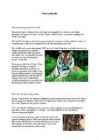
Rare animals Rare Chinese tiger seen in the wild Researchers have confirmed that a wild tiger, photographed by a farmer in the Qinba Mountains of Shaanxi Province, Central China, is indeed that of the critically endangered South China tiger. The South China tiger classified as one of only five subspecies of tiger still alive today is extremely rare, with only an estimated 20 to 30 still remaining in the wild. The wildlife and conservation group WWF says the South China tiger is actually native to the Hainan most forests of south-east China, and because there are so few individuals left, it is regarded by many scientists as being "functionally extinct" in the wild. But a group called Save China's Tigers has been working on a captive- breeding programme and hopes to reach an agreement with China's State Forestry Administration to reintroduce captive-bred animals into the wild. If
Each has its own provincial or territorial symbols. The major difference between a Canadian province and a territory is that a province receives relatively greater power and authority. The youngest of the territories and provinces is Nunavut, created from the east portion of The Northwest territories. 6. Towns, economy, agriculture The two largest cities in Canada are Montreal and Toronto, however, the capital is Ottawa. Canada's vast forests have made it the world's largest producer of pulpwood for making paper. The country also has enormous mineral reserves, especially of oil and iron, which have helped make Canada one of the ten leading industrial nations of the world. Canada is one of the few developed nations that is a net exporter of energy. Canada has vast deposits of natural gas on the east coast and large oil and gas resources centred in Alberta, and also present in neighbouring British Columbia and Saskatchewan
3 °C at Kilkenny Castle, County Kilkenny on 26 June 1887, where as the lowest recorded temperature was 19.1 °C at Markree Castle, County Sligo on 16 January 1881. Inland areas are warmer in summer, and colder in winter there are usually around 40 days of below freezing temperatures (0 °C) at inland weather stations, but only 10 days at coastal stations. Ireland is sometimes affected by heat waves, most recently 1995, 2003, 2006. Nature Ireland has fewer animal and plant species than either Britain or mainland Europe because it became an island shortly after the end of the last Ice Age, about 8,000 years ago. Many different habitat types are found in Ireland, including farmland, open woodland, temperate broadleaf and mixed forests, conifer plantations, peat bogs, and various coastal habitats. Forest covers about 10% of the country. Only 26 land mammal species are native to Ireland, because it was isolated from Europe by rising sea levels after the Ice Age
com/watch? v=avLWMHZR5dk Australian animals · Although most of Australia is semi-arid or desert, it includes a diverse range of habitats from alpine heaths to tropical rainforests. · The wildlife in Australia has evolved in isolation and so has a unique and individual appearance. This also means that the animals have adapted well to the varying and often harsh climatic differences around Australia. · About 85% of flowering plants, 84% of mammals, more than 45% of birds, and 89% of in-shore, temperate-zone fish are endemic. Australia has the greatest number of reptiles of any country, with 755 species. Australian animals · Many plant and animal species became extinct soon after first human settlement. · Australia is home to many dangerous animals including some of the most venomous snakes in the world. · Animal lovers will enjoy the interactivity of dolphins, the majestic Whales, the beautiful Koalas and the unique
Canada is a vast country, with a territory of 3.8 million square miles of land and fresh water it is the second biggest country in the world after Russia. Canada covers most of the northern part of North America. Canada has over 151,480 miles of coastline. Most of Canada's human population lives along its southern border. 3. Relief Canada's geography is very diverse. It has huge lakes, evergreen forests, prairies, meadows and beautiful mountains. There are thousands of miles of coastline with beaches, fjords and wild rivers flowing to the oceans. Canada is a country of wide open spaces and beautiful landscape where traveling visitors can unexpectedly bump into wild animals like bears or be struck by unusual sight like the scarecrows on the Cabot Trail. Canada is rich in natural
Other episodes during this period of the Portuguese presence in Africa include the 1890 British Ultimatum. This forced the Portuguese military to retreat from the land between the Portuguese colonies of Mozambique and Angola (most of present-day Zimbabwe and Zambia), which had been claimed by Portugal and included in its "Pink Map", which clashed with British aspirations to create a Cape to Cairo Railway. The Portuguese territories in Africa were Cape Verde, São Tomé and Príncipe, Portuguese Guinea, Angola, and Mozambique. The tiny fortress of São João Baptista de Ajudá on the coast of Dahomey, was also under Portuguese rule. In addition, the country still ruled the Asian territories of Portuguese India, Portuguese Timor and Macau. REPUBLIC AND TURMOIL On 1 February 1908, the king Dom Carlos I of Portugal and his heir apparent, Prince Royal Dom Luís Filipe, Duke of Braganza, were murdered in Lisbon. Under his rule, Portugal had
Tundra Tundra is the world's youngest biome. It was formed 10 000 years ago. Located at latitudes 55° to 70° North. Almost all tundras are located in the Northern Hemisphere, encircling arctic desert and extending south to the coniferous forests of the taiga. The ecotone (ecological boundary region) between the tundra and the forest is known as the tree line or timberline. Tundra comes from the Finnish word tunturi, meaning treeless plain. It is noted for its frost-moulded landscapes, extremely low temperatures, little precipitation, poor nutrients, and short growing seasons. Dead organic material functions as a nutrient pool. The two major nutrients are nitrogen and phosphorus
http://www.bbc.co.uk/nature/programmes/tv/jungle/vjungle.shtml Virtual Jungle worksheet I 1. Structure 1.1. Describe these layers Emergents The canopy trees are tall, but some species grow even taller until they stick right out above the canopy. These are called 'emergents' and can reach almost 90m in height. Up here they don't have to compete with other trees for light, but they are exposed to the high winds that lash the canopy during tropical storms. Emergents are the favourite nest sites of jungle eagles such as the harpy eagle of South America. Canopy Suspended 40m above the ground is the canopy - a belt of tree crowns supported by enormous rainforest tree trunks. This is the most productive and diverse habitat on Earth - perhaps 40% of the world's species spend their lives among its branches
On account of the country's proximity to the sea, the skies are often cloudy, and rain often falls in the spring and autumn, in the winter the rain turns to snow. The highest point in Estonia is Suur Munamäg It is in fact the highest point in the Baltic region Forest cover over one half of Estonia. The most common types of tree are pine, spruce and birch. Estonia, along with Finland and Sweden are the countries with the greatest percentage of forested land. Forest management and wood production are particularly important for the Estonian economy. One third of Estonian forests are protected areas. In these protected forests you can come across types of primeval forest cover, which have long ago disappeared from other parts of Europe. Examples of such primeval forests are the Järvselja forest in Tartumaa County and Poruni in Ida- Virumaa County. Meadows in Estonia are rich in different species much more so than in Western Europe.
2. Where is prairie, pampas, steppe, and veldt situated? EurasiaSteppe, North America-Prairie, South AmericaPampa, South AfricaVeldt 3. Using the climate diagram describe the climate of the region. Temperate deciduous forest -Well-defined seasons with a distinct winter characterize this forest biome. Moderate climate and a growing season of 140-200 days during 4-6 frost-free months distinguish temperate forests. Temperature varies from -15° C to 25° C. Precipitation (750-1500 mm) is distributed evenly throughout the year. Temperate grassland- Semiarid, continental climates of the middle latitudes typically have between 25 cm and 50 cm of precipitation a year. Much of this falls as snow, serving as reservoir of moisture for the beginning of the growing season. Warm to hot summers are experienced, depending on latitude. In the winter, grassland temperatures can be as low as
The unofficial anthem of Australia is `Waltzing Matilda'. It tells a story about a swagman, who has named his sleeping blanket Matilda. He is chased by police for stealing a sheep which he wanted to eat. The swagman doesn't want to be punished, so he jumps into a billabong and drowns. The golden wattle was proclaimed the official national floral emblem in 1988. It is a spreading shrub or a small tree, which grows in the under storey of open forest, woodland and open scrub in South Australia, Victoria, New South Wales and the Australian Capital Territory. Green and gold were proclaimed Australia's national colour by the Governor-General in 1984. Before the proclamation, Australia had no official colour, although three colour combinations traditionally had a claim to be Australia's national colours: red, white and blue; blue and gold; and green and gold. Head of State:
Protecting endangered species will make a difference in humans' life In the nature of humankind it is natural to hunt animals. However, nowadays hunting endangered species will make humans be just killers, because it is not necessary to kill something just to have a trophy on the wall at home. People can be proud of what they have done, but decreasing the population of a species largely will cause the specific animal breed to go extinct faster than it would happen via natural causes. Therefore, humans should stop hunting endangered species to slow down their extinction, as these species offer balance in the wildlife, are used without purpose in medicine, and may even reduce poverty. Species on the brink of extinction affect us more than we realize. Sure, pandas are cute, and rhinos are fun to look at, but is there anything more to that
the world by a great upheaval. They were cut off from Asia by the ocean. Almost no animals and few people visited Australia before the English colonists. The first people in Australia were the Aborigines. They came there more than 50,000 years ago. They were the only inhabitants. They were living in the Stone Age. Their only weapons were simple spears and boomerangs. They raised no crops and had no heards of tame animals. For food the hunted, fished and gathered wild fruit and nuts. Their tribes had very well worked out customs. Chinese sailors visited Australia 2,500 years ago. Australia remained unknown for Europeans until 400 years ago and no European settled there until 1788. Long before the seventeenth century, people though there was land in the southern ocean, but nobody had seen it. So it was called Terra Australis Incognita - the Unknown South Land.
image, scenery, Lord of the Rings film setting, adventure and culture. ..................................................................................................................................................... About 80-100 million years ago, New Zealand drifted away from the massive supercontinent of Gondwanaland into the South Pacific. Since then, a unique flora and fauna has evolved, with a large number of beautiful native birds and plants, as well as direct descendants of prehistoric wildlife, including the tuatara, weta (the world's heaviest insect), and giant snail. As Time magazine said, New Zealand is an "ultimate storehouse for discontinued zoological models". A reptile with links to the dinosaur, the native tuatara is found mainly on islands around New Zealand's coast. Every species of this reptile family, except the tuatara, died out around 65 million years ago
Quebec (Quebec City), Saskatchewan (Regina), Newfoundland and Labrador (St. John's), Northwest Territories (Yellowknife) and Yukon Territory (Whitehorse). Geographically, Canada can be divided into five major regions: the Pacific Region, the Prairie Provinces, Central Canada, the Atlantic Provinces and the North. The Pacific Region includes Canada's westernmost province, British Columbia. The region is known for it's mild coastal climate, its forests and its spectacular mountains, including the famous Rockies. Alberta, Saskatchewan and Manitoba are Canada's Prairie Provinces. They are known for their rolling plains and extreme climate with long, cold winters and hot, dry summers. Much of the area is covered with farms producing wheat and other grains. The region is also rich in oil and natural gas. Central Canada includes Ontario and Quebec. It is not geographically the centre of Canada.
Canada is a vast country, with a territory of 3.8 million square miles of land and fresh water it is the second biggest country in the world after Russia. Canada covers most of the northern part of North America. Canada has over 151,480 miles of coastline. Most of Canada's human population lives along its southern border. Geographical facts. Canada's geography is very diverse. It has huge lakes, evergreen forests, prairies, meadows and beautiful mountains. There are thousands of miles of coastline with beaches, fjords and wild rivers flowing to the oceans. Canada is a country of wide open spaces and beautiful landscape where traveling visitors can unexpectedly bump into wild animals like bears or be struck by unusual sight like the scarecrows on the Cabot Trail. Canada is rich in natural wonders, one of them, the Niagara Falls between lakes Erie and
Nearly a fifth of New Zealand's people live in rural areas, small settlements are linked by good roads. But in rugged country, the nearest neighbours may be many kilometres away. As a result, some farmers live almost in isolation. Animals Due to its isolation New Zealand has unique wildlife. Most of New Zealands land animals have been introduced from other countries. Deer and rabbits as well as cattle, sheep and pigs were all brought by the European settlers. Two species of bats ar the only native mammals. There are no snakes in New Zealand. New Zealand has many native birds including the kakao parrot, the kea, the weta and the kiwi. A kiwi is a flightless nocturnal native bird, and the national bird of New Zealand. It has nostrils at the end of its beak and a good sense of smell. It is now endangered, and difficult to see in the wild. It lives in undergorund burrow and it can be quite fierce.
Another suggestion, although much less frequently used, is the Islands of the North Atlantic (IONA). Climate Overall, Ireland has a mild, but changeable, climate all year. The island is not noted for its extremes. The warmest recorded air temperature was 33.3°C. The coldest air temperature was -19.1°C Average temperatures in the island vary from -4°C (min) to 11°C (max) in January, and 9°C (min) to 23°C (max) in July. Flora and fauna Ireland has fewer animal and plant species than either Britain or mainland Europe because it became an island very soon after the end of the last Ice Age, about 8,000 years ago. Nevertheless, it is home to hundreds of plant species, some of them unique to the island. Many different habitat types are found in Ireland, including farmland, open woodland, temperate forests, conifer plantations, peat bogs, and various coastal habitats. Fauna
 annaabi.ee