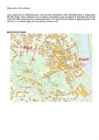
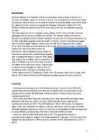
The History of Estonia 8000 BC traces of first settlement at Pulli 3000 BC Finno-Ugric tribes arrive 1st cent AD Estonians mentioned in written records by Tacitus 1030 first written mention of Tartu 1154 first written mention of Tallinn, map of Estonia 1219 Danish invasion by the Teutonic Order 13th century German invasion by the Livonian Order 1343 St George's Night uprising 15th century serfdom begins to develop 16th century Reformation 1558.1583 The Livonian War between Sweden, Poland, Denmark, Russia 1629.1710 Swedish era 1700.1721 The Northern War, Russian invasion 1860.1885 era of national awakening 1918.1920 the War of Independence 1918.1940 the Republic of Estonia 1940.1941 first Soviet occupation 1941.1944 German occupation, World War II 1945
Before the Germans invaded in the 13th century proto-Estonians of the Ancient Estonia worshipped the spirits of nature. Since the Northern Crusades Estonia became a battleground for centuries where Denmark, Germany, Russia, Sweden and Poland fought their many wars over controlling the important geographical position of the country as a gateway between East and West. Being conquered by Danes and Germans in 1227, Estonia was ruled initially by Denmark in the north, by the Livonian Order, an autonomous part of the Monastic state of the Teutonic Knights and Baltic German ecclesiastical states of the Holy Roman Empire. From 1418–1562 the whole of Estonia was part of the Livonian Confederation. After the Livonian War, Estonia became part of the Sweden from the 16th century to 1710/1721, when it was ceded to the Russian Empire as the result of the Great Northern War. Throughout this period the Baltic German nobility enjoyed autonomy,
Before the German invasions in the 13th century proto-Estonians of the Ancient Estonia worshipped the spirits of nature. Since the Northern Crusades Estonia became a battleground for centuries where Denmark, Germany, Russia, Sweden and Poland fought their many wars over controlling the important geographical position of the country as a gateway between East and West. Being conquered by Danes and Germans in 1227, Estonia was ruled initially by Denmark in the north, by the Livonian Order, an autonomous part of the Monastic state of the Teutonic Knights and Baltic German ecclesiastical states of the Holy Roman Empire. From 1418–1562 the whole of Estonia was part of the Livonian Confederation. After the Livonian War, Estonia became part of the Swedish Empire from the 16th century to 1710/1721, when it was ceded to the Russian Empire as the result of the Great Northern War. Throughout this period the Baltic German nobility enjoyed autonomy,
and large beaches. The Pärnu River flows through the city and drains into the Gulf of Riga. The city is served by Pärnu Airport. Pärnu is a health resort of international stature. Hotel and restaurant staff speaks English, Russian and some Finnish in addition to Estonian. Since 1996 Pärnu has been known as Estonia's Summer Capital. Paide is called ,,the heart of Estonia". It is the closest town to me. It is the capital of Järva County, Estonia. A castle built by the Livonian Brothers of the Sword is located here. The town was formally founded 30th of September 1291 by Halt, master of the Livonian Order. The well-known composer Arvo Pärt was born here, as were film actress Ita Ever and author Hermann Hesse's father Johannes Hesse. Top model Carmen Kass spent her childhood in this town. As of 1st of January 2011 the population of Paide was 8981.
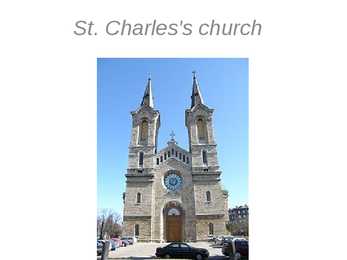
St. Charles's church Is a Romanesque style church in Tallinn. First time mentioned a a church in 1458 Probably built in the 13th Conquest century Chapel was destroyed, probably during the Livonian War. Was consecrated in the 1870th year, although construction began eight years earlier The Church was designed by the Baltic German architect Otto Pius Hippius Johann Köler painted the altarpiece of the church, and it took him ten days time. St. Charles Church also decorates the work of Sally von Kügelgen The organ was completed in 1923 which was made of by German organist Friedrich Eberhard-Walker Thank You for watching Tauri Einberg
History of Estonia Elina, Rasmus, Joosep Pre-history The Mesolithic Period The Neolithic Period The Bronze Age The Iron Age Early Middle Ages Click to edit Master text styles Second level Third level Fourth level Fifth level Counties of Ancient Estonia The Middle Ages Danish Estonia Swedish Coastal Settlements Terra Mariana The Reformation Period Division of Estonia in the Livonian War PolishLithuanian Commonwealth Estonia in the Swedish Empire Estonia in the Russian Empire Age of Enlightenment National Awakening Road to Republic Occupation of Estonia by German Empire. United Baltic Duchy Declaration of Independance As a result of the availability of education Age of awakening Red Army's retreat and arrival of German troops in Pärnu on 23 February in Tallinn on 24 February 1918 Independence (1918-1939) Tartu peace treaty in 1920
beautiful, sandy beaches invite people to come to Pärnu. Amazing nature, as attractive as the beach, can also be found throughout Pärnu County, which boasts a 242 km coastline. Tallinn Gate The so called Tallinn Gate used to mark the beginning of the postal road from Pärnu to Tallinn and was built during the Swedish period in the 17th century. The medieval fortification system of Pärnu was almost fully destroyed in the preceding Livonian War. Ammende Villa Villa Ammende is one of the best examples of early art nouveau style in Estonia. The grand villa with a large garden was built in 1905 and belonged to the Ammende merchant family. Ammende Villa The house has been also used as a summer casino and a club. The villa has now been restored and turned into a luxurious hotel and restaurant.
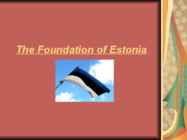
Every country has its history and some moments are more important than the others. Here are some of the most notable dates from Estonian history. 3rd millennium BC the Finno-Ugric tribes arrive in Estonia 1154 First written mention of Tallinn (by al-Idrisi) 13th century German and Danish invade Estonia. Estonians' numerous attempts to restore independence fail 1343 St. George's Night uprising 1558-1583 the Livonian War after which Northern Estonia is occupied by Sweden and Southern Estonia occupied by Poland 1632 Tartu University was founded 1860-1885 the era of national awakening, the foundation for Estonian journalism was laid, collection of folklore 1869 First all-Estonian Song Festival in Tartu 1884 The blue-black-and-white flag of Estonian Students' Society was consecrated 24 February 1918 the birth of the Republic of Estonia
Main room also includes a big dining room and two beautiful balconies. The Defence Tower has suffered the most and has been numerously rebuilt. The tower has Neogothical paintings on the wall, fireplace, staicase and a gallery made of oak. The other tower, Tall Herman is the oldest and best preserved part of the castle. The tower is isolated from the castle, the only connection is drawbridge. History It was founded in 1381. Kuressaare castle was a bishops resident til the end of Livonian war. In 1559. Johannes V Münchhausen sold the castle to Danes. The Danes built a new defence system to the castle, because military technology was improved. In 1645 , with a Brömsebro peace treaty the castle was given to Sweden. In the beginning of 20, century , Kuressaare castle was restaured to be a resident of Saaremaa knighthood. Since September 22 1920, the castle belongs to county government. Why go there?
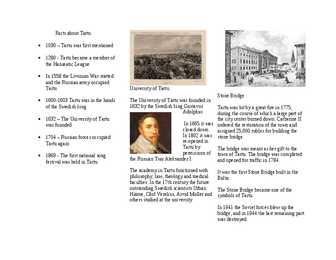
Facts about Tartu · 1030 Tartu was first mentioned · 1280 - Tartu became a member of the Hanseatic League · In 1558 the Livonian War started and the Russian army occupied Tartu University of Tartu Stone Bridge · 1600-1603 Tartu was in the hands The University of Tartu was founded in of the Swedish king 1632 by the Swedish king Gustavus Tartu was hit by a great fire in 1775, Adolphus
About the convent It was founded by St. Birgitta in 1412 and consercrated in 1436. The area is 1360 square meters. It was the biggest church building in the Middle aged Estonia. Name Pirita is orginated from St. Birgitta. The idea and construction The history of the the Pirita Convent dates back to the 15 century. The idea to found a convent in Tallinn, the capital of Estonia, was initiated by some Tallinn merchants already in 1400. Building plot was donated from Livonian Order. The building were built in two different parts. One for nuns and one for monks. Church in the middle and it was used by both. St. Birgitta rules In the convent have to live both - nuns and also monks. Nuns and monks were seperated and did not see each other at all. The Convent could not have more than 85 members 60 sisters and 25 brothers. The leader of the convent is a woman-abess. They could not play the organ. The song must replace the organ.
• EVERYONE CAN EAT WHAT THEY • TOWN COUNCILMAN'S GAME PREFERS, AND WHEN A DISH RUNS OUT, FEAST MORE IS ALWAYS BROUGHT. • GRAND FEAST TO THE HONOUR • THE PRICES ARE REALLY HIGH, OF REWALIAS TOWN COUNCIL RANGING FROM 40-100 EUROS A FEAST, GUESTS SO IT'S NOT REALLY A PLACE TO GO TO EVERY NIGHT. ROYAL HUNTING FEAST DRY GAME SPICED WITH HERBS FRENCH ROYAL POULTRY LIVER PATE ANADALUSIAN SALMON EARL'S PICKLED CUCUMBERS LIVONIAN STYLE LONDON MERCHANT'S SAFFRON PICKLES BERRIES OF THE HIGHLY BLESSED OLIVE TREE SPICE MERCHANT'S BERRY SAUCE HERB-BREAD WITH NUTS RYE BREAD WITH HAM CASTLE'S FRESH CHEESE WELL-COOKED SPELT WITH SAFFRON BAKED SMOKED-SAUERKRAUT CRUSADER’S LENTILS SAUCE GINGER TURNIP CATERING STAFF THE CATERING STAFF IS ALL DRESSED IN MEDIEVAL CLOTHES AND COSTUMES, WHICH REALLY CREATES JUST THE RIGHT ATMOSPHERE. OLDE HANSA IS WIDELY CONSIDERED TO HAVE ONE OF THE BEST CUSTOMER
After the subjugation, the Danes immediately set out to fortify it In the following years, the Danish stronghold was repeatedly besieged All attempts ended in failure Timeline Occupied in 1227 by the Order of the Brethren of the Sword In 1238 the rights of the Danes in North Estonia were restored and Toompea was once again ruled by Danes In 1346 Denmark sold its possessions to the Teutonic Order Until 1561 Toompea belonged to the Livonian Order According to the Altmark peace treaty of 1629, Estonian territories went to the king of Sweden Already earlier (1561), new rulers had come to Toompea In 1710 the knighthood of North Estonia signed the Harju capitulation treaty At first Russians could not initiate any changes in the country they had conquered. For half a century Toompea fell into oblivion Situation changed during the reign of Catherine II Second decade of the last
HAAPSALU By Marika Form 7 HAAPSALU Seaside resort town located on the west coast of Estonia Administrative centre of Lääne County Population - 11,618 Tallinn 100 km away White Lady Western Region Administrative Centre Area - 10,59 km2 HISTORY The German Knights of the Sword conquered this region in 1224, and Haapsalu became the bishop's residence, with a fortress and cathedral built soon afterwards. The Danes took control during the Livonian War then the Swedish had their turn in the 17th century, but they lost it to the Russians during SYMBOLS Flag-blue and white, the flag is confirmed on 27 September 1994 Coat of arms- of the 27th confirmed September 1994 NATURE A few rivers and lakes A lot of deciduous trees and coniferous trees Lakes- Vaikeviik lake Rivers- Asuküla Main Ditch Haapsalu Bay FAMOUS PEOPLE Kaia Kanepi - tennis player Eda-Ines Etti - singer Eia Uus - writer Ly Seppel - poet and translator
States that has not undergone considerable alterations and due to that is an internationally important architectural monument. This castle is built of limestone. The roof is made of red stone. The construction of the stronghold was closely connected with the Estonians fight against the German feudals. The first documented data about Kuressaare castle originate only from 1380s. Kuressaare castle remained the residence for the bishops of Saare-Lääne Bishopric until the beginning of the Livonian War. At the end of the XIV and the beginning of the XV century the castle was surrounded by a new mighty 625 m long and 7 m high belt of walls, erected around the old belt of walls dating from the XIII century. The necessity to improve the defence of the castle was due to the invention and usage of firearms. The old parts of the walls have been preserved in the new earthwork and bastions even today. In the middle of the XV century the wall was made higher and cannon towers were built. The most
Pope Eugene renewed the indulgence in 1342. There are records of pilgrimages to the chapel in the 15th and 16th centuries. In the first century of its existence the castle was not involved in much military action. Campaigns conducted against the surroundings of Vastseliina did not concern the castle as a rule. The castle was systematically under siege for the first time in 1463 but without any result. The castle surrendered to the Russian forces only in the Livonian War, after a siege of three weeks, on June 30, 1558 and was controlled by them till the end of the war. According to the conditions of the Jam Zapolski peace treaty the castle was surrendered to Poles in 1582. Vastseliina castle repeatedly featured in the wars of the 17th century. During that time, in 1625, it came under the control of Swedes for a longer period. By that time Vastseliina castle had lost most of its former significance.
main ideological movement, which based its ideas on US President Woodrow Wilson's principle of self-determination. On April 8, 1917, Estonian organisations and military personnel totalling 40 000 held a demonstration in Petrograd (St. Petersburg) in support of self-government of Estonia. The organised, peaceful demonstration achieved its goal when, on April 12, the Russian Provisional Government signed the Law on Estonian Autonomy, which united the Livonian counties of Tartu, Võru, Viljandi, Pärnu and Saaremaa with Estonia. For the first time an Estonian, Jaan Poska was appointed as a Provincial Commissioner of Estonia. A six-member Provisional National Council, the Maapäev, was formed. The Maapäev appointed a national executive that began to organise and modernise local government and educational institutions. Prior to its forceful dissolution by Bolshevik authorities, and the foreseeable invasion
History Archaeological evidence of the first human settlement in Hiiumaa dates to as early as the 4th century BC. The first documented record of the island of Dageida was made by contemporary chroniclers in 1228, at the time when Hiiumaa, along with the rest of Estonia, had been conquered by Germanic Crusaders. In 1254, Hiiumaa was divided between the Bishoprick of Ösel-Wiek and the Livonian branch of the Teutonic order who were also partly acting on behalf of the Hanseatic league The island was part of Swedish Estonia from 15631720, after which it passed to the Russian as part of the Governorate of Estonia, although Dagö's Swedish population kept most of their privileges. Most of the island's previously numerous Swedish speaking population emigrated or were "Estonia" during the period of Imperial Russian rule, although a small minority remains to this day
you get to know them they’re very open. • Estonians are patriotic due to the hardships during it’s history and their own shared love of their home country. • Historically Estonia is one of the "least religious" countries in the world in terms attitudes, though many Estonians do look for alternative beliefs. Language • The Estonian language is finno ugric, it’s closest relatives are the Finno-Ugrian languages of the Vedic and Livonian languages. • There are many dialects, the main groups can be separated into North and South Estonian dialects. • Besides the typical spoken Estonian language the second most notewordy dialect is the Võru dialect. • Estonian is one of the languages with a larger number of noun cases than typical. • According to comparative grammar studies, Estonian is one of the most sophisticated languages among the world languages. Holidays and Celebrations • Jaanipäev(Jaans day)
Reformation period Third level Fourth level Fifth level · The Reformation in Europe began in 1517. · Martin Luther. · Great change in the Baltic http://3.bp.blogspot.com/- 2iKFa26pWck/TV4hTI9ULYI/AAAAAAAAAVk/UT WLf9xGjBw/s1600/Martin-Luther.jpg Livonian war Click to edit Master text styles 1558-1583 Second level Third level Fourth level · Northern Estonia Fifth level submitted to Swedish control · Southern Estonia briefly came under the control of the Polish-Lithuania Commonwelth. · Hard to peasants
Estonia has many national parks. A national park is a protected area. They are good to protect animals, birds, insects and other natural resources. The most famous national parks are: Lahemaa, Karula, Soomaa, Vilsandi, Matsalu. On the 8th millenium BC first people began to settle here in Estonia. On the 13th century Germans and Danish tried to conquer our country. On the 16th century the first book in Estonian language was publicated. Then the Livonian War began. Northern part of Estonia was occupied by Sweden and the southern part of Estonia was occupied by Poland. On the 17th century Estonia was under Sweden occupation. In 1632 Tartu University was founded. On the 18th century there was a Norhern War and Estonia was occupied by Russia. On the 19th century poeple started to collect Estonian folklore. In 1869 was the first Estonian song festival in Tartu. 1884 blue-black-white flag of Estonia was consecrated in Otepää Church. In 1885-1890
elders. Until the beginning of the 13th century Estonia was politically independent. Then began a long chain of occupation and control by foreign powers. In the 1200s the German crusaders converted Estonia into a Christianity by force and took control over South Estonia. In 1219 Denmark conquered Northern Estonia. About a century later, in 1346 Denmark sold its territory to Germany. By the 1500s German nobles owned much of Estonia's land. After the Livonian War (1558-1583) the northern part of Estonia went under Swedish control, the southern part belonged to Poland and the islands to Denmark. Only in1629 the whole mainland Estonia became subject to Sweden. Under Swedish rule the University of Tartu was founded in 1632 and also the oldest school working on the same premises was founded in Tallinn (GAG).After the Northern War (1700-1721) Estonia became a province of Russia. During that period
Battle of St. Matthew's Day · The Battle of St. Matthew's Day (Estonian: Madisepäeva lahing) was fought near Viljandi on September 21, 1217 during the TeutonicEstonian War. The adversaries were the German crusading order the Sword Brethren with their recently converted allies and an army of 6000 Estonian men from different counties, led by Lembitu, who had attempted to unify the Estonians. The Germans won, Lembitu and Kaupo (converted Livonian chieftain, fought on the order's side) were killed. Also many others were converted and without would be murdered Baltic Way · It was in August of 1989 that an event of monumental significance occurred one which put Estonia, Latvia and Lithuania onto the final road toward renewed independence. The event was the "Baltic Way" human chain, held on 23 August 1989. · The "Baltic Way" human chain was a joint protest action
Middle Ages churches, built in the characteristic Western Estonian onenave style, in the whole of Estonia. There are fragments of the ceiling paintings (probably from the 14th century), a Baroquepulpit (1656, E. Thiele) and an altar preserved in the Church. · The Germans built the Lihula Stronghold in 1242. In 12341251 Lihula was the center of the Diocese of SaareLääne. The Stronghold together with the settlement formed next to it was destroyed in the Livonian War (15581583). On the ruins if the stronghold there is a singing ground today and from here a beautiful view opens onto the surrounding area. · Kuressaare Bishop Stronghold is probably the bestpreserved medieval stronghold in all the Baltic States, being erected in the second half of the 13th century. In the center of the building from tooled dolomite bricks is a square courtyard, which is on the second and third floors surrounded by a closed cloister
married, and attach a padlock to the benches on the hill, it means that they will stick together for the rest of their lives. Also the young unmarried couples come here to kiss, because it has became to a tradition of good luck as a couple. After five minute walk you will see the ruins of Toome Cathedral. Building of the cathedral started in 13 th century and was complete in 15th century. It was a massive cathedral for Tartu and South Estonia. In course of the Reformation and Livonian war the church was badly damaged, and the fire in 1624 made complete destruction for the cathedral. After some time library moved into the cathedrals choral room, it lasted there for nearly two hundred years. After that it became to Tartu University History Museum. After the cathedral you will walk for about 10 minutes as you will notice the Angel Bridge. The name of the bridge "Inglisild" probably comes from the name "Inglisesild", which means "English bridge", due to the fact
The 1710 of the corporations of knights and towns, until Alexander II (18551881), established the relationships between Estonia, Livonia and the Russian Empire. The Baltic Landesstaat reached its full development. The freedom of action in the new provinces was naturally granted to one of the most firm ideological pillars of the tsarist empire -- the Russian orthodox church; though as the Landeskirche in the Estonian and Livonian territories, the Lutheran church long maintained a de facto predominance. The most important organ of Baltic German local government was the Diet, consisting of all the noble families who had been `selected' in a list of the eligible. Although jealously guarding their privileges, the knighthoods still never became entirely closed. Between sessions of a Diet, the legislative power of the knighthoods belonged to the Council of the Diet. The towns were governed by the
It is written in the chronicles that Kiek in de Kök was once the most powerful tower along the Baltic shores. The round cannon tower, built in the 15th century, has a diameter of 17 meters. Its height is 38 meters and its walls are 4 meters thick. The tower was just high enough that its guards had a view into the kitchens of neighbouring buildings. The tower s name, "peek in the kitchen", comes from its height. The tower was partially destroyed during the Livonian War (1558-1583), but the building itself did not fall. The tower has been rebuilt several times, but up until the 20th century, it was still being used as a gunpowder storage and storehouse. Today the tower tells the story of the birth and development of Tallinn and the most important military events from the 13th to the 18th centuries. The external wall still holds stone and iron cannonballs from Russian tsar Ivan IV.
line, the parrot suddenly fell to the ground, pierced by an arrow. The sharpshooter turned out to be a poor boy called Toomas. The annoyed contestants told him to place the parrot back on the top of the pole. Everyone was impressed and the story about Toomas spread quickly. The major of Tallinn asked him to be the town-guard. It was a great honor for the young man and he proved his reliability several times in the battles of the Livonian war. At old age his looks were very similar to the man on the weather vane on top of the spire of the Tallinn's Town Hall, so the people started to call the vane Old Thomas. How did Wheel's Well get the name Cat's Well The legend says that citizens of Tallinn believed that an evil spirit, who threatened to make all the towns wells run dry, lived in the Wheel's Well. To keep the spirit happy, people
The first inhabitants came to the area that now forms present-day Estonia some 11 000 years ago. Estonians were one of the last pagan people in Europe. Estonia was incorporated into Christendom at the beginning of the 13th century, under the pressure of crusaders from Denmark and Northern Germany. Estonians were reduced to the status of peasantry until the 19th century. From 1558 onwards, Estonia became the battleground for the Livonian War involving Denmark, Sweden, Russia and Poland. Sweden emerged as the winner and Estonia remained under its influence until the beginning of the 18th century. During Swedish rule, the first university in Estonia was founded at Tartu in 1632. Tartu University is still widely considered the most important university in Estonia. The period is still often remembered by Estonians as "the Good old Swedish time". In the early 18th century, the Great Northern War left Estonia under Russian rule.
The height of the tower came to it's peak in 1610 - 22,5 meters. Today it has 5 storeys. The upper floors were used for defensive purposes and the lower ones as warhouses. The shape of the tower is horseshoe. It is well preserved and many activity is held there. Kiek in de Kök Kiek in de Kök is a well-known artillery tower built between 1475 and 1483 AD. Kiek in de Kök stands six stories tall and is a historic landmark of the Livonian War. Today, the tower still houses Ivan IV's nine cannonballs, as well as a museum and photography gallery. Kiek in de Kök means Peek into the Kitchen. Tall Hermann Tower Tall Hermann Tower (Pikk Hermann ) belongs to the Toompea Castle and is easily spotted from Toompea hill in Tallinn. The tower dates back to the 1400s and rises 50 meters high. The first part was built 1360-70. It was rebuilt (lenght brought to 45,6 m) in the 16th century.
assaults of Vikings, Danes, Swedes and Russians before the 13 th century. In 1346, the Danes, who possessed northern Estonia, sold the land to the Teutonic Knights of Germany, who already possessed Livonia (southern Estonia and northern Latvia). The Teutonic Knights reduced the Estonians to serfdom. The Estonian capital city of Tallinn was founded by Danish and German crusaders and merchants. In the mid-fourteenth century the Danes sold their possessions in North Estonia to the Livonian Order a religious fraternity of German crusaders. In 1523 Tallinn became a member of the mercantile Hanseatic League. As a result of the long period of wars between Old Livonia, Russia, Sweden, Denmark and Poland, Sweden gained control of Estonia. The times under the Swedish crown between the Livonian War and the Northern War are remembered in Estonian folklore as the Good Old Swedish Times. Russia conquered Estonia in the Great Northern War (1700-1721). The
kitchens of the houses below. Kiek in de Kök is also the starting place for visitors interested in the fascinating system of hidden tunnels (Bastion tunnels) that run underneath the old bastions of Toompea hill. Make sure to pay a visit to the top floor café for beautiful Old Town views. Kiek in de Kök was originally built in the 1470s, but quickly expanded and strengthened, now the walls are four metres thick. The investment paid off: During the Livonian war in the late 1500s, Ivan the Terrible's forces managed to blow a huge hole through the top storey, but the tower held. During post-war repairs, a row of four cannon balls was placed in the newly patched stone wall as a memorial. You can still see them on the tower's south east side. http://www.tourism.tallinn.ee/eng/fpage/explore/attractions/old_town #!p_174740 Tallinn Town Hall
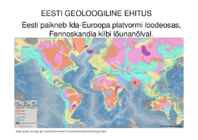
Estonian Academy Publishers, Tallinn. 436 pp. Fig. 160. Zonation of the bedrock topography (after Tavast 1992): 1 - boundaries of large bedrock forms; 2 - boundaries of medium bedrock forms; 3 - escarpments. I - Depression of the Gulf of Finland: 1 - Sub-Vendian Peneplain; 2 - Cambrian-Vendian Peneplain; 3 - Vendian Escarpment; 4 - Cambrian Escarpment. II - Viru-Harju Plateau: 1 - Ordovician Escarpment; 2 - Pandivere Elevation; 3 - Ahtme Eminence. III - Livonian Lowland: 1 - West-Estonian Lowland; 2 - Depression of the Gulf of Riga. IV - Middle-Devonian Plateau: 1 - South- Sakala Elevation; 2 - Otepää Elevation; 3 - North-Vidzeme Depression. V - Central-Estonian Lowland and Depression of Lake Võrtsjärv. VI - Lake Peipsi Depression. VII - Valga and South-Estonian lowlands. VIII - Upper- Devonian Plateau: 1 - Haanja-Aluksne Elevation; 2 - Karula Eminence; 3 - Vidzeme Elevation; 4 - Devonian Escarpment; 5 - East-Latvian Lowland. Raukas, A. 1988
Today the building hosts a beer restaurant carrying the same name. Ruins of Toome Cathedral The name of Tartu's "Toome Hill" is derived from the "Toomkirik" or Toom Cathedral of the area's bishopric. For that time the cathedral was truly massive, being the largest religious building in all of the Liivimaa territory. Building of the cathedral began in the 13th century and was completed in 15th century as a triple-aisled basilica.In the course of the Reformation and Livonian War the church was damaged. The fire of 1624 completed the destruction. In 1807 the university library was built into the choral room of the church, which was housed there until 1982. Now the Tartu University History Museum is located there, and observing platforms have been renovated in the tower ruins.
Nad muutusid liialt vägivaldseks ja auahneks. Neile ei piisanud kunagi sellest, mis neil oli ja nad tahtsid alati rohkemat. Kui nad oleksid täitnud rohkem oma esialgset eesmärki siis neil oleks olnud võimalus kesta kauem. 12 Kasutatud allikad Foto 1. (2018). [WWW] http://www.maskoliunasfamilyproject.com/wp- content/uploads/2013/01/Livonian-Brothers-of-the-Sword-Fratres-militiæ-Christi- Livoniae.jpg (02.10.2018). Foto 2. (2018). [WWW] https://upload.wikimedia.org/wikipedia/commons/thumb/f/f0/Den_tyske_ordens_skjold.svg/2 50px-Den_tyske_ordens_skjold.svg.png (02.10.2018). Foto 3. (2018). [WWW] https://www.taskutark.ee/m/wp- content/uploads/sites/2/2014/02/Eesti_Ajaloo_atlas_Liivi_soda
burned the Scandinavian capital of Sigtuna in 1187. By the early 13th century, Estonia was divided into eight large counties -- Saaremaa, Läänemaa, Rävala, Harju, Viru, Järva, Sakala, and Ugandi. Annual consultations were held by representatives of several counties and developments took the direction of establishing a state. Estonia until this time retained a pagan religion centered around a deity called Tharapita. Estonia was christianised when the German "Livonian Brothers of the Sword" invaded southern Estonia as part of the Northern Crusades in the early 13th century. At the same time, Denmark attempted to take possession of northern Estonia. Estonia was consolidated under the two forces by 1227. Northern Estonia remained a possession of Denmark until 1346. Tallinn (known as Reval at the time) was given its Lübeck Rights in 1248 and joined the Hanseatic League at the end of the 13th century. In 1343, the people of
Mainly seashore wetlands and chaste woodland and wetland areas. The preservation of traditional cultural landscapes is important as well. 5 History To the Nineteenth Century The Estonians settled in their present territory before the Christian era. They were mentioned by Tacitus 1st century A.D., who called them Aesti. In the 13th cent. the Danes and the German order of the Livonian Brothers of the Sword formed an alliance to conquer the pagan Estonian tribes. The Danes founded Reval (now Tallinn) in 1219 and introduced Christianity and Western European culture to Estonia. While Denmark took the northern part of Estonia, the knights occupied the southern portion. In 1346 the Danes sold their territory to the order, and Estonia remained under the rule of the knights and the Hanseatic merchants until the order's dissolution in 1561.
Ural Mountains. Historical references to Estonia begin in the 1100's. At that time the region was divided into small pagan states. Beginning in 1202, an order of German crusading knights from Livonia (Latvia) joined with the Danes to conquer and 2 Christianize the Estonians. By 1227 the Danes controlled northern Estonia; the Livonian Knights, southern Estonia. The Teutonic Knights, another German crusading order, gained control of southern Estonia in 1237 and later conquered all of Estonia. The Teutonic Knights withdrew from Estonia in 1560. Sweden and Poland then fought for control of Estonia; in 1629, Sweden won and annexed the region. Peter I of Russia conquered Estonia in 1710, and in 1721 Sweden formally recognized Russian possession of the region.
the spot of the Toompea Hill, but the real Tallinn was built by the Danes who conquered the north of Estonia in 1219. Legend has it that one day, when the Danes were about to lose a bloody battle, the sky suddenly opened and a red flag with a white cross on it dropped down upon them from the heaven. This is how the Danes obtained their national flag. In 1346 the Danish king sold his Estonian lands to the Teutonic Order, who a year later resold them to the Livonian Order. The Germans renamed Tallinn and called it Reval. Toompea became the seat of the German-born gentry. A fortified wall was built between Toompea (the Upper Town) and the Lower Town, as there were conflicts between the two. The Lower Town was the home of simple people, the artisans and the merchants. The doors and gates in the wall were locked at night. Tallinn joined the German-dominated Hanseatic League in 1285 and became a junction
The left wing was for the nuns and the priests lived in the right wing. The church building was completed and consecrated in 1436. Other buildings took longer to build they were completed at the beginning of the 16th century. The number of nuns was not to exceed sixty according to the regulations of the Order. A girl who wished to become a nun had to be at least 18 years old. The priests could not be younger than 25. The decline of the cloister began during the Livonian War (1558-1583). The fire of 1564 caused considerable damage to the buildings. The convent suffered its final destruction in 1577 at the hands of Ivan the Terrible. 5. Museums Kiek in de Kök is a tower in the Town Wall that stands on Harjumägi (Harju Hill), a former bastion on the slope of Toompea, and was built in the late 15th century. Today, it houses a branch of the Tallinn City Museum
briefly and exchange a kiss. Those old and new customs coexist in harmony influencing each other and bringing variety anf glamour to people's everyday lives. "Jaanipäev" ("John's Day" in English) was celebrated long before the arrival of Christianity in Estonia, although the day was given its name by the crusaders. The arrival of Christianity, however, did not end pagan beliefs and fertility rituals surrounding this holiday. In 1578, Balthasar Russow wrote in his Livonian Chronicle about Estonians who placed more importance on the festival than going to church. He complained about those who went to church, but did not enter, and instead spent their time lighting bonfires, drinking, dancing, singing and following pagan rituals.Midsummer marks a change in the farming year, specifically the break between the completion of spring sowing and the hard work of summer hay making. Understandably, some of the rituals of Jaanipäev have very strong folkloric roots
staged on the initiative of the Estonian Women’s Society, in 1906. 2 The plot and libretto was not to the liking of the Estonian audience. The Estonian poetess Anna Haava (1864-1957) reshaped it into poetic form under the title The Daughter of Lembitu 1 Editor’s note: both were popular light romantic pieces rather than challenging pieces demanding the attention of the audience. 2 Exact date unknown. (Lembitu was a 13th-century Estonian leader and freedom fighter against the Livonian Brothers of the Sword). The two-act opera begins with a spring morning scene, maidens are singing, and Aino the daughter of Lembitu appears. A young Estonian Meelis expresses his love for Aino but she declines him, in her aria she appeals to the spirit of her ancestors for strength. In the second act the historical Battle of St. Matthew's Day (September 21st, 1217) has just taken place and Lembitu is dead. Aino, the people, and the knights
 annaabi.ee