Leidsid 33 sarnast õppematerjali, mis on seotud failiga "Level of education". Need materjalid aitavad sul teemat sügavamalt mõista.
women, secondary, basic, fact, chosen, higher, report, turn, century, popular, shows, cover, ground, prefer, pursue, case, proportion, occupation, fixed, income, certainly, necessary, elementary, opportunity, substantial, university, degree, goals, conclusion, different, levels, having, came, here, exercise, study, englishloudly. What I don't begin to know is the ideal breakdown, according to age, of reading, listening to instruction, and working or hands-on time. What about technology in excess? Before the age of printing and cheap paper, comparatively few people could become learned. Now, theoretically, our electronic age makes learning easier than ever. Well, technology is indisputably better. We can store and retrieve data much more efficiently. We can communicate in a flash. But still, at the basic level, we must be well grounded -- we must possess common sense, civil manners, frank discussion skills, reasoning abilities, and moral fiber. It is possible to be a technological genius, say a computer nerd, without social skills or civil conscience. I'd rather have as a neighbor an illiterate janitor with an easy-going, friendly disposition. Hence, I value what we might call character more than specialist knowledge from an antisocial person. God knows we want
Introduction Children have `somewhat tenuous relationship to citizenship` as a number of authors interested in children`s citizenship have noted.1 Historically, they have not been considered as subjects of rights, but rather as objects of social concern or citizens-in-making. Children have been perceived as objects of investments in the future, and thereupon recognised as `productive economic subjects` who will be carrying out vital tasks for the society and their families`.2 Similarly to how women were once viewed, children have been seen as irrational, emotional and incompetent and therefore are often excluded from the citizenship status. However, the adoption of the U.N Convention of the Rights of the Child (UNCRC) in 1989 was the initial legally binding law that for the first time, granted children the recognition as worthy individuals with rights of their own. 3 The UNCRC has been considered as one of the most innovative international treaties ever ratified
and Scotland with the Acts of Union 1707 on 1 May 1707 under Queen Anne. In 1801, under a new Act of Union, this kingdom merged with the Kingdom of Ireland to create the United Kingdom of Great Britain and Ireland. After the Irish War of Independence most of Ireland seceded from the Union, which then became the United Kingdom of Great Britain and Northern Ireland. The relatively limited variety of fauna and flora on the island is due to its size and the fact that wildlife has had little time to develop since the last glacial period. The high level of urbanisation on the island has contributed to a species extinction rate that is about 100 times greater than the background species extinction rate. 2 The History of the Great Britain The island was first inhabited by people who crossed over the land bridge from the European mainland
Even so, it is unfair to say that schools which are situated in big towns are giving better education than the ones in small towns. Mostly, examination results are being compared, when making this kind of statistics. I truly believe that the only difference between schools is that some institutions just give better conditions for students. At the moment I am studying in Hugo Treffner Gymnasium and this school is highly valued in our country. After finishing the basic school, I knew that I would like to continue my studies in that school. The main reason was the fact that in Hugo Treffner Gymnasium it was possible to study social sciences extensively. The contest was hard to get in, but I had set a goal and I managed to fulfill my expectations.This school has given me better conditions to study the subjects which interest me. Still I think it is wrong to say that so called valued schools are essential for a good education
British Cuisine Some people criticize English food. They say it's unimaginable, boring, tasteless, it's chips with everything and totally overcooked vegetables. The basic ingredients, when fresh, are so full of flavour that British haven't had to invent sauces to disguise their natural taste. What can compare with fresh pees or new potatoes just boiled and served with butter? Why drown spring lamb in wine or cream and spices, when with just one or two herbs it is absolutely delicious? If you ask foreigners to name some typically English dishes, they will probably say "Fish and chips" then stop
Established church The Church of England is the established church, which means that: 1.)the Monarch is the Supreme Governor of the church, 2.)the Church performs a number of official functions, 3.)Church and State are linked. To disestablish Disestablishmentarianism refers to campaigns to sever links between church and state, particularly in relation to the Church of England as an established church. It was initially a movement in the United Kingdom in the 18th century. The established churches in Wales and Ireland could not count on even nominal adherence by a majority of the population of those countries. In Ireland, the predominantly Roman Catholic population campaigned against the position of the established Anglican Church of Ireland - eventually disestablished in Ireland from 1 January 1871. A broad church The Church of England is a broad church, representing a wide spectrum of theological thought and practice
RAPE OF A RACE Let’s take slavery for instance. We attribute everything that has happened to the Black race to slavery. We delude ourselves about African Kingdoms which had thrived before the onslaught of first the Arabs, and later the Caucasians. We talk about the Pyramids of Egypt, the great empire of Mali and the learning capital of Timbuktu. Yes, I am constrained to agree that these were great legacies that our ancestors left us, but one cannot deny the fact that in the middle Passage of the 19th century we stopped functioning as a people with intelligence and the instinct to defend ourselves. In the 17th century, more than 36 million African men and women were taken into slavery and to the shores of America. Of that 36 million, more than 18 million died in the Trans-Atlantic crossings. Listen, don’t get me wrong. We are talking of over 36 million African men and women who were rounded up by
It is built of 150 enormous stones which are set in a purposive circular pattern. Stonehenge was probably built to mark the longest and shortest day of the year because it lies on the line of the midsummer sunrise and the midsummer sunset. That would have enabled people to keep a record of changing of seasons. Although it is still unclear who built it. Hadrian’s Wall is an ancient wall which was built in 2nd century by Hadrian, the emperor of Rome from AD 117 to 138, and it marked the northern border of the Roman Empire in Britain. The wall was 80 Roman miles (117 kilometres) long and it is situated in northern Great Britain and stretched from Solway Firth in the west to the Tyne River near Newcastle in the east. It was built to keep the Caledonians of Scotland out of England. Windsor Castle, which is one of the official residents of British monarch, is located in the English country of Berkshire
Furthermore, Estonia has really outstanding level of education. Compared to other countries, our students get more thorough education and have good knowledge of languages. Based on the OECD’s Education at a Glance 2014 at least 90% of 25-64years old Estonians have secondary education, while average of OECD is 75%. Their level of education is more appreciated on the job market both in homeland and abroad. Moreover, due to countrys valuable workforce, Estonia has an effective job market. Higher standards of education do not only represent for an objective need for education, but it also provides an opportunity to legally restrict access to higher positions, which provide higher income. Innovative e-Services and even mobile-based services are hallmarks of Estonia's market economy. Estonia as also called as „e-Estonia“ is one of the most advanced e-societies in the world, offering services like e-elections, e-healthcare, e-school, etc to make people lives more simple and convenient
Acknowledgments The writing of this book has taken many years of work, reading, teaching, and experience. Many people have contributed to my thinking and have been invisible guides as these chapters came to- gether. I would like to first thank my friend Mark Victor Hansen, who introduced me many years ago to Emmet Fox, perhaps the finest spiritual thinker of the twentieth century. Ernest Holmes, founder of Science of Mind, opened my eyes and heart to the incredible universe of potential contained within each person when they changed their thinking and changed their lives. Great spiritual teachers such as Charles Fillmore, Neville, Eric Butterworth, Wayne Dyer, and Roberto Assagioli have had a profound influence on my thinking. I would also like to thank those great practical thinkers on suc-
Many high-level positions in companies are filled by men even though the workforce in many developed countries is more than 50 percent female. Companies should be required to allocate a certain percentage of these positions to women. To what extent do you agree? In the 21st century it is all about gender equality and every individual wants to achieve high level position in their work place. In the past, women, in many societies, had less rights and privileges than men. The statement says that companies should give a certain number of higher positions to women. However, I do not agree with this requirement completely. Giving a certain percent of higher positions to women certainly is an easy solution but in my opinion it will bring even more sexism. It shows that women are somehow weaker, fragile and need help for everything
advocate of women's rights. Wollstonecraft is best known for A Vindication of the Rights of Woman (1792), in which she argues that women are not naturally inferior to men, but appear to be only because they lack education. Caroline Norton English feminist, social reformer, and author of the early and midnineteenth century. She divorced her husband, because the marrige was very unhappy and Caroline was a victim of regular beatings. His husband claimed that Caroline was guilty of adultery with the home secretary Lord Melbourne and sued Melbourne for seducing his wife. Norton lost the case but Caroline's reputation was ruined. Norton refused Caroline access to
British Literature in the 20th-21st Century REVISION QUESTIONS 1. The Contradictory, diverse, chaotic 20th century. New developments in science and philosophy. The essence and influence of Freudian theory. Contradictory, diverse, chaotic 20th c- simultaneous rejection and invocation of the past. While modernists apotheosized the creative geniuses of the past, they also rejected old poetic forms. Challenge old and established beliefs and more and more people had access to books and education more people went to universities. profound change in morals:
Origin of Native Americans Nearly one-third of Native American genes come from west Eurasian people linked to the Middle East and Europe, rather than entirely from East Asians as previously thought, according to a newly sequenced genome. Native peoples of North and South America descended from ancestors who arrived via land bridges from East Asia, possibly in a single migration. Different tribes and their way of life The men were hunters, warriors, and protectors, while the women tended to the children, their homes, and farmed. It depended on the tribe when it came to artwork. In some tribes, the men would actually weave baskets and blankets. Natural foods were consumed and hunted. Deer, buffalo, fish, and various birds were the game of choice. Corn, beans, squash, berries, nuts, and melons were the fruits and vegetables that were consumed. Berries were also often used as a natural dye for fabrics.
key role in behavior. 2) Animals may be studied as a means of understanding human behavior. 3) There are biological correlates of behavior. Cognitions, emotions and behaviors are products of the anatomy and physiology of our nervous and endocrine system. Explain how principles of the biological level of analysis may be demonstrated in research. 1) Correlational studies: Study by Buss, who hypothesized that across cultures, men will prefer to marry younger women because of greater reproductive capacity and women will place greater value on a potential mate's earning potential to provide survival advantages. This evolutionary hypothesis was tested in 37 cultures by sending out questioners. 2) Twin studies (type of correlational studies) compare trait similarities in identical and fraternal twins (Minnesota twin study by Tellegen, Buchard). 3) Experiment: Split-brain experiments by Gazzaniga & Sperry, brain plasticity
clothes, sing our national songs and dance our national dances. And they do it with pleasure and proudness. Everyone who has been there, including me, know how every song and dance makes you feel more Estonian and what an overpowering feeling of unity it gives. It has been always said that Estonians are singing natoin and young people carry this tradition on and all over the world, advertising and introducing it proudly. Furthermore, there are many young men and nowadays also women, who want to take part in time service, which is indispensable when crisis situation should brake forth, because those people are trained and prepared to fight for Estonia whenever it is necessary. They are ready to give their life for the freedom of their homeland. One the other hand, there are many young Estonians who want to go to study abroad and sometimes they stay there for the rest of their lives. They think that life is better compared to the contitions Estonia has to offer
Estonian and British Education System Estonian and British education system is not quite different. In Estonia, the education system is based on six levels which include the: kindergarten, primary school, basic school, secondary school and university or vocational school. In Britain, the education system is also based on six levels which include the: nursery school, infant school, junior school, secondary school, 6th form and university or college. What is similar for both systems is that the first level of education starts at age of three. While in Estonia this level is called Kindergarten, then in Britain it is called Nursery school. Kindergarten is for children´s from age three to six, but Nursery school is for children´s three to four. Differently from Estonian system, at age of five to seven, British children ´s go to Infant school
Like for example USA's kids have to go to school exactly the same amount of time as our Estonian children. And basically learn same amount of same things. Like everywhere there are always differences. Education in the United States is mainly provided by the public sector, with control and funding coming from three levels: federal, state, and local. Child education is compulsory. A sub-type of compulsory education is public education. Public education is universal at the primary and secondary levels (known inside the United States as the elementary and high school levels). At these levels, school curricula, funding, teaching, and other policies are set through locally elected school boards with jurisdiction over school districts. School districts are usually separate from other local jurisdictions, with independent officials and budgets. Yet in Estonia our school system mainly stands on government. Public
environments, technology offers greater opportunities for interactivity and learner control. There are more educators and language teachers using the Internet in language teaching as well. Many computer applications, especially asynchronous computer-mediated communication such as email and electronic bulletin boards, promote interactive learning. With the booming growth of technology, blogs have become another learning platform for language teaching. Accordingly, these in turn have provided both teachers and learners with an alternative avenue, unlike the traditional face-to-face meetings or discussions, to foster their personal knowledge development through meaningful negotiation and communication. The web-based technology supports collaborative learning that enriches learning performance, both for individual knowledge construction and group knowledge sharing. I became interested in the field since I realised that nowadays in order to be an effective
Work or university? After finishing secondary school you can take two choices. Whether you are going to work or study at the university. Now I would like to talk about their positive and negative sides. Firstly, I'd like to speak about going to work. Many people after finishing secondary school are going to work. One reason for this is that people have different abilities. Not everybody is suitable for university. The second reason is that perhaps they don't want to spend a lot of time on academic education. They are interested in particular profession which doesn't need an academic degree and want to move on with their life. Positive sides are that people can earn money and grow up faster. Negative sides are that it's not easy to get a job if doesn't have an education
Positive sides of outdoor learning Essay "Tell me and I forget. Teach me and I remember. Involve me and I learn." Benjamin Franklin In the last few years outdoor education has become more and more popular worldwide and in Estonia too. While there are many definitions for outdoor education, I think the best way to describe it would be outdoor education is a form of education, when learning takes place somewhere else than a classroom and the subjects are not only about the environment and nature but also linked to the national curriculum. Outdoor education often takes place on a walk around the block, a visit to the cemetery or a local post office. It can happen at a city
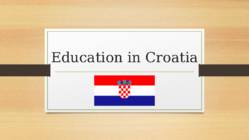
2 Educational system in Croatia divided into: 1. Early childhood education 2. Primary education 3. Secondary education 4. Higher education 3 Early childhood education There are three stages of early childhood education: • from when the child is 6 months old to when they're one • from the ages of one to three • from the age of three until the child stars attending primary school Even though these three stages are not compulsory, every child must attend kindergarten for a year prior to primary school.
English was spoken until around 1100. [5] 2) Middle English (1100-1500) In 1066 William the Conqueror, the Duke of Normandy (part of modern France), invaded and conquered England. The new conquerors (called the Normans) brought with them a kind of French, which became the language of the Royal Court, and the ruling and business classes. For a period there was a kind of linguistic class division, where the lower classes spoke English and the upper classes spoke French. In the 14th century English became dominant in Britain again, but with many French words added. This language is called Middle English. It was the language of the great poet Chaucer (c1340-1400), but it would still be difficult for native English speakers to understand today. [5] 3) Early Modern English (1500-1800) Towards the end of Middle English, a sudden and distinct change in pronunciation (the Great Vowel Shift) started, with vowels being pronounced shorter and shorter. From the
the minds of the people. It is because the communication is designed in such a way that it appeals to a larger demographic segment. The test of a good mass communication marketing drive is to see if it gets the people talking. If it does, then not only does it mean that the advertising drive has been successful, but the organization in charge of the mass communication is also getting publicity by the word-of-mouth channel! Mass Media Influence It is hard to argue with the fact that mass media has a compelling effect on the human mind. Especially on minds which are more impressionable. For example, the mass media influence on children is understandably higher than it is in adults. So how exactly does mass media influence us? Mass Media Influence on Youth There is a burgeoning need amongst the youth to be accepted as a part of a group, to be popular, to have friends and relationships with people of the opposite sex etc. Mass
Choices after secondary school There are many things to consider before choosing a career after high school. Like go to job, university or some trade school. Both of them have positvies and negatives sides. I would like to describe both of them positvies sides. Go to the job after high school is very good idea. Especially when you do not know what you want on your life. Lots of my friends went to the job after high school because they have so tired and so sick of the school. Some of them work a year and after that they had thought clear what they want in their life. They go to the school after they had relaxed. Furthermore they study very hard because they have already aim about what they want to study. But some friends who went to the work after high school are decided to stay and they do not want to go to school anymore. This could be due to that they have found what they like and these are their dream jobs. They have got a working skills, good job and
That is to say ceasing of fighting in all of the Freek world for as long as the Olympic Games were on. The Olympic Games were held, after the completion of four years during the month of July or August. The time between two competitions was called the Olympiad. In the beginning the games lasted for only one day and comprised only one event, the running of one Stadion, but gradually more events were added resulting, towards the 5th century B.C., in the games lasting for 5 days. In total the Olympic Games consisted of 10 events: running, the pentathlon (viievõistlus), jumping, discus, "ekebolon" javelin, wrestling, boxing, the pancration, chariot racing and horse racing. All Greeks who were not criminals had the right to take part in the games. Women were not allowed to compete, they could not even watch the competition. The athletes presented themselves 1 moth before the games began at Elis, the
· Writers task is to record facts, systems of behaviour, living conditions, never revealing any natural unbiased (completely natural) · Point of view: amoral-outside the category of morality, neither good or bad · Naturalist find it absurd to blame the wicked. These criminals are doing what nature, environment, their unconscious tells them to do. Naturalists do not judge their characters, they simply report. Try to describe facts like they are. Naturalists depict the lower, coarser forms of life. · Drab, squallid set of scene. Revolting, disgusting · Characters are people with strong animal desires · Neurotic characters unable to understand the forces that control them · By the end of the 18th century the naturalism depicts in europe, but stars to become the literature method no 1 in america
teaches every subject with the exception of foreign languages and Religion. The students stay in one classroom for the 4 years. · 5th through 8th grades, where different teachers teach different subjects. The students no longer have one classroom, but rather move around the school to get to their classes. People who have completed only primary education are classified as "unqualified workers". Secondary education Secondary schools in Croatia are subdivided into: · Gymnasiums: · prirodoslovno-matematicka gimnazija (specializing in math, informatics and science) · jezicna gimnazija (with a focus on foreign languages and with less science) · klasicna gimnazija (with a curriculum centered around classics, namely Latin and Ancient Greek) · opa gimnazija (which covers a general education and is not as specific).
The period spent there is something what i would never change. Variety of cultures and thoughts, but one dream and a one team. What and inspiring place to be, to learn about food, cultures, different opinions on world, business and hospitality. Leaving from England was hard, for some reason a piece of me left there, so that was the moment i promised to myself, that i will go back to study in this multicultural environment. The second achievement i made at my first year secondary school studies, was when i decided to do research work in history and got recognition from Estonian president for reflecting everyday life. The theme was: ,,Changes during 20 years of independence-Changes in Estonians eating habits". The third bigger breaktrough came, after my Estonian teacher asked my if i would be interested of taking part from and essay-writing competition, where the main prize would be a trip to Brussels, European Parliament and meeting with Siiri Oviir, who is working as a
Topic Sports Tallinn English College 8b form 2007 1. Introduction For some people sport plays a very important part in their lives. And to some, it is even a way of life. There are different kinds of sports. For instance, there are sports meant for playing indoors, some can be practised only at a certain time of year. There are winter and summer sports also. Skiing, figure-skating, sledding and snowboarding these four most popular are practised during winter. Good examples of summer sports are: swimming, badminton, roller skating and golf. 2. The ancient Olympic Games The first recorded Olympic Games took place in 776. B.C. at Olympia but the city may have functioned as a meeting place for worship and other political practices many years earlier. The city is located in western Greece. The games were held every four years. It is also presumed
School system in the USA Education in the United States is provided by government. Each of the 50 states has its own laws regulating education. Children start school at the age of 5 or 6 and continue until the age of 18. Primary or grade school starts from the first grade up to the sixth grade. Then students attend middle school also called junior high school for three years. After middle school, students attend secondary schools, which are called "high schools" from ninth to twelfth grades. The idea of secondary school is to get a high school diploma. Students should take on average 17 or over 20 units during their studies. Public schools are free of charge and available for everybody. To which school a child attends is determined by where they live. Primary school American children start school at the age of five. The first year at school is called kindergarten
English Literature ,Victoria Age 1) Overview of the Victorian age · Periodization During the reign of Queen Victoria (1837-1901) · Why is the Victorian Age compared to the Elizabethan Age? Both are associated with the reign of a very popular queen; Victorian age idealised the Elizabethan Age; many changes in different fields- economy, religion etc.; focusing more on people's attitudes, political developments etc; Victorian age was inspired by Elizabethan era; Britain became an empire · What were the most important changes in politics, religion and social life that occurred during the Victorian age? Politics: 1848 Chartist movement (voting right for the working class); women's suffrage movements;
A basic education is provided free of charge for young people in nearly all developed and democratic countries. However, when it comes to university, or higher education, there are many different approaches taken. In some countries (such as Finland and Sweden) higher education is still free. In other countries, higher education is purchased like any other service. In many countries (such as the UK and the USA), fees are charged to students but how much of the cost of education these cover varies greatly. Often governments offer loans and financial support to help students pay these fees. However, more and more people want to go to university, putting student funding systems under pressure. So should Governments charge fees for higher education, or provide it for free?
 annaabi.ee