Leidsid 33 sarnast õppematerjali, mis on seotud failiga "Kolm vaatlusväärsust inglismaal". Need materjalid aitavad sul teemat sügavamalt mõista.
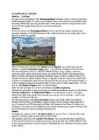
museum, british, visit, armor, bank, seen, complete, without, famous, living, members, royal, court, treasury, mint, today, houses, crown, jewels, filled, torture, another, popular, tourist, sight, towers, meters, above, banks, thames, river, located, near, westminster, abbey, opposite, county, views, clear, there, rosetta, stone, comprehensive, ancientand the third-tallest free-standing clock tower in the world. The clock first ticked on 31 May 1859. The pendulum is installed within an enclosed windproof box sunk beneath the clockroom. It is 3.9m long, weighs 300 kg and beats every 2 seconds. The clockwork mechanism in a room below weighs 5 tons. · Buckingham Palace is the official London residence of the British monarch. Originally known as, the building which forms the core of today's palace was a large townhouse built for the Duke of Buckingham in 1703 on a site which had been in private ownership for at least 150 years. During the 19th century it was enlarged, principally by architects John Nash and Edward Blore, forming three wings around a central courtyard. Buckingham Palace finally became the official royal palace of the British
It is situated on the river Thames. The Thames is a river flowing through southern England and connecting London with the sea. The Thames has a length of 346 kilometres (215 miles). The first bridge was the tower bridge, built in the 12th century. The second bridge was built in the year 1750. .The river Thames divides London into the northern and the southern part. The port of London is one of the greatest trade centres in the world. The river Thames is certainly the most famous water body in London. London is also the seat of the government of Great Britain. It is one of the largest cities in the world with its population of about seven million. Before the great fire in 1666 there were many wooden houses and narrow crooked streets in the town but after the fire it became a well-planned city with wide streets, beautiful squares and parks. It started on the second of September, from a bakery shop in Pudding lane and lasted for about 5 days. It destroyed 89
London History The Romans AD 43- AD 410 The Romans finally invaded Britain in AD 43 from Kent. The Romans lead by Julius Caesar attempted to invade Britain twice before that in 55 and 54 BC but the invasions were unsuccessful. They made their way to the river Thames and sailed up it. The Romans knew it was important to control a crossing point at the river Thames, so they decided to build a settlement on the north bank. Although small settlements had been built on the banks of the Thames, the Romans were the ones who built the first city. They called their city Londinium. The Roman engineers noticed that the point where the swampy river narrowed would make an ideal crossing point, they built London Bridge. Less than 20 years later the native Iceni tribe, led by Queen Boudicca, rose up against the Romans in revenge for mistreatment and burnt Londinium to the ground
A weekend in London Made by .... 6.d klass We will stay at the fabulous 5 Star Athenaeum Hotel in Mayfair which is close to Green Park and Buckingham Palace. It's creative and friendly. There are the colossal Living Wall and the beautifully refurbished spa and gym downstairs. There are also floor to ceiling windows, flat screen TV and complimentary mini bar soft drinks and snacks. Saturday At first we will go visit Buckingham Palace which is the official London residence and principal workplace of the British monarch. We would also like to see the nearby park where are a lot of birds and squirrels. Then we would like to see the river Thames and the Big Ben. Just a short walk from the Thames is situated Westminster Abbey which is a significant building in British history. This beautiful gothic church is a UNESCO World Heritage. Kings, Queens, statesmen,
The City's boundaries have remained constant since the Middle Ages, and hence it is now only a tiny part of the larger London metropolis. The City was originally surrounded by a defensive wall, known as "London Wall", which was built by the Romans to protect their strategic port city. The City of London borders the City of Westminster to the west. The City of London is England's smallest ceremonial county by both population and area covered and is the second smallest British city in both population and size, after St. David's in Wales. 5. The City of Westminster The City of Westminster is a borough of London with city status. The city contains most of London's West End and is the seat of the United Kingdom's government, with the Palace of Westminster, Buckingham Palace, Whitehall and the Royal Courts of Justice. The City of Wesminster covers all or part of the following areas of London: Covent Garden, Hyde Park, Mayfair, Paddington, Queen's Park, St
They burnt down Londinium to the ground and killed most of its inhabitants. Roman armies eventually defeated Boudicca and Londinium was rebuilt. At the end of the fourth century AD the Roman Empire began to crumble and the Roman armies were recalled from Britain to defend Rome itself. Once they had left, tribes such as Angles, Saxons and Jutes invaded and settled in from Holland, Germany and Denmark. Together they are known as Anglo-Saxons. They were farming people who preferred living outside towns. For a while London probably lay in ruins, but it eventually developed again, partly because its position on the river was good for trading. In 1666 most of the City of London was destroyed in the Great Fire of London. London Bridge The home of the London Bridge is the Thames River, and a bridge has existed on the spot for at least the last 2000 years. The first bridge on record was constructed by the Romans, and since
London Topic Tallinn 2008 2 General information London is the capital of the United Kingdom. It covers the area of about 1000 square kilometres and its population is about 7 million. London is located on the river Thames. It is divided into 32 boroughs and the City. Currency used in London is British Pound. London is one of the most popular tourist destination in the world. It is also world's leading business, financial and cultural centre. Subway is commonly used to move around in London. Climate London has a temperate marine climate. It has daily high temperatures during summer. The warmest month is July. The coolest month is January. Winders are seldom below freezing. Rainfall is regular, but most often in the form of drizzle occurring throughout the year. Snow
LANDMARCS HYDE PARK: Hyde Park is one of the largest parks in central London, England and one of the Royal Parks of London, famous for its Speakers' Corner. The park is divided in two by the Serpentine. The park is contiguous with Kensington Gardens; although often still assumed to be part of Hyde Park, Kensington Gardens has been technically separate since 1728, when Queen Caroline made a division between the two. THE TOWER OF LONDON: Her Majesty's Royal Palace and Fortress, more commonly known as the Tower of London (and historically as The Tower), is a historic fortress and
The Romans. They burnt Londinium to the ground but Roman armies eventually defeated Boudicca. The city was rebuilt and was gradually surrounded with a wall of stone and brick which lasted for many centuries. During the archeological excavations in 1954 the Roman Temple of Mithras was revealed. It was a pagan temple dedicated to the Persian Sun-god. The Temple was later reconstructed only a short way from its original site and the relics are displayed in the Museum of London in the Barbican. At the end of the fourth century AD the Roman Empire began to crumble and the Roman armies were recalled from Britain to defend Rome itself. Once they had left Anglo-Saxons invaded and settled in Britain. They were farming people who preffered to live outside towns. For a while London probably lay in ruins, but it eventually developed again, partly because of its position on the river was good for trading. The Tower of London
made Britain a Roman province. They stayed for three hundred years, and built villas, roads and towns. Many Roman remains can be visited in Britain today. The Romans finally abandoned Britain in AD 410 and a long period of invasion by Nordic peoples (from northern Germany and Scandinavia) started. The Angles, Saxons and Jutes began to settle from the sixth to the eighth centuries, and the Angles gave England its name. These invaders introduced a new culture to Britain, and even today British customs and habits are described as ´Anglo-Saxon`. Anglo-Saxon England was one of the most civilised countries in Europe, with organised systems of agriculture and trade. The Vikings came from Scandinavia in the tenth century; they settled in the north and made the town of York the capital of their kingdom. The last successful invasion of Britain was in 1066, when William the Conqueror defeated the English at the Battle of
London March 28th Parliament of the United Kingdom The Parliament of the United Kingdom, commonly known as the UK Parliament or British Parliament, is the supreme legislative body in the United Kingdom, British Crown dependencies and British overseas territories. It alone possesses legislative supremacy and thereby ultimate power over all other political bodies in the UK and its territories. Its head is the Sovereign of the United Kingdom (currently Queen Elizabeth II) and its seat is the Palace of Westminster in the City of Westminster, one of the Boroughs of the British capital - London. Tower of London The Tower of London, officially Her Majesty's Royal Palace and Fortress of the
About 13,200 houses had been destroyed and 70 80,000 people had been made homeless. To prevent such a disaster happening again the king commanded that all new houses in London should be of stone and brick not wood. In 1834 Parliament was destroyed by fire. The new parliament included a great clock, which is now known as Big Ben. In the 19th century new museums were created in London such as the Victoria & Albert, the Science Museum and the Natural History Museum. The first doubledecker bus appeared in the streets of London as early as in 1904. After the two world wars, London went through a massive rebuilding. Several structures were built in London to mark the year 2000: the Millenium Dome, Millenium bridge, London Eye etc. London's vast urban area is often described using a set of district names. Since 1965 Greater London has been divided into 32 London boroughs. However, it is a city that is surprisingly easy to get
The City and The Tower of London Styv Solovjov G1a The City Founded by Romas 43-50 AD, set up trading post It has seen at least 15 major fires 1666 burnt down 4/5 of its houses Then The City was rebuilt Tower Bridge (Tower Hill tube), built in 1894 during the Second World War, its was heavily bombed Now there is one of the biggest financil centres in Europe Banks, stock exchange Many banking and insurance institutions have their headquarters there Stock Exchange, Lloyd's of London,the Bank of England are all based in the City Over 500 banks have offices in the City
The business on constitutional monarchy never ends. 3. Who is the present heir to the throne? Speak about his education. Who are the 2nd and 3rd in line? Present heir is Prince Charles, The Prince of Wales. Has been an exchange student in Australia. Graduated from the university of Cambridge with BA (honors). 2nd and 3rd in line are Prince William of Wales and Prince Henry of Wales, respectively. 4. Make up your list of 5 top British people. Give your motivation. The Queen, Adele, Elton John, Shakespeare, JK Rowling. 5. Which 5 places attract visitors in Wales and Scotland? Edinburgh, Loch Ness, The Highlands, Snowdonia, Cardiff. 6. Name 6 islands, 5 rivers, 3 lakes, 3 mountains in UK. Isle of Man, Isle of Wight, Isle of Lewis, Island of Mull, Island of Arran, Anglesey Island Severn, Thames, Tweed, Avon, Trent, Dove Ben Nevis, Snowdon, Ben Macdui 7. Stonehenge.
including St Paul`s Cathedral. The fire began in the kitchen of the King`s baker Thomas Farriner in Pudding Lane and lasted for five days. London is the capital of England and the United Kingdom. By now London has swallowed up many of the small towns and villages that once surrounded it. London is on the same latitude as Warsaw. London is a city were more than 7 million inhabitants live. In London there are famous Telephone booths and taxis. Also there are red double- decker buses. The quick and easy way is use the underground trains. The cheapest is to buy a Travelcard. London hosted the 1908 and 1948 Summer Olympic Games and will host the 2012 Summer Olympic Games. Many visitors come to see the famous sights, museums and galleries; others come for the shopping. The famous sopping street is Oxford Street. It is the most famous street in London
the arts contributes to its status as a major global city. Central London is the headquarters of more than half of the UK's top 100 listed companies (the FTSE 100) and over 100 of Europe's 500 largest companies. The city is a major tourist destination for both domestic and overseas visitors, with annual expenditure by tourists of around £15 billion. London hosted the 1908 and 1948 Summer Olympic Games and will host the 2012 Summer Olympic Games. Samuel Johnson, author of the first complete dictionary, famously wrote about the city, citing "You find no man, at all intellectual, who is willing to leave London. No, Sir, when a man is tired of London, he is tired of life; for there is in London all that life can afford." Greater London contains four World Heritage Sites: the Tower of London; the historic settlement of Greenwich; the Royal Botanic Gardens, Kew; and the site comprising the Palace of Westminster, Westminster Abbey and St. Margaret's Church.
Anglo-Saxons. The annals were initially created late in the 9th century, probably in Wessex, during the reign of Alfred the Great. Multiple manuscript copies were made and distributed to monasteries across England and were independently updated. In one case, the chronicle was still being actively updated in 1154. Nine manuscripts survive in whole or in part, though not all are of equal historical value and none of them are the original version. 8. Beowulf Beowulf is the most famous heroic poem (written down 8-9cc) Beowulf is a war-leader from Scandinavia.He rescued the land of the Danes from a man-like monster Grendel. The monster kills the hero.The poet describes the funeral and how warriors mourned their king. 9. The Vikings, their way of life. Sutton Hoo In 789 three ships carrying Northmen (Vikings vikingr = pirate, raider in the old Norwegian) landed on the coast of the kingdom of the West Saxon. Many were sailors who sailed looking for plunder,
English (later British) kings and queens have lived in London for almost 1,000 years. There are several royal palaces in the capital. St James's Palace was built by King Henry VIII in the 16th century. Since 1837 the monarch has lived in Buckingham Palace LONDON'S EARLY HISTORY The Romans invaded England in 43 AD. They landed in Kent, made their way to the River Thames and sailed up it. Then they settled in a place on the north bank, where the river was not to wide. This settlement was called Londinium. A bridge was later built across the Thames. Roman London Tribes in England fought the Romans. The Iceni tribe, led by Queen Boudicca, burned down Londinium in 61 AD. The Romans later defeated the tribes and restored Londinium. It became the capital of Roman Brittan. A Basilica, forum and fort were built, plus a wall around the city. The Romans ruled until 410. Medieval London After Edward came King Harold in1066
How well do you know London? Form 10, February 2012 Welcome back to the tour of London! This is your second day (lesson) that you spend exploring the famous landmarks of the city. Again - follow the map so that you would not get lost and try to get streetwise in London. It is also wise to use Google Maps Street View simultaneously it gives you the wonderful feeling of strolling the streets and landmarks. Take the following questions with you, find answers to them and put them down for yourself in this MSWord document. Don't forget to "take" photos - you are supposed to recognise the landmarks later on! At the end of the
The romans stayed there for three hundred years. After the romans left came the Angles, Saxons and Jutes. Angles gave England its name. The population nowadays is about 60 million people UK lies off the north-west coast of mainland Europe. The climate in UK is generally mild and temperate. The climate is greatly influenced by the surroundig days. It is said you can experience four seasons in one day. The longest river is The Severn which is 240 miles long. The most famous English river The Thames is 215 miles long. Lakes can be found in the north of England, in and Area called Lake District. The most beautiful lakes are in Scotland. British mountains are low. The highest peak Ben Nevis is 4.406 feet. The biggest towns are London, Birmingham, Leeds, Glasgow, Sheffield, manchester and Liverpool. The United Kingdom is a constitutional monarchy. The monarch is expected to be politically neutral and should not make political decisions
The Chief Warder represents the Yeoman Warders who have looked after the Tower since the 14th century. · Today they perform the role of tour guide in addition to their ceremonial duties. Tickets for this ceremony are free but you need to apply 6-8 weeks in advance. · Write to: The Ceremony of the Keys, Waterloo Block, HM Tower of London, London, England, EC3N 4AB, stating the names of the attendees and enclosing a self- addressed envelope, together with the requisite British Postage Stamps, or a minimum of two International Reply Coupons. Ham House · This suggestion comes from one of our New Zealand readers. · With such passion and vigor he has described this one. · The first Earl of Dysart was granted a peerage and the estate of Ham for enduring Charles I`s punishments when misbehaving. · It was his daughter, Elizabeth, very ambitious lady who had with help of her second
The Presentations Triinu: "The Notorious Prisoners of the Tower" Built in 1078, has been used as a fortress, Royal Palace, a prison, the home for Crown Jewels. The first prisoner was Ranulf Flambard in 1100. The only woman tortured in the Tower was Anne Askew. Guy Fawkes was prisoned 5 th November 1605, hung in 1607. Walter Raleigh was knighted, married without queen´s permission. Last prisoners were in the Tower in 1952. Rita: "Alexander Fleming" Was a pharmacologist, has graduated 6 schools, studied anti-bacterial agents, found Lysozyme accidentally in 1922 and penicillin, which changed the world, in 1928. Won Nobel Prize in 1945. Has been married twice, first wife was a trained nurse. He died in 1955 at home because of a heart attack. He had 1 child. Liis: "The Phantom of the Opera" A.L
London is an international transport hub, with five international airports and a large port, it has extensive underground, train, bus and taxi services. It is a major tourist destination and one of the world's most remarkable and exciting cities, with iconic landmarks including the Houses of Parliament, Tower Bridge, the Tower of London, Westminster Abbey, Buckingham Palace and the London Eye amongst its many attractions, along with famous institutions such as the British Museum and the National Gallery. About 30% of London is made up of parks and green space, that provides the perfect opportunity for walks, relaxation or sporting activities. England has the population around 50 million, London around 8 million people. The official language is British English. The national currency is the British pound that is devided into 100 pence. The government type in England is constitutional monarchy, the chief of the state is queen
Art Museum of Estonia Art Museum of Estonia was founded on November 17th, 1919, but it was not until 1921 that it got its first permanent building the Kadriorg Palace, built in the 18th century. In 1929 the palace was expropriated from the Art Museum in order to rebuild it as the residence of the President of Estonia. The Art Museum of Estonia was housed in several different temporary spaces, until it moved back to the palace in 1946. In September, 1991 the Kadriorg Palace was closed, because it had totally deteriorated by then. At the end of the year the Supreme Council of the Republic of Estonia decided to guarantee the construction of a new building for the Art Museum of Estonia in Kadriorg. Untill then the Knighthood House at Toompea Hill served as the temporary main building of the Art Museum of Estonia
Main Sights England is known for its many world-famous sightseeings and people all around the world come to see them. Some of them are even like symbols of England. The most famous ones are: Stonehenge is one of the greatest national icons of Britain. That prehistoric monument is located in the plain of Salisbury, in the county of Wiltshire in the south-west of England. It is built of 150 enormous stones which are set in a purposive circular pattern. Stonehenge was probably built to mark the longest and shortest day of the year because it lies on the line of the midsummer sunrise and the midsummer sunset. That would have enabled people to keep a
The Scottish flag has a white cross on a blue background. It is also on the Union Jack. Northern Ireland is the smallest part of the UK as it only covers about 5500 square kilometres. About half of the 1.7 million inhabitants live in or around Belfast, the capital, in the eastern coastal region. The centrepiece of Northern Ireland's geography is Lough Neagh, at 151 square miles (392 km²) the largest freshwater lake both on the island of Ireland and in the British Isles, and the third largest lake in Western Europe. A second extensive lake system is centred on Lower and Upper Lough Erne in Fermanagh. Northern Ireland don't have an official flag any more nor a coat of arms. Due to the division of the population along ethnic, religious and political lines, a wide variety of flags can be seen flying from lampposts and private houses across Northern Ireland. Government. The British Constitution is an unwritten constitution, not being
Edinburgh, which dates from the early 12th century.As with all castles, Edinburgh's fortress has been a centre of military activity. As an ancient fortress Edinburgh Castle is one of the few that still has a military garrison, albeit for largely ceremonial and administrative purposes. The New Barrack Block is now home to the official headquarters of the Royal Regiment of Scotland and 52 Infantry Brigade, as well as home to the regimental museum of the Royal Scots and Royal Scots Dragoon Guards. The Governor of Edinburgh Castle is Major General David McDowall, GOC of the British Army's 2nd Division. The Governor of the Castle has always been the head of the Army in Scotland. Direct administration of the castle by the War Office only came to an end in 1923 when the army formally moved to the city's new Redford Barracks. Nevertheless, the Castle continues to have a strong connection with the Army.
Most of the islands are inhabited and many of them have been developed as tourist resorts. Scientists estimate that the reef is more than thirty million years old. It had its beginning as a tiny animal known as the polyp. It protects itself by forming an external skeleton of lime. When it dies its shell hardens. It has been growing for thirty million years. There are more than 300 varieties of coral with colours ranging from pale blue to bright yellow. Recently a black coral was found. Tourists visit it because it is beautiful, relaxing and interesting. Lakes The big lakes of the desert area are dry most of the time. Enormous Lake Eyre (70km wide, 130km long) was dry for a hundred years until 1950. Lake Eyre is the lowest place in Australia. It is 16 meters below sea level. Other bigger lakes are Lake Disappointment, Lake Mackay, and Lake Carnegie in the western part. Lake Torrens, Lake Gairdner and Lake Eyre in the southern part. Rivers The biggest river is the Murray
Edward the Confessor (1003-1066) Edward was the oldest son of Ethelred II (Ethelred the Unready http://en.wikipedia.org/wiki/Ethelred_the_Unready) and Emma of Normandy (http://en.wikipedia.org/wiki/Emma_of_Normandy). He wast he penultimate Anglo-Saxon king of England. The family was exiled in Normandy after the Danish invasion of 1013 so Edward spent the first part of his life in Normandy. He grew up in deep religious views and gained the nickname ''Confessor''. As Edward was seperated from his family and grew up in a strange land, it is said that his childhood wasn't a happy one. After Ethelred's death in 1016 the Danes again took control of England. The throne of England passed to Canute the Great. T
London There were some people living on the banks of the Thames when the Romans came to England in 43 AD. But we don't know much about them. London first called Londinium . In 200 they built a wall around their city, a part of which can still be seen near the Museum of London . London Bridge was built in stone in 1176. It was London's only bridge until 1729. Now there are about twenty bridges . London soon became the largest city in England and by the time of the Norman Conquest in 1066 it had become the most important city in Britain. It grew in are and population until September 1666, when the Great Fire destroyed four fifths of the wooden buildings in the City including St Paul's Cathedral
The beginning of London Before the founding of London, there had already been smaller groups of people in the area. There aren't any records on who they were. The first mayor settlement of London was in 43 AD. Romans came to the banks of the river Thames. They built houses, a port and a bridge over the river (later known as London Bridge). They named the place Londinium. In the year 200 they built a wall around their city. The wall doesn't exist today, but a part of it can be seen near the Museum of London. In the year 61 Londinium was burned down. The houses were made out of wood back then, so this was easy to do. The people, who destroyed the city, were from the Iceni tribe. The tribe was located to the north-east of Londinium. They had bad relations with the Romans, which is why they burned down the place. London was rebuilt in the year 100. During the 2nd century, Roman London had a population around 60 000 people. In the 8th century there was a lot of Vikings attacking the city
the noble craft of engineers. A bridge can be defined in many ways, but Andrea Palladio, the great 16th century Italian architect and engineer, hit on the essence of bridge building when he said "...bridges should befit the spirit of the community by exhibiting commodiousness, firmness, and delight." In more practical terms, he went on to explain that the way to avoid having the bridge carried away by the violence of water was to make the bridge without fixing any posts in the water. Since the beginning of time, the goal of bridge builders has been to create as wide a span as possible which is commodious, firm, and occasionally delightful. Spanning greater distances is a distinct measure of engineering prowess. In terms of engineering, bridges are discussed by design or type (beam, arch, truss, cantilever, suspension, or moveable); length (usually expressed in terms of clear or overall span); and materials
media, fashion and the arts contributes to its status as a major global city.Central London is the headquarters of more than half of the UK's top 100 listed companies and over 100 of Europe's 500 largest companies. The city is a major tourist destination for both domestic and overseas visitors, with annual expenditure by tourists of around £15 billion. London hosted the 1908 and 1948 Summer Olympic Games and will host the 2012 Summer Olympic Games. Samuel Johnson, author of the first complete dictionary, famously wrote about the city, citing "You find no man, at all intellectual, who is willing to leave London. No, Sir, when a man is tired of London, he is tired of life; for there is in London all that life can afford." Greater London contains four World Heritage Sites: the Tower of London; the historic settlement of Greenwich; the Royal Botanic Gardens, Kew; and the site comprising the Palace of Westminster, Westminster Abbey and St. Margaret's Church.
 annaabi.ee