 50 punkti
Autor soovib selle materjali allalaadimise eest saada 50 punkti.
50 punkti
Autor soovib selle materjali allalaadimise eest saada 50 punkti.
 ~ 2 lehte
Lehekülgede arv dokumendis
~ 2 lehte
Lehekülgede arv dokumendis
 2015-01-15
Kuupäev, millal dokument üles laeti
2015-01-15
Kuupäev, millal dokument üles laeti
 20 laadimist
Kokku alla laetud
20 laadimist
Kokku alla laetud
 0 arvamust
Teiste kasutajate poolt lisatud kommentaarid
0 arvamust
Teiste kasutajate poolt lisatud kommentaarid
 juntsu100
Õppematerjali autor
juntsu100
Õppematerjali autor
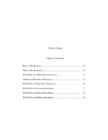
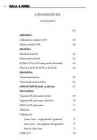
Word Order Table of Contents Types of Sentences ..................................................................................2 Parts of the Sentence ..............................................................................2 Word Order in Affirmative Sentences ...................................................3 Position of Adverbs of Frequency .........................................................5 Word Order in Negative Sentences......................................................6 Word Order in General Questions.........................................................7 Word Order in Special Questions ..........................................................8 Word Order in Subject Questions ..........................................................9 Types of Sentences There are four basic types of sentences in English. AFFIRMATIVE and NEGATIVE sentences both end with a full st
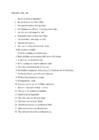
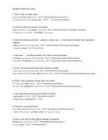
Fill in IN, ON, AT: 1. Dave was born in September. 2. He was born on the 16th of May 3. We agreed to meet at half past four. 4. On Christmas we all went to see our grandmother. 5. Jennifer came to England in 1992. 6. It started to snow on New Year's Day. 7. The First World War ended in 1918. 8. She arrived in spring. 9. We met on Sunday afternoon last week. 10. Do you drive at night? 11. It's Bruce's birthday next Wednesday. 12. Dick and Mary got married in 1993 on the 10th of July. 13. At midnight we heard footsteps. 14. In the morning we went to school as usual. 15. This castle was built in the 15th century. 16. My brother is taking his driving test at 2 o'clock on the 4th of October. 17. Mr Froster doesn't go to office on Saturdays. 18. We'll see Ken tomorrow evening. 19. It happened last week. 20. Can you come to see me on Friday morning? 21. Ron and Laura were in Italy in winter. 22. They go to the country at weeke
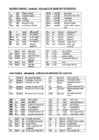
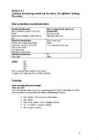
50 9.15 10.45 19.05 6.15 7.45 20.15 19.40 14.30 16.29 23.25 5.49 8.02 13.55 17.09 18.22 Addresses Aadressidest rääkides kasutatakse eessõna at, kui öeldakse ka korteri või maja number, ning eessõna in, kui öeldakse ainult tänava nimi. They live at 5 Oxford Street. She got a job in Weston Road. Ameerika inglise keeles kasutatakse tänavatest rääkides eessõna on. He lives on Penn Street. What's the address? Do you know the address? Practise asking and saying addresses: Süda 1, 10118 Tallinn Akadeemia tee 311 Kentmanni 25-91 Saue, Harjumaa, 76402 Jõgisoo MODULE 5 Word order A Verb + object I like children very much. Did you see your friends yesterday? Ann often plays tennis.
WOULD LIKE 92 IT IS 92 THERE IS / ARE 92 EESSÕNA Ajamäärused: eessõnaga ja ilma eessõnata 93 Eessõnad kohamäärustes 94 ARVSÕNA Põhiarvsõnad 95 Järgarvsõnad 95 60 KUUL UULAA & KORD KORDA ORDA ARTIKKEL Inglise keeles on 2 artiklit: 1) umbmäärane artikkel - A või AN 2) määrav artikkel - THE Umbmäärane artikkel - A / AN Esemete või olendite esmamainimisel kasutatakse tavaliselt artiklit A või AN. A kasutatakse kaashäälikuga algava sõna ees. AN kasutatakse reeglina siis, kui sõna algab täishäälikuga või kui hääldus algab täishäälikuga: an apple (üks) õun
Tests Superstar 1 Luke Prodromou Test 1 Name____________________ Class_______ Use your English 1 Complete these sentences using the correct form (present simple or present continuous) of the verb in brackets. _ 1 She is in a band and she _________________________________ (record) a CD at the moment. _ 2 She is an actress and often _________________________________ (appear) on television. _ 3 At the moment she _________________________________ (have) a rest because she is tired. _ 4 Mike is a doctor and he _________________________________ (live) in Manchester. _ 5 I _________________________________ (start) work at 8.30 every morning. _ 6 He is a good cook but she _________________________________ (prefer) to eat out. _ 7 English tests _________________________________ (get) more and more interesting. _ 8 They _________________________________ (have) a party because it's her birthday. _ 9 I sometimes ____________
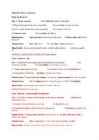
Golden Grammar rules 1. Don't use an with own. Sue needs her own room. (NOT Sue needs an own room.) I'd like a phone line of my own. (NOT ... an own phone line.) 2. Use or rather to correct yourself. She's German or rather, Austrian. (NOT She's German or better, Austrian.) I'll see you on Friday or rather, Saturday. 3. Use the simple present play(s), rain(s) etc to talk about habits and repeated actions. I play tennis every Saturday. (NOT I am playing tennis every Saturday.) It usually rains a lot in November. 4. Use will ..., not the present, for offers and promises. I'll cook you supper this evening. (NOT I cook you supper this evening.) I promise I'll phone you tomorrow. (NOT I promise I phone you tomorrow.) 5. Don't drop prepositions with passive verbs. I don't like to be shouted at. (NOT I don't like to be shouted.) This needs to be thought about some more. (NOT This needs to be thought some more.) 6. Don't use a present tense after It's time. It's t
PRESENT SIMPLE (lihtolevik) Form: 1st form (+s) Use: 1. Things in general. Nurses look after patients in hospitals. 2. Things that happen all the time or repeatedly. She usually goes away at weekends. 3. Laws of nature (things that are true in general). The sun rises in the east. 4. Timetable events. The train leaves at 6.50 p.m. Negative form: I don't (do not) normally eat my lunch here. He doesn't (does not) like this film at all. Question form: Do you live here? How often does it rain around here? Signal words: always, every day/month, never, normally, often, seldom, sometimes, usually etc. PRESENT CONTINUOUS/PROGRESSIVE (kestev olevik) Form: am/is/are + ing Use: 1. Unfinished actions happening at or around the time of speaking. Listen! Somebody is crying. They are building a new bridge in our town. 2. Changes happening around now.
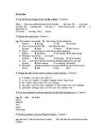
Exercises 1. Use the Present Simple of the verb be or have. ( 10 points ) Mary........blue eyes and blond hair, but her brother ........dark hair. He ........in his late twenties. He........married and........two sons. I........short, but my sister........tall. We........a dog and a cat. Our uncle........two dogs. They........brown. 2. Choose the correct item. ( 5 points ) e.g. The residents were made...D....their homes by the authorities. A leave B leaving C left D to leave 1) Ann is my best friend! We........each other for years A know B knew C knows D have known 2) Nicky........to San Francisco when the accident happened. A flies B has flown C was flying D has been flying 3) Why don`t you let her........her story? A finish B to finish C finishing D have finished 4) Tim........in a cafe at present, but he has already applied for a
 annaabi.ee








Kõik kommentaarid