Leidsid 33 sarnast õppematerjali, mis on seotud failiga "Guild of the Blackheads". Need materjalid aitavad sul teemat sügavamalt mõista.
building, guild, origin, clear, coat, active, latvia, left, 1940s, located, nearly, renaissance, other, events, open, watching, lillepruunChristmas Market enchants the crowds on the square, as does the town's Christmas tree (a tradition whose roots stretch back to 1441), which stays up for a month or more. Town Hall Square has also become the traditional centre of the Old Town Days festival, a modern version of a medieval carnival. Traditions from the Middle Ages are kept alive here, including parades, a knights' tournament, a parrotshooting contest and the election of the May Count. Tallinn`s late Gothic Town Hall building is one of the most famed symbols of the city, recognized throughout Estonia as a venerable, unique architectural treasure. The Town Hall was established on the central square, probably at the beginning of 13th century. In 14021404, the building was substantially reconstructed. The exterior we know today dates from this period, and the basic room plan has also been preserved, as it was reconstructed for hosting receptions.
could be deers trying to escape from the Danes, running down the Toompea hill Tallinn - the word origins from estonian language, could mean “taani-linn”, “tali-linn” or “talu- linn”; Reval was replaced when Estonia became independent Symbols Flag - blue black white tricolor; blue represents sky, black the soil, and white our freedom. Danneborg - red flag with a white cross fell from the sky during the battle in 1219. It is also set into the small coat of arms of Tallinn. Great coat of arms - three lions, a knight, and Danish queen; leaves around Old Thomas - quardian of Tallinn, put on top of the spire of Tallinn Town Hall in 1530; boy that excelled springtime contests thrown by Baltic German elite, because of his low-born status was unable to receive a prize, therefore was granted the position of town guard. Right now there’s third Old Thomas, first one can be seen at Tallinn City Museum. Toompea as a symbol of power
Tallinn Mustamäe College G2K Jaana-Kristiina Jõgevest The Four oldest churches of Tallinn Report Supervisor: Ingrid Teigar Tallinn 2009 The Dome Church The Danes began fortification of Toompea after the conquest of Tallinn in 1219 and probably also built the first church there. It was presumably a wooden building located at the site of the present cathedral. However, a serious conflict with the Order of the Brothers of the Sword broke out soon as the latter wanted to gain control of the entire Estonia. The order succeeded in subordinating Tallinn and the whole of North Estonia to its rule in 1227. The monks of the Dominican Order began the construction of a stone church in Toompea in 1229. The first written data on the cathedral date back to 1233, the date of a
The Great Guild Liisbeth Kallakmaa The Great Guild Medieval Tallinn's social institutions were guilds and brotherhoods, whose main function was to provide members with social interactions and ensure their rights, but also played an important political and economic role. Tallinn had three important guilds - The Great Guild, St. Canute's Guild and St. Olaf's guild. The Great Guild was the youngest among them, founded in the 14th century, but soon became the biggest and most important. It was founded as an organization of the wealthiest merchants and shipowners. The name of the Great Guild was introduced in the late 15th century. There were close ties between the guild and the town rules: only members of the Great Guild had the right to belong to the town council and could be elected for mayor. Tallinn's small coat of arms is also the Great Guild's coat of arms
Tallinn English College Topic Estonia Tallinn 2008 1. Introduction Estonia is a small country about the size of Switzerland, or New Hampshire and Massachussetts combined. Estonia is named after the people called "Ests" who lived in the region in the 1 st century AD. The Republic of Estonia is one of the three countries commonly known as the "Baltic States". The other Baltic States are Latvia and Lithuania. 2. Geographical position Estonia is situated in northeastern Europe. Estonia is bounded on the north by the Gulf of Finland, on the east by Russia, on the south by Latvia and on the west by the Baltic Sea. In the north it borders on Finland. The coastline of the Baltic Sea in Estonia is characterized by numerous gulfs and bays, the biggest of them being the Gulf of Finland, the Gulf of Riga and the Gulf of Pärnu. Bays include the
school, with staff demonstrating how people lived and worked in times past. 4.Oleviste Church (St. Olav's Church) and Tower 124-metre steeple still dwarfs most of Tallinn's buildings and remains an important symbol of the town. From April to October, visitors can make the vigorous climb to the top of the stone portion of the tower for magnificent and dizzying views of Old Town, Toompea hill and the port. 5.Kumu Art Museum A must-see for culture creatures, Kumu, the main building of Art Museum of Estonia, serves both as Estonia's national gallery and as a centre for contemporary art. The complex itself is a work of art - it was opened in 2006 after nearly a decade of planning and construction, and is considered a modern architectural masterpiece. Tallinn Old Town Tallinn's medieval Old Town is known around the world for its well- preserved completeness and authentic Hanseatic architecture. Enchanting
Tallinn grew into a major port and an industrial centre, with huge shipyards. Interest in culture grew and Estonians became conscious of their national identity, dreams of independence gained ground. On 24 February 1918 Estonia was declared an independent country and Tallinn became the capital of the Republic of Estonia. During World War II Estonia was occupied by both German and Russian invaders and Tallinn suffered heavily. The bombing of the city by the Soviet air force on 9 March 1944 left over 20,000 people homeless. During the Russian occupation which followed attempts were made to Russify the local people. Estonia re-established its independence on 20 August 1991. Toompea Toompea is the oldest and the most respectable part of the city. For centuries there was only one means of access to Toompea Pikk Jalg Street. In the middle of the 15th century the Lower Town fenced itself off with these walls from the Upper Town because
Tallinn Was first mentioned in 1422 There were also sold other goods like: ground bats, dried frog feet etc You can try spiced wine claret which was known and valued during the middle ages Bread passage Smallest square in Tallinn Name earned by the numerous bakeries that made delicious bread during the Middle Ages Cute miniature shop where the bakery was belonged to a former whose family coat of arms are still decorating the door. The Holy Spirit church It was built in 1360.This church plays an important role in Estonian cultural history. The first sermons in Estonian language were held in this church in order for the local people to understand the Bible stories. The church's altar is made by the famous Lübeck master Bernt Notke. The Great Guild house The impressive building of the Great Guild is in late Gothic style
Art Museum of Estonia Art Museum of Estonia was founded on November 17th, 1919, but it was not until 1921 that it got its first permanent building the Kadriorg Palace, built in the 18th century. In 1929 the palace was expropriated from the Art Museum in order to rebuild it as the residence of the President of Estonia. The Art Museum of Estonia was housed in several different temporary spaces, until it moved back to the palace in 1946. In September, 1991 the Kadriorg Palace was closed, because it had totally deteriorated by then. At the end of the year the Supreme Council
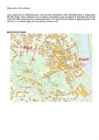
1. Fat Margareta - 16. Cent. Tallinn's most impressive defensive structures, the Great Coastal Gate (Suur Rannavärav) and Fat Margaret's Tower. They were built not only to defend the city from the seaward side of town, but also to impress any visitors arriving via the harbour. Fat Margareta used to be a prison. It is a town wall's building. Now it's home to the Estonian Maritime Museum, which provides a detailed look at the nation's seafaring past. 2. The Great Coastal Gate - with the Viru Gates, are the last of six gates that controlled access to the town in Medieval times. 3. Kolm Õde - a hotel. In 2003, three of Tallinn's splendid merchant houses, built in 1362, were renovated and united to create The Three Sisters, which now offers modern amenities with great design and a
Estonians became conscious of their national identity. Tartu was the centre of the movement of national awakening. On 24 February 1918, Estonia was proclaimed an independent democratic republic. Tallinn developed into a modern European capital. A period of prosperity followed, but independence only lasted for 20 years. During World War II Estonia was occupied by both German and Russian invaders, and Tallinn suffered heavily. The bombing of the city by the Soviet air forces on 9 March 1944 left over 20,000 people homeless. During the Russian occupation which followed (and which lasted for five decades) attempts were made to Russify the local people. Large scale industry was developed in Tallinn, workers were resettled from Russia and new blocks of flats sprang up on the outskirts to provide housing for the newcomers. Tallinn was the biggest grain-handling port in the Soviet Union. Russian speakers outnumbered Estonians in Tallinn.
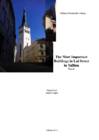
Tallinna Mustamäe College The Most Important Buildings in Lai Street in Tallinn Report Supervisor: Ingrid Teigar Tallinn 2014 Table of Contents Introduction.............................................................................. 3 Lai Street in general.................................................................. 4 The origin of the name "Lai"...................................................... 4 1 Lai Street / 4 Nunne Street...................................................... 5 17 Lai Street............................................................................. 6 23 Lai Street............................................................................. 6 27 Lai Street............................................................................. 8 29 Lai Street................................................
Musical shows, dances and contests of strength and skill will be held all over town. This festival is held in August and it is said that Haapsalu, Estonia's most famous ghost, appears during this festival Black nights film festival http://www.tourism.tallinn.ee/fpage/events/newwinprint/ Beerfestival ( Õllesummer) The beer festival "Õllesummer" is one of the largest festivals in the region--bringing together 80,000 people each year. Õllesummer is located in the Tallinn Song Festival grounds which is located 15 minutes walking time from the center of the city. The program includes Estonian bands and international acts as well featuring over a 100 concerts on more than 10 stages. Õllesummer is a friendly, safe and joyful event that attracts many tourists and visitors of Tallinn. Next Õllesummer festival will take place between 8-12 July 2009 in Tallinn Song Festival
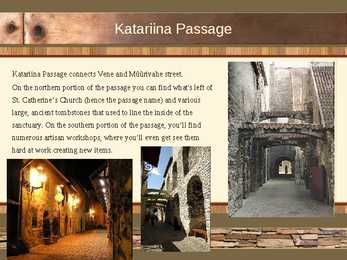
Katariina Passage Katariina Passage connects Vene and Müürivahe street. On the northern portion of the passage you can find what's left of St. Catherine's Church (hence the passage name) and various large, ancient tombstones that used to line the inside of the sanctuary. On the southern portion of the passage, you'll find numerous artisan workshops, where you'll even get see them hard at work creating new items. City wall Tallinn's medieval city wall is a sub-facility that was built to protect the lower Tallinn and upper Tallinn (Toompea).
ground. Tartu was the centre of the movement of national awakening. On 24 February 1918, Estonia was proclaimed an independent democratic republic. Tallinn developed into a modern European capital. A period of prosperity followed, but independence only lasted for 20 years. 1 During World War II Estonia was occupied by both German and Russian invaders, and Tallinn suffered heavily. The bombing of the city by the Soviet air force on 9 March 1944 left over 20,000 people homeless. During the Russian occupation which followed (and which lasted for five decades) attempts were made to Russify the local people. Large-scale industry was developed in Tallinn, workers were resettled from Russia and new blocks of flats sprang up on the outskirts to provide housing for the newcomers. Tallinn was the biggest grain-handling port in the Soviet Union. Russian speakers out- numbered Estonians in Tallinn.
national hero. ● Koluvan - found in old Russian chronicles, the name possibly deriving from the Estonian mythical hero Kalev ● Reval - used after 1219; comes from two german words ‘reh’ and ‘fall’, meaning the falling of the deer - as they fall down the Toompea hill, probably when escaping from the Danish occupation or just the hunters. ● Tallinn - used after Estonia gained its independence in 1918, origin is definitely estonian; meaning Taani-linn, tali- linn. Liberty Square ● The central square of Tallinn, it was renovated in 2008. There used to be Harju gate, which can now be seen through glass. ● The statue of Liberty, 2009; represents freedom, Estonia has been under many foreign powers, starting with Danes, Sweden, German and Russia. The clock of liberty, 2004. Kiek in de Kök ● The cannon tower, founded in 1475-1483
of the repertory is in Russian, quite a number of Estonian classical plays are staged there. The other important theatres in Tallinn are the Tallinn City Theatre, the Estonian Drama Theatre and the Estonian State Puppet Theatre. 3 The Estonia National Opera "Estonia" became a professional theater on September 16, 1906. The current Estonia house - a representative building in the heart of Tallinn - opened the doors in the summer of 1913. The building was designed by Finnish architects Armas Lindgren and Wiwi Lonn. The "Estonia" theatre has had several names during history, but since 1998, it bears the name The Estonian National Opera. From 1994 the theater is managed by the general manager Paul Himma. The Estonian National Opera is the home of the symphony orchestra, the opera choir and the ballet
Mauritius completed his studies at the University of Paris, which was then the best in Europe. On his return to his native land Mauritius kept in touch with colleagues in Germany. His intellectual stature is indicative of the quality of the monastery's leadership. The offerings made on the occasion of such family festivals made a significant contribution to the monastery's finances. The various guilds gave gifts when their feast days were celebrated. The Merchant Guild, for example, each year in December gave the friars a tun of meat, a tun of codfish, and a tun of peas. Rich burgers left legacies to the monastery for the privilege of having a family tomb in the church, But these did not suffice to sustain all those whom the monastery housed. The friars, in consequence, becaipe farmers and fish-mongers. In addition they ran a brewery, which produced four different kinds of beer. In northern
conductor, one of the most recognized symphonists throughout history. He served as concert master and conductor at the Vanemuise Theatre. In 1944, when the theatre was destroyed, he left Estonia to Sweden. Monument to Gustav II Adolf In 1632, King Gustav II Adolf of Sweden, then at the war camp near Nürnburg, signed the charter to found Tartu University, which was also named Academia Gustaviana in his honour. The memorial statue to King Gustav II Adolf (1594-1632) stood next to the main building of the university from 1928, until 1950, when it was removed by the Soviet occupation forces. With Swedish assistance, it was repaired and re-mounted 42 years later, in 1992. The King of Sweden was present both at the original and the re-opening of the monument. Elisabeth Tebelius-Myren authored the restored work. Karl Ernst von Baer monument Karl Ernst von Baer was a naturalist, the founder of comparative embryology and
parent, daddy) In some words we may find transfer meanings (methapfor- the flowers nodded their heads), metonymy (nt, how many vendes, macaroni) 3. Extra-and intralinguistic connection of words. Extral are those between a word and reality (nt, farm firmus (latin) that ment hard.) The answer lies in historical condition. Word ,,firma" ment stable payment. Finally it ment ,,tenant`s dwelling (elamine). To sack means when workers were dismissed, theiy took their tools in a sack and left. Intral words are connected with each other. New facts in the lg cause some change in the meaning of some words. (nt, autumn pushed harvest out, harvest tähendas nii sügist kui ka viljalõikust) 4. Motivation. Folk etymology. Motivation reflects some feature of an object in a word (nt, cucoo! Duck ducan (sukelduma)). Types of mot: a)phonetics- called sound imitation (onomatopoeia), (nt, murmur, bang, giggle, whistle).
London until 1739. Because the passage across this one bridge was narrow and clogged with traffic, it was much quicker for travellers to hire boatmen to row them across the river, or transport them up or down river. In 1191 Richard I acknowledged the right of London to self-government, and in 1192 the election of the first Mayor was held. In 1245 Henry III began his lifetime work of rebuilding Westminster Abbey, which was re- consecrated in 1269. An other building project of the medieval period was Old St. Paul's Cathedral which was finished in 1280. Tudor London 1485-1603 When Henry VII took the throne in 1485, the population of the city of London was about 75,000. By 1600 that number had risen to 200,000. London also grew in importance under the Tudor rule. As the Roman Catholic Church didn't give Henry VIII a divorce he wanted, he changed the entire religion of England. He also started to build ships, as Britain's navy
started to run randomly and then he fell, because of fear and weariness, down of the seashore and broke its neck. Tallinns German name Reval is deriverd from the word Reh Fall (roe-deer falling). According to the legends, Tallinn is a city which is never ready. Indeed, once each autumn goes dark at midnight, one small gray man from the Ülemiste lake. He goes to the city gates and asks from the gate guard if the city is completed or is it still in the middle of the building process. Because of that the guard has to answer that the city is not completed jet and the constructions are still going on. Then the old man goes away. If, however, answered him by mistake, that the city is ready, then Ülemiste lake floats Tallinn with its water. Formerly, there was a cloister on the Vene street, what was burnt down. Old dungeons are preserved even nowadays. When the building was redecorated, then there were found many humanbones
was toppled by the Danes shortly after 1219 - who then constructed an impressive stone edifice, much of which still remains today. In the summer of 1227 the castle at Toompea was conquered by the Order of the Brothers of the Sword, who remained there for the following ten years and played a key role in the history of the development of Toompea. The Order divided the stronghold into two parts: castrum maius or the Great Castle, and castrum minus or the Small Castle. The Great Castle was located in the place where the Dome Church stands today and it became an episcopal centre. The Small Castle stood in the same place as today’s castle and became the centre of secular power. Immediately after the conquest the Order started to fortify the hill. The first castle- type stone fortess (the Small Castle) was built in the southwestern corner of the hill in 1227-1229, perfectly protected by deep moats and towers. You can see one of them on the south-west corner of the castle -it´s Pikk
Alice Tärk, 9b Tallinn 2007 FACTFILE Area: 45 228 sq km Poplulation: under 1.4 million Capital: Tallinn Language: Estonian Currency: Eesti kroon (EEK) Main religion: Lutheran National holiday: 24 February (anniversary of the republic) National flower: Cornflower National bird: Barn Swallow National stone: Limestone LOCATION The Republic of Estonia is the northernmost and smallest of the three Baltic States. It is located on the eastern shores of the Baltic Sea in the north east of Europe. To the east the country borders Russia. Latvia is the countries neighbour to the south. From the west the coast of Estonia is washed by the Baltic Sea and from the north by the Gulf of Finland. The length of the coastline is approximately 3 800 km. The longest distance from east to west is 350 km, while north to south Estonia stretches 240 km. THE NAME
Is it possible to visit the ruins of the Cathedral? Now, go straight ahead until you reach the Lossi street, turn right. Soon you will see The Devils Bridge. From what stone do you think it is made of? To go to the next object, you need to turn around and walk back along the Lossi street. Then you should see the famous Angels Bridge. What is written on the bridge? When do you think it was built? After that, go along the Lossi street, until you reach Jaani street. Then turn left on Jaani street, walk approximately 100 meters along the Jaani street. On your left you should see the Main Building of Tartu University. How many pillars has The University Building? What has been written on the under them? Whose statue is behind this building? If you are done with the tasks, walk again approximately 100 meters forwards along the Jaani street. You should soon notice a church, this is Tartu Jaani (St. John's) Church. About how high is this churches tower?
May 1988. The national flower is cornflower, the national bird is barn swallow and the national stone is limestone. The Estonian national anthem called "My Native Land, My Pride and Joy" was composed in 1848 by Friedrich Pacius. The Estonian language words were written by J. V. Jannsen. It was officially adopted after the War of Independence in 1920.The same melody with different words is also Finland's national anthem. The current coat of arms of Estonia is a golden shield which includes three slim, blue leopards (or lions) in the middle, with oak branches along the side of the shield. It originates from Denmark. It was officially adopted in 1925. Geography Estonia is the northernmost of the three Baltic States. It is located on the northern hemisphere on the eastern shores of the Baltic Sea in the north-east of Europe. It has land contact with Russia from the east and Latvia from the south
Estonia. Estonia, officially the Republic of Estonia is a country in Northern Europe. It is the smallest of the three Baltic countries. Estonia has land borders with Latvia (339 km) to the south and Russia (229 km) to the east. It is separated from Finland in the north by the narrow Gulf of Finland and from Sweden in the west by the Baltic Sea. Estonia has been a member of the European Union since May 1, 2004 and of the NATO since March 29, 2004. The area of Estonia is about 45000 square kilometres and the population is about 1.4 million people. The capital of Estonia is Tallinn and the official language is Estonian. The currency is Eesti kroon
(There are many such legendary burial places of him in Estonia.) The cathedral was built during the period of late 19th century Russification and was so disliked by many Estonians as a symbol of oppression that the Estonian authorities scheduled the cathedral for demolition in 1924, but the decision was never implemented due to lack of funds and the building's massive construction. As the USSR was officially non-religious, many churches including this cathedral were left to decline. The church has been meticulously restored since Estonia regained independence from the Soviet Union in 1991. http://en.wikipedia.org/wiki/Alexander_Nevsky_Cathedral,_Tallinn The church's towers hold Tallinn's most powerful church bell ensemble, consisting of 11 bells, including the largest in Tallinn, weighing 15 tonnes. You can hear the entire ensemble playing before each service. http://www.tourism.tallinn.ee/eng/fpage/explore/churches#!p_307
with the technology of the time. Another is its purpose. It appears to function as a kind on astronomical clock and we know it was used by the Druids for ceremonies marking the passing of the seasons. It appears in number of novels. These days it is not only the interest of tourists but is also a gathering point of certain minority groups. It is now fenced off to protect it from damage. 3. The Roman conquest Julius Caesar's first raid was in 55 BC but the romans left. Ad 43- the Romans came to stay. The army established Roman rule in the south and SW of the country. The Romans started to introduce their laws to a new province of the Roman Empire and started to build good roads. Officials were appointed (governors, procurators to collect taxes, look after the estates and mines and se that the gold, silver, iron and lead were exported back to Rome). Introduced schools,a new language Latin, large farms (villas), baths. In AD 410 they had to leave
Reconstructions in the 16th and 17th century changed the original looks of the tower considerably. 4. Suur Munamägi ("Big Egg Hill") Mountain Suur Munamägi, or Big Egg Hill, is the highest point in Estonia and other two Baltic countries. It is 318 meters high. The mountain is located in the middle part of Haanja uplands. It is in Haanja national park in Võrumaa. On the top of the mountain there is an observation tower the view from 346,7 meters is 50 km in radius. 5. The Town Hall building 3 The building history of the Town Hall goes back to the 13th century. In its
To some extent, anyway, and not without exceptions. Usually the exact time and location are given in the book. The language became more descriptive. Essays also rose in importance. Essays are political pieces. Daniel Defoe (1660 1731) was a writer of the Enlightenment period. He came from a wealthy, Puritan family. Danny was to become a clergyman, but he preferred to be a merchant and that's what he did. He had an interesting life. 1694 he became active in public affairs. He was the first literary journalist and combined the life of a man of action and a writer. He wrote 'Essay on Projects' in which he recommended establishing saving-banks, building railways, allow higher education for women, 'The True Bon Englishamn', 'The Shortest Way with Dissenters' in which he attacked both the Tories and the church and deended religious freedom. For the latter he was sent to the pillory for three days
Jõgeva maakond Endla nature reserve It is located on the borderline of Järva, Jõgeva and West-Viru counties. It is mostly known for various marshes, fens, quaking bogs, lakes, canebrakes, wellsprings, rivers, fen forests, fens and mesotrophic mires, marsh forests, meadows, diverse flora and fauna. Jõgeva town The small town of Jõgeva town is located on the eastern side of Middle-Estonia. You won't find large buildings or breathtaking architecture here, but an overwhelming sense of togetherness and plenty of cultural events, the majority of them geared towards younger people. Jõgeva town was born 130 years ago, thanks to the Tapa-Tartu railway: this is where the first train stopped and a village formed around the railway station. Just half a century later, Jõgeva earned its town rights. There are about 6500 people living in Jõgeva.
couldn't reproduce it in most of the US either. What does it take to make a silicon valley even here? What it takes is the right people. If you could get the right ten thousand people to move from Silicon Valley to Buffalo, Buffalo would become Silicon Valley. That's a striking departure from the past. Up till a couple decades ago, geography was destiny for cities. All great cities were located on waterways, because cities made money by trade, and water was the only economical way to ship. Now you could make a great city anywhere, if you could get the right people to move there. So the question of how to make a silicon valley becomes: who are the right people, and how do you get them to move? Two Types I think you only need two kinds of people to create a technology hub: rich people and nerds
 annaabi.ee