Leidsid 33 sarnast õppematerjali, mis on seotud failiga "Estonia´s neighbours". Need materjalid aitavad sul teemat sügavamalt mõista.
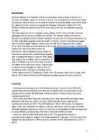
lithuania, latvia, finland, country, soviet, official, total, language, republic, europe, finnish, region, share, nazi, germany, commonwealth, until, russian, riga, baltic, seasonal, consequence, occupation, both, ethnic, found, 18th, however, outset, incorporated, invaded, fifty, years, singing, revolution, started, vilnius, biggest, catholic, countyEstonia Topic Tallinn 2007 2 List of Contents page Facts and figures 3 Geography 3 Climate 3 Nature 4 History 5 Economy 6 Culture 6 Biggest towns 7 Language 8 3 Facts and figures The Republic of Estonia is a small country. Covering only 45, 228 sq km it is slightly bigger than Denmark, Belgium or Switzerland. Estonia's population is under 1.4 million. The official language is Estonian but since very many Russians live here Russian is also wide spread. The capital of Estonia is Tallinn. The currency used in Estonia is Eesti kroon. The Estonian national flag is blue-black-white. It was originally the flag of the Estonian Students' Society. The flag was first consecrated in Otepää Church in 1884. For a while,
Milestones in Estonian History The Estonians are a Finno-Ugric people who came from the area near the Urals and the Volga and Oka rivers. They migrated westward to the Baltic shores some 5, 000 years ago. In the ninth century A.D. Viking ships invaded Estonia and the country became a vital link in the sea-trade between East and West. By the 12th century, the Arabian geographer al-Idrisi had placed the city on his maps. In the 13th century, Tallinn joined the Hanseatic League, the union of European commercial towns that stretched from London to Novgorod. Pärnu, Viljandi and Tartu were also members. Estonia became a vital link in the sea-trade between East and West. The oldest preserved book written in Estonian, a catechism, dates from 1535. Tartu
Where it is? Republic of Estonia is a state in the Baltic region of Northern Europe .It is bordered to the north by the Finland, to the west by the Baltic Sea, to the south by Latvia (343 km), and to the east by lake Peipus and Russia (338.6 km). Across the Baltic Sea lies Sweden in the west and Finland in the north. Towns Tallinn is the capital and the largest city of Estonia. It lies on the northern coast of Estonia, along the Gulf of Finland. There are 33 cities and several town-parish towns in the country. In total, there are 47 linna, with "linn" in English meaning both "cities" and "towns". More than 70% of the population lives in towns. History • Estonia was settled near the end of the last glacial era, beginning from around 8500 BC. Before the German invasions in the 13th century proto-Estonians of the Ancient Estonia worshipped the spirits of nature
Tallinn English College Topic Estonia Tallinn 2008 1. Introduction Estonia is a small country about the size of Switzerland, or New Hampshire and Massachussetts combined. Estonia is named after the people called "Ests" who lived in the region in the 1 st century AD. The Republic of Estonia is one of the three countries commonly known as the "Baltic States". The other Baltic States are Latvia and Lithuania. 2. Geographical position Estonia is situated in northeastern Europe. Estonia is bounded on the north by the Gulf of Finland, on the east by Russia, on the south by Latvia and on the west by the Baltic Sea. In the north it borders on Finland. The coastline of the Baltic Sea in Estonia is characterized by numerous gulfs and bays, the biggest of them being the Gulf of Finland, the Gulf of Riga and the Gulf of Pärnu. Bays include the
Introduction Estonia, officially the Republic of Estonia (Estonian: Eesti or Eesti Vabariik) is a country in the Baltic region of Northern Europe. It is bordered to the north by Finland across the Gulf of Finland, to the west by Sweden across the Baltic Sea, to the south by Latvia (343 km), and to the east by the Russian Federation (338,6 km). The territory of Estonia covers 45,227 km² and is influenced by a temperate seasonal climate. The Estonians are a Finnic people closely related to the Finns, with the Estonian language sharing many similarities to Finnish. The modern name of Estonia is thought to originate from the Roman historian Tacitus, who in his book Germania (ca. AD 98) described a people called the Aestii. Similarly, ancient Scandinavian sagas
TartuWaldorf School FINLAND Report Johan Mähar Tartu 2008 Contents p. 1. Introduction.........................................................................................
Tallinn, general overview Prepared: Hanna Bergmann 16.04.2011 Tallinn's Old Town is in the list of UNESCO World Heritage Sites. Tallinn is ranked as a global city and has been listed among the top 10 digital cities in the world. Tallinn is a European Capital of Culture for 2011, along with Turku, Finland. Location Tallinn is situated on the northern coast of the country, on the banks of the Gulf of Finland, 80 km south of Helsinki, east of Stockholm and west of Saint Petersburg. Tallinn is situated on the southern coast of the Gulf of Finland, in north-western Estonia. Tallinn Population The registered population of Tallinn is 412,341 (as of 1 Dec 2010). According to Eurostat, in 2004 Tallinn had the largest number of non-EU nationals of all EU member states' capital cities.As of 2009 around 22% of its population are not EU citizens.
Estonia. Estonia, officially the Republic of Estonia is a country in Northern Europe. It is the smallest of the three Baltic countries. Estonia has land borders with Latvia (339 km) to the south and Russia (229 km) to the east. It is separated from Finland in the north by the narrow Gulf of Finland and from Sweden in the west by the Baltic Sea. Estonia has been a member of the European Union since May 1, 2004 and of the NATO since March 29, 2004. The area of Estonia is about 45000 square kilometres and the population is about 1.4 million people. The capital of Estonia is Tallinn and the official language is Estonian. The currency is Eesti kroon. The main religion is Lutheran. Anniversary of the republic is celebrated on February 20. The national flower is cornflower, national
calling for greater autonomy, and later, complete independence from the Russian empire. Following the Bolshevik takeover of power in Russia after the October Revolution of 1917 and German victories against the Russian army, between the Russian Red Army's retreat and the arrival of advancing German troops, the Committee of Elders of the Maapäev issued the Estonian Declaration of Independence in Pärnu on February 24, 1918. after winning the Estonian Liberation War against Soviet Russia and at the same time German Freekorps volunteers (the Tartu Peace Treaty was signed on 2 February 1920), Estonia maintained its independence for 22 years. Initially a parliamentary democracy, the parliament was disnaded in 1934, following political unrest caused by the global economic crisis. Subsequently the country was ruled by decree by Konstatin Päts, who became President in 1938, the year parliamentary elections resumed.
Estonia officially the Republic of Estonia, is a country in the Baltic region of Northern Europe. It is bordered to the north by the Gulf of Finland, to the west by the Baltic Sea, to the south by Latvia and to the east by Russia. Across the Baltic Sea lies Sweden in the west and Finland in the north. The territory of Estonia covers 45,227 km2, and is influenced by a humid continental climate. Estonia is a democratic parliamentary republic divided into fifteen counties, with its capital and largest city beingTallinn. With a population of 1.3 million, it is one of the least-populous member states of the European Union. The Estonians are a Finnic people, and the official language, Estonian, is a Finno-Ugric language closely related to Finnish
Tallinn Tallinn is situated on the southern coast of the Gulf of Finland, in north-western Estonia. A limestone cliff runs through the city. It is exposed, for instance, at Toompea and Lasnamäe. However, Toompea is not a part of the cliff, but a separate hill. Coastline is 46 kilometres long.The highest point of Tallinn, at 64 meters above the sea level, is situated in the district of Nõmme, in the south-west of the city. The first human steps, that archeologists found, are about 5000 years old. Tallinn`s first fortress was built in Toompea, in 1050
Estonia lies on the eastern shores of the Baltic Sea on the level northwestern part of the rising east European platform. Estonia is a flat country covering 46 226 square kilometers.Estonian's neighbours are Finland, Sweden, Latvia and Russia. Estonia is rich in islands. The two largest are Saaremaa and Hiiumaa . Saaremaa is famous for its big meteorite crater called Kaali and Hiiumaa is famous for its nature and plants. The countries highest point Big Egg hill ( Suur- Munamägi) reaches 318 meters above sea level. Estonia has many uplands too. The uplands are: Pandivere upland, Otepää upland, Vooremaa upland, Karula upland Haanja upland, Sakala upland. Estonia is covered by about 18 000 square kilometers of forest
Estonia Estonia is a small country in Northern Europe with an area of about 45 000 sq km. As a part of the East-European Plain, the country has a rather flat surface. The highest and most diverse region in Estonia is in the south-eastern part of the country. At 318 metres, Suur Munamägi is not only the highest point in Estonia, but of all the Baltic countries. There are about 1500 islands in Estonia, the biggest of which being Saaremaa and Hiiumaa. Sixty-four species of mammals have been recorded in Estonia, three of them have been introduced: the racoon dog, the American mink and the muskrat. A couple of species have been re-introduced The European beaver, who was hunted to extinction by the end of the 19th century
Soviet Union in June 1940 and in 1941, the Meri family was deported to Siberia. They came back to Estonia 1945. In 1953, Lennart Meri graduated cum laude from the Faculty of History and Languages of the University of Tartu. Interesting fact would be that, on 5 March 1953, the day of Joseph Stalin's death, he proposed to his first wife Regina Meri, saying "Let us remember this happy day forever." The politics of the Soviet Union did not allow him to work as a historian, so Meri found work as a dramatist in the Vanemuine and later on as a producer of radio plays in the Estonian broadcasting industry. Lennart Meri as a writer and a filmmaker Lennart Meri's first book was "Kobrade and karakurtide jälgedes", which tells of his trip to Central Asia in 1958. The film The Winds of the Milky Way (Estonian: Linnutee
Soviet Union in June 1940 and in 1941, the Meri family was deported to Siberia. They came back to Estonia 1945. In 1953, Lennart Meri graduated cum laude from the Faculty of History and Languages of the University of Tartu. Interesting fact would be that, on 5 March 1953, the day of Joseph Stalin's death, he proposed to his first wife Regina Meri, saying "Let us remember this happy day forever." The politics of the Soviet Union did not allow him to work as a historian, so Meri found work as a dramatist in the Vanemuine and later on as a producer of radio plays in the Estonian broadcasting industry. Lennart Meri as a writer and a filmmaker Lennart Meri's first book was ,,Beavers and Mediterranean black widowes footseps" (Kobrade and karakurtide jälgedes), which tells of his trip to Central Asia in 1958. The film
Economic Country Review: Finland, Estonia and Hungary Girli Vasiljev Report Business Economics, RB1X 06.05.2012 Abstract 06.05.2012 Experience and Wellness management Author Group Girli Vasiljev RB1X Title of report Number of pages Economic Country Review: Finland, Estonia 20 and Hungary Teacher Kalevi Torunen The goal of this paper is to compare the economic performance of Finland, Estonia and Hungary. First, a general overview on the countries will be given. After, economic indicators (real GDP growth rate, inflation, unemployment, household consumption, investment, current account, government budget and deficit) of the three countries will be compared to draw a conclusion. Keywords
· The nationwide Song Festival tradition began with the first Song Festival in Tartu, June 18 20, 1869. · 1860 marks the beginning of the period of the National Awakening. A singing society led by Johann Voldemar Jannsen started and carried through the nationwide idea of Song Festival. · During 1879 1910 six Song Festivals were held that played an important part in the nation's cultural and economical awakening and growth. In the independent Estonian Republic the Song Festivals were held in every five years (1923 1938). After World War II, the Song Festival tradition began again in 1947. Since 1950 General Song Festivals were held in every five years again. 1969 was an exception though when 100th anniversary of the Song Festival was celebrated. · The foreign authorities have tried to use the Song Festivals in their own interests. During the reign of the Russian czar the Estonians were forced to hold Song
the home of prosperous Estonian farms..." Tourism and handicraft in Lõuna-Viljandimaa Lõuna- Viljandimaa captivates senses with its beautiful landscapes. Lõuna- Viljandimaa as we know it today stays in the heart of the historic Mulgimaa. Mulgimaa is the home of mountains, deep valleys and lakes, its natural axis is the beautiful old valley of Halliste. Southern Viljandimaa has been the homeplace of mulgi inhabitants who spoke their own dialect called mulgi language. The speakers of mulgi language can still be found in Southern Viljandimaa and in the past years people have started to pay more attention to learning and developing the dialect. The mulgi inhabitants have always been characterised by strong connection to their old-established traditions and customs. At the same time, the way of life of the local people is characterised by strong families, marriage, children and respect and love for fellow men. The local cultural heritage offers
Estonians from becoming Germans. Considering their relatively small number, the beneficiaries of the Landesstaat were additionally protected by their disproportionally large representation amongst the Russian elite during the following two centuries. Many noblemen of the Baltic provinces had remarkable military careers, the most brilliant being Michael Barclay de Tolly who excelled in the war against Napoleon. Highly-educated and with good language skills, the share of Baltic Germans in the Russian diplomatic corps was considerable; several became ministers and governors general. 3|Page Population and social structure Systematic pillaging by Russian forces at the time of the Northern War, and the 17101711 plague epidemia, caused a huge demographic catastrophe. It is thought that after the Northern War there left no more than 150 000170 000 Estonians
The Membership of World Organisations Merilin Tamme Xa Tallinna Järveotsa Gymnasium 2008 The schedule · 04.04.1949 establishment of NATO. · 1951 Supreme Headquarters Allied Power Europe (SHAPE) was created near Paris in France. Later, SHAPE was relocated to Mons in Belgium. · 1952 Greece and Turkey join NATO. · 1955 Western Germany joins NATO. · 1982 Spain joins NATO. · 1991 Rome summit. Estonia is one of the founding members of the NACC. · January 1994 Brussels summit. Estonia joins PFP on 3 February. · March 1995 Estonia submits the first Individual Partnership for Peace (IPP) to NATO
Estonia Estonia, officially the Republic of Estonia, is a state in the Baltic region of Northern Europe. It is bordered to the north by the Gulf of Finland, to the west by the Baltic Sea, to the south by Latvia, and to the east by Lake Peipus and Russia. Across the Baltic Sea lies Sweden in the west and Finland in the north. The territory of Estonia covers 45,227 km 2, and is influenced by a humid continental climate. The Estonians are a Finnic people, and the official language, Estonian, is a Finno-Ugric language closely related to Finnish, and distantly to Hungarian and to the Sami languages. The population of Estonia is 1.5 million. Of this number 62 per cent are Estonians. The geography of the land is surprisingly varied. Islands make up 9,2 per cent of Estonian’s total
Tallinna Inglise Kolledz Estonia Topic Alice Tärk, 9b Tallinn 2007 FACTFILE Area: 45 228 sq km Poplulation: under 1.4 million Capital: Tallinn Language: Estonian Currency: Eesti kroon (EEK) Main religion: Lutheran National holiday: 24 February (anniversary of the republic) National flower: Cornflower National bird: Barn Swallow National stone: Limestone LOCATION The Republic of Estonia is the northernmost and smallest of the three Baltic States. It is located on the eastern shores of the Baltic Sea in the north east of Europe. To the east the country borders Russia. Latvia is the countries neighbour to the south. From the west the coast of Estonia is washed by the Baltic Sea and from the north by the Gulf of Finland. The length of the coastline is approximately 3 800 km. The longest distance from east to west is
Independent Estonia (1918-1940) On February 24, 1918 Estonia took advantage of the weakening Bolsheviks and proclaimed independence; already the next day German troops occupied Estonia. Local town government was restored after Germany capitulated in the WW I. The first city council elected during the Republic of Estonia assembled on June 16, 1919. On 2 February 1920, the Tartu Peace Treaty was signed with Soviet Russia, wherein Russia acknowledged the independence of the Estonian Republic. Tallinn became the capital of an independent Estonia. Esonian first constitutional law was accepted in 15.06.1920. There was extensive citizenlaws: confluence-, religion-, meetings- and speechfreedom. Legislative law was accomplished by Riigikogu (100 members). Goverment was called into job by Riigikogu. Goverment head was riigivanem, who had country representing tasks. In 01.12
..................................................17 Appendix 1...................................................................................................................................18 2 Introduction The aim of this research is to get know more about the Netherlands history and its geographical facts. This report is describing one of most the most beautiful countries in the Europe - Netherlands. Netherlands is famous for its windmills and flowers. Netherlands is also known unofficially as Holland. Government is constitutional monarchy of north-western Europe. Netherlands is bordered on the north and west by the North Sea, on the east by Germany and on the south by Belgium. The European portion of the Netherlands has a total area of 41,528 sq km of which 33,939 sq km is land surface. Country's capital and largest city is Amsterdam. Population is about 16 million.
Linguistics teach a vast number of core courses to junior students, both offering major courses to senior students in all the divisions of the faculty. The Department of Theory of Literature teaches literature as a type of art, focusing on the genesis, structure, classification, and functioning of literary works, on stylistics and versification, as well as on the methodology of literary criticism, a number of major courses being offered in these specialist areas. The Division of the Russian Language and Literature unites the Department of the Russian Language, the Department of Russian Literature, the Department of Russian Literature of XX century, and the Department of Russian Folklore. The core curriculum includes courses in the history of Russian literature (from Kievan Rus times to the present) and folklore, modern Russian , Old Slavonic, the history of the Russian language and Russian dialectology, etc.
Society and culture of english-sspeaking countries Introduction 1. The countries of the world where the English language is spoken. 2. Approximate number of mother tongue speakers of English approximately 350-400 million native speakers. Which place does English occupy in the world by its number of speakers?After which language? English occupies second place by its number of speakers after Mandarin Chinese. 3. What is the difference between English as a Second Language, English as a Foreign Language and English for Specific Purposes? Give examples of situations where they are used. English as a Second Language (ESL or TESL) is a traditional term for the use or study of the English language by non-native speakers in an English-speaking environment. That environment may be a country in which English is the mother tongue (e.g., Australia, the U.S.) or one in which English has an established role (e.g., India, Nigeria)
Holidays, Festivals, Cultural events TALLINN - If you're looking for entertainment in Estonia this summer, you are really spoiled for choice. Festivals and events dedicated to the consumption of beer are a lot of fun, but if you want to get the true feel of the country, you need something a little more ethnic. Like a town fair. Just as July becomes August, the seaside town of Haapsalu will host a grand spectacle of rural Estonian entertainment. The White Lady Days is a summer celebration filled with amusement for all the family. Held in and around the remains of the Teutonic-knights-era castles, the fair combines enchanting medieval legends with modern countryside charm to create a comprehensive experience of Estonia beyond the big cities.
It is on almost the same latitude east St. Petersburg in Russia, Stockholm in Sweden and Stavanger in Norway, and covers 158 sq km. Tallinn was first marked on a map of the world by the Arab geographer al-Idrisi in 1154, its name then being Kolyvan (probably derived from the name Kalev). In the 13th-century Chronicle of Henricus de Lettis the town was called Lyndanise. Later came Reval (presumably after the old county of Rävala), the name used by the Germans who ruled the country for seven centuries. Russians then modified Reval to Revel. For Estonians, the town came to be called Tallinn from Taanilinn (Danish town) after Danish conquest in the 13th century. Over the course of time, Taanilinn was shortened to Tallinn The place is believed to have been settled by Finno-Ugric peoples about 2500 BC. The Danes, led by King Valdemar II, conquered northern Estonia in 1219. Legend has it that one
Tallinn developed along three lines: fortress, port and market town. The Lower Town, a free town of merchants and craftsmen, gradually evolved at the foot of Toompea. From the 13th century onwards these became separate towns with different communities, both with their own interests and laws. Tallinn grew rapidly and had developed into a well-known trading centre by the 15th, century. A century later its population of 7,000-8,000 made it one of the biggest cities in northern Europe. Unfortunately, prosperity did not last long due to the weakening of the Hanseatic League, epidemics, hunger and wars. Sweden finally managed to take control of the whole of Estonia in 1629. Though hard times continued, the period that followed is known as the good old Swedish era': foundations were laid for the Estonian school system, the privileges of the nobility were curtailed, local peasants were granted the right to own property, and so on.
1%, Finns 1% Capital of Estonia: Tallinn Number of islands: 1 521 Highest point: Suur-Munamagi (Great Egg Hill) 318 m Religion: Lutheran Currency: Estonian Kroon (EEK),1 EUR = 15,65 EEK Estonia has two Independence Days - Estonia first achieved independence from the Soviet Union on the 24th February 1918 and again on the 20th August 1991 after 51 years of occupation. The second date is known as the Restoration of Independence Day The Estonian language belongs to the Finno-Ugric group and is most similar to Finnish Estonia was the first country in the world to introduce online political voting Estonia won the Eurovision Song Contest in 2001 with the song Everybody There are over 1500 Islands, 1000 lakes and 7000 rivers in Estonia Chess Grandmaster Paul Keres was born in Estonia. When he died in 1975 over 100,000 people attended his funeral, thats around 10% of the entire population of Estonia!
Gümnaasium Prague referaat Autor: Klass: Juhendaja: 2010 CONTENTS 1. Contents 2. Introduction 3. Compendium about Prague 4. Important about Czech Republic and Prague 5.-7. History 8. Independence 9. Main sights 10. the Czech Republic 11. List of famous people from Prague 12. Geography 13. Weather and climate 14. Population 15. Culture 2 INTRODUCTION The Czech Republic lies at the heart of Central Europe and at its center is the beautiful and historic city of Prague. With a population of some 1.3 million residents, the city lies on either side of the Vltava River in the middle of Bohemia that is one of the three
I. Portugal ABOUT Photo Location of Portugal (dark green) Portugal (Portuguese: Portugal, IPA: [putua]; officially the Portuguese Republic, Portuguese: República Portuguesa) is a country located in Southwestern Europe, on the Iberian Peninsula. It is the westernmost country of mainland Europe, and is bordered by the Atlantic Ocean to the west and south and by Spain to the north and east. The Atlantic archipelagos of the Azores and Madeira are Portuguese territory as well. The country is named after its second largest city, Porto, whose Latin name was Portus Cale. SETTLEMENT
Tallinn English College Topic The United States of America Tallinn 2007 1. Introduction The United States of America's territory is over 3.7 million square miles (over 9.6 million km²) and population more than 300 million people. The capital city is Washington D.C. Although the United States has no official language at the federal level, English is the de facto national language. English is the most common language for daily interaction among both native and non-native speakers. Spanish is the second language. The largest city is the New York City. The Government is Federal constitutional republic and the president is George W. Bush. 2. Geographical position The United States of America is located on the continent of North America. It has borders with two countries Mexico and Canada. There are also the Atlantic Ocean, the Pacific Ocean and the Gulf of Mexico surrounding the big country
 annaabi.ee