Leidsid 33 sarnast õppematerjali, mis on seotud failiga "Easter". Need materjalid aitavad sul teemat sügavamalt mõista.
easter, christ, jesus, sunday, christian, date, year, fall, march, important, feast, changes, april, falls, first, following, full, moon, oldest, festival, celebration, death, coming, again, christians, dawn, message, there, days, supper, good, friday, came, back, languagesEaster in England Kaia Teder Susanne Rajang K112 What is Easter ? Easter is the time for holidays, festivals and a time for giving chocolate Easter eggs. But Easter means much more. Easter is the oldest and the most important Christian Festival, the celebration of the death and coming to life again of Jesus Christ. For Christians, the dawn of Easter Sunday with its message of new life is the high point of the Christian year. In fact, it has been in vogue even before the pre Christian times Easter story Easter is the story of Jesus' last days in Jerusalem before his death.The Easter story includes Maundy Thursday (the Last supper leading to the Eucharist), Good Friday (the day on which Jesus was crucified) and Easter Day (the day on which Jesus came back to life). It is a sad story because Jesus was killed. But the story has a very happy ending, because Jesus
Estonian Public holidays New Year's Day January 1 New Year is the time at which a new calendar year begins and the calendar's year count is incremented. In many cultures, the event is celebrated in some manner. The New Year of the Gregorian calendar, today in worldwide use, falls on 1 January, as was the case with theRoman calendar. There are numerous calendars that remain in regional use that calculate the New Year differently Independence Day Independence from the Russian Empire in 1918. Independence re-declared from the Soviet Union in 1991 An Independence Day is an annual event commemorating the anniversary of a nation's assumption of independent statehood, usually after ceasing to be a group or part of another nation or state; more rarely after the end of a military occupation. Most countries observe their respective independence days as a national holiday, and in some
1. How many public holidays or Red-Letter Days are there in Britain? Name them. 8 public holidays in Britain: two at Christmas, one for the New Year(which was only introduced in the late 1970s) two at Easter and three Bank Holidays. 2. What is the same and what is different about the way Christmas is celebrated in England and Estonia? In England, there's common to sing Carol's and for children, Christmas means pantomimes plays based on fairy tales which combine comedy, dance and song. A traditional Christmas dinner includes roast turkey with roast potatoes, a range of vegetables, cranberry sauce etc., followed by Christmas pudding and Christmas cake
Dear Tom, It was nice to hear from you and you asked me to write about religious holidays that are celebrated in my country. I will talk about Easter and Christmas celebrations. Easter is a moveable feast, meaning it is not fixed in relation to the civil calendar. The date of Easter therefore varies between March 22 and April 25. Originally only Christians celebrated Easter. According to Christians, Jesus was resurrected from the dead that day. Newer elements such as the Easter Bunny and Easter egg have become part of the holiday's modern celebrations, and those aspects are often celebrated by many Christians and non-Christians alike. There are also some Christian denominations who do not celebrate Easter. Other religious holiday is Christmas. It's one of the most popular festivals of Christian community celebrated all over the world. According to Christians it's the day when Jesus was born. Christmas is held on December 25 in most countries
order to sneak into the castle. But, alas, the lord of the manor's son discovers the deception. He is overcome by jealous rage and orders his men to seal the girl inside the thick stone walls while still alive. Turned into an incarnation of undying love, the White Lady now appears every August, on the night of the full moon, in the Dome Church chapel window. Haapsalu is seven-and-a- quarter centuries old this year, and the townsfolk intend to make it a celebration to remember. The annual dance and light show dedicated to the Lady alone involves over 100 performers - and you'll have several chances to catch it over the four days of the event. Musical shows, dances and contests of strength and skill will be held all over town. This festival is held in August and it is said that Haapsalu, Estonia's most famous ghost, appears during this festival Black nights film festival http://www.tourism.tallinn
Easter Quiz 1.What day is Easter celebrated? Sunday 2.Where does the name Easter come from? An Anglo-Saxon goddess called Eastre 3.On Palm Sunday, Christians celebrate the day that .... Jesus rode into Jerusalem on a donkey and was greeted by cheering crowd 4.How long is Lent is western churches? 40 days 5.Why do we have eggs at Easter? They are a symbol of rebirth 6.The night before his death, Jesus finished the Passover meal with disciples by sharing bread and wine 7.What traditionally happened on Ash Wednesday? People put ash on their foreheads 8.What does Shrove Tuesday have to do with Easter? Shrove Tuesday is the last day to indulge before Lent. 9.Lent is the time of .... Abstinence (of giving things up) 10.Which of the following has nothing to do with Shrove Tuesday? Lean Tuesday 11.The ashes used on Ash Wednesday are made
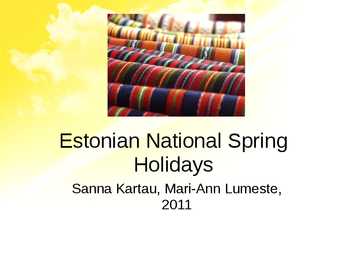
2011 What holidays do we have in Spring? March · 8th - Women's Day (Naistepäev) · 12th - St Gregorius's Day (Korjusepäev) · 14th - Estonia's Mother Tongue Day · 17th - St Gertrude's Day (Käädripäev) · 25th - St Mary's Day (Ussimaarjapäev) April 1st - April Fools Day 1st - Karjalaskepäev (the day cattle was first sent to the pastures after winter) 14th - Plowing Day (Künnipäev) 23rd - St George's Day (Jüripäev) Moving Easter (Lihavõtted) May · 1st - Walpurgis Day and Night (Volbripäev) · 9th - St Nicholas's Day (Nigulapäev) · The second Sunday of May - Mother's Day (Emadepäev) We'll pick... A - 14th of March - Estonia's Mother Tongue day B - (varies between the 25th of March and 25th of April) - Easter C - 1st of May - Walpurgis Day and Night 14th of March - Estonia's Mother Tongue Day · Celebration of the birthday of Kristjan Jaak Peterson, also
each other Valentine cards Superstitions Pancake Day Shrove Tuesday On that day, people used to confess their sins Pancakes are eaten because they contain fat, butter, eggs. Pancake is a thin, flat cake, with caster sugar sprinkled on the top and a drop of lemon juice also added. Ash Wednesday The beginning of Lent Ash is the symbol of being sorry Ash is rubbed on your forehead to show your regret St. David's Day 1. March Big parades, concerts Leek and daffodil St. David's Cross Traditional Welsh costumes St. Patrick's Day 17. March Attending Mass Parades Wearing shamrocks Wearing green Drinking alcohol Leprechauns St. Patrick's Cross April Fools Day 1. April A day of fun and jokes
come to see them. Some of them are even like symbols of England. The most famous ones are: Stonehenge is one of the greatest national icons of Britain. That prehistoric monument is located in the plain of Salisbury, in the county of Wiltshire in the south-west of England. It is built of 150 enormous stones which are set in a purposive circular pattern. Stonehenge was probably built to mark the longest and shortest day of the year because it lies on the line of the midsummer sunrise and the midsummer sunset. That would have enabled people to keep a record of changing of seasons. Although it is still unclear who built it. Hadrian’s Wall is an ancient wall which was built in 2nd century by Hadrian, the emperor of Rome from AD 117 to 138, and it marked the northern border of the Roman Empire in Britain. The wall was 80 Roman miles (117 kilometres) long and it is situated in northern
century and early 7th century, which was found in 1939. The wooden ship, which was buried there, contained lots of armour, weapons, jewellery, symbols of power and other treasures, but no bodies were found. 10. Roman conquest In the 1st c. BC the Roman Empire began to make contact with Britain (wine, pottery, small bronze statues) Julius Caesar's first raid was in 55 BC (the troops were afraid of the sea crossing) In the following year he invaded again, this time he marched inland In AD 43 the Emperor Claudius decided the full-scale invasion (army of 40,000 men) The Roman occupation lasted nearly 400 years. They couldnt conquer Scotland or as they called it caledonia, and so they built a strong wall along the northern border, named after the Emperor Hadrian who planned it. (70 miles or 117km long) The army established Roman Rule in the South and SW of the country.
The successful Norman invasion of England in 1066 brought Britain into the mainstream of western European culture. Unlike the German invasions, the Norman invasion was small-scale. On 14 October 1066, an invading army from Normandy defeated the English at the Battle of Hastings. The battle was close and extremely bloody. At the end of it, most of the best warriors in England were dead, including their leader, King Harold. On Christmas Day that year, the Norman leader, Duke William of Normandy, was crowned king of England. He is known in popular history as “William the Conqueror” and the date is remembered as the last time that England was successfully invaded. There was no such thing as a Norman area of settlement. Instead, the Norman soldiers who had invaded were given the ownership of land and of the people living on it. A strict feudal system was imposed. 12. Magna Carta.
1) INDIAN ROCK ART: A NATIONAL TREASURE IN DANGER Unrecognized, unprotected, this priceless legacy of primitive art has endured the ravages of nature only to fall victim to wanton destruction by ,,civilized" man. Like the huge stone statues of Easter Island and prehistoric cave paintings of Altamira and Lascaux, North American Indian rock art is surrounded by an atmosphere of mystery. Although examples of rock art exist at some 15000 sites in canyons, deserts, caves and river gorges. Nowadays, however, primitive rock art in the United States has become a new field of scientific study. Klaus F Wellmann wrote two books about rock art. He is a professor of medicine. Rock art represents the history of aboriginal Americans
Mardi Gras in the USA Mardi Gras, from the French words meaning "Fat Tuesday," combines religious tradition with a carnival or festival to welcome spring. It is also called Shove Tuesday or Pancake Day (in UK pancakes have an important role in celebrating Mardi Gras). Mardi Gras is the final day of Carnival- a festival season. Carnival begins 12 days after Christmas on January 6 and ends on Mardi Gras, which always falls exactly 47 days before Easter. The date of Mardi Gras changes every year. In the year 2008 it is on the 5th of February. "Fat Tuesday" is also the last day that Catholics can eat meat before Lent, the forty-day period of fasting before Easter The cities most famous for their Mardi Gras celebrations include New Orleans, Louisiana; Venice, Italy; and Rio de Janeiro, Brazil. Many other places have important Mardi Gras celebrations as well. It is a federal holiday in Alabama, Florida and in 8 counties of Lousiana. History
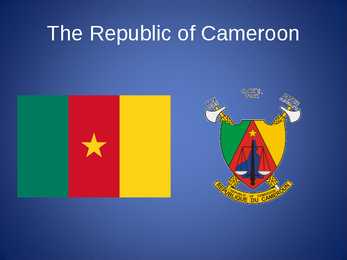
law with common law influences · The judiciary is officially divided into tribunals, the court of appeal, and the supreme court. Politics and Government · Human rights organisations accuse police and military forces of mistreating and even torturing criminal suspects, ethnic minorities, homosexuals, and political activists · The National Assembly makes legislation. The body consists of 180 members who are elected for five-year terms and meet three times per year. Laws are passed on a majority vote. Rarely has the assembly changed or blocked legislation proposed by the president. · President Paul Biya's Cameroon People's Democratic Movement (CPDM) was the only legal political party until December 1990. Numerous ethnic and regional political groups have since formed · The last parliamentary elections were held on 22 July 2007. Education · Most children have access to free, state-run schools or
The Easter Island Made by: Käty Kivirand Studygroup: MY08 Supervisor: Lugina Olga Easter Island(Rapa Nui, Spanish: Isla de Pascua) is a Polynesian island in the southeastern Pacific Ocean, at the southeastern most point of the Polynesian triangle. Easter Island is one of the most remote islands on Earth. Easter Island is only 15 miles long and 10 miles wide. The Polynesian Triangle is a region of the Pacific Ocean anchored by three island groups: Hawaii, Easter Island and New Zealand, often used as a simple way to define what constitutes Polynesia. The island has an area of 163.6 km2. Population is about 3791 (3304 people living in the capital of Hanga Roa). On July 11, 2010 at 18:15:15 a total solar eclipse occurred for the first time in Easter Island in over 1,300 years.
Central Canada which includes Ontario and Quebec is not the geographical centre of Canada. It is called that because it has historically been the political and economic centre of the country. Central Canada is the most heavily populated and industrialised area. In there lie the Great Lakes the largest body of fresh water in the world. Some of the first settlements in Canada were, naturally, built around those areas. In the Atlantic Provinces, the most important activities include fishing and farming of all sorts. Also in the Atlantic Provinces are the Appalachian Mountains old and rounded mountains. The North is also comprised of three territories. The area has a varied landscape including mountains and plains. The climate there is extremely cold with long winters and a lot of snow. Much of the area is treeless tundra. In the summer months, the sun stays up for the whole day, never setting
............................................... 8 Prepositions of Time – in, on & at • in is used with centuries, decades, years, seasons and months, parts of the day, periods of time • on is used with dates, special days, days of week, day of week + part of day, day + of ... • at is used with holidays, exact time, meals and with night in on at • the 20th century • the 29th of November • Christmas / Easter • the Middle ages /August the first • six o’clock / 7.30 • the 1980s • Christmas Day / New • midday / noon / • 2006 Year’s Eve / Easter midnight • winter / summer Sunday • the weekend / • May / August / • Wednesday(s) weekends November • Monday morning • breakfast
Lived on the British Isles in the 1st millenium. They most probably came from Eastern Europe and belonged to the Celtic race and also spoke Celtic. They were primitive hunters- gatherers, farmers. Some Celtic words are still used in modern English, however they are used mostly in place names. For example: · avon river · cumb valley · ford shallow place in the river Ancient Britons had their own religion and priests or druids and temples. In the year 55 BC Britain became a Roman province. Romans were highly developed and had their own language latin, which has also greatly influenced English. The military occupation of the Isles ended in 410 AD. The Romans eventually brought Christianity to Britain. Hadrian's wall on the border of Scotland and England. It began construction in 122 AD. An Anglo-Saxon attack on Rome forced the Romans to leave The British Isles. They were
Some Australians and particularly tourists often have their Christmas dinner at midday on a local beach, Bondi Beach in Sydney's Eastern Suburbs attracts thousands of people on Christmas Day. Other families enjoy their day by having a picnic. If they are at home, the day is punctuated by swimming in a pool, playing Cricket out the backyard, and other outdoor activities. The warm weather allows Australians to enjoy a tradition which commenced in 1937. Carols by Candlelight is held every year on Christmas Eve, where tens of thousands of people gather in the city of Melbourne to sing their favorite Christmas songs. The evening is lit by as many candles singing under a clean cut night sky. The sky with its Southern Cross stars is like a mirror. Sydney and the other capital cities also enjoy Carols in the weeks leading up to Christmas. Australians surround themselves with Christmas Bush, a native plant which has little red flowered leaves.
Mardi Gras Ursula 10. kl Mardi Gras A Christian holiday and popular cultural phenomenon, Mardi Gras dates back thousands of years to pagan spring and fertility rites. Mardi Gras can occur on any Tuesday from February 3 through March 9. It is always scheduled 47 days preceding Easter (the 40 days of Lent, plus seven Sundays). Mardi Gras, also known as "Shrove Tuesday", "Pancake Tuesday" or "Fat Tuesday" is celebrated all over the world with fun, games, and a lot of eating. The official colors of Mardi Gras are purple, green and gold. Purple represents justice, green stands for faith, and gold signifies power. There is no general theme for Mardi Gras, but each individual parade depicts a specific subject. Among the more popular subjects have been history, children's
Longer & Uncut in 1999, and the three-episode Imaginationland story arc was reissued straight-to-DVD in 2008 CHARACTERS Main protagonists: Stan Marsh, Kyle Broflovski, Eric Cartman, and Kenny McCormick There are many recurring characters on the show, including the boys' families, school staff, and other students. These include Leopold "Butters" Stotch, Chef (who no longer appears in the show), Mr. Hankey, Towelie, Jesus, and Satan. Episodes have parodied Michael Jackson ("The Jeffersons"), Paris Hilton ("Stupid Spoiled Whore Video Playset"), and The Passion of the Christ ("The Passion of the Jew"). The show has also addressed serious political issues such as terrorism ("Cartoon Wars"), American immigration policy ("Goobacks"), gay marriage ("Follow That Egg!"), racism ("With Apologies to Jesse Jackson"), and the Terri Schiavo case ("Best Friends Forever").
He writes his folk-tales and legends in a web of other events, mainly set in the Baltic Kingdoms. He shows a very rich and leisurely portrayal of this Baltic world, providing many customs like the close relationship between lord and man in the war-band and others. All this encouraged the supposition that the unknown author of the poem was himself a bard of the ancient type portrayed within the poem (a lord's scoop). However, many people propose that the author could be Christian poet, perhaps a monk, versed not only in old native traditions, but also in the culture and literature of the Latin Church, and whose purpose of writing was highly moral. For example, the fate is a `providentia' and the monster Grendel is an embodiment of evil fighting against Christian militant. This contrast corresponds to the poem itself. The poet is looking back from his own Christian times to an old society with different customs and beliefs
It extends about 2000 km along the coast of Queensland. Made of coral, it is the world’s largest structure created by living organism. . 4 Climate & Time Zones Australia is the driest continent in the world except Antarctica. It has low average rainfalls. About 70 per cent of the country is arid or semi arid and cannot support agriculture. The north part of the country gets about 300 mm of rain a year. Much of the rain soaks into the ground and does not form any rivers or lakes. Monsoon winds bring moist air during summer. This is the time of high rainfall. It’s known as “the wet “season. High temperature also means hat a lot of moisture evaporates or is used by plants. In the southern two thirds of the country the climate is temperate to cool. Winter temperatures can be low but not freezing. There are four seasons. The seasons are the opposite of our seasons. When we
Traditions Australia doesn't have many traditions. Attempts to get Halloween off the ground have stalled due to one too many homeowners telling little kids to get off their property or they will see a scary sight. Australia celebrates many of the same holidays as do people of the Western world, such as Easter and Christmas. However, Australians also celebrate some holidays unique to their country and culture. Australia Day Australia Day, 26 January, is the anniversary of the arrival of the First Fleet of 11 convict ships from Great Britain, and the raising of the Union Jack at Sydney Cove by its commander Captain Arthur Phillip, in 1788. On Australia Day, over half of the nation's population of 21 million attend either an organised
seemed so beautiful. So for us, their grandchildren, painting eggs has no connection with religion traditions. It is more like a way of expressing one's creativity. We use different colors and techniques: painting with herbs, watercolors, markers, special colors etc. There aren't any certain patterns to use, everyone can do it any way they like. We also give colored eggs as presents to friends and children are cracking the eggs. More than Easter Estonians have traditionally celebrated a spring. There is a day near Easter called Paastumaarjapäev (the Day of Virgin Mary and Fast) which is a women's day. Women and girls go together to swim in a spring in the sunrise it will make them fresh and goodlooking for rest of the year. After they dance and sing and dance traditional round dances. It used to be the only day when men stayed at home and took care of the house and children.
million years old. Australia is often called `Down Under', because it lies in the Southern Hemisphere. As a result, its seasons are the opposite of ours. Australia, Tasmania and a number of smaller islands form the Commonwealth of Australia. Because of the country's great size, the climate in Australia ranges from tropical regions of the Northern Territory to the cool temperate conditions in the southeast and Tasmania, where it often snows in winter. In the north, half the year is `wet' and half is `dry'. From November to April heavy rain fills the rivers and makes enormous lakes where thousands of birds come for the summer. From May to October it is often sunny and dry for weeks, and it is a popular place for winter holidays in the sun. In the hot, flat centre of Australia, there is an area called the `outback'. It covers more than two-thirds of Australia, but its population is less than 100,000. In some places, it doesn't rain for years
The Most importatantauthority is the parlament. Britain does not have a written constitution, but a set of laws such as the Magna Carta, The Declaration of Rights and the Acts of Parlament. Education is compusory from 5-16 years. Primary schools starts from the age of 5 and continues until they are 11. At 11 most pupils go to secondary school. 90% of the schools are co-educational. At 16 pupils take a national exam called GCSE and they can leave school if they want to. Some 16 year olds continue their studies in the sixth form at school or at a sixth form collage. The sixth form prepares pupiils for a nation ecam called A level at 18. You need A levels to enter a university. 7% of British children go to private schools. The United Kingdom has given us many famous people. For example Charles Dickens, William Shakespeare, Robert Burns and Oscar Wild are only some of the famous writers
During his adolescence, Dante fell in love with a beautiful girl named Beatrice Portinari. He saw her only twice but she provided much inspiration for his literary masterpieces. Her death at a young age left him grief-stricken. His first book, La Vita Nuova, was written about her. Sometime before 1294, Dante married Gemma Donati. They had four children. Dante was active in the political and military life of Florence. He entered the army as a youth and held several important positions in the Florence government during the 1290's. During his life, Florence was divided politically between Guelphs and Ghibellines. The Guelphs supported the church and liked to keep things as they were, unlike the Ghibellines. The Ghibellines were mostly supporters of the German emperor and at the time Dante was born, were relieved of their power. When this change took place, the Guelphs for whom Dante's family was associated took power. Although born into a Guelph family, Dante became
· http://www2.gsu.edu/~wwwesl/egw/verbs.htm Ajamääruslaused (Adverbs of time) can be time expressions such as · `last night'. can be prepositional phrases with `at', `in', or `on'. `For' refers to a period of time in the past, present, or future. `Since' refers to a point in past time. A We use adverbials of time to say when something happens. We often use noun groups called time expressions as adverbials of time. yesterday, today, tomorrow last year, next Saturday, next week the day after tomorrow, last night, · the other day · Do not use the prepositions `at', `in', `on'!!! Prepositional phrases as adverbials of time: `at' is used with: clock times: at eight o'clock, at three fifteen religious festivals: at Christmas, at Easter mealtimes: at breakfast, at lunchtimes specific periods: at night, at the weekend, at weekends, at half-term `in' is used with: ·
who submits (to God)". There are between 1.1 billion and 1.8 billion Muslims, making Islam the secondlargest religion in the world, after Christianity. Muslims believe that God revealed the Qur'an to Muhammad, God's final prophet, and regard the Qur'an and the Sunnah (words and deeds of Muhammad) as the fundamental sources of Islam.They do not regard Muhammad as the founder of a new religion, but as the restorer of the original monotheistic faith of Abraham, Moses, Jesus, and other prophets. Islamic tradition holds that Jews and Christians distorted the revelations God gave to these prophets by either altering the text, introducing a false interpretation, or both. Islam includes many religious practices. Adherents are generally required to observe the Five Pillars of Islam, which are five duties that unite Muslims into a community. In addition to the Five Pillars, Islamic law (sharia) has developed a tradition of rulings that touch on virtually
But why it is so? I have read lot about that Show. Everybody seems to be like this, even if there are lots of not so good things. First I thought it could be very nice way to spend day with family but Chelsea is not a family day out and they take care in targeting the garnering market. There is no discount for children, no family tickets, no children's play areas. Exhibitions want customers and our job is to manage the balance between the needs of exhibitors and those of the visitors. It's important to have the right number of exhibitors in each category with a good range of prices, from expensive to economic. They try to pick those with good after sales service. If we discovered a rogue exhibitor and it has happened once or twice we swiftly replace them. The second mine theory was that maybe some scientist or just amateurs want to learn something new, change experiences with others. But so many people can also make it
to put under their pillows. When the guests began to dance, the bride and her mother went to the bridal chamber where she took off her wedding clothes and changed into her nightgown. The bride and groom spent their honeymoon in her parents' house. They were expected to stay in the bedroom for five days or more. Creole Customs Creole customs can be divided into two kinds: religious and non-religious. Religious customs focus on holidays: All Saints Day, Mardi gras and Easter, for example. On All Saints Day Creoles bring flowers made of white, black, or purple tissue paper to place on graves in the cemetery. The week before this holiday shops display crowns and crosses with black beads. Mardi Gras or Fat Tuesday is celebrated on the Tuesday before Ash Wednesday, which is the beginning of Lent. At Easter, rabbits come out at night. The children try to stay up as late as possible, but they don't see the rabbits. The rabbit's nests are found filled
gather supplies and men before sailing to Minorca and then to Liguria. Ibiza negotiated a favorable treaty with the Romans, which spared Ibiza from further destruction and allowed it to continue its Carthaginian-Punic institutions well into the Empire days, when it became an official Roman municipality. For this reason, Ibiza today offers excellent examples of late Carthaginian-Punic civilization. During the Roman Empire, the island became a quiet imperial outpost, removed from the important trading routes of the time. After the fall of the Roman empire and a brief period of first Vandal and then Byzantine rule, the island was conquered by the Moors, as well as much of the Iberian peninsula. Under Islamic rule, Ibiza came in close contact with the city of Dénia (the closest port in the nearby Iberian peninsula, located in the Valencian Community) as the two areas were administered jointly by the same taifa
 annaabi.ee