 50 punkti
Autor soovib selle materjali allalaadimise eest saada 50 punkti.
50 punkti
Autor soovib selle materjali allalaadimise eest saada 50 punkti.
 ~ 1 leht
Lehekülgede arv dokumendis
~ 1 leht
Lehekülgede arv dokumendis
 2009-04-17
Kuupäev, millal dokument üles laeti
2009-04-17
Kuupäev, millal dokument üles laeti
 9 laadimist
Kokku alla laetud
9 laadimist
Kokku alla laetud
 0 arvamust
Teiste kasutajate poolt lisatud kommentaarid
0 arvamust
Teiste kasutajate poolt lisatud kommentaarid
 basicgirl
Õppematerjali autor
basicgirl
Õppematerjali autor
Easter in England Kaia Teder Susanne Rajang K112 What is Easter ? Easter is the time for holidays, festivals and a time for giving chocolate Easter eggs. But Easter means much more. Easter is the oldest and the most important Christian Festival, the celebration of the death and coming to life again of Jesus Christ. For Christians, the dawn of Easter Sunday with its message of new life is the high point of the Christian year. In fact, it has been in vogue even before the pre Christian times Easter story Easter is the story of Jesus' last days in Jerusalem before his death.The Easter story includes Maundy Thursday (the Last supper leading to the Eucharist), Good Friday (the day on which Jesus was crucified) and Easter Day (the day on which Jesus came back to life). It is a sad story because Jesus was killed. But the
part of another nation or state; more rarely after the end of a military occupation. Most countries observe their respective independence days as a national holiday, and in some cases the observance date is controversial or contested. Good Friday Moveable Friday Good Friday is a religious holiday observed primarily by Christians commemorating the crucifixion of Jesus Christ and his death at Calvary. The holiday is observed during Holy Week as part of the Paschal Triduum on the Friday preceding Easter Sunday, and may coincide with the Jewish observance of Passover. It is also known as Holy Friday, Great Friday, Black Friday, or Easter Friday, though the latter properly refers to the Friday in Easter week. Easter Sunday Moveable Sunday Easter is a Christian festival and holiday celebrating the resurrection of Jesus Christ on the third day after his crucifixion at Calvary as described in the New Testament. Easter is the culmination of the Passion of Christ, preceded by Lent, a forty-
1. How many public holidays or Red-Letter Days are there in Britain? Name them. 8 public holidays in Britain: two at Christmas, one for the New Year(which was only introduced in the late 1970s) two at Easter and three Bank Holidays. 2. What is the same and what is different about the way Christmas is celebrated in England and Estonia? In England, there's common to sing Carol's and for children, Christmas means pantomimes plays based on fairy tales which combine comedy, dance and song. A traditional Christmas dinner includes roast turkey with roast potatoes, a range of vegetables, cranberry sauce etc., followed by Christmas pudding and Christmas cake
Dear Tom, It was nice to hear from you and you asked me to write about religious holidays that are celebrated in my country. I will talk about Easter and Christmas celebrations. Easter is a moveable feast, meaning it is not fixed in relation to the civil calendar. The date of Easter therefore varies between March 22 and April 25. Originally only Christians celebrated Easter. According to Christians, Jesus was resurrected from the dead that day. Newer elements such as the Easter Bunny and Easter egg have become part of the holiday's modern celebrations, and those aspects are often celebrated by many Christians and non-Christians alike. There are also some Christian denominations who do not celebrate Easter. Other religious holiday is Christmas. It's one of the most popular festivals of Christian community celebrated all over the world. According to Christians it's the day when Jesus was born. Christmas is held on December 25 in most countries
the Republic of Estonia. A modest military parade takes place on Vabaduse väljak and the atmosphere is one of quiet restraint; following the proclamation, it took Estonian soldiers and illequipped volunteers nearly two years to clear the territory of German and Soviet Russian forces. On April Fool's Day (1 April), people delight in playing tricks on each other. Two holidays in June commemorate historical events 11 April Easter Sunday Easter is celebrated from Good Friday to Easter Sunday. Easter eggs are delicately painted, and special foods are eaten during this time. At the Pentecost (50 days after Easter), eggs are painted again. Estonians have called Easter the spring holiday, the egg festival and swing festival. All these names refer to activities carried out during the holidays. According to the ecclesiastical calendar, Lent came to an end on that day and it was allowed to eat meat again. A general custom was dyeing eggs
Easter Quiz 1.What day is Easter celebrated? Sunday 2.Where does the name Easter come from? An Anglo-Saxon goddess called Eastre 3.On Palm Sunday, Christians celebrate the day that .... Jesus rode into Jerusalem on a donkey and was greeted by cheering crowd 4.How long is Lent is western churches? 40 days 5.Why do we have eggs at Easter? They are a symbol of rebirth 6.The night before his death, Jesus finished the Passover meal with disciples by sharing bread and wine 7.What traditionally happened on Ash Wednesday? People put ash on their foreheads 8.What does Shrove Tuesday have to do with Easter? Shrove Tuesday is the last day to indulge before Lent. 9.Lent is the time of .... Abstinence (of giving things up) 10.Which of the following has nothing to do with Shrove Tuesday? Lean Tuesday 11
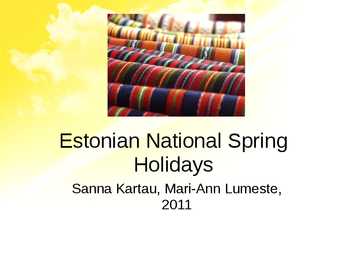
2011 What holidays do we have in Spring? March · 8th - Women's Day (Naistepäev) · 12th - St Gregorius's Day (Korjusepäev) · 14th - Estonia's Mother Tongue Day · 17th - St Gertrude's Day (Käädripäev) · 25th - St Mary's Day (Ussimaarjapäev) April 1st - April Fools Day 1st - Karjalaskepäev (the day cattle was first sent to the pastures after winter) 14th - Plowing Day (Künnipäev) 23rd - St George's Day (Jüripäev) Moving Easter (Lihavõtted) May · 1st - Walpurgis Day and Night (Volbripäev) · 9th - St Nicholas's Day (Nigulapäev) · The second Sunday of May - Mother's Day (Emadepäev) We'll pick... A - 14th of March - Estonia's Mother Tongue day B - (varies between the 25th of March and 25th of April) - Easter C - 1st of May - Walpurgis Day and Night 14th of March - Estonia's Mother Tongue Day · Celebration of the birthday of Kristjan Jaak Peterson, also
SHROVE TUESDAY Shrove Tuesday, or Pancake Day, is the traditional feast day before the start of Lent on Ash Wednesday. Lent – the 40 days leading up to Easter – was traditionally a time of fasting and on Shrove Tuesday, Anglo-Saxon Christians went to confession and were “shriven” (absolved from their sins). A bell would be rung to call people to confession. This came to be called the “Pancake Bell” and is still rung today. Shrove Tuesday always falls 47 days before Easter Sunday, so the date varies from year to year and falls between February 3 and March 9. Shrove Tuesday was the last opportunity to use up eggs and fats before embarking on the Lenten fast and pancakes are the perfect way of using up these ingredients. In the UK, pancake races form an important part of the Shrove Tuesday celebrations – an opportunity for large numbers of people, often in fancy dress, to race down streets tossing pancakes
 annaabi.ee






Kõik kommentaarid