Leidsid 33 sarnast õppematerjali, mis on seotud failiga ""You Belong To Me" by Mary Higgins Clark". Need materjalid aitavad sul teemat sügavamalt mõista.
susan, clark, year, kill, murder, higgins, chandler, work, donald, rich, victim, belong, mary, wrote, radio, alex, know, richard, york, books, daughter, carol, during, years, richards, women, before, could, even, reading, works, back, days, jane, woman, wants, regina, wells, managed, program, goes, times, tells, killer, come, finds, going, police, enjoyHis most important preserved printings are the 40 copies of the Bible. By the end of the 15 th century there were about 1000 print-shops in Europe already. The oldest Estonian book dates back to 1535. Libraries form a vital part of education. They make available-through books, films, recordings and other media- knowledge that has been accumulated through the ages. People in all walks of life use libraries to get information for their work. Libraries also play an important role in preserving people's cultural heritage. For example, some libraries have rare books, authors' and composers' manuscripts or works by artists. Today's libraries differ very much from the ones from the past - not only in the contents and services, but also in physical layout and atmosphere. Library derives from the Latin word "liber" which means book. It shows that libraries were
BOOK REPORT Title of the book: The Catcher in the Rye Author: Jerome David Salinger (January 1, 1919 January 27, 2010) was an American writer who died at the age of 91. He was married three times and has two children. Some of his most notable works are The Catcher in the Rye, Nine Stories and Franny and Zooey. The Catcher in the Rye is by far the most famous and most critiqued book of his, selling over 250,000 copies every year. In total the book has sold over 65 million copies worldwide. The success of The Catcher in the Rye led to public attention: Salinger became reclusive, publishing new work less frequently. Analysis of the book 1. Setting The story starts in the year 1950 when the novel's protagonist and narrator Holden starts telling a story from a hospital about the events of last year's winter. Most of the
small and he had to give a good soldier in return. Soon he was traded to a new army, where he was used properly in battle. Always as soon Ender was getting used to the situation and started feeling happy, things were made more difficult. Time passed and Ender was the most respect soldier in the school. He was the number one soldier in the rankings, and no-one was even close to him, he also held training sessions for elite soldier and launchies. He was so hated by some, who actually tried to kill him, but instead he killed their leader Bonzo, who had been Ender's first commander, and every one else looked up to him, admiring him. Finally he was made commander and given his own army, which was handpicked and consisted mostly of launchies, who got promoted being quite young. Also all the rules were changed, to make Ender's life difficult: they had their first battle in two weeks, instead of three months, he wasn't allowed to make trades, had to fight every day, finally twice a day,
Mother wants me to water the flowers. 2 Ma tahan, et sa mind matemaatika kodutöös aitad. I want you to help me with my maths homework. 3 Kas sa tahad, et ma aitan sul seda rasket kotti kanda? Do you want me to help you to carry this heavy bag? 4 Õpetaja tahab, et me loeksime Roald Dahl´i Matilda´t. The teacher wants us to read Matilda by Ronald Dahl. 5 Mu väike õde tahab, et ma talle laulan. My little sister wants me to sing to her. 4 Write the sentences in reported speech. 1 Susan said, "I´m waiting for the bus." Susan said that she was waiting for the bus. 2 Mary said, "I have read kadri by SIlvia Rannamaa twice." Mary said she had read kadri by Silvia Rannamaa twice. 3 Tom´s mother said, "Your old shoes are too small for you." Tom´s mother said his old shoes were too small for him. 4 Our teacher said, "I usually go home for luch." Our teacher said she usually went home for lunch. 5 My friend said, "I enjoy reading adventure stories."
really love. However, distance makes everything clearer; you can only see the whole when you are far enough. Take Alex for an example, as she had travelled ever further outwards, she found the answer. The Nature of Truth: Annie was a successful author and she met an old friend, Jane, on the train. Things change a lot, even if you had settled down. Jane had the boyfriend in collage and they soon got married after graduated. At first, they had a happy life, but one year later, Jane's husband had extramarital relations and divorced with Jane. In a summary, what will life be in the future? Future is not to see. Just the facts: Reporter was Lisa's first job and now she was going to write an article about Gary who killed a judgment in town and Gary was sentenced to death. However, Gary said he didn't kill that man. All of Lisa's associates thought prisoners always emphasized they were innocent, so Lisa's boss just
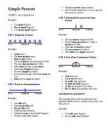
· California is not in the United Kingdom. · You only speak English. · Windows are made of glass. · Do you only speak English? I am not reading any books right now. Present Continuous · · Are you working on any special projects at work? [am/is/are + present participle] · Aren't you teaching at the university now? Examples: USE 3 Near Future · You are watching TV. · Are you watching TV? · You are not watching TV. USE 1 Now Examples: · I am meeting some friends after work.
4Use a capital letter for the first letter in a sentence: The dog is barking. Come here! 4Always use a capital letter for the word I : I am eight years old. Tom and I are good friends. 4Use a capital letter for the names of people: Alice, Tom, James, Kim, Snow White 4Use a capital letter for the names of places: National Museum, Bronx Zoo, London, Sacramento 4Use a capital letter for festivals, holidays, days of the week, months of the year: New Year's Day, Christmas, Labor Day, Mother's Day, Sunday, Monday, Friday, January, May, July, October Exercise 1 Circle the letters that should be CAPITALS. Then write the correct letter in the space above them. 1 peter and i are good friends. we are going to chicago during our summer 2 vacation. 3 there is an interesting football game on sunday. 4 jason lives on thomson avenue.
for laughs. The second letter went to Mrs Symmington, the local solicitor Mr Symmington's wife. It turned out the letters were no trick at all, when she committed suicide, after reading a letter that stated her last child wasn't her husband's. Her body was discovered with the letter, a glass containing potassium cyanide and a torn suicide note which read: I can't go on. Few days after, Mr Symmington's maid was murdered. Shockingly, the body was found by Megan, Mr Symmington's 20 year old step-daughter. Scotland Yard sent someone to investigate, and came to the conclusion that the letter- writer/murderer was a middle-aged woman who must be one of the citizens of Lymstock. The village was plunged into suspicion and terror. Once a village of trust, now all inhabitants were on the verge of accusations. There was a break in the case when the Symmington's beautiful young governess, Elsie Holland,
.... ice cream, too! 7) Linda sat ..... the rock and sang ..... song. 8) ..... school is something you never forget, yet while studying many things just are forgotten. 9) He jumped off ..... cliff and fell ..... the ice-cold ocean. 10) It was ..... noisiest concert ever! 11) What are you doing? Don't you know that ..... fishing isn't allowed here? 12) Neither ...... them moved, they were just staring ..... each other. 13) You must go, Susan, or else I won't go ..... there as well. 14) He laughed ..... her, not feeling any pity at all. 15) Mother listened ..... the radio while Jim was catching ..... butterflies. 16) She was soon bored, so he decided ..... finish his speech earlier. 17) Marta was hungry; she went ..... the kitchen .... order to grab ..... sandwich and ..... bottle ..... milk. 1.4 Write a postcard to your friend from America who will be visiting you next week.
Pygmalion act 3 Where does the action take place in Act III? Name the places. At Mrs. Higgins's home Why is Mrs. Higgins not happy to see her son? Because Higgins offended all her friends and she wasn't happy about it. Why has Higgins invited Eliza to his mother's place? She wants to present her to her mother and the Who had Mrs Higgins invited to visit her? Miss Eynsford Hill, Mrs. Eynsford Hill, Freddy, Colonel Pickering. How does Higgins use the word ,,dickens". Quote his use of the word in different sentences and explain it's meaning. He uses the word in sentences like "Cynical! Who the dickens said it was cynical? I mean it wouldn't be decent." and ,,What the dickens has happened to you?" He uses the word instead of a swearing word. Comment on Eliza's behaviour at the meeting.(Do it in about 4 sentences) Eliza is speaking very properly and is polite. She is answering the questions that are asked
Karenin asks her to break off the affair to avoid society gossip and believes that their relationship can then continue as previously. Kitty goes with her mother to a resort at a German spa to recover from her ill health. There they meet the Pietist Madame Stahl and the saintly Varenka, her adopted daughter. Influenced by Varenka, Kitty becomes extremely pious, but is disillusioned by her father`s criticism. She then returns to Moscow. Part 3 Levin continues his work on his large country estate, a setting closely tied to his spiritual thoughts and struggles. Levin wrestles with the idea of falseness, wondering how he should go about ridding himself of it, and criticising what he feels is falseness in others. He develops ideas relating to agriculture and the unique relationship between the agricultural labourer and his native land and culture. He believes that the
He is horribly angry when he discovers that his daughter has married Othello secretly. He brings her to the Duke of Venice, but in front of the court, she confesses, that she is in love with Othello. Rodrigo he is a gentleman from Venice. He is in love with Desdemona and also one of Iago's proponents in the plan to destroy Othello. Iago kills Rodrigo in the dark, pretends that someone else was the murderer. He is young, rich and still foolish by trusting Iago. Duke of Venice he runs the city and delegates order, he is the official authority there. The Duke sends Othello to Cyprus and allows Desdemona to meet him there. He admires Othello as a public and military servant. Montano he is the governor of Cyprus. He supports Cassio in his attempted reconciliation with Othello and tries to
Book report The book I read is called "Life At The Top" written by John Braine. It is a continuation to a novel "Room At The Top". It is all set 20th century, England. The main characters are Joe Lampton, an ambitious man of humble origins, his gorgeous upper-class wife Susan, two children Harry and Barbara. Barbara is Joe´s dearest treasure. Harry is a lot like Joe he wants to please everybody and he wants so be his own master, too. There are also Mr.Brown who is Susan´s father, her wife Margaret Brown, Susan´s cousins Mark and Sybil, a number of businesspartners , Joe´s secretary Hilda and two lovely ladies Norah Hauxley and Jean. Joe has an executive job in his father-in-law firm and everything what should satisfy his needs
her books.It is Christie's first published novel, and introduces Hercule Poirot, Inspector Japp and Lieutenant Hastings (later, Captain) The story is told in first person by Hastings, and features many of the elements that, thanks to Christie, have become icons of the Golden Age of Detective Fiction. It is set in a large, isolated country manor. There are a half-dozen suspects, most of whom are hiding facts about themselves. The book includes maps of the house, the murder scene, and a drawing of a fragment of a will. The Mysterious Affair at Styles was adapted as a 103-minute drama and transmitted on ITV in the UK on Sunday September 16, 1990 as a special episode in their series AgathaChristie'sPoirotto celebrate the centenary of the author's birth. AGATHA CHRISTIE Agatha Christie was born Agatha May Clarissa Miller in Devon, in England in 1890, the youngest of three children. Her father died, when she was a child
in brackets. _ 1 She is in a band and she _________________________________ (record) a CD at the moment. _ 2 She is an actress and often _________________________________ (appear) on television. _ 3 At the moment she _________________________________ (have) a rest because she is tired. _ 4 Mike is a doctor and he _________________________________ (live) in Manchester. _ 5 I _________________________________ (start) work at 8.30 every morning. _ 6 He is a good cook but she _________________________________ (prefer) to eat out. _ 7 English tests _________________________________ (get) more and more interesting. _ 8 They _________________________________ (have) a party because it's her birthday. _ 9 I sometimes _________________________________ (ride) my bicycle to school. 10_ She usually _________________________________ (go) to the gym on Friday evenings.
Taken at the Flood "There is a Tide" redirects here. "There is a Tide" is also the name of a short story by Larry Niven, set in the Known Space universe. Taken at the Flood is a work of detective fiction by British writer Agatha Christie, first published in the US by Dodd, Mead and Company in March 1948 under the title of There is a Tide...[1] and in the UK by the Collins Crime Club in the November of the same year under Christie's original title.[2] The US edition retailed at $2.50[1] and the UK edition at eight shillings and sixpence (8/6).[2] It features her famous Belgian detective, Hercule Poirot, and is set in 1946. 1 Plot summary In a flashback from late Spring to early Spring, Lynn Marchmont, newly demobilised from the Women's Royal Naval Service, finds difficulty settling into the village life of Warmsley Vale. She is engaged to Rowley, one of several members of the Cloade family living nearby
when they have to deal with racism. Plot summary (NB! Use the present tenses) Anita and Me by Meera Syal is the story of a young Punjabi girl growing up in the fictional English village of Tollington in the Midlands in the 1960s. The book follows Meena during her pre-teen years as she is desperate to fit in with the other children in her neighbourhood while forever feeling like an outsider because she is "different". She and her family are the only immigrants in the village. They are trying to work out how to fit into British society while attempting to maintain their own culture. Meena's house is always full of a constant stream of ethnic visitors and her parents seem to see no need to integrate futher. Namely, her parents considered every Indian immigrant in England as a friend or even as a part of the family. Meena's family are keen to see her keeping up the family's cultural tradition. Meena on the other hand, is caught between two cultures. She is having a difficult time
during World War II, Norma Jeane Dougherty moved in with her mother-in-law where she started working in the Radioplane Munitions Factory owned by Hollywood actor Reginald Denny. She sprayed airplane parts with fire retardant and inspected parachutes. During this time Army photographer David Conover snapped a photograph of her for a YANK magazine article. He encouraged her to apply to the The Blue Book modeling agency. She signed with the agency, and she began researching the work of famous actresses Jean Harlow and Lana Turner, and enrolled in drama and singing classes. Monroe had her hair cut, straightened, and lightened to golden blonde.[15] She became one of Blue Book's most successful models, appearing on dozens of magazine covers. In 1946, she came to the attention of talent scout Ben Lyon. He arranged a screen test for her with 20th Century Fox. She was offered a standard six-month contract with a starting salary of $125 per week. [16]
especially by Thomas Paine in "The Age of Reason" and by Thomas Jefferson in his short Jefferson Bible from which all supernatural aspects were removed. Benjamin Franklin was influential in America, England, Scotland, and France, for his political activism and for his advances in physics. The American Dream is a national ethos of the United States, a set of ideals in which freedom includes the opportunity for prosperity and success, and an upward social mobility achieved through hard work. In the definition of the American Dream by James Truslow Adams in 1931, "life should be better and richer and fuller for everyone, with opportunity for each according to ability or achievement" regardless of social class or circumstances of birth. The idea of the American Dream is rooted in the United States Declaration of Independence which proclaims that "all men are created equal"
help from Tom. Grace is sure that she never wants to ride again: especially with Pilgrim. She is sure that the accident was her fault because she could not get her friend Judith and her horse Gulliver away from the road before the truck came. But after meeting Joe who is son of a local farmer she quietly becomes to get better and in time she is ready to try riding again. But will Grace be brave enough to ride Pilgrim again one day? Tom Brooker has to do some serious work with Pilgrim. He did not want to do it but he could not say no to Annie, that lovely lady with red hair and the most beautiful green eyes he had ever seen. And Annie had come so far to get help. Although in the end Pilgrim will let Tom near him but that is all. Anyone else can't touch him. So Tom has to try another way and that isn't very nice to see. Conflict in this book is between Grace and her horse. Will they ever to be able to trust each other
" "Mr. Bennet, how can you abuse your own children in such a way? You take delight in vexing me. You have no compassion for my poor nerves." "You mistake me, my dear. I have a high respect for your nerves. They are my old friends. I have heard you mention them with consideration these last twenty years at least." "Ah, you do not know what I suffer." "But I hope you will get over it, and live to see many young men of four thousand a year come into the neighbourhood." "It will be no use to us, if twenty such should come, since you will not visit them." "Depend upon it, my dear, that when there are twenty, I will visit them all." Mr. Bennet was so odd a mixture of quick parts, sarcastic humour, reserve, and caprice, that the experience of three-and-twenty years had been insufficient to make his wife understand his character. Her mind was less difficult to develop. She was a woman of mean
Well, there's that. And I also learned a lot of Russian from my mother's lover who was a Russian military officer and pretty much my father figure at the time. I tried to teach him Estonian and learned some Russian instead. My Russian studies in school have always been very hectic and making very little sense. Teachers kept changing all the time, teaching methods kept changing as well and learning Pushkin by heart does not work wonders with one's speaking skills, really. (Although I still can recite one of his poems...) The point is, I actually really like Russian. I've never been good at it, but I like the language and I really wish I knew it better. I can speak some, but not read much. As soon as the characters stop talking to each other, I'm stuck and can barely understand anything. Most of my Russian skills my ten years younger mates envy come from my year of living in Narva (literally starve or learn!) and
Chekov Lady and the Lapdog Reid about Chekov: The characters in Chekhov's plays are never fully "known" as a writer, he seems to delight in maintaining a sense of indeterminacy, and unknowability, about them. The bare facts are always laughably inadequate to the complexity of "real" people. Anton Pavlovich Chekhov was born on 29 January (New Style), 1860, in Taganrog, a small port on the Sea of Azov, in southern Russia. As the son of a grocer and grandson of a serf, Chekhov was a first-generation intellectual. His modest background and upbringing are crucial to his development as a writer. Chekhov always felt that he missed out on childhood. It was a very hard lifeand it may have contributed to his poor health: he succumbed later on to the"family disease", tuberculosis, which led to his early death at the age of 44.His mother was a quiet, gentle soul who was full of stories of her early life. In later years, Chekhov would say that "we inherited our talent from our father,but mother
As the magistrates were signing the contracts of Oliver's indenture, they realized that Oliver was petrified of going with the evil looking Mr. Gamfield. Because of this, they ordered Oliver back to the workhouse from which he came with orders to Mr. Bumble to treat him well. Chapter 4: The board decides that the best thing to do with Oliver is send him out to sea as a cabin boy. They figure that the sailors will take the best care of him, by which they mean treat him the worst and probably kill him. As Mr. Bumble is looking into this new arrangement, he runs into Mr. Sowerberry, the undertaker. Mr. Bumble tells him of young Oliver stating that anyone who takes him off the states hands will receive five pounds. Mr. Bumble asks if he knows of anyone who needs a boy, and Mr. Sowerberry offers to take him. The board agrees upon the plan, and Mr. Bumble takes Oliver, weeping from loneliness, to the Sowerberry house. He meets both Mr. and Mrs. Sowerberry, the serving girl Charlotte. Mr
womens magazine. Anti human values of the city. Sacco and Vanzetti-two Americans of Italian origin, who were fighters of rights of workers. They were executed, it is been proved that they have been accused wrongfuly, it wasnt fair, they were communists. The 1930's saw the publications ,,USA trilogy"- 1."The 42nd Parallel", 2. ,,1919", 3. ,,Big Money". All the three books were published in 1930's. It's his masterpiece, the greatest work. He did a huge work. He traces the history of usa to the very end of the 19th century, the american-spanish war-to 1927, the execution of Sacco and Vanzetti. He shows history as a great operative force, wants to recreate history, wants to show that the causes of what is happening now has to be found somewhere in the history. Unlike other modernists Dos Passos is interested in the average man, more than other modernist authors. Geography of the novel extends from east coast to west coast
British authors from the United Kingdom, which includes England, Scotland, Northern Ireland, Wales, the Channel Islands, and Isle of Man Includes early works written in Gaelic, Welsh, and Latin, works in Old, Middle, and Modern English, each of which represents a different period Full of great works British works in Latin Venerable Bede He lived between 673 and 735 AD The greatest of all the AngloSaxon scholars He's the earliest English historian, whose work has shed light on a period of English history that would have otherwise been unknown ,,The Father of English History" Wrote / translated about 40 books on almost every area of knowledge, i.e. nature, astronomy, and poetry His best known work is "The Ecclesiastical History of the English People" Starting with the Roman invasion in the 5th century, he recorded the history of the English up to his own day Old English Cædmon ,,The Father of English Hymn"
Jake knows that once they finish the drink it will be easier to get rid of Cohn. At the bar, Cohn continues to harangue Jake about traveling outside of Paris. He complains that he is tired of Paris and the Latin Quarter. Jake asserts that Cohn's discontent has nothing to do with geography, saying, "You can't get away from yourself by moving from one place to another." After the drink, Jake says he needs to return to the office to work. Cohn asks if he can sit outside in the waiting room. Jake allows him to, and, after he is finished at work, he and Cohn have a drink and watch the evening Parisian crowd. You can't get away from yourself by moving from one place to another. Summary: Chapter III After Cohn leaves, Jake continues to sit in the café. He catches the eye of a pretty prostitute named Georgette. They have a drink together, and Jake decides it would be nice to have dinner with someone.
The total number of witch trials in Europe which are known for certain to have ended in executions is around 12,000. In Early Modern European tradition, witches have stereotypically, though not exclusively, been women. Witch-hunts first appeared in large numbers in southern France and Switzerland during the 14th and 15th centuries. The peak years of witch-hunts in southwest Germany were from 1561 to 1670. One writer has estimated the number of executions at an avarage of 600 a year for certain German cities or two a day. Nine-hundred witches were put to deathh in a day. In the Bishopric of Trier, in 1585, two villages were left with only one female inhabitant each. Many writers have estimated the total number killed to have been in the millions. Women made up some 85 percent of Athose executed old women, young women and children. In locale and timing, the most virulent witch hunts were associated with periods of great
About a boy Nick Hornby I read a book named About a boy. It was a book full of romance, serious problems, also full of comedy . This story is about a man called Will and a boy called Marcus, how did they change each other lives. Will lives a very comfortable lifestyle in London, thanks to substantial royalties left to him from the successful Christmas song that his father composed. Will doesn´t need to work and spends most of his free time watching television, and reading about pop culture. When Will's friends, Christine and John ask him to be the godfather of their second child, Will bluntly refuses, he didn´t want to be responsible for the child, if something would happen with her parents. In an attempt to avoid spending time with the couple, Will meets Angie, and starts dating with her. But soon they break up and Will understands, that he have to look for girlfriend in some single-parents group
She just had to enjoy it. In the sixth letter he tells her to go to the lighthouse. Near the lighthouse swim dolphins and Holly liked them very much. In the seventh letter he tells her to find a job that she really enjoys. Holly hated her previous jobs. The eight letter says that she should plant sunflowers, to brighten the dark October days. Also there was an extra letter for his friend John. It was a birthday wish. The ninth letter says that she should go to the ball that they attend every year. The last letter tells her not to be afraid of falling in love again. Every letter ended with the same sentence: "P.S. I love you..." Even if she didn't like all the plans he had for her, she followed through and did them all. During the experience she meets up with Daniel. Daniels girlfriend had been unfaithful and he was alone. Together they became close and Daniel fell in love with Holly. But because Holly wasn't ready for it she started ignoring Daniel
He was also a wizard, but didn't yet know about his magical powers. His name was Harry Potter. Harry has since made Rowling (whose pen name is J.K. Rowling) the richest author in the world. Her six books about his adventures have sold more than 300 million copies worldwide and exist in more than 50 different languages. Most of the readers are children or young teenagers, but the books are unusual in the way that they also appeal to adults. Each of the six books covers about a year in Harry's life as he grows from a boy into a teenager. At the start of the first book we learn that he is an orphan who lives with his horrible aunt and uncle, the Dursleys. On his eleventh birthday he discovers he is a wizard, and soon afterwards goes off to study at Hogwarts School of Witchcraft and Wizardry, which is where most of the action in the six books takes place. Hogwarts is part of a magical world that is invisible to people without magical powers, who are
We shall soon be running into debt. Really, life is getting difficult. MR. BROWN: I know what. MRS. BROWN: What? MR. BROWN: Let's forget all our troubles and go out to the theatre. There's a fine play on at the Coliseum. It's a good idea when you're feeling miserable to go out and give yourself a treat. It would cheer us up. MRS. BROWN: Well, I haven't had an outing 3 for months. Let's go. What's the use of worrying? Care killed the cat, but I'm not going to let it kill me. I'll be ready in a moment. But what a strange way to begin to economise! =============== 1. to make both ends meet=make income cover expenses. 2. extravagant = wasteful. 3. dress allowance=money a husband allows his wife to buy her clothes with. 4. I had hardly a rag, etc. = sometimes said by ladies to justify expenditure on clothes. A FRIENDLY VISIT The other evening, Mary and I were reading in the sitting-room when the bell rang. The
2F Photo comparison 2G Review page 18 If necessary, in a weaker class, page 17 brainstorm ideas about both 1 1 all-time pictures before starting. Students 1 1 skipping 5 kicked 2 highly acclaimed work in pairs to do the task. 2 get 6 kick 3 divided · Writing: Read through and discuss 3 hanging 7 sleeping 4 story the task together, then refer 4 walked 8 hang 5 involving students to the Writing Bank for
 annaabi.ee