Leidsid 33 sarnast õppematerjali, mis on seotud failiga "Westminster Abbey". Need materjalid aitavad sul teemat sügavamalt mõista.
abbey, westminster, towers, henry, built, years, bells, height, feet, meters, architects, wren, gloucester, british, exceptWest Saxons on 3 April 1043. According to those who compiled the Anglo- Saxon Chronicle, the first thing Edward did, despite his religious views, was to deprive his mother of all of her estates and reduce her to relative poverty. It is said that Edward blamed her for his miserable and lonely childhood. For the first eleven years of Edward's reign the real ruler of England was Godwin, Earl of Wessex. In 1045, he married Godwin's only daughter, Edith. Godwin was the most important nobleman in England. They had no children as Edward had taken a vow of celibacy. Even this marriage couldn't prevent a breach between Godwin and Edward in 1049. A number on Normans were killed in a scrap in Dover and Kent in 1051. Edward still had influential
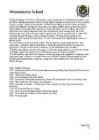
Westminster Abbey Facts The Collegiate Church of St Peter at Westminster Owned directly by the royal family Dedicated to St Peter Located next to the Houses of Parliament UNESCO World Heritage Site History 616, a shrine was founded 10451050, Edward the Confessor Consecrated on December 28, 1065 Romaneque style, to house Benetictine munks Rebuilt 12451517 in Gothic style by Henry III History 2 Henry VII Lady Chapel in 1503 Dissolution of the Monasteries in 1534 Attacked by Puritans in 1640s Oliver Cromwell's funeral in 1658
Parliament of the United Kingdom The Parliament of the United Kingdom, commonly known as the UK Parliament or British Parliament, is the supreme legislative body in the United Kingdom, British Crown dependencies and British overseas territories. It alone possesses legislative supremacy and thereby ultimate power over all other political bodies in the UK and its territories. Its head is the Sovereign of the United Kingdom (currently Queen Elizabeth II) and its seat is the Palace of Westminster in the City of Westminster, one of the Boroughs of the British capital - London. Tower of London The Tower of London, officially Her Majesty's Royal Palace and Fortress of the Tower of London, is a historic castle located on the north bank of the River Thames in central London. It lies within the London Borough of Tower Hamlets, separated from the eastern edge of the square mile of the City of London by the open space known as Tower Hill.
London History The Romans AD 43- AD 410 The Romans finally invaded Britain in AD 43 from Kent. The Romans lead by Julius Caesar attempted to invade Britain twice before that in 55 and 54 BC but the invasions were unsuccessful. They made their way to the river Thames and sailed up it. The Romans knew it was important to control a crossing point at the river Thames, so they decided to build a settlement on the north bank. Although small settlements had been built on the banks of the Thames, the Romans were the ones who built the first city. They called their city Londinium. The Roman engineers noticed that the point where the swampy river narrowed would make an ideal crossing point, they built London Bridge. Less than 20 years later the native Iceni tribe, led by Queen Boudicca, rose up against the Romans in revenge for mistreatment and burnt Londinium to the ground. The well disciplined Roman army defeated her forces and Londinium was rebuilt
London important sights guide Roman period 20th century · Big Ben is the nickname for the great bell of the clock at the north end of the Palace of Westminster in London and is often extended to refer to the clock or the clock tower as well. It is the largest four-faced chiming clock and the third-tallest free-standing clock tower in the world. The clock first ticked on 31 May 1859. The pendulum is installed within an enclosed windproof box sunk beneath the clockroom. It is 3.9m long, weighs 300 kg and beats every 2 seconds
It is also wise to use Google Maps Street View simultaneously it gives you the wonderful feeling of strolling the streets and landmarks. Take the following questions with you, find answers to them and put them down for yourself in this MSWord document. Don't forget to "take" photos - you are supposed to recognise the landmarks later on! At the end of the tour send the worksheet to yourself so that you could use it again. Good luck with exploring the city! DAY 2. The route: Westminster Abbey The Houses of Parliament London Eye 10 Downing Street St Paul's Cathedral The Tower of London Tower Bridge Globe Theatre Greenwich Observatory Destination 1: Westminster Abbey When was Westminster Abbey founded? (see its homepage: http://www.westminster-abbey.org/home ) 960 When was the last royal wedding held in Westminster Abbey? Whose was it? 29 April 2011 Prince William and MissCatherine Middleton How many monarchs have been buried in Westminster Abbey? 17
Birmingham, the second largest, has just over one million inhabitants. Cultural life London is the worldclass centre. It has more than40 theatres, where audiences enjoy everything from musicals to William Shakespeare's plays. The city also contain many cinemas, concert halls, museums and art galleries. Royal residence English (later British) kings and queens have lived in London for almost 1,000 years. There are several royal palaces in the capital. St James's Palace was built by King Henry VIII in the 16th century. Since 1837 the monarch has lived in Buckingham Palace LONDON'S EARLY HISTORY The Romans invaded England in 43 AD. They landed in Kent, made their way to the River Thames and sailed up it. Then they settled in a place on the north bank, where the river was not to wide. This settlement was called Londinium
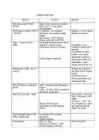
The Celtic period (400 BC Name: Celtic words (Llyn (a lake) + AD 43) Dun (a fort or strong place) ) Not important The Roman occupation (AD 43 Londinium not important Boadicea a revolt against - AD 410) politically. An important trading the Roman conquest centre. Devastation AD 61. Rebuilt. Roman walls built in AD 200. Anglo Saxons (AD 400 Destroyed the Roman towns. Many 1066) kingdoms. London in ruins. King Egbert one Flourishing. Attacks by Vikings. kingdom England (the 9th century) King Albert the Great
Westminster School The Royal College of St. Peter in Westminster, almost always known as Westminster School, is one of Britain's leading independent schools,with the highest Oxbridge acceptance rate of any secondary school or college. Located in the precincts of Westminster Abbey in central London, and with a history stretching back beyond the 12th century, the school's notable alumni include Ben Jonson, Robert Hooke, Christopher Wren, John Locke, Jeremy Bentham, and A. A. Milne. The school traditionally encourages independent and individual thinking. Boys are admitted to the Under School at age seven, and to the main school at age thirteen; girls are admitted only at sixteen. The school has around 750 pupils; around a third are boarders, of whom most go home for the weekends, after Saturday morning school. It is one of the original nine English public schools as defined by the .
Westminster Today For centuries, Westminster was the political and religious center, but today Westminster is the center of government. Westminster Hall was built in 1099 by the son of William the Conqueror and is one of the largest medieval halls. It was part of the Westminster Palace, which was destroyed by a fire in 1834. The Houses of Parliament that we see today were rebuilt in the 19th century after the fire. The Big Ben clock tower is the largest four-sided ringing clock in the world and it is also one of the London's most famous symbols. Some think that Big Ben is the name of the clock on the tower, but actually it is the name of the big 13-ton bell that rings every fifteen minutes.
existence. The Romans rebuilt the town into a centre of great importance. After the Romans withdrew from Britain in the Picts, Scots, Jutes, Angles and Saxons invaded London. It started to expand again under the Saxon kings. London was described as a commercial centre into which goods from all parts of the world flew by land and sea. King Alfred the Great repopulated and fortified the city. Edward the Confessor started to build a new royal palace at Westminster and raised London to the level of capital. William the Conqueror started the construction of the Tower of London and his successor William II enlarged it and constructed Westminster Hall. The two centres which were to characterise the English capital for many years emerged: The City of L and Westminster. In 1193 Londoners elected Henry Fitzalwin their first Mayor and in 1209 a stone bridge was built to replace the earlier wooden one, which was the first real London Bridge.
HOUSES OF PARLIAMENT Houses of Parliament also known as the Palace of Westminster is one of the most attractive buildings in London. It stands on the site where Edward the Confessor had the original palace built in the first half of the eleventh century . In 1547 the royal residence was moved to Whitehall Palace, but the Lords continued to meet at Westminster, while the commons met in St. Stephen's Chapel. Ever since these early times, the Palace of Westminster has been home to the English Parliament. In 1834 there was a huge fire that destroyed much of the old palace. All that remained was the chapel crypt, The Jewel Tower and Westminster Hall. It was Lord Melbourne, the Prime Minister, who saved the great hall by arranging for the fire engines to be brought right into the hall and personally supervising the fire fighting operation. The magnificent Gothic Revival masterpiece you see today was built between
The Norman Conquest William I (the Conqueror) (1066 - 1087) On October 14, in the fateful Battle of Hastings, William defeated and killed Harold and seized the English throne. Two months after the Battle of Hastings, William I was crowned king in Westminster Abbey. The service was held on Christmas Day 1066, with all the traditional ceremonies associated with the coronation of English kings since the time of Edgar. William had gained his throne by accepting the English form of coronation, William emphasised his claim to be legitimate successor to Edward the Confessor. William I was a strong king and a man of immense determination. He was stern to people who opposed his will, but kindly disposed to those who did not.
grown up around it. London has been an important settlement for over two millenniums. It is also one of the world's leading business, financial and cultural centres and its influence in politics, education, entertainment and even fashion contribute to its status as a major global city. London is a major tourist attraction with four world heritage sites, several royal parks and numerous iconic landmarks such as the Houses of Parliament, Towe Bridge, the Tower of London, Westminster Abbey and the London Eye. 2. History Although there is some evidence of a permanent settlement before the Romans came in 43 A.D., it is more accepted by historians that the Romans were the first. The settlement was called Londinium. The first London lasted for just seventeen years, for around AD 61, a tribe of Celts led by Queen Boudica stormed London, burning it to the ground. The next heavily-planned London
Inventors & Scientists: Isaac Newton, Charles Darwin Actors,Actresses & Filmmakers: Sir Charlie Chaplin, Dame Elizabethe Taylor, AlfredHitchock, Hugh Grant, Orlando Bloom, KeiraKnightley, Daniel Radcliffe Musicians & Singers: Sir Elton John,Phil Collins,George Michael,Robbie Williams King Henry VIII Born: June 28, 1491 at Greenwich Palace Parents: Henry VII and Elizabeth of Y ork House of Tudor Ascended to the throne: April 21, 1509 aged 17 years Crowned: June 24, 1509 at Westminster Abbey Married: (1) Catherine of Aragon 1509-1533 Divorced (2) Anne Boleyn 1533-1536 Beheaded (3) Jane Seymour 1536-1537 Died (4) Anne of Cleves 1540 Divorced (5) Catherine Howard 1540-1542 Beheaded (6) Catherine Parr 1543-1547 Survived Children: Three legitimate who survived infancy; Mary, Elizabeth and Edward. Several illegitimate children Died: January 28, 1547 at Whitehall Palace, London, aged 55 years Reigned for: 37 years, 9 months, and 7 days William Shakespeare
It seems that the Celts, who had been arriving from Europe from the 8th cent BC onward, intermingled with the peoples who were already there. The Celts were extremely talented people, creative and artistic. More than 1 Celtic tribe invaded Br. The descendants of ancient Celts live in Wales, Scotland, Cornwall and Ireland. They lived in primitive society. Druids priests, more powerful than chiefs. Acted like prophets. 2. Stonehenge From prehistoric period. Was built on Salisbury plain between 2500 and 1500 bc. One of the most famous and mysterious archaeological sites in the world. One of the mysteries is how it was built at all with the technology of the time. Another is its purpose. It appears to function as a kind on astronomical clock and we know it was used by the Druids for ceremonies marking the passing of the seasons. It appears in number of novels. These days it is not only the interest of tourists but is also a
politically, but was, however an important crossing point for the romans over the river Thames. Londinium was at a very good place, so it soon became a trading centre. In AD 61 the city was devastated by Boudicca, who led a revolt againt the Roman conquest of Britain. The city was burned down and its inhabitants massacred. London was rapidly rebuilt, becoming the capital of the province Britannia. AD 122 Roman walls were built around it as a Around AD 400 the Anglo-Saxons invaded Britain. They destroyed the roman towns and formed many kingdoms that were hostile to one another. London fell into ruins. King Egbert united all the small kingdoms and formed one kingdom named Englad. Later king Alfred the Great chose London to be the capital of the country. During the reign of Edward the Confessor Westminster Abbey and the royal palace were built.
It is located within the London Borough of Tower Hamlets and is separated from the eastern edge of the City of London by the open space known as Tower Hill. It is the oldest building used by the British government. [1] TOWER BRIDGE: Tower Bridge is a combined bascule and suspension bridge in London, England, over the River Thames. It is close to the Tower of London, which gives it its name.It has become an iconic symbol of London. WESTMINISTER ABBEY: Westminster Abbey is steeped in more than a thousand years of history. Benedictine monks first came to this site in the middle of the tenth century, establishing a tradition of daily worship which continues to this day. The Abbey has been the coronation church since 1066 and is the final resting place of seventeen monarchs. THE PALACE OF WESTMINISTER AND BIG BEN: The Palace of Westminster, also known as the Houses of Parliament or Westminster Palace, is the seat of the two houses of the
He invaded and attacked England on Edward's death, as he was promised the English crown, but then denied it by the Saxon Harold. King George VI King George VI did not expect to become king, he was the shy brother of Edward VIII who only took the thrown when Edward abdicated. King George VI ruled during World War two and bravely refused to leave London during the blitz. The two princesses; Elizabeth and Margaret, spent the war years in Windsor Castle away from harm. King Henry VI King Henry VI still holds the record for being the youngest king of England, it is unlikely that the record will be broken any time soon. He came to the thrown at just 9 months old. For the first 20 years of his life England and France were ruled by his uncles and advisors. King Stephen King Stephen was king of England (and not Normandy), although he was born in France. He was crowned at Westminster Abbey, like his father before him
beautifully refurbished spa and gym downstairs. There are also floor to ceiling windows, flat screen TV and complimentary mini bar soft drinks and snacks. Saturday At first we will go visit Buckingham Palace which is the official London residence and principal workplace of the British monarch. We would also like to see the nearby park where are a lot of birds and squirrels. Then we would like to see the river Thames and the Big Ben. Just a short walk from the Thames is situated Westminster Abbey which is a significant building in British history. This beautiful gothic church is a UNESCO World Heritage. Kings, Queens, statesmen, aristocrats, poets, priests, heroes and villains are all part of the church's fascinating history. Many of whom were buried at the Abbey including Charles Dickens, Geoffrey Chaucer, Dr. Samuel Johnson and Charles Darwin. There is a special Scientists corner at the church which is home to a memorial for Isaac Newton
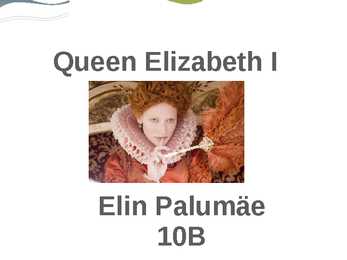
Queen Elizabeth I Elin Palumäe 10B Elizabeth I Reign - 17 Nov. 1558 24 March 1603 (44 years) Coronation - 15 January 1559(25 years) Predecessor - Mary I Successor - James I House - House of Tudor Father - Henry VIII Mother - Anne Boleyn Born - 7 September 1533 Greenwich, England Died - 24 March 1603 (aged 69) Burial - Westminster Abbey Anne Boleyn Queen consort of England Mother of Elizabeth I Tenure - 28 May 1533 17 May 1536 Coronation 1 June 1533 Anne Boleyn was Queen of England from 1533 to 1536 as the second wife of Henry VIII of England and the 1st Marquess of Pembroke in her own right for herself and her descendants. House - House of Tudor Father - Thomas Boleyn, 1st Earl of Wiltshire Mother - Lady Elizabeth Howard Born c.1501/1507 Blickling Hall/ Hever Castle, England Died 19 May 1536 (aged 29-35)Tower of London
THE HOUSES OF PARLIAMENT a.k.a thePalace of Westminster IN GENERAL... The last monarch to live there, Henry VIII, moved out in 1512 Parliament has met in the Palace of Westminster since around 1550 there has been a royal palace on this site for nearly 1,000 years in the 19th Century a fire destroyed most of the earlier medieval buildings HISTORY Was originally laid out for Edward the Confessor more than 1,000 years ago in 1066, became the home of William the Conqueror in 1834, everything except Westminster Hall was burnt in the great fire the present building was designed specifically to house parliament and was laid out in Gothic style by Sir Charles Barry, completed in the 1840's THE BUILDING Nearly 1,200 rooms 100 staircases over 3 kilometres (two miles) ofcorridors located next to the River Thames in London TOWERS Includes several towers:
Regent's Park Regent's Park (officially The Regent's Park) is one of the Royal Parks of London. It is in the northern part of central London partly in the City of Westminster and partly in the London Borough of Camden. It contains Regent's College and the London Zoo. Description The park has an outer ring road called the Outer Circle (4.3 km) and an inner ring road called the Inner Circle, which surrounds the most carefully tended section of the park, Queen Mary's Gardens. Apart from two link roads between these two, the park is reserved for pedestrians. The south, east and most of the west side of the park are
The City and The Tower of London Styv Solovjov G1a The City Founded by Romas 43-50 AD, set up trading post It has seen at least 15 major fires 1666 burnt down 4/5 of its houses Then The City was rebuilt Tower Bridge (Tower Hill tube), built in 1894 during the Second World War, its was heavily bombed Now there is one of the biggest financil centres in Europe Banks, stock exchange Many banking and insurance institutions have their headquarters there Stock Exchange, Lloyd's of London,the Bank of England are all based in the City Over 500 banks have offices in the City City is an established leader in trading in Eurobonds, foreign exchange, energy futures and global insurance Of the $3
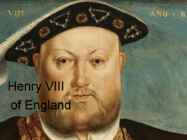
Henry VIII of England Henry VII Born on 21 June 1491. Died in January 28 1547. Is the 2nd son of King Henry VII and Elizabeth of York. Was crowned King at Westminster Abbey, London, on the 23 June 1509 at the age of 17. Elizabeth of York | King Henry VII Henry VIII is known for... Establishing the Church of England. Having six wives. Beind a big, fierce-looking man. Early life Not much is known about his early life, because he was not expected to become king. Around the age of ten his brother Arthur died, thus leaving the crown to him. He also married his brother`s widow, Catherine of Aragon.
· James VI was the King of both countries, the crowns were united · In 1745, Bonnie Prince Charlie tried to seize the throne · The end of dreams of freedom for Scots · Major changes in the late 18th and 19th c. · Highland Clearances farmers were deprived of their land, filled with sheep instead · Fast development of coal mining, steel production and shipbuilding · Bridges, railways, canals · In 1950 the Nationalists stole the Stone of Scone from Westminster Abbey and took it back to Scotland · Important part of British Coronation since 13th c. · In 1979 the British Government decided to allow Scotland to establish a separate assembly · Surprisingly they didn't got the support of 40% of people in a referendum that was needed · In 1999 Scotland voted for its own separate parliament · The first Parliament in almost 300 years · It is unicameral and has 129 members- largest parties are the Labour Party, the Scottish National Party and the
Ordinary English wedding costs around 25,000 pounds (about 25,565 euros). Royal wedding costs around 10 million pounds (about 8,547,009 euros). Kate and William's wedding was allegedly of Beyonce and Jay-Z (their favorite singers). Kate and William have asked their guests not to bring gifts, but asked that they would support the royal wedding charity fund, which are placed in 26-charitable fund. William got engaged to Kate in October 2010, but married 29 April 2011. Westminster Abbey The present church, begun by Henry III in 1245, is one of the most important Gothic buildings in the country. The Library and Muniment Room houses the important (and growing) collections of archives, printed books and manuscripts belonging to the Dean and Chapter of Westminster. Prints William Prince William is the elder son of Charles and Diana and third eldest grandchild of Queen Elizabeth II and Prince Philip. He was educated at four schools in the United Kingdom and obtained
5. Which 5 places attract visitors in Wales and Scotland? Edinburgh, Loch Ness, The Highlands, Snowdonia, Cardiff. 6. Name 6 islands, 5 rivers, 3 lakes, 3 mountains in UK. Isle of Man, Isle of Wight, Isle of Lewis, Island of Mull, Island of Arran, Anglesey Island Severn, Thames, Tweed, Avon, Trent, Dove Ben Nevis, Snowdon, Ben Macdui 7. Stonehenge. Stonehenge was produced by a culture that left no written records. Built on Salisbury Plain, in Wiltshire, England some time between 5,000-4,300 years ago. One of the most famous megaliths in the world, dating from prehistoric times. Stonehenge consists of circles of stone arranged in complex patterns, and their origin is still being explored. Some of the stones come from over 200 miles away in Wales. There is little or no direct evidence revealing the construction techniques used by the Stonehenge builders
7. How was Protestantism established in England? When and by who? It was established by Henry VIII because he wanted to divorce his first wife. Up until then England was Catholic and divorcing was not allowed for him. He really wanted a new wife, so he declared that England was no longer a part of the Catholic Church and made himself as the head of the new church. It happened in 15 8. What good did the invasion of Romans bring to England? It brought roads and order. They also built the first version of London. 9. What do you know about the Tower of London? It was at first a castle for the king of England, but Henry VIII turned it into a prison. There are Beefeaters, who are the tour guides now but used to be the guards. They keep the royal jewels there. It's one of the most visited sight in London and also one with the most fascinating history. 10. If going back in time was possible, which decade in British history would you choose to live in? Why?
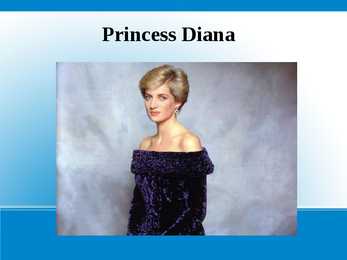
hospitals, schools, etc.) In addition, the Princess was the patroness of charities and organisations working with the homeless, youth, drug addicts and the elderly. From 1989, she was announced as a President of Great Ormond Street Hospital for Children. She was married on 29 July 1981. The wedding, which was held at St. Paul's Cathedral, was televised and watched by a global audience of over 750 million people. On June 21, 1982 her first son Prince William was born. Two years later, on September 15, 1984, Diana's second and youngest son Prince Henry was born. On August 26, 1996, Diana and Charles divorced. On 31 August 1997, Diana was fatally injured in a car crash in the Pont de l'Alma road tunnel in Paris. Her companion Dodi Fayed and the driver Henri Paul were pronounced dead at the scene of the accident. Fayed's bodyguard, Trevor Rees-Jones, was the only survivor. Princess Diana's death has been claimed as a conspiracy.
London London is the capital of Great Britain. It is situated on the river Thames. The Thames is a river flowing through southern England and connecting London with the sea. The Thames has a length of 346 kilometres (215 miles). The first bridge was the tower bridge, built in the 12th century. The second bridge was built in the year 1750. .The river Thames divides London into the northern and the southern part. The port of London is one of the greatest trade centres in the world. The river Thames is certainly the most famous water body in London. London is also the seat of the government of Great Britain. It is one of the largest cities in the world with its population of about seven million. Before the great fire in 1666 there were many wooden houses and
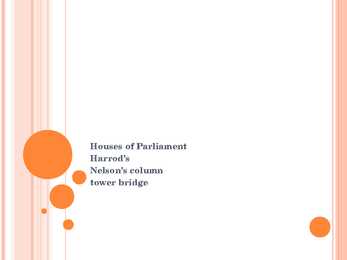
Houses of Parliament Harrod's Nelson's column tower bridge NIMI .... Houses of Parliament The Houses of Parliament, otherwise known as The Palace of Westminster, stands on the site where Edward the Confessor had the original palace built in the first half of the 11th century. In 1547 the royal residence was moved to Whitehall Palace, but the Lords continued to meet at Westminster, while the commons met in St. Stephen's Chapel. Ever since these early times, the Palace of Westminster has been home to the English Parliament. Harrod's One of the world's most famous department stores, established in 1849 as a humble grocery store employing two assistants. Today, it offers everything from food to fashion, furniture to sportswear plus 20 instore restaurants serving every kind of cuisine imaginable from pizza to sushi. Services range from piano tuning to fitting saddles
THE CITY OF LONDON History The City of London occupies one square mile in the middle of the capital. It once made up entire town of London, surrounded by the wall first built by Romans. The Romans also built a bridge over the Thames and there has been one in the same area ever since. The Roman Londinium grew up on the northern side of the bridge. In AD 61 the native Celtic tribe, led by Queen Boudicca, rose up against the Romans. They burnt down Londinium to the ground and killed most of its inhabitants. Roman armies eventually defeated Boudicca and Londinium was rebuilt. At the end of the fourth century AD the Roman Empire began to crumble and the Roman armies
 annaabi.ee