English speaking countries- UK The United Kingdom of Great Britain and Northern Ireland is a sovereing state off the north-western coast of continental Europe. It consist of Great Britain, the north- eastern part of the island of Ireland and many smaller islands. The capital of United Kingdom is London.The flag of the United Kingdom is the Union Flag The United Kingdom is a unitary state governed under a constitutional monarchy and a parliamentary system, with its seat of government in the capital city of London. It is a country in its own right and consists of four countries:: England, Northern Ireland, Scotland and Wales . The United Kingdom is a unitary state under a constitutional monarchy. Queen Elizabeth II is the head of state of the UK as well as of fifteen other independent Commonwealth countries.
New Zealand English speaking countries Where? o It is in the southwestern Pacific Ocean o Next to the Australia About Capital-Wellington Largest city-Auckland Government-Unitary parliamentary constitutional monarchy • Monarch - Queen Elizabeth II • Governor-general - Jerry Mateparae • Prime minister - John Key About Area-268,021 km2 Population-4,509,461 ( January 2014 ) Anthem-"God Defend New Zealand„ New Zealanders are calling their country Aotearoa. History o Māori were the first to arrive in New Zealand, journeying in canoes from Hawaiki about 1,000 years ago. A Dutchman, Abel Tasman, was the first European to
France France is a country located in Western Europe, with several overseas islands and territories located on other continents. France is a unitary semi-presidential republic with its main ideals expressed in the Declaration of the Rights of Man and of the Citizen. Metropolitan France is bordered (clockwise from the north) by Belgium, Luxembourg, Germany, Switzerland, Italy, Monaco, Andorra, and Spain. France's overseas departments and collectivities also share land borders with Brazil and Suriname and the Netherlands Antilles. France is the largest country in the European Union by area and the second largest in Europe behind Ukraine
• In 1066, the Normans invaded England from France • In 1603, the kingdoms of England, Scotland and Ireland were united in a personal union when James VI, King of Scots, inherited the crowns of England and Ireland and moved his court from Edinburgh to London • In the mid-17th century, all three kingdoms were involved in a series of connected wars, which led to the temporary overthrow of the monarchy and the establishment of the short-lived unitary republic of the Commonwealth of England, Scotland and Ireland. Acts of Union • On 1 May 1707, the united Kingdom of Great Britain came into being, the result of Acts of Union being passed by the parliaments of England and Scotland to ratify the 1706 Treaty of Union and so unite the two kingdoms • The term "United Kingdom" became official in 1801 when the parliaments of Britain and Ireland each passed an Act of
KEIDI PUKK MTT2 ITALY ITALY Italy officially the Italian Republic is a unitary parliamentary republic inSouthern Europe. The capital of Italy is Rome. I've been living in Italy for half of year. ITALIAN FLAG Click to edit Master text styles Second level Third level Fourth level Fifth level CLIMATE Italy has a variety of climate systems. The inland northern areas of Italy have a relatively cool
Service) Service that help students who realize on opening their A-level results that they haven’t got the grades required by their universities of choice to find a university place A framework used by all maintained schools to ensure that teaching and learning is balanced and consistent = National curriculum 15. What do you call a state or country that is governed constitutionally as on single unit, with one constitutionally created legislature? A unitary state- see A single-nation state A federal state A multi-nation state
· Ethnicity and territory? · More powerful State Governors · Relatively homogeneous As you hint here, some groups (eg NP) wanted · Ethnicity and territory are closely correlated to poverty. society, no major territorial more provincial autonomy, but ANC wanted STATES ethnic divisions something more unitary compromise · Formally modelled on US federalism Germany Exhibit #2: · But authoritarian rule centralized power. Logic: · The East Regional imbalances also within provinces development, consolidation of power to end rivalries. · Memory of statehood;
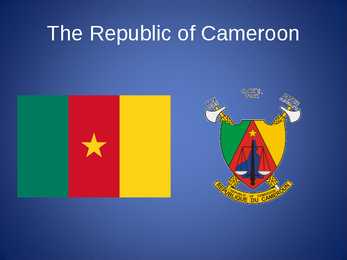
The Republic of Cameroon Cameroon · A unitary republic of central and western Africa · Bordered by Nigeria to the west; Chad to the northeast; the Central African Republic to the east; and Equatorial Guinea, Gabon, and the Republic of the Congo to the south. · Cameroon's coastline lies on the Bight of Bonny, part of the Gulf of Guinea and the Atlantic Ocean. · The country is called "Africa in miniature" for its geological and cultural diversity. History
1. Society- people who interact in such a way as to share a common culture. The cultural bond may be ethnic or racial or geographical, based on gender, or due to shared beliefs, values, and activities. 2. Culture- beliefs, behaviors, objects, and other characteristics common to the members of a particular group or society. 3. A unitary state- a state governed as one single power in which the central government is ultimately supreme and any administrative divisions (subnational units) exercise only powers that their central government chooses to delegate. The majority of states in the world have a unitary system of government. 4. A federal state-- a political entity characterized by a union of partially self- governing states or regions under a central (federal) government. 5
.......................................................kaupa vahetama 484. Trading day ....................................................börsipäev 485. Traditional economy ......................................tavamajandus 486. Trial ...............................................................katse 487. Turnover - .........................................................käive 488. Unemployment rate .......................................tööpuuduse määr 489. Unitary elastic demand ..................................ühikelastne nõudlus 490. Utility - .............................................................kasulikkus 491. Wages .............................................................töölise palk 492. Value for money ............................................kvaliteedi-hinna suhe 493. Variable ..........................................................muutuja 494. Variable costs ..........................................
1. Feminism movement, ideology to defend women’s rights Suffrage – right to vote 2. Feminism isn’t a unitary movement because it represents different women and different experiences for them in different parts of the world. Different ideologies 3. Three waves of feminism • 1st wave – early 19th century – early 20th century (Political rights, suffrageright to vote) • 2nd wave – 1960s1980s (Social inequalities, gender norms, Women's Liberation Movement)
kaarelastsus Arc Elasticy Дуговая эластичность Keskpunkti valem Midpoints Formula Формула средней точки Täielikult elastne Perfectly Elastic Совершенно эластично mitteelastne Inelastic Неэластично ühikelastne Unitary Elastic Единично эластично elastne Elastic эластично Absoluutselt mitteelastne Perfectli nonelastic Абсолютно не эластично kogutulu test Total Revenue Test Проверка на доход
................................................................................... 66 2.7. Corporate forms ......................................................................................................... 71 2.7.1. Limited Liability Company ................................................................................. 72 2.7.2. Joint-Stock Company.......................................................................................... 73 2.7.3. Private unitary enterprise .................................................................................. 74 2.7.4. Registration of the companies in Belarus .......................................................... 75 2.8. Taxation ..................................................................................................................... 75 2.8.1. Corporate income tax (CIT) ............................................................................... 75 2.8.2
Administrative subdivisions Historical types subdivisions of Scotland include the mormaerdom, stewartry, earldom, burgh, parish, county and regions and districts. The names of these areas are still sometimes used as geographical descriptors. Modern Scotland is subdivided in various ways depending on the purpose. For local government, there have been 32 council areas since 1996, whose councils are unitary authorities responsible for the provision of all local government services. Community councils are informal organisations that represent specific sub- divisions of a council area. For the Scottish Parliament, there are 73 constituencies and eight regions. For the Parliament of the United Kingdom, there are 59 constituencies. The Scottish fire brigades and police forces are still based on the system of regions introduced in 1975
In 1769-70 James Cook sailed around New Zealand, charting its entire coastline. 4. By which treaty did the Maoris cede their sovereignty? By the treaty of Waitangi. 5. The status of the Maori language and Maori culture at present. Maori became an official language in 1987, New Zealand Sign language became an official language in 2006. 6. The peculiarities of New Zealand’s plant and animal life. The national bird of New Zealand. 7. The political system of New Zealand. New Zealand is a unitary constitutional monarchy. The Parliament is comprised only of the House of Representative. The British monarch is the head of state. The Governor-General is the representative of the monarch and carries out most of the monarc's constitutional and ceremonial duties. The Governor-General is appointed by the monarch on advice from the New Zealand Prime Minister.
Neuman, B., & Young, R.I. (1972). A model for teaching total per- son approach to patient problems. Nursing Research, 21, 264 OE 269. Nightingale, F. (1992). In D.P. Carroll (Ed.), Notes on nursing (commem- orative ed., pp. 8 OE 76). Philadelphia: Lippincott. Peplau, H. (1994). Quality of life: An interpersonal perspective. Nursing Science Quarterly, 7(1), 12 OE 14. Reilly, D.E. (1975). Why a conceptual framework? Nursing Outlook, 23, 566 OE 569. Rogers, M.E. (1989). Nursing: A science of unitary human beings. In J. Riehl-Sisca (Ed.), Conceptual models for nursing practice (3rd ed., pp. 181 OE 195). Norwalk, CT: Appleton & Lange. Roy, C. (1997). Future of the Roy model: Challenge to redefine adapta- tion. Nursing Science Quarterly, 10(1), 43 OE 47. Schuyler, C.B. (1992). Florence Nightingale. In D.P. Carroll (Ed.), Notes on nursing (commemorative ed., pp. 3 OE 17). Philadelphia: Lippin- cott. 20 Thomas, R. Jr
acid i mutates into amino acid j for all pairs of amino acids. such matrices are constructed by assembling a large and diverse sample of verified pairwise alignments of amino acids. If the sample is large enough to be statistically significant, the resulting matrices should reflect the true probabilities of mutations occurring through a period of evolution. Unitary Matrix Also known as Identity Matrix. A scoring system in which only identical characters receive a positive score. Tühiku skoorid- Calculating alignment scores. The raw score S for an alignment is calculated by summing the scores for each aligned position and the scores for gaps. In this figure, a DNA alignment is shown. In amino acid alignments, the score for an
in the 1980s thought was good a perspective that today is probably not shared by many experts anymore, including those within the IFI's themselves. And indeed, what the respective IFI's held to be good in the 1980s was neo-liberalism, the Free Market as a world view, and thus the retrenchment of the state. Within the state sector itself, many of the principles of "Good Governance" are therefore identical with NPM. And while a unitary definition of the concept never existed, not even within the respective individual IFI's, "good" principles usually encompassed such concepts as transparency, efficiency, participation, responsibility, and market economy, state of law, democracy, and justice. Many of them are indubitably "good" as such, but all of them except the last one, which is the most abstract are heavily context-dependent, hinging not only on definition and interpretation, but also on time and place
First wave feminist movement at the end of the 19th century; second wave feminism in the 1960s and the third wave in the 1980s and 90s. “Her-‐story” vs. history. Eva Figes. Her-‐story contests the idea of a single unitary and linear history. The subjectivity of history and its fragmented nature. History is just another story, someone has chosen what to include and what to exclude. Helene Cixous and ecriture feminine, i.e. writing in the feminine. The idea is that
recognize faces although they are able to see the face and understand that it is a face of a person. However, they are able to recognize and identify faces through other sensory stimuli such as auditory, tactile and even other visual stimuli patterns. Prosopagnosia is associated with the fusiform gyrus. The study of prosopagnosia has been crucial in the development of theories of face perception. Because prosopagnosia is not a unitary disorder (i.e., different people may show different types and levels of impairment), it has been argued that face perception involves a number of stages, each of which can be separately damaged. This sort of evidence has been crucial in supporting the theory that there may be a specific face perception system in the brain. A classic case of a prosopagnosia is presented by "Dr. P." in Oliver Sacks' 1985 book The Man Who Mistook His Wife for a Hat, though this is more properly considered
The master's thesis' exploratory task is to evaluate the government offices' readiness in solving the crisis of document and archive management. Written inquiry and literature, legal acts', standards' and databases' (including internet) analysis were used as a method. After analyzing the received inquiries, the author gives the following suggestions: · To compose the crisis regulation plans that include different fields' prevention and security measures in order to achieve unitary readiness for the emergencies; · To unify the legislation, so that the different fields would adhere with each other; · To develop unified methodology for conducting document and archive management, IT security and work healthcare risk analysis, and more specific regulations and suggestions in order to unify different fields and to develop solid and clear understanding between document and archive management.
accounting. The law does not say that the accounting records contains information used to calculate the tax and accounting reports for the benefit of taxation should be submitted to the relevant tax authorities. The Federal Law "On Accounting" applies to all organizations in the territory of Russia, including branches and representative offices of foreign companies, if it does not contradict Russian treaties with other countries. All legal entities registered under Russian law, unitary 51 enterprises, public institutions are required to maintain accounting records in compliance with the Act. Federal authorities say mandatory for all organizations in Russia: Chart of accounts and instructions for their use; Regulation (standards) of accounting, stating the principles, rules and methods of accounting for business transactions and the preparation of financial statements;
intelligentsustestiks ning, mis hiljem (1916) sai testi inglise keelde adapteerinud Ameerika psühholoogi Lewis Termani koduülikooli järgi nime Stanford-Binet skaala. See skaala leidis laialdast kasutust ning on sama nimetuse all tuntud ka tänapäeval, viimati revideeriti seda 1985. aastal. In 1916, Terman adopted William Stern's suggestion that the ratio between mental and chronological age be taken as a unitary measure of intelligence multiplied by 100 to get rid of the decimals. The resulting "intelligence quotient" became known as the "IQ" and is now known in the classic formula: IQ = Mental Age/Chronological Age X 100. Testi loojate ülesandeks ei olnud uurida terviklikku nähtust, mida võiks kutsuda intelligentsuseks, vaid ennustada laste edasijõudmist koolis ja selleks see test kõlbas. Madalamad skoorid ennustasid halba edasijõudmist paremini, kui kõrged head.
The first stationary cinema was built in Tallinn in 1907. The first Estonian filmmaker was Johannes Pääsuke (1892-1919) from Tartu. He is the author of the first Estonian feature film: Karujaht Pärnumaal (Bear Hunt in Pärnu county, 1914), a political satire involving the Mayor of Pärnu. The main centre for national romantic art ideology and practice was the atelier and art of Ants Laikmaa. Like his Finnish colleagues he aspired to create a unitary national style in art, applied art, furniture design and architecture. The opening of the new opera and concert house Estonia on August 24th, 1913 was a major event in Estonian cultural history. The accomplishment of this significant enterprise was a result of nation-wide cooperation in the face of incessant opposition from the tsarist regime and the weakening Baltic-German factions. The new representative buildings1 gave actors, artists and composers better facilities for creative
(1976) "The Semantics of Singular Terms." Philosophical Studies 30: 35377. Locke, J. (1690/1955) Essay Concerning Human Understanding. Chicago: Encyclopaedia Britannica. Loux, M. (1998) Metaphysics: A Contemporary Introduction. London: Routledge. Ludlow, P. (2007) "Descriptions." In E. N. Zalta (ed.), The Stanford Encyclopedia of Philosophy. Available at http://plato.stanford.edu/entries/descriptions/ (last accessed 15 November 2007). Ludlow, P., and G. Segal (2004) "On a Unitary Semantical Analysis for Definite and Indefinite Descriptions." In A. Bezuidenhout and M. Reimer (eds.), Descriptions and Beyond. Oxford: Oxford University Press. Lycan, W. G. (1974) "Could Propositions Explain Anything?" Canadian Journal of Philosophy 3: 42734. ---- (1984) Logical form in Natural Language. Cambridge, MA: Bradford Books/ MIT Press. ---- (1994) Modality and Meaning. Dordrecht and Boston, MA: Kluwer Academic Publishing. Lyons, J. (1977) Semantics, vol. 1
 annaabi.ee