Leidsid 33 sarnast õppematerjali, mis on seotud failiga "ühendverbid". Need materjalid aitavad sul teemat sügavamalt mõista.
look, turn, call, come, jenny, visit, drop, through, yesterday, children, meeting, catch, keep, came, money, hold, sure, blow, broke, deborah, helen, class, check, minute, consciousness, good, lenny, carrie, find, along, essay, continue, henry, going, students, hand, jackie, looking, larry, looks, forward, wanted, susan, tony, pass, pick, fire, acrosspost box. wall. chair. hands. Viljandi 2009 Viljandi County Gymnasium 2. Prepositions of movement Picture It Clip Art Preposition Example "He carried the rubbish to the to bin." "The train came through the through tunnel." across "He swam across the channel." along "He walked along the road." down "He skied down the mountain." over "They walked over the bridge."
Color-- -1- -2- -3- -4- -5- -6- -7- -8- -9- Text Size-- 10-- 11-- 12-- 13-- 14-- 15-- 16-- 17-- 18-- 19-- 20-- 21-- 22-- 23-- 24 TWILIGHT By Stephenie Meyer Contents PREFACE 1. FIRST SIGHT 2. OPEN BOOK 3. PHENOMENON 4. INVITATIONS 5. BLOOD TYPE 6. SCARY STORIES 7. NIGHTMARE 8. PORT ANGELES 9. THEORY 10. INTERROGATIONS 11. COMPLICATIONS 12. BALANCING 13. CONFESSIONS 14. MIND OVER MATTER 15. THE CULLENS 16. CARLISLE 17. THE GAME 18. THE HUNT 19. GOODBYES 20. IMPATIENCE 21. PHONE CALL 22. HIDE-AND-SEEK 23. THE ANGEL 24. AN IMPASSE EPILOGUE: AN OCCASION twilight STEPHENIE MEYER LITTLE, BROWN AND COMPANY New York Boston Text copyright © 2005 by Stephenie Meyer All rights reserved. Little, Brown and Company Time Warner Book Group 1271 Avenue of the Americas, New York, NY 10020 Visit our Web site at www.lb-teens.com First Edition: September 2005 The characters and events portrayed in this book are fictitious.
" "I don't know if I'll make it back in time." I gestured at my yoga pants and fitted workout tank. "After I time the walk to work, I'm going to hit the gym." "Walk fast, work out faster." Cary's perfectly executed arched brow made me laugh. I fully expected his million-dollar face to appear on billboards and fashion magazines all over the world one day. No matter his expression, he was a knockout. "How about tomorrow after work?" I offered as a substitute. "If I make it through the day, that'll be worth celebrating." "Deal. I'm breaking in the new kitchen for dinner." "Uh..." Cooking was one of Cary's joys, but it wasn't one of his talents. "Great." Blowing a wayward strand of hair off his face, he grinned at me. "We've got a kitchen most restaurants would kill for. There's no way to screw up a meal in there." Dubious, I headed out with a wave, choosing to avoid a conversation about cooking. Taking
I suppose. Our facial features are pretty similar same eyes, same-shaped 14 borrowed forehead. I've seen photos of her when 1E Phrasal verbs page 8 5 (possible answers) she was my age and apart from the 1 1 go ahead 5 come to eighties hairstyle we're the spitting 1 Well, you will go to bed late every night. 2 fall through 6 bring about image of each other! Some people 2 Well, you will refuse to wear a 3 tip off 7 go down with say that they can see a strong family
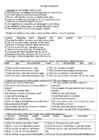
They usually go to bed at about midnight. 2 Macmillan Publishers Limited 2001. This sheet may be photocopied for use in class. 8 ____________________________________________________________________________________________ Yes, we own a BMW. 9 ____________________________________________________________________________________________ I don't know what the word means. Look it up in a dictionary. 10 ____________________________________________________________________________________________ No, I don't like the Spice Girls. Marks: /10 Words, words, words 4 Complete these sentences using the correct form of the words below. There is one extra word which you do not need to use.
May I see your passport? H: - Yes. Please. So...Should I write my full name, my passport number and the sum of money that has been sent to me, right? J: - Certainly. How would you like the money? H: - I prefer one hundred rouble notes, if you don't mind. J: - Here is your money. H: - Thank you Getting a post-restante. H: - Hi, Julia! What are you doing here? J: - I'm getting post restante letter from Boris... H: -Ah, yeah, remember him. What is he saying? J: - Oh, well...He is asking to come to him, and, besides, here is the money-order... H: - Oh! Would you like to cash money-order? Have you got your passport with you? J: - Yeah, certainly. H: - Then, they'll cash your money order without fail. J: - Ok, I'll go to that counter and speak to clerk. Wait for me, please! Can you go and by tickets with me after this? H: - Certainly! Discuss the functions of post office H: - There are a lot of functions of post office. Of course, we have friends in different parts of
# # A D/A A D/A A Bm C#m E # # A D # So ya thought ya might like to go to the show # # A # To feel the warm thrill of confusion # # D # That space cadet glow # # A # Tell me is something eluding you sunshine? # # Bm E7 # Is this not what you expected to see? # # C#m # If you wanna find out what's behind these cold eyes? # # E # You'll just have to claw your way through this disguise # # A D A D A D A E A # # The Thin Ice # --- ---- --- # # # C Am # Mamma loves her baby # # F G # and daddy loves you too # # C Am # and the sea may look warm to you babe # # F G # and the sky may look blue # # C G F C/G Am # Ooooooooooooh babe # # C G F C/G Am Am7 Am6 # Oooooooh baby blue # # C G F C Am D7 G # Ooooooooooh ooooooh babe #
Lamb to the Slaughter by Roald Dahl (1916-1990) The room was warm and clean, the curtains drawn, the two table lamps alight - hers and the one by the empty chair opposite. On the sideboard behind her, two tall glasses, soda water, whiskey. Fresh ice cubes in the Thermos bucket. Mary Maloney was waiting for her husband to come him (correction: home) from work. Now and again she would glance up at the clock, but without anxiety, merely to please herself with the thought that each minute gone by made it nearer the time when he would come. There was a slow smiling air about her, and about everything she did. The drop of a head as she bent over her sewing was curiously tranquil. Her skin - for this was her sixth month with child - had acquired a
· action set by a timetable or usually schedule Present A: He is speaking. · action taking place in the at the moment, Continuous N: He is not speaking. moment of speaking just now, Q: Is he speaking? Listen!, Look!, · action taking place only for a now, right now limited period of time · action arranged for the future Past Simple A: He spoke. · Finished action in the past yesterday, 2 N: He did not speak. minutes ago, in Q: Did he speak
Töövihik on kooskõlas 2009. a uuendatud õppekomplektiga I Love English 6. Tartu, 2014 ISBN 978-9949-436-59-0 Kirjastus Studium Riia 15b, Tartu 51010 www.studium.ee Trükitud OÜ Greif trükikojas Lohkva, Luunja vald Tartumaa 62207 --- 3 xxx 1. The Big Apple 1. Write the verbs in the present continuous or the past continuous tense. Do you remember? am is are was were verb -ing 1 Sorry. I ... (write) a report at the moment. I can't come with you. 2 When Peter arrived, his friends ... (play) football. 3 I ... (sleep) when the alarm went off in my sister's room. 4 Dad's mobile phone is switched off because he ... (fly) to Paris. He's on the plane at the moment. 5 I ... (read) an interesting book. It's a collection of memories. 6 Leo was late again. He ... (step) out of his father's car when the bell rang. 7 Helen ... (lie) on the sofa when an ambulance stopped in front of the house. 8 I ..
Problems 1 Underline the most suitable word or phrase. a) Many people were injured when the building demolished/collapsed. b) The ship radioed to say that it was in difficulties/dangers. c) The government has announced plans to help the poor/poverty. d) There was a large demonstration/manifestation against nuclear power in Manchester yesterday. e) Everyone agrees that the environment/nature must be protected. f) There has been another increase/rising in the level of crime. g) There are few jobs here and many people are away from work/unemployed. h) The train was in a/an accident/collision with a bus on a level crossing. i) The driver of the bus admitted that he had done/made an error. j) No ships are sailing today because of the high/storm winds. 2 Complete each sentence with a word from the box. Use each word once only.
see through- to understand see through- to provide support or cooperation to (a person) throughout a period of time see through- to work on (a project) until completion Do away with- to kill or murder somebody do away- get rid of something do over- repeat do with- to put st somewhere do with- to make use of something do without- manage without something one wants or needs do about- if you do st about a problem you do something to fix it or solve it do up- make st look new again by repairing it do up- to secure zip, button.. wear off- disappear after a period of time wear down- gradually make someone lose their vitality and strength wear out- use st until they are not usable any more wear out- cause to be very tired wear in- you wear st for a short period until they feel comfortable stand aside- to leave a job or position so that someone else can do it stand aside- to step sideways to make a space for someone else
come forward to present oneself come in for to be subject to come into to inherit Do away with to dispose with do down to critisise do out to decorate do out of to deprive of do over to ransack do without to manage despite not having Done for doomed Drive at to allude to drive away to discourage drive off to repel Fall apart to break into pieces fall back on to resort to fall in with to agree with fall into to engage (in conversation) fall through to fail (of agreement etc) fall to to become so's duty Get about/around to circulate get along to leave get around to to eventually do sth get away to take a holiday Hold back to detain, retard hold down to retain hold out (for) to insist on sth hold up to delay hold with to subscribe to Keep down to limit, control keep on to continue to employ keep on at to nag keep to to follow keep up sustain Look back to think about the past
3 have/'ve caught 7 As she got older, her health and judging by the students' 4 lived deteriorated. expressions, I'd say that they are 5 haven't finished enjoying their lesson. They look 3 She was unlucky because she was 6 have/'ve known interested and it looks as though shipwrecked three times. 7 walked they are working hard. Most of She was lucky because she survived
Chapter1: An unknown woman was found lying in the street and brought into the workhouse. She delivered a sickly child who had trouble breathing. The woman, without a word of who she was, died and left her new born boy, Oliver, to the drunken nurse that stood by. Chapter2: The State gave Oliver to Mrs. Mann who housed a number of orphaned children. Mrs. Mann took a large portion of the money given to her by the authorities for each child's food so Oliver grew up small and malnourished. On his ninth birthday, the town beadle, Mr. Bumble, came to collect Oliver and take him to the board for an interview. They told him he was to live with other wards of the state to become educated and learn a trade. Oliver did not mind this, but soon after he arrived, the state
CHARACTERS MADAME PERNELLE, mother of Orgon ORGON, husband of Elmire ELMIRE, wife of Orgon DAMIS, son of Orgon MARIANE, daughter of Orgon, in love with Valere CLEANTE, brother-in-law of Orgon TARTUFFE, a hypocrite DORINE, Mariane's maid M. LOYAL, a bailiff A Police Officer FLIPOTTE, Madame Pernelle's servant The Scene is at Paris ACT I SCENE I MADAME PERNELLE and FLIPOTTE, her servant; ELMIRE, MARIANE, CLEANTE, DAMIS, DORINE MADAME PERNELLE Come, come, Flipotte, and let me get away. ELMIRE You hurry so, I hardly can attend you. MADAME PERNELLE Then don't, my daughter-in law. Stay where you are. I can dispense with your polite attentions. ELMIRE We're only paying what is due you, mother. Why must you go away in such a hurry? MADAME PERNELLE Because I can't endure your carryings-on, And no one takes the slightest pains to please me. I leave your house, I tell you, quite disgusted; You do the opposite of my instructions;
It's very annoying/worrying. e) You're not scared/thrilled of spiders, are you? f) If we forget to do our homework, our teacher gets cross/terrifying. g) Tim completely lost his temper! He was absolutely furious/upset. h) Your written work is full of careless/naughty mistakes. 2. Replace the word(s) in italics with a suitable word from the box. Use each word once. confused fascinating scared depressed dull glad naughty upset a) I'm afraid the children have been very badly-behaved today. b) I felt a bit frightened when I went into the dark room. c) Jean was very unhappy when her kitten was run over. d) This film we saw last night was rather boring. e) This is a really interesting book. You must read it. f) I'm so happy that Helen has got the job she wanted. g) Sometimes when I hear the news I feel very miserable. h) Sorry I gave you the wrong tickets. I got a bit mixed up. 3. Complete each sentence with a word or phrase from the box
After they had understood that this sentence is an anagram, Sophie remembered that her grandfather liked to create anagrams of famous paintings. When she was young, he took her to visit the Mona Lisa when the museum was closed. She didn't care much of that painting that time. She knew that grandfather had an access to the Mona Lisa, so she decided to go to the painting. She gave car keys to Mr. Langdon, but when he realized why Sophie's granddad told to Sophie to find him, he started to running back to Sophie. Silas looks around the church and finds the rose-line, where to keystone should lie under the obelisk. Sister is standing on balcony and is looking at Silas
d) Helen never does her homework. She is rather gentle/lazy'/reliable. e) I didn't talk to anyone at the party because I felt ambitious/lonely/shy. f) When Harry saw his girlfriend dancing with Paul he felt jealous/selfish/sentimental. g) I don't like people who are noisy and aggressive/courageous/sociable. h) Thanks for bringing us a present. It was very adorable/grateful/thoughtful of you. i) Teresa never gets angry with the children. She is very brave/patient/pleasant. j) Tom always pays for everyone when we go out. He's so cheerful/generous/honest. 2. Match the words in the box with the descriptions (a-l). Use each word once only. bad-tempered determined lazy reliable cheerful frank mean selfish considerate honest punctual sympathetic
he took his wife, 49, along. "What I had not expected was to see her getting stuck in with a blowtorch. She wound up liking it so much that she gave up her IT job to join me in my career change." The same happened with Annie and Paul Clayton, both 42. "We both worked in the police for nearly 20 years," says Annie. "But Paul had become disillusioned and had a friend who was a tree surgeon. He started helping him out and he loved it, so he gave up the police. I'd turn up with sandwiches and realised I loved it too, so now we run a business together." Some of the most successful career changes come out of pursuing a hobby, as Bob Jennings, 53, knows all too well. Having been offered redundancy from a laboratory supplies company where he'd worked for 32 years, he built a 15ft stitch and glue boat. "I decided to do a 10-month course to learn more about boat building and while there, I decided this could be a fantastic career option
.. 3. Dear Sirs, I am writing to complain about the poor quality of the items which I received from your company. I have no other alternative but to cancel the order which 1 placed earlier this week ... 4. ... thus, I recommend that you accept this advice on the matter. I am pure that the suggestion offered is the best solution. Please let me know if this was helpful. Yours sincerely, Lee Jones 5. ... I would appreciate a reply at your earliest convenience. I look forward to meeting you to discuss employment opportunities. Yours faithfully, Nicole Porter Paragraph Plan for Letters · salutation · Paragraph 1 reasons for writing · Paragraphs 2, 3 development · Final paragraph closing remarks · Name · Letters are divided into two categories, formal and informal. There are various types of formal and informal letters .
My presentation/talk/lecture will take/last about (...) minutes. I shall only take (...) minutes of your time. I plan to be brief. This should only last (...) minutes. Outline/Main parts (Signposting) I've divided my presentation into four parts/sections. They are ... This talk is divided into four main parts: firstly, ... etc. The subject can be looked at under the following headings:... We can break this area down into the following fields: Firstly/First of all/To start with, I'd like to look at ... Let me begin with/start by ... I'd like to start by saying something about ... I'd like to begin by ... Secondly/Then/Next, I'll be talking about ... Thirdly,/And then we come to ... My fourth point will be about ... Finally/lastly/last of all, I'll be looking at ... Firstly, ... secondly, ... thirdly, ... lastly, ... First of all ... then ... next ... after that ... finally ... To start with ... later ... to finish up ... Inviting questions
midagi uut, meile kahele. · Women are stronger than men, because they can walk in a 12 cm stilettos without showing the pain. · Men would kill to protect women they love. Men were born because of women. Women.. We're special · It doesn't matter where, when, or how did we met. What matters is the fact that we did. · Loving someone so much doesn't always mean they're right one for us. · Wishes are for lazy people who can't get up and make their dreams come true on their own. Make it happen! · It's easy to say something, but it's harder to mean it. · Distance isn't a big factor in a relationship. Communication is. But most of all, commitment is the biggest. · A broken heart can hurt but it's the memories that kill you. · Every girl deserves to be treated with respect and not to be lied to or cheated on. · Remember, you need to open your eyes before opening your mouth!
adjectives, adverbs, prepositions, conjunctions, and interjections--as well as the standard patterns of English sentences. All students of English, be they native speakers or those who are studying English as a second language, will profit from the fundamental introduction and review of grammar provided by SADDLEBACK'S BASIC ENGLISH GRAMMAR 1 and 2. Helpful marginal notes throughout the books have been provided to reinforce existing skills and call attention to common problem areas. We wish you every success in your pursuit of English proficiency. 1 What is Grammar? 5 The Simple Past Tense 98 Regular and Irregular Verbs 99 Was and Were 104 2 The Capital Letter 6 The Past Progressive Tense 106
IMPROVING SEX The 15-Minute Female Orgasm--Part Un The 15-Minute Female Orgasm--Part Deux Sex Machine I: Adventures in Tripling Testosterone Sex Machine I: Adventures in Tripling Testosterone Happy Endings and Doubling Sperm Count PERFECTING SLEEP Engineering the Perfect Night's Sleep Becoming Uberman: Sleeping Less with Polyphasic Sleep REVERSING INJURIES Reversing "Permanent" Injuries How to Pay for a Beach Vacation with One Hospital Visit Pre-Hab: Injury-Proofing the Body RUNNING FASTER AND FARTHER Hacking the NFL Combine I: Preliminaries--Jumping Higher Hacking the NFL Combine II: Running Faster Ultraendurance I: Going from 5K to 50K in 12 Weeks--Phase I Ultraendurance II: Going from 5K to 50K in 12 Weeks--Phase II GETTING STRONGER Effortless Superhuman: Breaking World Records with Barry Ross Eating the Elephant: How to Add 100 Pounds to Your Bench Press FROM SWIMMING TO SWINGING
She has a boyfriend and goes to university. Emma is very pleased with the changes in her life. Ex. 5 1. They were always very close- They had a strong relantionships. 2. I kept missing school- I was sad because i wasn't at school. 3. Emma decided to stay on at school- Emma decided to go into a higher class and take exams. 4. (Emma) worked hard for her exams- She did a lot of work Ex. 7 bring up , tell of 1. My grandmother had a difficult life. She grow up nine children! 2. I hate being the oldest because i always have to look after my younger sister. 3. They tell her off when they found her smoking. 4. My brother's really naughty. Sometimes I find it difficult to put up with him. 5. When my little brother bring up , he wants to be a doctor. 6. Everybody says I take after my uncle. We both have the same nose. Ex. 8 Get Make
, Hoboken, New Jersey. Published simultaneously in Canada. No part of this publication may be reproduced, stored in a retrieval system, or transmitted in any form or by any means, electronic, mechanical, photocopying, recording, scanning, or otherwise, except as permitted under Section 107 or 108 of the 1976 United States Copyright Act, without either the prior written permission of the Publisher, or authorization through payment of the appropriate per-copy fee to the Copyright Clearance Center, Inc., 222 Rosewood Drive, Danvers, MA 01923, (978) 750-8400, fax (978) 750-4470, or on the web at www.copyright.com. Requests to the Publisher for permission should be addressed to the Permissions Department, John Wiley & Sons, Inc., 111 River Street, Hoboken, NJ 07030, (201) 748-6011, fax (201) 748-6008, e-mail: [email protected].
I´m Estonian. 5 The descendants of the Africans brought to America are called settlers. 6 Uwe´s grandparents live in Germany. They speak German. 7 Michael comes from Australia. He speaks Australian English. 8 Eve lives in Ireland. She speaks English and Irish. 3 Write the sentences in reported speech. 1 Martin said, "We´re going on a class trip tomorrow." Martin said they were going on a class trip the next day. 2 Mary said to us, "I bought a book on big cats yesterday." Mary told us she had bought a book on big cats the day before. 3 Ben said to Brian, "You can wait for me here." Ben told Brian he could wait for him there. 4 Dad said, "I´ll finish work early today." Dad said he would finish work early that day. 5 My sister said to me, "This dress looks good on you." My sister told me that dress looked good on me. 6 Simon said, "I was in Springfield last week." Simon said he had been in Springfield the week before. 4 Complete the sentences
Gordie grabs a crowbar and kills it, but then he becomes convinced that it is June he has just killed. taut (223) - Strained; tense. Sister Mary felt excited rising alone, her legs felt springy and lean, her body taut like a girl's. an orderly (229) An attendant who does routine, nonmedical work in a hospital. Mary Martin follows Gordie into the apple trees but losts him. The whole morning they were waiting for the orderlies and the tribal police to come, they heard him cry like a drowned person. to be/stay at somebody's beck and call (230) - Ready to comply with any wish or command. Lipsha is grateful for his Grandma... a smokescreen (232) - An action or statement used to conceal actual plans or intentions.; A disguise. to hanker after/for something (239) - To want someone or something; to long for someone or something. The problem wasn't that Nector was not all there, but that what was there of him often hankered after Lamartine.
(Ta ostis tahvli okolaadi.) OFF: Dick fell off the ladder. (Dick kukkus redeli pealt maha.) ON: Put it on the table. (Pane see lauale.) OUT OF: She took her purse out of her pocket. (Ta vttis taskust rahakoti.) OVER: He climbed over the fence. (Ta ronis le aia.) PAST: He went past the house. (Ta lks majast mda.) ROUND: The earth turns round the sun. (Maa tiirleb mber pikese.) SINCE: I haven't seen her since Monday. (Ma pole teda esmaspevast saadik ninud.) THROUGH: The river flows through the town. (Jgi voolab lbi linna.) TILL (UNTIL): We'll wait for you till 2 o'clock. (Me ootame sind kella kaheni.) TO: Have you been to Spain? (Oled sa Hispaanias kinud?) TOWARDS: The plane flew towards the north. (Lennuk lendas phja poole.) UNDER: She sat under the tree. (Ta istus puu all.) UP: He ran up the stairs. (Ta jooksis trepist les.) WITH: Come with me. (Tule minuga.) WITHOUT: Don't go out without your coat. (ra mantlita vlja mine.) SNAD, MIS NUAVAD ENDA JREL KINDLAT EESSNA (NB
Break up If someone who is talking on a mobile phone is breaking up, their voice can not fully be heard. STOP CLASSES When schools and colleges, or the teachers and students who go to them break up, their classes stop and the holidays start: We broke up for the holidays in June. END A RELATIONSHIP If a marriage breaks up or two people in a romantic relationship break up, their marriage or their relationship ends: Jenny and George have broken up. She's just broken up with her boyfriend. Break open open with force: He broke open the picnic basket. OPEN, OPEN UP cause to open or to become open; come open suddenly and violently, as if from internal pressure: BURST, SPLIT, POP burst open with a sharp, explosive sound: Break into sth to suddenly begin to do something: He felt so happy that he broke into song (= suddenly began to sing).
.......................................................95 National and Racial Pain-bodies................................................................97 Chapter Six Breaking Free - 99 Presence.....................................................................................................100 The Return of the Pain-Body.....................................................................102 The Pain-body in Children.........................................................................103 Unhappiness...............................................................................................105 Breaking Identification with the Pain-body...............................................106 “Triggers”...................................................................................................108 The Pain-Body as an Awakener..................................................................110
In London you'll also find Indonesian, Mexican, Greek... Cynics will say that this is because English have no "cuisine" themselves, but this is not quite the true. Vocabulary: to criticize - tasteless overcooked - ingredient - to invent - sauces - to disguise - spice herb - delicious - disappointing - to lend cuisine British Youth (2) Most 18 and 19 year-olds in Britain are quite independent people. English people say that children grow up more quickly now. Relationships within the British family are different now. Children have more freedom to make their own decisions. For example, children aged 13 may be employed part time in Great Britain. Age 15 is legally a "young person" not a "child". Age 16 is a school leaving age. They can leave home, drive a moped, marry with "parents' consent" buy beer. Age 17 can drive a car. Age 18 can vote, get married, drink in pubs.
 annaabi.ee