Leidsid 33 sarnast õppematerjali, mis on seotud failiga "The Internet is making literature irrelevant". Need materjalid aitavad sul teemat sügavamalt mõista.
internet, reading, books, them, literature, spend, best, ways, person, know, there, while, could, things, ending, making, irrelevant, stanislav, masb11, computers, spread, today, appeared, lives, friends, important, entertainmentwadays, answerbody, reads, tired, gain, surfing, pair, glasses, front, really, quite, chair, instead, borrow, everybodydifferent now. Children have more freedom to make their own decisions. For example, children aged 13 may be employed part time in Great Britain. Age 15 is legally a "young person" not a "child". Age 16 is a school leaving age. They can leave home, drive a moped, marry with "parents' consent" buy beer. Age 17 can drive a car. Age 18 can vote, get married, drink in pubs. Education is a very important part in the life of British youth. One can't become an independent person without it. When time comes to enter a college a young Englishman chooses one far away from home. It is a necessary part of becoming adult. During the last 30 years there were a lot of different trends in youth movements. All of them were characterized by their own philosophy, way of life, style of dressing. Each tendency was born by the influence of economic and political changes in the society. Those trends are known as the "hippies" the "punks" the "rockers".
Libraries. We know a lot of things thanks to books, but we do not know exactly when and where they originated, and what should be considered the first book in the world. Ancient document, written on parchment, papyri and vellum can hardly be qualified as books the way we understand the word today. Centuries went before paper replaced parchment and papyri. In the 15 th century Johann Gutenberg invented a mechanical process of duplicating texts, which we today call book printing. The first book was printed between 1444 and 1446, so these years can be considered as the beginning years of book printing. His most important preserved printings are the 40 copies of the Bible. By the end of the 15 th
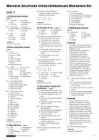
6 have/'ve known interested and it looks as though shipwrecked three times. 7 walked they are working hard. Most of She was lucky because she survived 8 have you phoned them are looking at the experiment each of the three disasters. 2 1 written 8 was trying and working together. They are 4 1 D 3 F 5 G all wearing uniform it's quite an 2 been meaning 9 came
, 222 Rosewood Drive, Danvers, MA 01923, (978) 750-8400, fax (978) 750-4470, or on the web at www.copyright.com. Requests to the Publisher for permission should be addressed to the Permissions Department, John Wiley & Sons, Inc., 111 River Street, Hoboken, NJ 07030, (201) 748-6011, fax (201) 748-6008, e-mail: [email protected]. Limit of Liability/Disclaimer of Warranty: While the publisher and author have used their best efforts in preparing this book, they make no representations or warranties with respect to the accuracy or completeness of the contents of this book and specifically disclaim any implied warranties of merchantability or fitness for a particular purpose. No warranty may be created or extended by sales representatives or written sales materials. The advice and strategies contained herein may not be suitable for your situation
· And when you begin to miss me, dont forget it was you who let me go. · There is an end to things no matter how much we want to hold into them. · Otsisin keset seda pimedust, sind ja loodetud vabadust,kui mu käed su poole, tegid alguse loole, printsessist ja printsist, ühest kaunist kandist, kus oleme meie kaks, kus lõbutseme, kuni otsas jaks. Sa ei pea muinasmaad looma, sa ei pea tähti taevast tooma. Ole vaid minu kõrval, kui tõuseb päike. Ole vaid mu kõrval kui mind piinab meeleheide. Ole mu kõrval, kui kumab kuu, kui su nime
Education Education is so multifaceted that it is difficult for me to know where to begin discussing it, or how to prioritize the many factors. Relaying my own experience is easy: I had a standard classroom approach, supplemented by inordinate reading. In only the briefest and least memorable instances did I receive any individual tutoring. Education is commonly thought of as the job of schools. Adults cry "educate our children!" Everyone has opinions about the best way to do the job. It is of urgent importance, and all the numerous factors are much studied, debated, and new (or old) ideas continually tested or retested. Some people say "it's as simple as . . . " and then name their pet peeve or passion. My view is not of an education specialist, but of one who loves sharing what I learn, and owes much to educators. Since I don't have an educational theory neatly worked-out, nor an outline
advertisements on TV, or in the newspapers, or on websites on how people can be more popular using a certain product. Most advertisements you see which are aimed at the youth generally talk about the 'cool quotient' of the product and how it is going to be the next 'in-thing'. And if you want to stay ahead of the game, it is absolutely vital that you procure it. The visual effect, seeing the things happen in front of you and the slice-of-life effect makes them look a lot believable than they should be. So how should mass media be used with youth? Mass media, effective as it is, can be used on the youth to drive home pressing concerns in the country. Child obesity, the dangers of alcohol and preteen sexual relations, importance of exercise and fitness etc. If these things can be done, the mass media will be able to influence the youth for the better and send better messages for the development of the youth than what it is sending today.
6 drop me off A. So there you are ... problem solved! 7 to lay off Rosie Yeah, these are good 8 turned up intentions, but not if we end up poisoning people in the long run. I 1F Discussion page 9 don't know, I just find the whole thing unnatural. I don't think we have a right 1 1 laboratory 5 crops to `play God' in this way. 2 controversy 6 harmful Leo I see what you mean. But to be 3 discredited 7 term honest with you, people have been 4 campaign 8 crisis crossing breeds for hundreds of years.
Copyright ©2007 by Saddleback Educational Publishing. All rights reserved. No part of this book may be reproduced in any form or by any means, electronic or mechanical, including photocopying, recording, or by any information storage and retrieval system, without the written permission of the publisher. ISBN 1-59905-201-6 Printed in the United States of America 13 12 11 10 09 08 07 9 8 7 6 5 4 3 2 1 Introduction Grammar is a very old field of study. Did you know that the sentence was first divided into subject and verb by Plato, the famed philosopher from ancient Greece? That was about 2,400 years ago! Ever since then, students all over the world have found it worthwhile to study the structure of words and sentences. Why? Because skill in speaking and writing is the hallmark of all educated people. Lesson by lesson, this book provides basic instruction in the eight parts of speech--nouns, pronouns, verbs,
likely not yet favorable for a widespread flowering to occur. One day, however, a critical threshold was reached, and suddenly there would have been an explosion of color and scent all over the planet – if a perceiving consciousness had been there to witness it. Much later, those delicate and fragrant beings we call flowers would come to play an essential part in the evolution of consciousness of another species. Humans would increasingly be drawn to and fascinated by them. As the consciousness of human beings developed, flowers were most likely the first thing they came to value that had no utilitarian purpose for them, that is to say, was not linked in some way to survival. They provided inspiration to countless artists, poets, and mystics. Jesus tells us to contemplate the flowers and learn from then how to live. The Buddha is said to have given a “silent sermon” once during which he held up a flower and gazed at it. After a
1 _____________________________________________________________________________________________ Yes, I have a painting by Picasso on my wall. 2 _____________________________________________________________________________________________ In my free time I watch TV and read. 3 ____________________________________________________________________________________________ I'm reading a book by Charles Dickens. 4 ____________________________________________________________________________________________ She works in a bank. 5 ____________________________________________________________________________________________ No, he isn't learning to play a musical instrument. 6 ____________________________________________________________________________________________ My birthday is on 8 August.
was to give official information to people. It was supported by the government. Now television plays a big role in every civilised society. Today television gives people a possibility to be well informed and enjoy "civilised pleasures." The programmes are various and people have a chance to select what they want to see. Television provides great opportunities for education. There are programmes devoted to specialised subjects. With the help of TV it is possible to learn foreign languages, to know a lot of wonderful things concerning the world flora and fauna. TV teaches the ideals of democracy and political argument. Watching television can be compared with reading books. It provides an outlet for creative talents. By the beginning of the 21-th century TV became a coloured world network. Numerous programmes people can receive by satellite or cable. The choice of the channels ranges from six to twenty.
There are all kinds of wars in Africa than the rest of world put together. The majority of so-called Africans leaders want to stay in power until the day their bodies are put in the grave. Through buffoonery, utter mismanagement and downright stealing of the wealth of the masses, these leaders have so impoverished Africa that we are now nothing but a beggar continent. We beg for everything; we are more dependent on our colonial masters than when we received our independence from them. Africa owes the West more money than we and our generations to come can pay. I arrived in America in December of 1967as an official of what we believed was going to be a dynamic African nation – the young Republic of Biafra. But Biafra was defeated and Nigeria remained one, as a giant of Africa. In the last 32 years, I have watched with horror and outright helplessness as the downward slide of the African race continues to escalate. But rather than address the problems, we
14. Good institutions help to overcome human moral inertia. 15. I am not one of your little friends. 16. If a dimension is anywhere it's everywhere. 17. If God's not crazy, why are you? 18. If one makes a promise one shouldn't have made it cannot stand against the obligation to do the right thing. 19. If you odn't give a certain amount of attention to filtering distractions, every distraction is a catastrophe. 20. If you don't know what your duty is, your duty is to find out. 21. If you're not an animal, then you must be a vegetable. 22. If you want to get along you have to get along with those who don't want to get along. 23. If you whine whenever anybody messes with your crutches you can't claim not to be crippled. 24. I hate an unfair fight, so I need to be ganged up on. 25. Inattention is not O.K. 26. Injustice in your vicinity is your business--particularly your own. 27
New Media Economy Social media information and data collection and security In this brief essay, i would like to focus on the social media platforms in our moren society. How people use them, what kind of information we give away, what companies will do with this. Information sharing and data protection has become very popular theme in the recent few years. People care more about their privacy and avoid „big brother“ foreshadowing. It is important to know what social media platforms promise and are they really going to keep it. Users should think about what they share and what kind of information they generate. Because it is all recorded and some info can be traced back to real people. Privacy and data protecion topics are becoming more and more important and the amouts of data generated is becoming larger. When wrongly access this kind of data, a lot damage could be done by criminals
Essay How the right of privacy was viewed in the 1890s and 2010s. Comparison between two articles by Warren & Brandeis and Julie Cohen The two articles have questioned - What is privacy ? The simplest answer would be that the privacy is a human right and like in the first article by Warren & Brandeis, they quote Judge Cooly who sayd that, the privacy is the right to be let alone. This means, that a person is free to go and do what ever the person wants, no one has a right to harm him/her physically or mentally and vice versa. What ever the person decides to do, nobody else has the right to know about it without persons premission. Julie Cohen starts her essay with a point that privacy has the image problem. In the world where there is no mobile platforms, data mining social meedia, in simple words the internet, its easyer to leave the
First of all, advertisements on TV are called commercials and to get air time on Tv is very expencive and not every company can offord it. Secondly, TV commercials mingt be the easyest way to advertise products because for example in the radio You can not see the product, you can only hear what people are talking about it. On the other hand, nowadays the popularity of TV commercials is getting smaller because of the Internet. More and more people use Internet more than they watch TV. In conclusion, Allthough advertising on TV is the easyest way to advertise, it might me a bit too expencive for some companies and they shouls consider advertising on the Internet. The role of social security Social security is a government program that provides economic security to people who are retired, unemployed or unable to work. First of all, social security gives a secure feeling for people that when something happens and they are not
We sometimes ignore it and try to hide behind words, but we should never forget that we cannot fool everyone! Children react to body language because they experience the world through intuition. The same can be true for adults when feelings are involved. People who are in bad shape emotionally will often place great importance in it. In fact, they often pick up the smallest hint of a lapse in attention in the person they are speaking to. And they frequently jump to the conclusion that they are boring or a nuisance - thus compounding any sense of depression or poor self-esteem. A way to learn the secrets of body language is to watch television with the sound turned off and try to interpret what is being said simply from reading body language. You will experience that humans say a lot with their mouth which is contradicted by their body, gestures and other channels of communication. Messages are ambiguous.
ads and the subliminal presentation o Twice as many Reader's Reports- first-person accounts in which readers of odors. of previous editions describe how e Increased coverage of how compliance they've seen a principle work on principles work in other cultures. or for them. Reader's Reports have New insights are derived from the become the most popular feature of research findings, sayings, and customs the book. Boston. New York • San Francisco Mexico City • Montreal • Toronto • London • Madrid • Munich • Paris Hong Kong • Singapore • Tokyo • Cape Town • Sydney Acquisitions Editor: Michelle Limoges Editorial Assistant: Christina Manfroni Executive Marketing Manager: Wendy Gordon
neighbourhood, this truth is so well fixed in the minds of the surrounding families, that he is considered the rightful property of some one or other of their daughters. "My dear Mr. Bennet," said his lady to him one day, "have you heard that Netherfield Park is let at last?" Mr. Bennet replied that he had not. "But it is," returned she; "for Mrs. Long has just been here, and she told me all about it." Mr. Bennet made no answer. "Do you not want to know who has taken it?" cried his wife impatiently. "You want to tell me, and I have no objection to hearing it." This was invitation enough. "Why, my dear, you must know, Mrs. Long says that Netherfield is taken by a young man of large fortune from the north of England; that he came down on Monday in a chaise and four to see the place, and was so much delighted with it, that he agreed with Mr. Morris immediately; that he is to take possession before Michaelmas, and some of his servants are
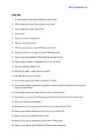
23. Have you ever been to a zoo? Which zoo? What animals were there? http://www.abiks.pri.ee 24. Have you ever been to a funfair? Where? 25. Have you ever been to a circus? When? Where? 26. Have you ever seen a circus show on TV? 27. What did you see in the show? (an animal act? clowns? acrobats? jugglers?) 28. Are you good at juggling? What makes you think so? 29. Do you like aerobics? Are you good at it? Do you know anybody who is? 30. Would you like to perform in a circus? 31. Do you know anybody who might become a good clown? What must a clown be good at? 32. Have you ever played sport regularly? What training classes do you go to and how often? What sport would you like to play and why? 33. Have you ever taken part in sport competitions? When, where and what were the results? 34. Are sports days held at your school? 35. What sports events do you watch on TV? 36
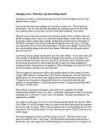
Changing career: 'These days, I go home feeling relaxed' Starting a new career is a daunting prospect for many. But Kate Hilpern discovers that plenty of help is at hand Some of the jobs that career changers are most keen to break into PR and teaching, among them are the very same jobs that people are queuing to get out of, says John Lees, author of How to Get a Job You'll Love and Take Control of Your Career. Many of us get to the point, whether in our twenties, thirties, forties or fifties where we decide to change careers. Some of us will make radical changes, while others will move to the edge of their comfort zone, perhaps shifting from acupuncturist to homeopath or PR office to journalist
And free with your advice on all occasions. DAMIS But . . . MADAME PERNELLE You're a fool, my boy--f, o, o, l Just spells your name. Let grandma tell you that I've said a hundred times to my poor son, Your father, that you'd never come to good Or give him anything but plague and torment. MARIANE I think . . . MADAME PERNELLE O dearie me, his little sister! You're all demureness, butter wouldn't melt In your mouth, one would think to look at you. Still waters, though, they say . . . you know the proverb; And I don't like your doings on the sly. ELMIRE But, mother . . . MADAME PERNELLE Daughter, by your leave, your conduct In everything is altogether wrong; You ought to set a good example for 'em; Their dear departed mother did much better. You are extravagant; and it offends me, To see you always decked out like a princess. A woman who would please her husband's eyes Alone, wants no such wealth of fineries. CLEANTE But, madam, after all . . . MADAME PERNELLE Sir, as for you,
E-Myth Worldwide and the world's #1 small business guru "Timothy has packed more lives into his 29 years than Steve Jobs has in his 51." --Tom Foremski, journalist and publisher of SiliconValleyWatcher.com "If you want to live life on your own terms, this is your blueprint." --Mike Maples, cofounder of Motive Communications (IPO to $260M market cap) and founding executive of Tivoli (sold to IBM for $750M) "Thanks to Tim Ferriss, I have more time in my life to travel, spend time with family, and write book blurbs. This is a dazzling and highly useful work." --A. J. Jacobs, editor-at-large of Esquire magazine and author of The Know-It-All "Tim is Indiana Jones for the digital age. I've already used his advice to go spear shing on remote islands and ski the best hidden slopes of Argentina. Simply put, do what he says and you can live like a millionaire." --Albert Pope, derivatives specialist at UBS World Headquarters
Jakko Viilo, 11.c Books are not absolutely dead things Books have been our mates many centuries. They give you a lot of knowledge, they make you feel happy, but sometimes also sad too. If you have read any book through, one is certain your life is not the same anymore as it was. So, a question comes to my mind if books are material things, they can not speak, they can not do anything to you, they just lay on the table, then how they can influence your life sometimes so much? They are all written by humans. But the interesting thing actually is, that in his lifetime, human being is the smartest on this planet and can make big things, but this is all transient. Humans die. But if human creates something, for example, a book, then it may live centuries. Books are like the continuation of the book writers life
religion. American Enlightenment a gradual but powerful awakening that established the ideals of democracy, liberty, and religious tolerance in the people of America. If there were just one development that directly caused the American Revolution and uplifted the intellectual culture of the continent while it was only a British colony, it would be the American Enlightenment. Broadly, the Enlightenment was an intellectual movement that changed the fundamental perspective of the masses, urging them to foster skepticism and apply scientific principles in matters of religion and morality. Its chief values were: Liberty, Democracy, Republicanism, Religious Tolerance. The movement gained momentum with the publication of landmark texts like Thomas Paine's The Age of Reason, and the Jefferson Bible, but the most influential thinker was undoubtedly John Locke, whose ideas spread to the colonies and across Europe
Continuous speaking. certain time in the future couple of hours, N: He will not have all day long been speaking. · putting emphasis on the Q: Will he have been course of an action speaking? Note: we use continuous tenses only for actions and happenings (e.g. they are singing/ it is snowing). Some verbs are not action verbs (e.g. know, like). You cannot use continuous tenses with the following verbs: like love hate want need prefer know realise suppose mean understand believe remember belong contain consist depend seem 4 The following verbs are usually only used in Simple Present (not in the continuous form). state: be, cost, fit, mean, suit Example: We are on holiday. possession: belong, have Example: Sam has a cat.
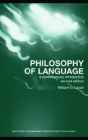
includes a detailed discussion of the problem of indirect force and surveys approaches to metaphor. Part IV, new to this edition, examines the four theories of metaphor. Features of Philosophy of Language include: · new chapters on Frege and puzzles, inferentialism, illocutionary theories of meaning, and relevance theory · chapter overviews and summaries · clear supportive examples · study questions · annotated further reading · glossary Praise for the First Edition: "This exceptional text fulfils two essential criteria of a good introduc- tory textbook in the philosophy of language: it covers a broad range of topics well, all of which are the basis of current active research, and does so in an accurate manner accessible to undergraduate students." Mike Harnish, University of Arizona ". . . an excellent textbook for teaching
They have the power to change the world up-side down. The English textbook given to us this year is something we must carefully treasure after all, there are going to be more people next year either to praise or suffer from it. But not the emotions count at the moment, the future does we must all learn from this wonderful book that wit is not easily gained, however once it's collected, it'll be never lost again. The first chapter includes three specially chosen units. Unit one includes reading about the UK, learning how to form questions, listening, some vocabulary exercises, monologue and, of course, an `extra word exercise' about Ireland. The sweetest part will be probably the last one since I used to like the game odd-man-out in middle school. We often played it, as well as Bingo and Puzzle, but finding a word lost in a bizarre of difficultly read context was still my favourite! I have high expectations for it. Unit two is somewhat odd-man-out
The Noble Savage in 20th Century Fiction Pop culture has a important part in shaping the mind of today's people. A large part of pop culture consists of stories which have the ability to change a person his take on life, taste in music and books, how to treat other people etc. It may seem simple and pointless but all the devoted fans, all the trekkies, warsies, twihards, potterheads and ringers (there are many more, with crazier names) prove us that stories can become more than entertainment. Of course, a story can change people without making them go to all sorts of conventions. Even the small ideas make a change. The main part in a story, the one that seemingly makes the impact, who guides the consumer
· Hereditary · Naturalists tried to apply in fiction the processes of natural sciences · Writers task is to record facts, systems of behaviour, living conditions, never revealing any natural unbiased (completely natural) · Point of view: amoral-outside the category of morality, neither good or bad · Naturalist find it absurd to blame the wicked. These criminals are doing what nature, environment, their unconscious tells them to do. Naturalists do not judge their characters, they simply report. Try to describe facts like they are. Naturalists depict the lower, coarser forms of life. · Drab, squallid set of scene. Revolting, disgusting · Characters are people with strong animal desires · Neurotic characters unable to understand the forces that control them · By the end of the 18th century the naturalism depicts in europe, but stars to become
That's a striking departure from the past. Up till a couple decades ago, geography was destiny for cities. All great cities were located on waterways, because cities made money by trade, and water was the only economical way to ship. Now you could make a great city anywhere, if you could get the right people to move there. So the question of how to make a silicon valley becomes: who are the right people, and how do you get them to move? Two Types I think you only need two kinds of people to create a technology hub: rich people and nerds. They're the limiting reagents in the reaction that produces startups, because they're the only ones present when startups get started. Everyone else will move. Observation bears this out: within the US, towns have become startup hubs if and only if they have both rich people and nerds. Few startups happen in Miami, for example,
century festival in China and the Apollo 11 moon landing in 1969. However, there is a link and that is that they both relied on the use of rockets. The Chinese first developed rockets by filling bamboo tubes with an explosive made from saltpetre, charcoal, and sulphur. The sealed tubes would be thrown onto fires during celebrations because it was thought that the loud explosions would protect them. It was not long before the ancient Chinese realised the military potential of these devices and primitive rockets were used to repel a Mongol invasion in 1232 AD. Word of these new amazing weapons quickly spread around the world and soon rockets were being used in military operations in North Africa and Europe. During the 15 th and 16th centuries they were widely used in naval battles to set fire on enemy ships. Around this time they also started being used for more peaceful purposes again
 annaabi.ee