The Germanic Invasions Anglo-Saxon invasion During the 5th c. a number of Germanic tribes invaded The Angles, the Saxons, the Jutes Different peoples, but common language and customs Advance halted by King Arthur Distortions of popular history In folklore, myth (and films) a great English hero, an example of medieval nobility and chivalry In fact a Romanized Celt, lived before medieval times, fought the Anglo-Saxons (people who became "the English") Predominated by the end of the 6th c. Kingdoms established: Wessex, Essex, Sussex, Mercia, Northumbria, East Anglia etc. Kingdoms constantly at war with each other Celtic culture and language survived in Scotland, Wales and Cornwall Anglo-Saxon lifestyle A great impact on the countryside Introduced new farming methods Established numerous villa...
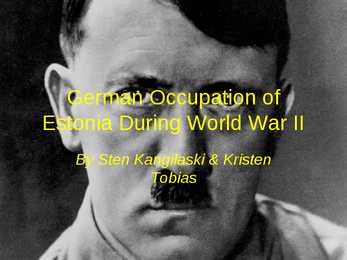
German Occupation of Estonia During World War II By Sten Kangilaski & Kristen Tobias The Beginning · WWII began with the invasion of Poland · Poland was an important regional ally to Estonia · On september 24th, 1939, the Moscow press and radio started attacking Estonia as "hostile" to the Soviet Union. Summer War · After Germany invaded the Soviet Union on June 22, 1941, Finland sided with Germany in the Continuation War. · Thousands of people including a large portion of women and children were killed. · Dozens of villages, schools and public buildings were burned to the ground. German Occupation · Most Estonians greeted the Germans with relatively open arms. · In April 1941, Alfred Rosenberg laid out his plans for the East. · Rosenberg felt that Estonians were the most Germanic out of the people living by the Baltic Sea. The Holocaust · The first...
Revision questions for the test on Old English and Medieval Literature. 1.) How is literature analysed and studied? What is the difference between the diachronic and synchronic view? Literature is studied and analysed by reading the piece of work profoundly and work on all the aspects of the piece. Diachronic is development in history Synchronic is particular state at any given moment 2.) Give a general overview of Celtic Britain, Roman invasion in 55-54 BC, Anglo-Saxon invasion and the second Roman "invasion" of Great Britain, who were the leaders, what influence did they leave on the culture of Great Britain? Celtic Britain was during the Bronze Age, there were many small tribal kingdoms fighting one another. Many megalithic monuments were built around that time, e.g. Stonehenge, the Avebury ring. The Roman Invasion 55-54 BC, Julius Caesar ruled Rome, Rome built the Hadrian's wall (73 miles long, built in 121 127 AD) agains...
The foundation stones The Island Britain has a mild climate due to the Gulf Stream which brings warm waters from the Gulf of Mexico. The northern part of the island in average 5'C cooler and it's mountainous or hilly and that's why the south has been more populated.. Britain became an island only 5000 years BC after the Ice Age ended. Britain's prehistory The first evidence of human life on the island are dated back to 250 000 BC. 50 000 BC in a milder Ice Age period Britain became habitable again. People from that time were the ancestors of the modern British. 10 000 BC ige age ended and Britain became inhabited by small groups of hunters who probably followed herds of deer. 5000BC Britain became an island and deer died out. 3000BC the Neolithic people came (probably from Spanish peninsula or even North African ...
Suppletion Present in languages of different families. Present in Old, Middle and Modern English, though the general tendency is towards more regularity/iconicity so the number of suppletive forms has decreased.In the text: goon to go wenden - to turn Gan was suppletive in Old English, past form: eode.Eode was supplanted by went (past form of wenden) at the end of the Middle English period.To wend has survived in Modern English in phrases such as to wend one's way, we wended homewards (ironic usage). Thus: suppletivity- suppletion different parts of one and the same paradigm come from what were originally different paradigms (different words with close meanings or words in different but close dialects).Suppletion embraces verbs, adjectives, nouns. Be was/were been (Old English beon/wesan) (am, art, is, are); in Old English some suppletive forms were used parallel to one another) Good better best Bad worse worst Much more...
The Saxons & Vikings Fragmentary knowledge of England in the 5th & 6th centuries comes from the British writer Gildas, the Anglo-Saxon Chronicle, saints' lives, poetry, archaelogical findings and place- name studies. British landlords ruled small, unstable kingdoms and continued some Roman traditions of governance. In the mid-5th cent, Vertigern, a British leader, hired Germanic mercenaries to help defend against peoples of the north (Picts & Scots). In the end they revolted & the process of invasion and settlement began. The first Saxon ,,kings" were Hengist & Horsa in Kent, Aelle in Sussex, Cerdic / Cynric in Wessex. So the first ,,English" became mainly from Northern Germany & Denmark. The resistance of the Celts was long. They were free at the time, not like other Roman provinces on the Continent. Around 500, the Britons seem to have won several victories. One of their leaders was Ambrosius Aurelianus and one of...
History of Great Britain Prehistory (55BC) no written records 6th 3rd c. BC the Celts came to British isles hill figures, hill forts, stone circles ( Stonehenge ) RomanBritain (55BC 400AD) Julius Caesar, named the country Albion Hadrian's Wall, villas, roads, the town of Bath The AngloSaxon, Danish and Norman invasions Germanic tribes settled and stayed Anglia Christianity was brought, religion became important, churches were built 8th century = raids by the Vikings and the Danes 1016 1042 : Under Danish rule ( York was the capital ) 1042 : local AngloSaxons regain their rule 1066 : Normans arrive ( the Norman conquest ) Medieval Britain (106615th c.) the Battle of Hastings William the Conqueror a new AngloNorman state the feudal system introduced the rule of the king and church strengthened centralised country, military rule Scotland, Wales and Ire...
1. Ancient Britain: the Celtic tribes. 2000 years ago there was an Iron Age Celtic culture throughout the Br Isles. It seems that the Celts, who had been arriving from Europe from the 8th cent BC onward, intermingled with the peoples who were already there. The Celts were extremely talented people, creative and artistic. More than 1 Celtic tribe invaded Br. The descendants of ancient Celts live in Wales, Scotland, Cornwall and Ireland. They lived in primitive society. Druids priests, more powerful than chiefs. Acted like prophets. 2. Stonehenge From prehistoric period. Was built on Salisbury plain between 2500 and 1500 bc. One of the most famous and mysterious archaeological sites in the world. One of the mysteries is how it was built at all with the technology of the time. Another is its purpose. It appears to function as a kind on astronomical clock and we know it was used by the Druids for ceremonies marking the passing ...
HISTORY TEST 5 invasions to Britain until 1066 1) The Celts o Gaels in 600BC; Cymry(Britons) in 300BC o From present-day Austria, Switzerland o The Celtic language survives in the names of many places in England- Dover, Kent, Thames o The Celts are best known for their art- many bronze objects with elaborate designs; brooches; pins; mirrors; Celtic stone crosses o The Celts had 3 social orders: warriors, druids(priests) ordinary people 2) The Romans o (55 BC-Caesar) 43 AD- 410 AD- Claudius o From present-day Italy o Southern Britain became Britannia and was ruled by a roman governor o The Romans built over 20 towns: Colchester, Londinium, Winchester etc. They were good engineers and built roads and villas that had central heating, glass windows and mosaic floors ...
khTallinn English College The United Kingdom Topic Mari-Liis Pakats Tallinn 2008 2 Table of Contents Introduction..................................................................................................................4 Geographical Position .................................................................................................4 History .........................................................................................................................4 Government..................................................................................................................5 Queen Victoria.............................................................................................................5 Relief...............................................................................................................................
N. A. Vavilov ASPECTS OF BRITISH HISTORY Н. А. Вавилов КРАТКАЯ ИСТОРИЯ ВЕЛИКОБРИТАНИИ Учебное пособие на английском языке Москва Институт международного права и экономики имени А. С. Грибоедова 2008 2 УТВЕРЖДЕНО кафедрой лингвистики и переводоведения Вавилов Н.А. Краткая история Великобритании: Учебное пособие на английском языке. – 2-е изд., пересмотр. и испр. – М.: ИМПЭ им. А.С. Грибоедова, 2008. – 88 с. Пособие содержит краткий очерк важнейших событий в истории Великобритании – от первых документально засвидетельствованных вторжений на остров (кельтов, римлян и англосаксов) до создания и распада Британск...
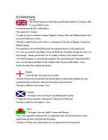
1) General facts The UK: * the United Kingdom of Great Britain and Northern Ireland was formed in 1801 * it covers 243,610 sq km * everybody from the UK is called British * the capital city is London * is made up of four constituent countries: England, Scotland, Wales and Northern Ireland which in turn are divided into counties * the flag is called the Union Jack which is a combination of the flags of England, Scotland and Northern Ireland * the population is about 60,000,000 people, the population density is 242 people/sq km * its coasts are washed by the Atlantic Ocean, the North Sea, the English Channel, the Celtic Sea, Saint George's Channel, and the Irish Sea. It is linked to France by the Channel Tunnel * the United Kingdom is a constitutional monarchy. The current monarch is Queen Elizabeth II, who is also the Queen and Head of State of fifteen other Commonwealth Realms, such as Can...
Outstanding figures in British literature Eva Martina Põder 11.b British literature Refers to all literature produced by British authors from the United Kingdom, which includes England, Scotland, Northern Ireland, Wales, the Channel Islands, and Isle of Man Includes early works written in Gaelic, Welsh, and Latin, works in Old, Middle, and Modern English, each of which represents a different period Full of great works British works in Latin Venerable Bede He lived between 673 and 735 AD The greatest of all the AngloSaxon scholars He's the earliest English historian, whose work has shed light on a period of English history that would have otherwise been unknown ,,The Father of English History" Wrote / translated about 40 books on almost every area of knowledge, i.e. nature, astronomy, and poetry His best known work is "The Ecclesiastical History of the English People" Starting with the Roman invasion in the 5th century, he...
The United Kingdom The United Kingdom consists of England, Scotland, Wales and North Ireland and it is situated in the Atlantic Ocean near the mainland of Europe. The population of the UK is 58.6 million and area is 244,110 sq km. Britain has a temperate humid climate. Its characteristic features are mild winters, warm summer, no temperature extremes, abundant rain all year round and frequent changes of weather. The mild climate is partly due to the warm Gulf Stream and partly to the south westerly winds. Occasional winds from the east in winter may bring cold and dry weather. The distribution of rainfall is influenced by the Atlantic Stream. The mountainous areas of the north and west have more rain than the lowlands of the south and east. Wales is located on a peninsula in central-west Britain. The entire area of Wales is about 20,779 km². Wales borders by England to the e...
Introduction Estonia, officially the Republic of Estonia (Estonian: Eesti or Eesti Vabariik) is a country in the Baltic region of Northern Europe. It is bordered to the north by Finland across the Gulf of Finland, to the west by Sweden across the Baltic Sea, to the south by Latvia (343 km), and to the east by the Russian Federation (338,6 km). The territory of Estonia covers 45,227 km² and is influenced by a temperate seasonal climate. The Estonians are a Finnic people closely related to the Finns, with the Estonian language sharing many similarities to Finnish. The modern name of Estonia is thought to originate from the Roman historian Tacitus, who in his book Germania (ca. AD 98) described a people called the Aestii. Similarly, ancient Scandinavian sagas refer to a land called Eistland, close to the German term Estland for the country. Early Latin and other ancient versions of the name are Estia and Hestia. Until the late 1930s, the ...
Estonia Topic Tallinn 2007 2 List of Contents page Facts and figures 3 Geography 3 Climate 3 Nature 4 History 5 Economy 6 Culture 6 Biggest towns 7 Language 8 3 Facts and figures The Republic of Estonia is a small country. Covering only 45, 228 sq km it is slightly bigger than Denmark, Belgium or Switzerland. Estonia's population is under 1.4 million. The official language is Estonian but since very many Russians live here Russian is also wide spread. The capital of Estonia is Tallinn. The currency used in Estonia is Eesti kroon. The Estonian national flag is blue-black-white. It was originally the flag of the Estonian Students' Society. The flag was first consecrated in Otepää Church in 1884. For a while, during the Soviet occupation, the flag was banned but it was again seen in p...
History exam *Stonehenge - is a monument located in England. It is one of the most famous prehistoric sites in the world and is composed of earthworks surrounding a circular setting of large standing stones. The surrounding circular, earth bank and ditch, have been dated to about 3100 BC. Stonehenge was produced by a culture with no written language. Many aspects of Stonehenge remain subject to debate. There is little or no direct evidence for the construction techniques used by the Stonehenge builders. *The Celts in Britain and their legacy The Cets lived in Britain in The Iron Age. They were warring tribes who were battleful amongst themselves as well as inter-tribal war. They were not centrally governed. The Celts brought iron working, iron ploughs and metal swords, horses, wheels and chariots - all these things gave them an instant superiority over the native tribes. The Celts built a number ...
I. Portugal ABOUT Photo Location of Portugal (dark green) Portugal (Portuguese: Portugal, IPA: [putua]; officially the Portuguese Republic, Portuguese: República Portuguesa) is a country located in Southwestern Europe, on the Iberian Peninsula. It is the westernmost country of mainland Europe, and is bordered by the Atlantic Ocean to the west and south and by Spain to the north and east. The Atlantic archipelagos of the Azores and Madeira are Portuguese territory as well. The country is named after its second largest city, Porto, whose Latin name wa...
Some of the things you will learn in THE CODEBREAKERS • How secret Japanese messages were decoded in Washington hours before Pearl Harbor. • How German codebreakers helped usher in the Russian Revolution. • How John F. Kennedy escaped capture in the Pacific because the Japanese failed to solve a simple cipher. • How codebreaking determined a presidential election, convicted an underworld syndicate head, won the battle of Midway, led to cruel Allied defeats in North Africa, and broke up a vast Nazi spy ring. • How one American became the world's most famous codebreaker, and another became the world's greatest. • How codes and codebreakers operate today within the secret agencies of the U.S. and Russia. • And incredibly much more. "For many evenings of gripping reading, no better choice can be made than this book." —Christian Science Monitor THE ...
UNO SOOMERE ESTONIAN SYMPHONIC MUSIC. THE FIRST CENTURY 1896-1996. AN OVERVIEW With a Historical and Cultural Summary IN MEMORY OF THE GREAT ESTONIAN COMPOSERS CONTENTS ESTONIA AND THE ESTONIANS FOREWORD IN THE FOLD OF TSARIST RUSSIA. EMERGENCE AND FIRST STEPS ON THE CLASSICAL-ROMANTIC PATH. HISTORICAL INTRODUCTION I. MUSICAL LIFE IN TARTU AT THE TURN OF THE CENTURY. TRAILBLAZERS: ALEKSANDER LÄTE, RUDOLF TOBIAS, ARTUR KAPP. II. THE FIRST DECADE OF THE 20TH CENTURY. ARTUR LEMBA: THE BEGINNING OF ESTONIAN SYMPHONY AND OPERA. III. NEW DEVELOPMENTS IN CULTURAL AND MUSICAL LIFE: THE END OF THE TSARIST PERIOD. THE INDEPENDENT REPUBLIC OF ESTONIA: THE INTRODUCTION OF INNOVATIONS FROM WESTERN ART AND THE EVOLUTION OF NATIONALLY ORIENTED MUSICAL TRENDS. IV. THE TWENTIES. ARTUR KAPP: ROMANTICIST AND DRAMATIST. V. THE INFLUENCE OF NEW WESTERN MUSIC...
 annaabi.ee