Leidsid 33 sarnast õppematerjali, mis on seotud failiga ""The Game" - Neil Strauss". Need materjalid aitavad sul teemat sügavamalt mõista.
strauss, women, lesson, method, pick, teach, himself, characters, grow, game, artists, account, know, going, journey, loser, through, finds, there, never, crazy, mystery, ross, nothing, girls, meets, secret, students, teachers, tips, based, therefore, look, attention, phone, numbers, learns, description, growing, took, change, call, editor, asking· Naturalists tried to apply in fiction the processes of natural sciences · Writers task is to record facts, systems of behaviour, living conditions, never revealing any natural unbiased (completely natural) · Point of view: amoral-outside the category of morality, neither good or bad · Naturalist find it absurd to blame the wicked. These criminals are doing what nature, environment, their unconscious tells them to do. Naturalists do not judge their characters, they simply report. Try to describe facts like they are. Naturalists depict the lower, coarser forms of life. · Drab, squallid set of scene. Revolting, disgusting · Characters are people with strong animal desires · Neurotic characters unable to understand the forces that control them · By the end of the 18th century the naturalism depicts in europe, but stars to become the literature method no 1 in america
health. There they meet the Pietist Madame Stahl and the saintly Varenka, her adopted daughter. Influenced by Varenka, Kitty becomes extremely pious, but is disillusioned by her father`s criticism. She then returns to Moscow. Part 3 Levin continues his work on his large country estate, a setting closely tied to his spiritual thoughts and struggles. Levin wrestles with the idea of falseness, wondering how he should go about ridding himself of it, and criticising what he feels is falseness in others. He develops ideas relating to agriculture and the unique relationship between the agricultural labourer and his native land and culture. He believes that the agricultural reforms of Europe will not work in Russia because of the unique culture and personality of the Russian peasant. Stiva stays with Levin on his country estate when he makes a sale of a plot of land, to provide funds for his expensive city lifestyle
the ground-breaking visuals, the classic score by Hans Zimmer, and the confidence of Nolan as a master storyteller make Inception not only the best film of the year so far, but what may be a celebrated film for years and years to come. Hats off to Nolan for daring to dream bigger, and delivering a masterpiece. Punane elavhõbe "Punane Elavhõbe" (red mercury in English) was announced as an Estonian historic crime movie about mafia and underground brutality in the 90's. The main characters were three thugs who weren't special at all, mainly only stealing car stereos etc. They heard that they could get rich when they would buy red mercury in Russia and then sell it with a higher price. So they took their way to Russia and one of them, Korba, would beat kill anyone who had something to do with them like taxi drivers. Estonian police had an eye over them and later they all got caught in Estonia. They also learned that Russians bluffed and red mercury didn't actually exist.
"The Hero's Journey," and step-by-step guidelines to plot and • character development. Based on the work of Joseph Campbell, The Writers Journey is a must for all writers interested in further developing their craft. This updated and revised Third Edition provides new insights and observations from Vogler's ongoing work on mythology's influence on stories, movies, and man himself. In revealing new material, he explores key principles like polarity and catharsis, plus: • A revised chapter which looks back at the Star Wars phenomenon and analyzes the six feature films as an epic on the theme of father-son relationships • New illustrations and diagrams that give additional depth to the mythic principles • A final chapter, "Trust the Path," an inspiring call to adventure for those who
some more, some less. He most likes being alone and either walking in the garden or reading a book in the library. Also, he does not stand one bit his son Freddie staying at the castle and is willing to do much to get rid of him. Throughout the book, he often gets into funny situations (Quotes 1,2). Also, he often drifts away from the topic on hand and starts to speak about what is on his mind at the moment. This often irritates many of the other characters (Quote 3). He is absolutely possessed with his garden and the farm animals and products that might win him prizes. Because of that, he spends much time with them and worries about them. This is probably because he still has the old nobility manners and thus tries to spend his free time this way. Many of his ancestors took part in these contests and many of them won there. So, he does not want to be worse than his ancestors were and uses a lot of time and care on these things
During the period of enlightenment the people of America came to realize that if they work hard enough that what they earn is for them to keep. There are no Kings or Dictators ruling the lower class. There is a huge amount of personal and financial freedom to be gained in American during this time. Crevecoeur states that "each person works for himself". American became a classless society during the Enlightenment period where each individual was allowed as much room to grow as needed. The Age of Romanticism. The early romantic writers. Washington Irving as a transitional figure from the traditions of the Enlightenment to those of Romanticism. Romanticism (or the Romantic era/Period) was an artistic, literary, and intellectual movement that originated in Europe toward the end of the 18th century and in most areas was at its peak in the approximate period from 1800 to 1840. Partly a reaction to the Industrial Revolution, it was also a
He grinned and held out his hand. "Parker Smith." "Eva Tramell." "You have a natural grace, Eva. With a little training you could be a literal knockout. In a city like New York, knowing self-defense is imperative." He gestured over to a corkboard hung on the wall. It was covered in thumbtacked business cards and fliers. Tearing off a flag from the bottom of a fluorescent sheet of paper, he held it out to me. "Ever heard of Krav Maga?" "In a Jennifer Lopez movie." "I teach it, and I'd love to teach you. That's my website and the number to the studio." I admired his approach. It was direct, like his gaze, and his smile was genuine. I'd wondered if he was angling toward a pickup, but he was cool enough about it that I couldn't be sure. Parker crossed his arms, which showed off cut biceps. He wore a black sleeveless shirt and long shorts. His Converse sneakers looked comfortably beat up and tribal tattoos peeked up from his collar
whether the right thing has been done in supposedly-analogous cases. It's simply irrelevant. You should do the right thing no matter what the rest of the world does. 52. The sincerity of a man's remorse is measured by whether he can refrain from taking potshots along with expressing it. 53. To one destined for purgatory, God says, "You try again." To one destined for hell, He says, "I'll try again." 54. Unless he's more intelligent than himself, there's no hope for a man. 55. Wants should subsidize needs. 56. We need to expand our sense of the possible and contract our sense of the probable. 57. What good is it to be able to read someone else's mind if you can't read your own? 58. When a moron meets a lesson, they annihilate one another. 59. While there is only one human race, there are lots of human losers. 60. Willingness to volunteer and suitability for the job to be done are two completely different things. 61
We could no longer recognize the truth, and even didn't speak out. We let power to do everything. Winter in the Desert: the woman, Lee, picked up a stranger, Jed, and saved his life in the desert. But soon she discovered this stranger was a killer, who killed her unfaithful husband. It was relief that you have when you find something precious you thought you'd lost, after a long search, you find cool, sweet water in the desert. The Knowledge: A taxi driver, Ricky, picked up a man called himself "Bruce Lee", and this "Bruce Lee" taught him the true meaning of fighting. He said," Don't think that fighting is about aggression. You don't realize that it's about being strong enough to walk away". After this strange thing, Ricky came home early and found his wife had another man. Ricky was too angry and felt like killing that man, but recalled what Bruce taught him, he calmed down and let his wife went away. He rethought his life and his ambition, he didn't want just be a taxi driver. He
By Taavo Allik March 23, 2009 Book Report on "Ender's Game".................................................................................................. Orson Scott Card....................................................................................................................... The Setting................................................................................................................................ Main Characters........................................................................................................................ Ender..................................................................................................................................... Valentine............................................................................................................................... Peter.......................................................................................
Big city libraries' materials are usually organized into subject areas, such as history, science, sports, fiction etc. There may be specials sections also for children. Almost every library has a special reading room with comfortable furniture for the readers and the students can work on independent study projects. School libraries. School libraries are part of the education system. It supports the curriculum as it helps the teachers and pupils to prepare for the lesson. Pupils can read extra materials there about the subjects they like. Everyone doesn't have a computer neither good encyclopedias at home so they can get the required information needed for their homework from the books or from the Internet. It is needed because it teaches how to find your books on your own from other libraries too because usually the same system is used for the book location. School libraries are
disturb the publisher even more for rejecting him. After initially publishing it as a short story in the 1995 compilation, Pursuit of Happiness, Palahniuk expanded it into a full novel, which --contrary to his expectations--the publisher was willing to publish. Some other well-known novels: Rant, Choke, Diary. Analysis of the book 1. Setting The story takes place in somewhere between 1980s and 1990s in the United States. 2. Characters · Main character/narrator His name is never mentioned in the novel. He works as a product recall specialist for a car manufacturing company, traveling from city to city, assessing the damages of car crashes. He describes his job in such a way that makes it sound complex when it actually is not. "If a new car built by my company leaves Chicago traveling west at 60 miles per hour, and
novelist living in Paris. When he first arrived in Paris, he experienced a cultural shock and got inspired by it. He started to keep a diary of his experiences and decided to publish it as a novel when the Anglo-French relationships were at their worst during the Iraq War spring 2003. Therefore his novels (he has written three in this series) have become enormously popular all around the world, especially because they are partly true. Stephen Clarke himself still lives in Paris with his French girlfriend. This novel is considered to be seriously funny and a comedy with a message. "Merde Actually" has one main character whose name is Paul West, but there are also many other significant characters, that come from the previous book "A Year in the Merde". I can say that it would be better to read the first book of this series first, other wise some jokes and thoughts might stay incomprehensible.
Chekov Lady and the Lapdog Reid about Chekov: The characters in Chekhov's plays are never fully "known" as a writer, he seems to delight in maintaining a sense of indeterminacy, and unknowability, about them. The bare facts are always laughably inadequate to the complexity of "real" people. Anton Pavlovich Chekhov was born on 29 January (New Style), 1860, in Taganrog, a small port on the Sea of Azov, in southern Russia. As the son of a grocer and grandson of a serf, Chekhov was a first-generation intellectual. His
through its change, is the protagonist. The development in the reader or the watcher happens through the transformation of the hero. Usually the main character starts off as an outcast, somebody the society sees as unimportant or too strange. Then something happens that sends the hero on an adventure. The breaking point on his road is meeting a teacher an encounter that gives him the ability to face the adversary of the story. In the end the hero faces his villain, emerges a winner, detaches himself from his outcast status and becomes a significant part of the society. It could be said that the most important part of the hero's progress is this teacher, someone who gives guidance and the knowledge how to defeat the antagonist. Commonly this guide is from a different world and a stranger to the main character. He has alien ways and an exotic nature. This mentor needs to be a stranger because nothing can be learned from something common and known
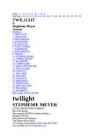
Color-- -1- -2- -3- -4- -5- -6- -7- -8- -9- Text Size-- 10-- 11-- 12-- 13-- 14-- 15-- 16-- 17-- 18-- 19-- 20-- 21-- 22-- 23-- 24 TWILIGHT By Stephenie Meyer Contents PREFACE 1. FIRST SIGHT 2. OPEN BOOK 3. PHENOMENON 4. INVITATIONS 5. BLOOD TYPE 6. SCARY STORIES 7. NIGHTMARE 8. PORT ANGELES 9. THEORY 10. INTERROGATIONS 11. COMPLICATIONS 12. BALANCING 13. CONFESSIONS 14. MIND OVER MATTER 15. THE CULLENS 16. CARLISLE 17. THE GAME 18. THE HUNT 19. GOODBYES 20. IMPATIENCE 21. PHONE CALL 22. HIDE-AND-SEEK 23. THE ANGEL 24. AN IMPASSE EPILOGUE: AN OCCASION twilight STEPHENIE MEYER LITTLE, BROWN AND COMPANY New York Boston Text copyright © 2005 by Stephenie Meyer All rights reserved. Little, Brown and Company Time Warner Book Group 1271 Avenue of the Americas, New York, NY 10020 Visit our Web site at www.lb-teens.com First Edition: September 2005 The characters and events portrayed in this book are fictitious.
novels and short stories, Wodehouse was also a talented playwright and lyricist who was part author and writer of fifteen plays and of 250 lyrics for some thirty musical comedies. Wodehouse took a modest attitude to his own works. In Over Seventy (1957) he wrote: "I go in for what is known in the trade as 'light writing' and those who do that humorists they are sometimes called are looked down upon by the intelligentsia and sneered at." Wodehouse's characters are often eccentric, with peculiar attachments, such as to newts (Gussie Fink-Nottle) or socks (Archibald Mulliner). His "mentally negligible" good-natured characters invariably make their lot worse by their half-witted (if that) schemes to improve a bad situation. Wodehouse's aristocrats, however, embody many of the comic attributes that characterize buffoons created by a genius. In many cases the classic eccentricities of Wodehouse's upperclass give rise to plot complications.
PRAISE FOR The 4-Hour Workweek "This is a whole new ball game. Highly recommended." --Dr. Stewart D. Friedman, adviser to Jack Welch and former director of the Work/Life Integration Program at the Wharton School, University of Pennsylvania "It's about time this book was written. It is a long-overdue manifesto for the mobile lifestyle, and Tim Ferriss is the ideal ambassador. This will be huge." --Jack Can eld, cocreator of Chicken Soup for the Soul®, 100+ million copies sold "Stunning and amazing
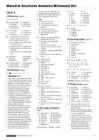
2 I prefer to travel ____ air because it's quicker. A on B to C in D by 3 The train to Victoria leaves from ____ three. A station B platform C stop D coach. 4 She didn't get a ____ ticket because she wasn't coming back. A single B return C double D travel 5 How long does it take you to ____ your suitcase before a trip? A put B press C pack D pick 6 If you don't hurry, we'll ____ the plane. A catch B lose C chase D miss 7 Ask the travel agent to make a ____ for you. A book B reserve C booking D check in 8 It's very windy up on the ____ I'm going to stay in my cabin. A ship B boat C deck D platform 9 We ____ the ship and set off for Italy. A boarded B climbed C got D booked
Cædmon's Hymn is the oldest recorded Old English poem, and also one of the oldest surviving samples of Germanic alliterative verse The Hymn itself was composed between 658 and 680, recorded in the earlier part of the 8th century Middle English Geoffrey Chaucer 13431400 Known as the ,,Father of English literature", the greatest English poet of the Middle Ages An author, philosopher, alchemist and astronomer, diplomat Wrote The Book of the Duchess, the House of Fame, the Legend of Good Women and Troilus and Criseyde Best known today for "The Canterbury Tales" Crucial figure in developing the legitimacy of the vernacular, Middle English, at a time when the dominant literary languages in England were French Modern English William Shakespeare 26 April 1564 23 April 1616 The Elizabethan Era English poet and playwright, widely regarded as the greatest writer in the English language and the world's most important dramatist ,,England's national poet"
Critics often analyze art and literature in Freudian terms. 2. Literary Modernism and its sub-movements. The influence of Structuralism and psychoanalysis. Main characteristic features of Modernism. Denial of conventions, traditional structure, plot and presentation of character. The stream of consciousness. Allusiveness. Virginia Woolf's Modern Fiction as a theoretical platform for Modernism. Criticism of Realist literary method. Literary modernism: end of the 19th century-1920 (reached its height) and ended 1940s. A self- conscious break with traditional aesthetic forms. Rejecting the sentiment and discursiveness typical of Romanticism and Victorian literature for poetry that instead favored precision (täppis) of imagery and clear, sharp language. Modernist writers embraced the unconscious fears of a darker humanity. Sub movements: surrealism, formalism, avant-garde, symbolism, imagism
My languages I love different languages. I mean, I really, really love different languages. I also believe and have been told that I pick them up rather easily. That might be true, although I did not pick any Greek up in Greece but that might have been because they spoke so damn fast that I could not tell if it was a word or an entire sentence. The first foreign language I learned was Russian. Considering I was ten when Estonia became a Republic, it makes sense. We began studying Russian in first grade, though it was simplified – "koška" instead of "kot", "medvešonok" instead of "medved", "saichik" etc. Did not make much sense and we mostly played some games in Russian (Tare-tareke etc)
worldwide. The success of The Catcher in the Rye led to public attention: Salinger became reclusive, publishing new work less frequently. Analysis of the book 1. Setting The story starts in the year 1950 when the novel's protagonist and narrator Holden starts telling a story from a hospital about the events of last year's winter. Most of the story takes place in winter of 1949 just over a couple of days in Pennsylvania and New York. 2. Characters · Holden Caulfield The main character of the book. He has been expelled from many schools due to his failure in fixing his grades and is expelled from his current school, Pencey Prep, right in the beginning of the story. Although he is intelligent, he fails almost every class, all except for English. He feels alone and sad, trying to find his place in the world, only finding support from his little sister
As much as six men could; we must give up The choicest tidbits to him; if he belches, ('tis a servant speaking) [2] Master exclaims: "God bless you!"--Oh, he dotes Upon him! he's his universe, his hero; He's lost in constant admiration, quotes him On all occasions, takes his trifling acts For wonders, and his words for oracles. The fellow knows his dupe, and makes the most on't, He fools him with a hundred masks of virtue, Gets money from him all the time by canting, And takes upon himself to carp at us. Even his silly coxcomb of a lackey Makes it his business to instruct us too; He comes with rolling eyes to preach at us, And throws away our ribbons, rouge, and patches. The wretch, the other day, tore up a kerchief That he had found, pressed in the /Golden Legend/, Calling it a horrid crime for us to mingle The devil's finery with holy things. [Footnote 1: Referring to the rebellion called La Fronde, during the minority of Louis XIV.]
· About the author .................................................................................................................... 3 · Plot ................................................................................................................................... ........ 4 · Characters ......................................................................................................................... ...... 5 · Theme/setting.................................................................................................................... ...... 6 · Language and style................................................................
3 1 I sometimes do my homework 1 1 dismal the shepherd noticing him. So that in front of the TV, as does my 2 vicious evening, just as the sun had been brother. 3 wailed / was wailing was setting, he went out in his new 2 She talks about soap opera 4 scrambled disguise. He was strolling strolled characters like they are real 5 ungracious confidently into a field where some people. 6 smudged sheep grazed were grazing. He 3 Her father works as a TV 7 twitch had spotted a juicy-looking lamb producer. 8 mimicking and was just going to pounce on it,
Namely, she believed that Sam is killing her older sister. They found them in the garden of Big House, where the witch suppose to live. When Tracey tries to attack Sam to defend Anita, the boy throws the girl into the pound. She would have been nearly drowned, if she hadn't been saved by a mysterious man. It turns out that the man is from India and also the owner of land, where the closed mine is. Meena's family decide to move out of Tollington. Characterize and analyze the main characters (what motivates them, are they round or flat characters, do they develop, if so, in what way) Meena Kumar is 9 years old and lives in the village of Tollington `the jewel of the Black Country', the daughter of Indian parents who have come to England to give her a better life. Meena is, much to her parents' chagrin, no angel: She lies, commits minor thefts, and has the bad habit of making vulgar remarks when her prim and proper aunties are around
He ranned into his friend in front of the exhibition hall. 8 have your a look take and time around Take your time and have a look around. --- 6 5. Complete the exercise with the adjectives. annoyed delighted easy free important lucky puzzled wise 1 I was lucky to meet Ben's friend, Nina, who had helped him so much at the party. 2 If you need somewhere to stay overnight, surf the Internet. Cheap hostels are easy to find. 3 After the last lesson we were ... to go, but we all stayed to discuss the trip. 4 The children looked annoyed so the teacher repeated the question. 5 If you don't need the gloves immediately, it's ... to wait until the sales start. 6 It's wise to remember the birthdays of your family and friends. 7 Gina's mum was puzzled to hear about the broken window. 8 I was ... to have a matchbox on me, so we could light a candle. 6. Translate. 1 Ma asun teele. Kohtumiseni homme! I'm off, see you at home!
The girls grieved over such a number of ladies, but were comforted the day before the ball by hearing, that instead of twelve he brought only six with him from London--his five sisters and a cousin. And when the party entered the assembly room it consisted of only five altogether--Mr. Bingley, his two sisters, the husband of the eldest, and another young man. Mr. Bingley was good-looking and gentlemanlike; he had a pleasant countenance, and easy, unaffected manners. His sisters were fine women, with an air of decided fashion. His brother-in-law, Mr. Hurst, merely looked the gentleman; but his friend Mr. Darcy soon drew the attention of the room by his fine, tall person, handsome features, noble mien, and the report which was in general circulation within five minutes after his entrance, of his having ten thousand a year. The gentlemen pronounced him to be a fine figure of a man, the ladies declared he was much handsomer than Mr. Bingley, and he was looked at with great
Partici- pant observation is a research approach in which the researcher becomes a spy of sorts. With disguised identity and intent, the investigator infiltrates the setting of interest and becomes a full-fledged participant in the group to be studied. So when I wanted to learn about the compliance tactics of encyclopedia (or vacuum cleaner, or portrait photography, or dance lesson) sales organizations, I would answer a newspaper ad for sales trainees and have them teach me their methods. Using sim- ilar but not identical approaches, I was able to penetrate advertising, public rela- tions, and fund-raising agencies to examine their techniques. Much of the evidence presented in this book, then, comes from my experience posing as a compliance professional, or aspiring professional, in a large variety of organizations dedicated to getting us to say yes. One aspect of what I learned in this three-year period of participant observa-
sonal performance. As long as you are going to think anyway, why not think great thoughts and get great results? Brian is a shining light in the speaking and writing world. He has done incredible thinking and achieved amazing results, for vii ccc_tracy_fm_i-xviii.qxd 7/7/03 3:22 PM Page viii viii ➤ FOREWORD himself and many hundreds of thousands of other people. Brian’s thinking in this book will inspire you to do the same or more. Get ready for one of the great adventures and explorations into the last great frontier, and the first—your mind! You are about to have a wonderful experience. MARK VICTOR HANSEN Author, Chicken Soup for the Soul ccc_tracy_fm_i-xviii
Analysis of Major Characters Frederic Henry - In the sections of the novel in which he describes his experience in the war, Henry portrays himself as a man of duty. He attaches to this understanding of himself no sense of honor, nor does he expect any praise for his service. Even after he has been severely wounded, he discourages Rinaldi from pursuing medals of distinction for him. Time and again, through conversations with men like the priest, Ettore Moretti, and Gino, Henry distances himself from such abstract notions as faith, honor, and patriotism. Concepts such as these mean nothing to him beside such concrete facts of war as the names of the cities in which he has fought and the numbers of decimated streets. Against this bleak backdrop, Henry's reaction to Catherine Barkley is rather astonishing. The reader understands why Henry responds to the game that Catherine proposes--why he pledges his love to a woman he barely knows: like Rinaldi, he hopes
Dracula Bram Stoker An Irish novellist Bram Stoker’s Gothic horror novel ‘’Dracula’’ was first published in 1897. The story is about vampire that tries to find new blood for himself and the hunt for him. Also you can find a little romance in the book. It takes place in Transylvania, Romania and in England. The novel is written in diary-form and several characters are telling their story by keeping a journal. Entries are written in six months by four persons. In the novel there are nine main characters: Jonathan Harker, whose writings are seen first; Count Dracula, of whom all the story is about, but he does not keep a diary; Wilhelmina ‘’Mina’’ Harker, early Murray, wife of Jonathan Harker; Lucy Westerna, a friend of Wilhelmina; Arthur Holmwood, Lucy’s fiancee, who also doesn’t write; John Seward, a
 annaabi.ee